
Samsung Galaxy Z Flip8 Review – When the Hinge Becomes More Than Just a Fold
- A smartphone with two physical states
- 180 grams and 6.1 millimetres – the design starts with a space problem
- The hinge – a component that should become boring as quickly as possible
- The flexible display and the crease – physics has been improved, not abolished
- IP48 and the problem with dust
- 21:9 across 6.9 inches – unusually tall, surprisingly narrow
- The FlexWindow – 4.1 inches that change the character of the Flip8
- The cover display is not miniature Android – and should not try to be
- Flex Mode – when a hinge suddenly becomes a camera accessory
- The cameras – two lenses and a deliberate limit
- The rear cameras are actually the more interesting selfie cameras
- Exynos 2600 – efficiency matters at least as much as peak performance in a foldable
- 12 GB of RAM – enough headroom without playing the numbers game
- Gaming and sustained load – a sports-car engine in a very small machine room
- 4,300 mAh – the packaging is almost more interesting than the capacity
- 25-watt charging – technically conservative and no longer especially exciting in 2026
- Energy efficiency class A and 1,200 charging cycles – ageing becomes measurable
- Seven operating-system upgrades – the software is allowed to age without becoming obsolete
- One UI 9 – the real translator between two halves of a chassis
- Galaxy AI, Now Brief and Gemini – useful where 4.1 inches are genuinely enough
- The real everyday test begins when the phone is closed
- Closing the phone after a call – mechanical feedback instead of a red icon
- Against the Galaxy S26 Ultra – two designs with completely different priorities
- €1,299 – the form factor has to do more than impress
- Eight generations later – when the foldable stops constantly trying to be a foldable
- Conclusion – the technical strength lies not in the hinge, but in the system built around it
- Transparency notice in accordance with EU requirements:
A smartphone with two physical states
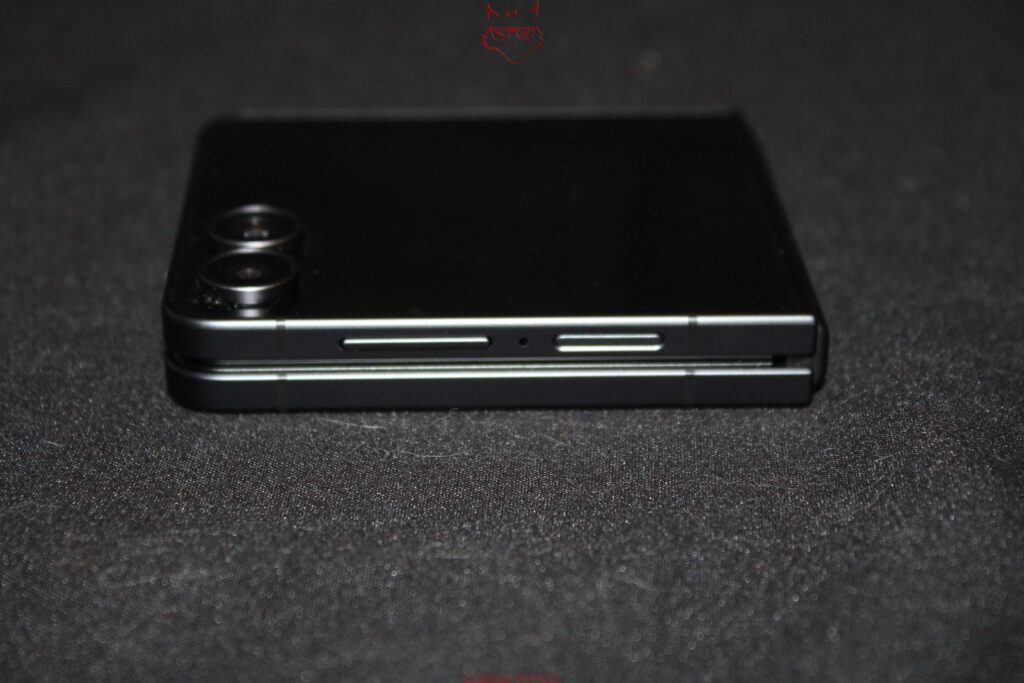
The Galaxy Z Flip8 is one of those smartphones where the specifications tell only part of the story. A 6.9-inch AMOLED display, 120 Hz, 12 GB of RAM, an Exynos 2600, a 4,300 mAh battery and a 50-megapixel main camera initially add up to a fairly conventional upper-tier smartphone specification sheet. The decisive difference sits between those components: Samsung builds the entire device around a hinge, dividing not only the chassis but also the way the phone is used into two fundamentally different states. Opened, the Flip8 measures 166.9 x 75.4 x 6.1 millimetres and behaves much like a conventional large smartphone. Folded, its height drops to 85.7 millimetres while thickness increases to 13.1 millimetres. Weight remains remarkably low at 180 grams for a device of this size. The result is not a small smartphone in the traditional sense. Samsung simply folds away the part that is not currently needed.
That distinction sounds almost trivial on paper, yet it matters surprisingly much in everyday use. Large displays are useful while they are being used. Inside a trouser or jacket pocket, however, screen diagonal is completely irrelevant. What matters there is only the body surrounding that display. A conventional smartphone therefore carries its full length around even when the screen is off. The Flip8 cuts that length roughly in half. The added thickness of 13.1 millimetres is noticeable, of course, but it is spread across a much smaller footprint. The result is a compact block that carries very differently from a smartphone measuring more than 16 centimetres in height.
Samsung has now been pursuing this principle for eight generations. The progress is less obvious in one spectacular headline feature than in how routine the construction has become. The hinge is no longer the star of some technical circus act. It is simply a component that has to create space, guide the flexible display and hold different opening angles securely. The outer display is no longer just a large clock with notifications. It now takes over part of everyday interaction. Even the camera benefits from the fact that the phone effectively brings its own stand with it.
The more interesting question is therefore no longer whether a smartphone can be folded in a useful way. Samsung has been answering that for years. The more relevant issue is which functions only become possible because of this construction, and which compromises still have to be accepted in return. That is where the Flip8 separates technical fascination from practical value.
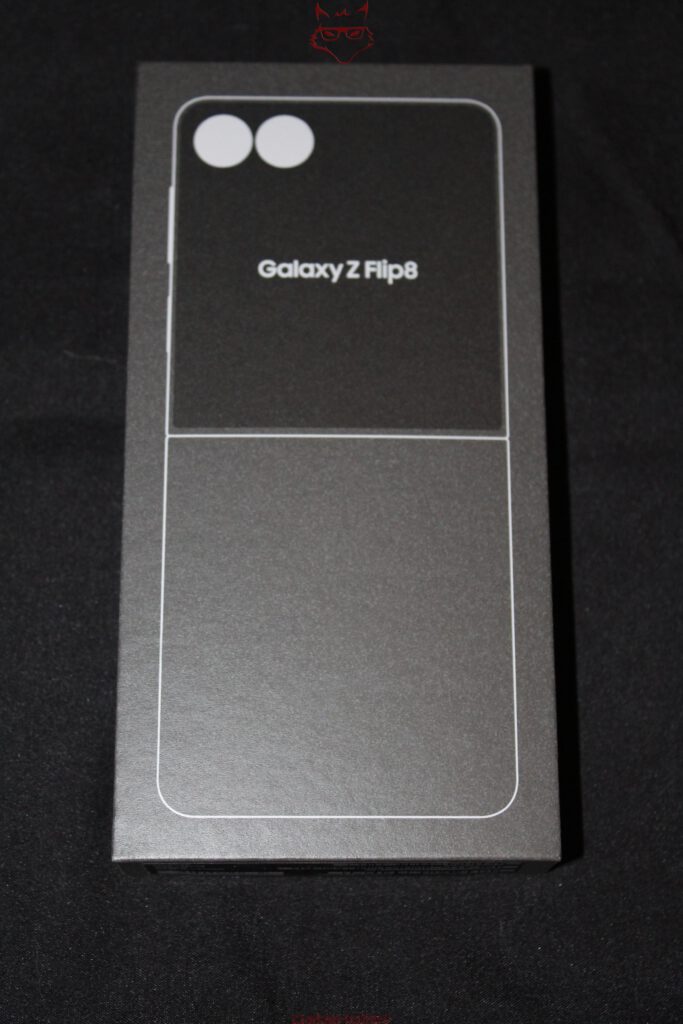
180 grams and 6.1 millimetres – the design starts with a space problem
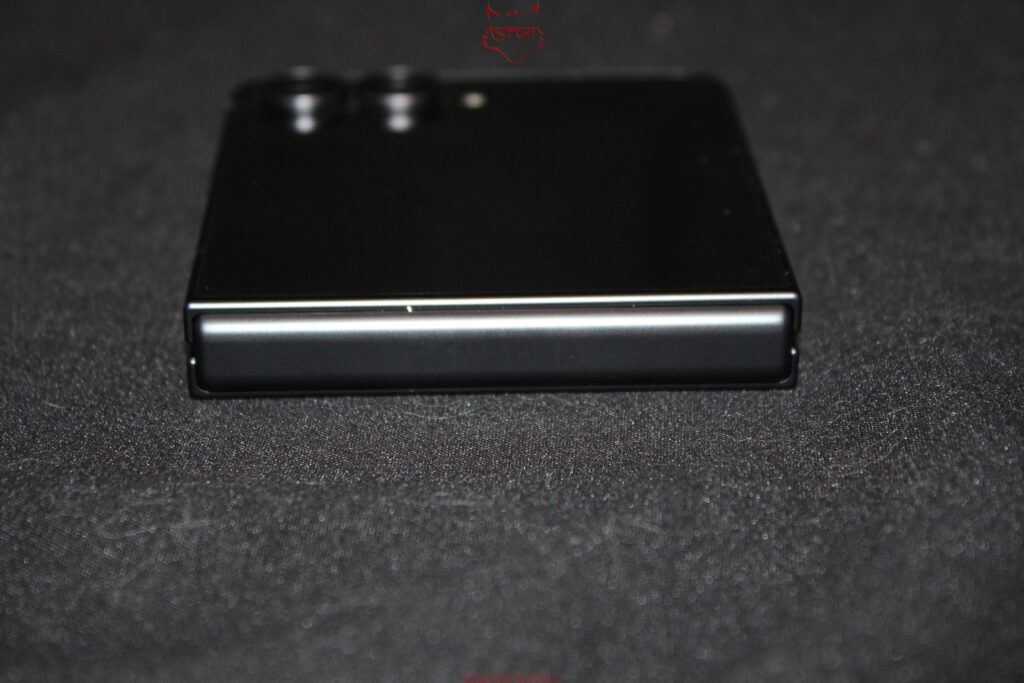
A foldable cannot be engineered internally like a conventional smartphone. In a rigid device, almost the entire area behind the display is available for the battery, mainboard, cameras, antennas, speakers, vibration motor and cooling system. On the Flip8, this space is divided into two extremely thin sections with a mechanical hinge sitting between them. Flexible interconnects have to carry electrical signals and power across this dividing point while the entire construction is expected to survive thousands upon thousands of opening and closing cycles. At the same time, the folded device must not turn into a small brick.
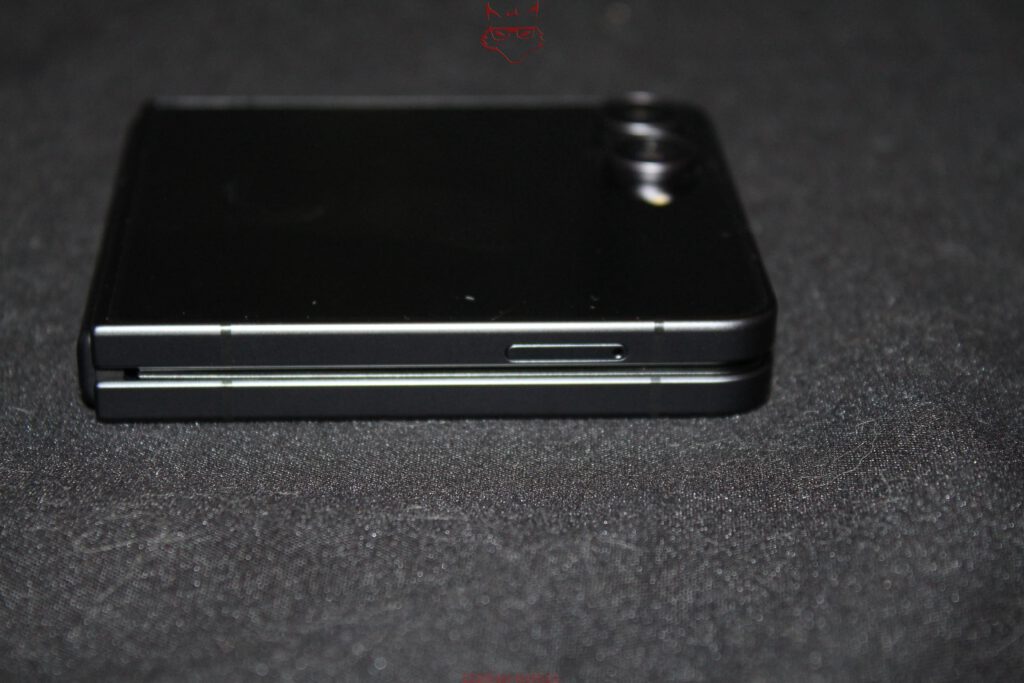
That makes the 6.1-millimetre thickness in the open position technically more interesting than the number initially suggests. The components inside each half have to fit within that depth without larger camera modules, cooling structures or battery cells simply growing further into the chassis. This explains some of the decisions that reappear later in the camera system, battery capacity and thermal behaviour. Foldables are essentially three-dimensional puzzles in which no component can simply claim a few extra millimetres for itself.
Samsung has also reduced the Flip8 to 180 grams. Within the same product family, the Flip7 weighed 188 grams and measured 6.5 millimetres when open. Eight grams and four tenths of a millimetre sound like typical specification-sheet cosmetics until both devices spend longer periods in a pocket. Every saved millimetre counts twice on a foldable because the folded thickness is made up of two body halves. The fact that Samsung still manages to fit a 4,300 mAh battery into the slimmer construction is therefore at least as interesting as any percentage gain in processor performance.
The lower mass also changes how the device behaves while opening. A heavier upper half would place more load on the hinge and make partially open positions less stable. On the Flip8, the relationship between both halves feels better controlled. The hinge provides enough resistance to hold intermediate angles without requiring excessive force every time the device is opened completely.
A basic principle of the entire product becomes clear here: the hinge cannot be evaluated in isolation. Weight, frame rigidity, display construction, body thickness and Flex Mode are mechanically linked. Change one of those variables and the others have to follow.
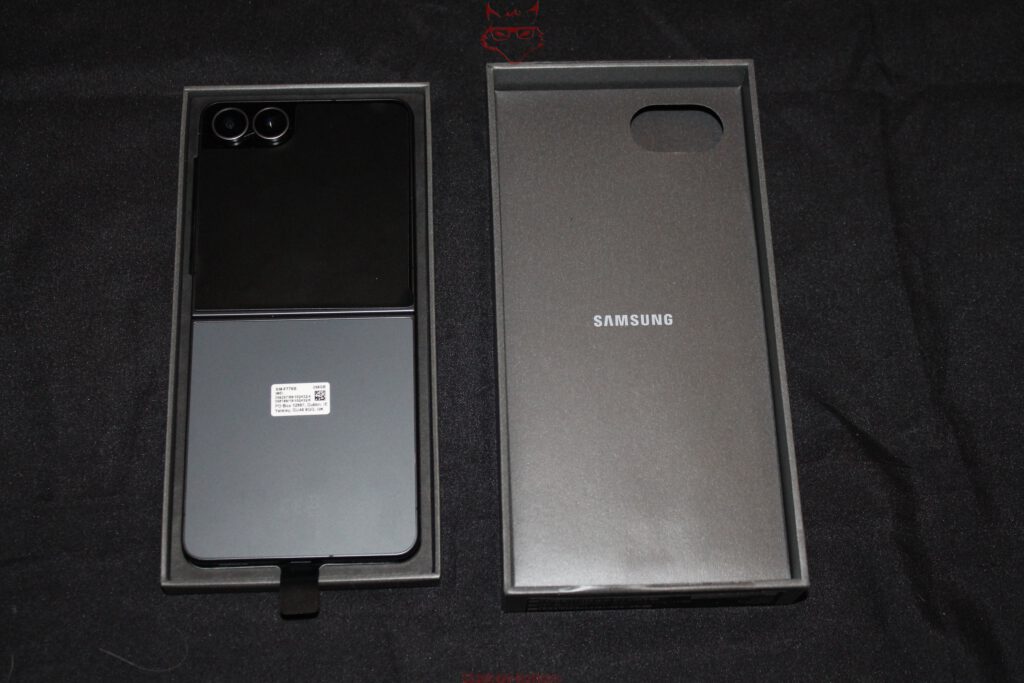
The hinge – a component that should become boring as quickly as possible
On early foldables, the hinge was almost an entertainment feature in its own right. Gap size, resistance, noises, folding angles and long-term durability were endlessly discussed because the entire product category depended on whether this mechanical joint could operate reliably. On the Flip8, the mechanism fades much further into the background. That is a sign of technical maturity.
The hinge on the review sample moves through its range with consistent resistance. Neither half shows any conspicuous lateral play, intermediate angles remain stable and the fully open position reaches a clearly defined endpoint. None of that sounds particularly exciting. For a foldable, however, precisely that lack of drama is a quality feature. A car door is not praised because its hinge demands attention every time it is opened.
The loads involved remain substantial. When the phone closes, the flexible OLED cannot simply be bent into a sharp crease. Its bending radius has to remain controlled while the display structure is allowed to move within the hinge area. At the same time, both chassis halves need to sit as closely together as possible when folded. The hinge therefore does more than perform the conventional task of a joint. It also forms part of the display-management system.
Flex Mode adds another layer. A conventional hinge only has to connect two end positions reliably. On the Flip8, the intermediate positions are functionally important. An angle around 90 degrees turns the lower body half into a base while the upper half carries the camera and display. Friction inside the joint therefore becomes part of the smartphone’s functionality.
One small detail describes the progress especially well: after the first few hours, thoughts about the hinge largely disappear. The device is opened, closed or positioned halfway without the mechanism being consciously checked every time. After eight generations, that is exactly where a foldable should have arrived.
The flexible display and the crease – physics has been improved, not abolished
The 6.9-inch main display operates at 2,520 x 1,080 pixels in a 21:9 aspect ratio. Samsung uses Dynamic AMOLED 2X with an adaptive refresh rate between 1 and 120 Hz. Point peak brightness reaches up to 2,600 nits. Technically, this places the panel firmly in modern premium territory, with one unusual detail: it is repeatedly bent through the middle.
That is the fundamental difference compared with a conventional smartphone. A rigid OLED can sit beneath relatively thick, solid cover glass. On the Flip8, the relevant display stack has to remain flexible. The OLED itself, its supporting structure, the ultra-thin glass and the protective layers above it all need to accommodate movement within the fold area. A material system that can bend thousands of times simply cannot have the same mechanical properties as a rigid sheet of glass.
The crease therefore remains visible and tactile. It becomes especially obvious with the screen switched off or under angled lighting. During vertical scrolling, a fingertip passes over a shallow depression. That is not an optical illusion and should not be written out of existence in a technical review.
What matters more is how little it interferes with actual use. Once content is displayed and the panel is viewed reasonably straight on, the crease quickly loses relevance. The eye focuses on text, images and movement rather than on the slight geometric change in the surface. Glasses work in a similar way: the frame remains permanently within the field of view but is soon filtered out by perception. The Flip8 produces a comparable effect. The crease does not disappear. The brain simply stops treating it as interesting.
It remains more noticeable to the touch. Scrolling through websites or social feeds repeatedly moves the finger across it, yet the hand adapts quickly as well. After a few days, the depression feels less like a defect and more like a structural characteristic.
The surface is still more sensitive to concentrated pressure than conventional smartphone glass. The factory-applied protective layer is part of the display assembly and should not be confused with an ordinary removable shipping film. Fingernails, hard objects and especially small abrasive particles deserve more caution. The Flip8 does not need to be handled with gloves, but keys, sand and a flexible OLED are not going to become ideal flatmates in the eighth generation either.
IP48 and the problem with dust
The IP48 rating is more interesting on a foldable than on a conventional smartphone. The second digit describes water protection, while the first refers to protection against solid foreign objects. That is where the limitations of the construction become visible. IP48 does not provide the same level of fine-dust protection associated with many conventional premium smartphones carrying an IP68 rating.
The reason once again lies in the hinge. Moving parts require defined gaps and mechanical tolerances. At the same time, the flexible display has to be guided in a controlled way during opening and closing. A fully rigid, sealed enclosure is significantly easier to protect against the smallest particles.
In everyday use, this does not translate into permanent anxiety. Rain, a spilled drink or general moisture are no longer the same threats they once were on early foldables. Very fine dust and sand remain a different matter. Sand grains are small, hard and abrasive. If they reach the wrong place, they introduce exactly the kind of material a moving foldable mechanism least wants to encounter.
A trip to the beach does not automatically turn the Flip8 into an insurance claim. A little more care than with a fully dust-sealed conventional smartphone is still sensible. Technical progress can solve a great deal. Silicon dioxide remains relatively unimpressed.
21:9 across 6.9 inches – unusually tall, surprisingly narrow
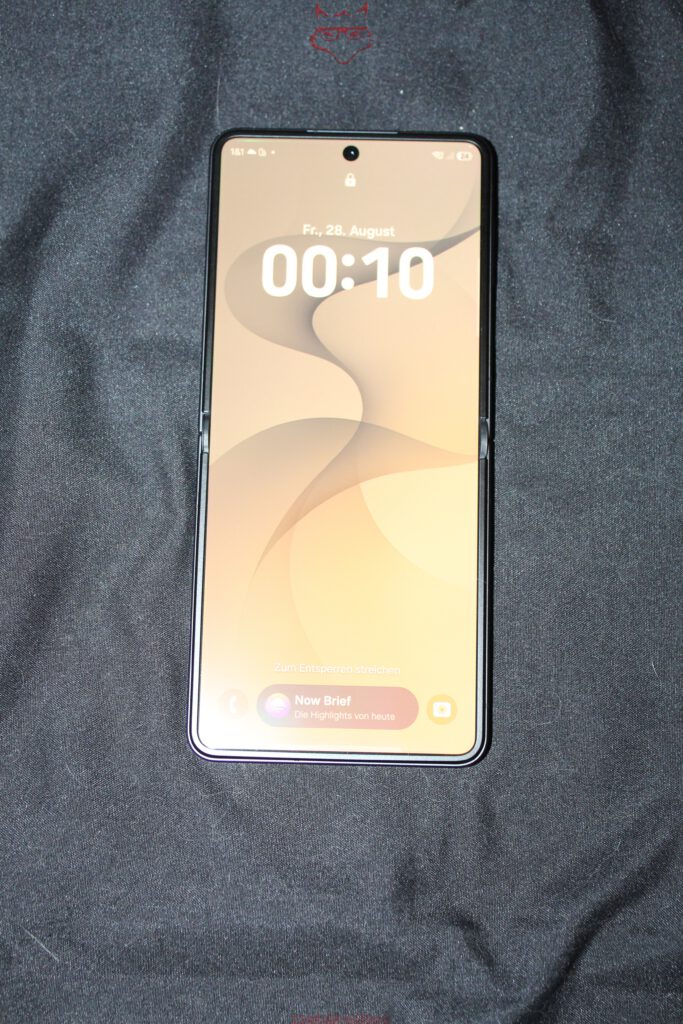
Opened, the Flip8 initially feels remarkably normal. The 6.9-inch panel provides generous space without making the body especially wide. That is a direct consequence of the 21:9 aspect ratio. Websites, messaging apps, emails and long lists benefit from the vertical space, while the controlled width keeps the device comfortable to hold despite its large diagonal.
The adaptive refresh rate is more than a specification-sheet number. With static content, the panel can reduce its refresh frequency and save energy. During fast movement, it rises to as much as 120 Hz. Scrolling, system animations and supported games therefore feel significantly smoother. The transition happens automatically, avoiding the need to constantly choose between battery life and a high refresh rate.
As expected from AMOLED technology, black levels are effectively absolute because black pixels can be switched off entirely. High-contrast interfaces benefit just as much as photos and video. The high peak brightness also helps outdoors, although the quoted 2,600 nits should not be interpreted as a sustained full-screen figure. Such peak values apply under specific conditions and usually to limited areas of the panel. In practice, the more important question is whether content remains clearly visible under bright ambient light. The Flip8 performs convincingly here.
The elongated format also has limits. Standard 16:9 video cannot make use of the entire panel without being cropped or distorted. Black areas are simply a consequence of geometry, not a display fault. With suitably wide cinematic material, however, the format works extremely well.
The FlexWindow – 4.1 inches that change the character of the Flip8
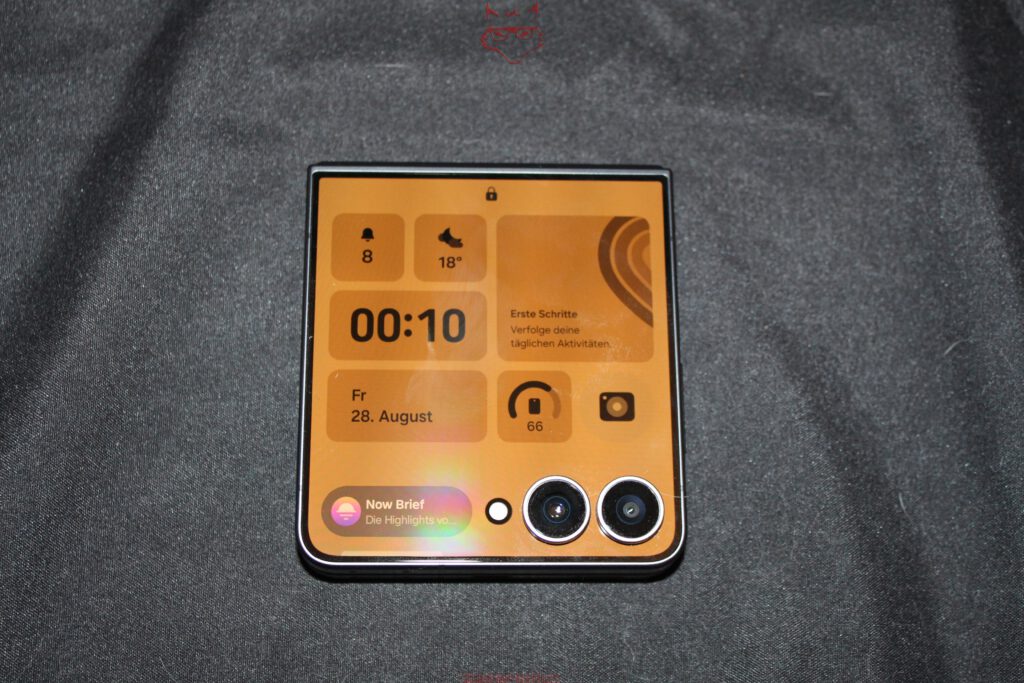
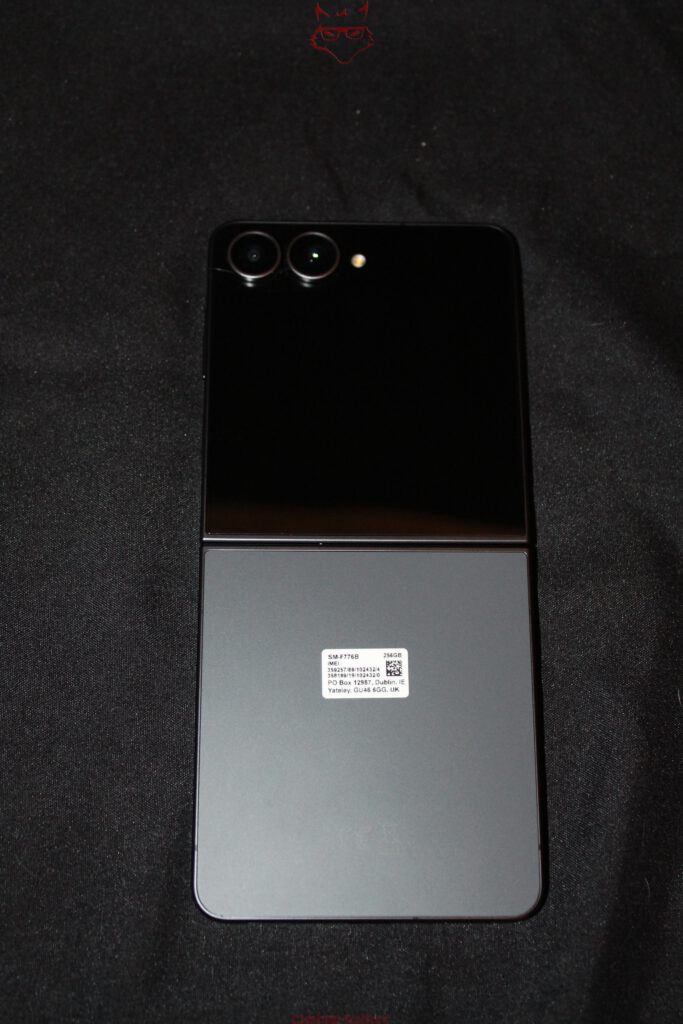
The more important screen may actually be the one on the outside. The 4.1-inch Super AMOLED cover display resolves at 1,048 x 948 pixels and runs at up to 120 Hz. Its unusual shape occupies almost the entire upper half of the chassis and wraps around the two rear cameras.
The hardware specifications alone do not explain why this display matters so much. Its significance comes from turning the folded state from a mere transport mode into a usable operating state of its own.
Early flip-style smartphones had to be opened for almost every task. A small cover display could show the time and a few notifications, but most interactions still ended with a hand reaching for the hinge. On the Flip8, far more can be handled directly from the outside. Media controls, weather, calendar, notifications, short replies, Samsung Health, Now Brief and additional widgets no longer require the main display.
That changes the logic of the device. The FlexWindow is not a smaller copy of the internal screen. It is a surface for short interactions, and that limitation frequently becomes an advantage.
Checking a message takes seconds. A music track is changed. The next appointment is visible directly on the outer display. Weather information does not need 6.9 inches either. For tasks like these, the phone remains closed.
This reduces more than the number of hinge movements. It also interrupts the familiar smartphone chain reaction in which checking the time somehow turns into five minutes inside an unrelated app. The smaller display provides enough space for the intended information but less room for digital detours.
The irony that a smartphone with two displays can occasionally lead to less screen use is one of the more elegant aspects of the design.
The cover display is not miniature Android – and should not try to be
Not every application benefits from the FlexWindow. An interface designed for six or seven inches does not become useful simply because it has been scaled down. Messaging, media controls, navigation, calendars and other clearly structured applications work well on the smaller surface. Complex apps with dense menus and controls can quickly look as though a desktop interface has been pushed through a letterbox.
That is less a limitation of the panel itself than one of software ergonomics. A 4.1-inch screen has different requirements. Large touch targets, shallow information structures and short interactions work extremely well. Long texts, extensive settings menus and complex editing interfaces still belong on the main display.
Samsung handles this sensibly by not trying to make the FlexWindow replace the internal screen completely. The two panels complement each other. Information and quick actions live outside, while full smartphone operation begins inside.
That also gives the act of unfolding a meaning that rigid smartphones do not have. It becomes a small mechanical decision between “quick glance” and “full interaction”. The extra movement can occasionally become annoying during very frequent transitions. At the same time, this distinction is exactly what makes the Flip8 feel different in daily use from a conventional device.
Flex Mode – when a hinge suddenly becomes a camera accessory
Some of the Flip8’s most interesting functions appear where Samsung stops treating it as a normal smartphone that merely happens to fold and begins exploiting the mechanism directly. Flex Mode is the clearest example.
The hinge can hold the device at a range of angles. When the Flip8 is opened to roughly 90 degrees and placed on a flat surface, the lower half acts as a base while the upper half carries the camera and display. The phone effectively becomes its own compact tripod without any additional component needing to be mounted or unfolded.
For video calls, that is immediately useful. The phone stands on a table, the camera sits at a practical angle and both hands remain free. The same principle works for group photos. The Flip8 is positioned, the framing checked and the shot taken.
It becomes even more useful with recordings that would normally require a stand. The device can be placed on a wall, table or another flat surface and angled appropriately. Time-lapse and hyperlapse recording benefit in particular because a stable camera position over a longer period matters more than a single quick shot.
This is where the difference between a technical gimmick and a structural feature becomes clear. The hinge was not designed as a camera tripod, yet its mechanical properties make the function possible. A necessary component gains additional practical value.
A conventional smartphone often ends up propped against a mug, book or any nearby object that happens not to move. That works too. Elegance is another matter.
The cameras – two lenses and a deliberate limit
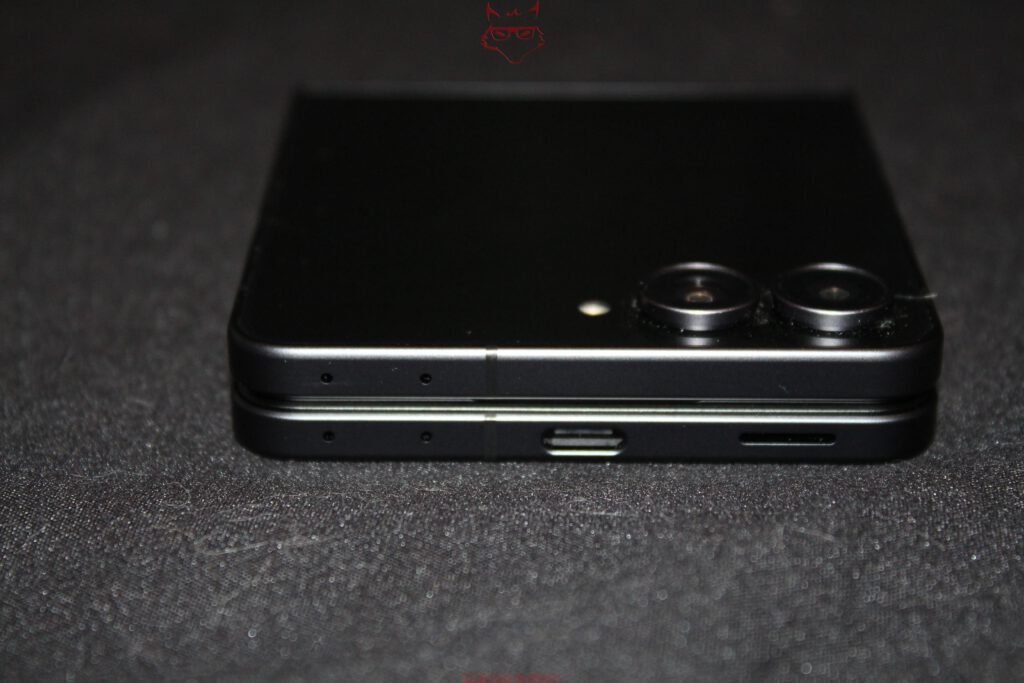
The Galaxy Z Flip8 uses a 50-megapixel wide-angle camera with an f/1.8 aperture, Dual Pixel autofocus and optical image stabilisation, joined by a 12-megapixel ultra-wide camera with an f/2.2 aperture and a 123-degree field of view. A 10-megapixel f/2.2 front camera sits within the main display.
The technical focus clearly lies on the 50-megapixel main sensor. Its high resolution is not used purely to store images with as many pixels as possible. Samsung also uses the additional sensor information for a 2x zoom in optical quality. Instead of simply enlarging the finished image digitally, a smaller area of the sensor is read out directly. Digital zoom extends up to 10x, although the amount of genuine detail naturally falls as magnification increases.
Optical image stabilisation compensates for small movements of the phone by shifting components within the camera system. At longer exposure times, this allows more light to be collected before hand movement turns directly into blur. OIS also reduces part of the unwanted movement during video recording.
The 12-megapixel ultra-wide camera serves a different purpose. Its 123-degree field of view captures substantially more of the surroundings and is therefore useful for architecture, landscapes, confined interiors or larger groups. Its smaller aperture and different optical construction do, however, leave it with less headroom in low light than the main camera.
The result is a capable but deliberately restrained camera system. What is missing is a telephoto lens.
That matters on a smartphone at this price. A genuine telephoto camera does more than simply increase the number next to a zoom icon. A longer focal length changes perspective and image compression. Portraits can look more natural, distant subjects can be captured without aggressive digital cropping and details on buildings or at events can be isolated far more effectively.
The 2x sensor crop from the main camera is a useful substitute at moderate magnification. It does not replace a true 3x optical zoom.
The reason for this omission is likely at least partly structural. Camera modules need not only surface area but depth. An additional telephoto assembly would have to fit somewhere inside a body half measuring only 6.1 millimetres thick, where the main camera, ultra-wide, FlexWindow, electronics and other components are already competing for space. That explains the compromise. It does not erase it.
The rear cameras are actually the more interesting selfie cameras
The FlexWindow solves a long-standing smartphone problem in a particularly elegant way. The technically best camera usually sits on the rear, while selfies are taken with a smaller front-facing unit. The reason is simple: without a display on the back, framing a shot with the main camera is awkward.
On the Flip8, a 4.1-inch display sits directly beside that main camera.
That changes the equation.
The folded phone can use its 50-megapixel main camera for self-portraits while the FlexWindow acts as a viewfinder. The better optics, larger main sensor and optical stabilisation are therefore available for selfies as well. For group shots, the ultra-wide camera can also be used.
That is technically more interesting than simply increasing the resolution of the front camera. Samsung solves the problem not by adding a better third camera, but by using existing hardware more intelligently.
The effect is immediately obvious in daily use. The subject can see the framing, the person taking the shot can as well, and the technically superior main camera performs the actual capture. In group photos, this reduces the familiar combination of overstretched arms, cropped heads and perspectives that look suspiciously like supermarket surveillance footage.
Exynos 2600 – efficiency matters at least as much as peak performance in a foldable
Samsung’s Exynos 2600 powers the Galaxy Z Flip8. The deca-core processor reaches clock speeds of up to 3.8 GHz and is paired with 12 GB of RAM. Internal storage comes in either 256 or 512 GB configurations.
The processor is particularly interesting in this device because a foldable creates far more demanding thermal conditions than a conventional large smartphone. Processor performance is never free. As CPU, GPU and NPU load increase, electrical power consumption rises and part of that energy ultimately becomes heat. That heat then has to escape from a chassis whose two halves are just 6.1 millimetres thick when open.
A conventional smartphone cooling system can use much of a continuous chassis area. Vapor chambers, graphite layers and metal frames distribute energy across as much surface as possible. The Flip8 instead has a mechanical split down the middle. A hinge is not a particularly effective substitute for one large uninterrupted cooling surface.
Samsung therefore needs more than a fast processor. It needs a chip that delivers performance efficiently. The Exynos 2600 handles that task convincingly in normal use. One UI responds immediately, apps launch quickly and even heavier multitasking does not trouble the 12 GB of RAM. Under ordinary workloads, there is no sense that the unusual form factor has been paid for with a noticeably lower performance class.
Samsung quotes gains over the Flip7 of 30 percent for CPU performance, 25 percent for GPU and 41 percent for the NPU. Those figures come from manufacturer comparisons and should not be interpreted as universal improvements in every workload. They do, however, indicate where development effort has been focused. The NPU is increasingly important for local AI processing, while the GPU handles modern Vulkan workloads and ray tracing alongside conventional 3D graphics.
Under sustained heavy load, the chassis becomes noticeably warm. Anything else would be physically surprising in a design like this. The important point is that thermal constraints remain largely invisible during normal smartphone use. The Flip8 therefore feels less like a compact compromise and more like a fast premium device that happens to fold through the middle.
12 GB of RAM – enough headroom without playing the numbers game
The 12 GB of RAM is sensibly matched to Android 17 and One UI 9. Memory is not there merely to make a single application run faster. The operating system uses it to keep active and recently used processes, image data, parts of the interface and background services immediately available. The more applications that can remain resident without being reloaded, the more immediate switching between them feels.
At the same time, adding more RAM beyond a certain point brings little practical benefit if normal workloads never use it. Twelve gigabytes therefore strike a sensible balance between reserve capacity and realistic use.
AI features also benefit from available memory because models and temporary working data can be kept there. On a platform where part of the processing is performed locally, sufficient RAM is more useful than simply chasing the largest possible number on the packaging.
Storage is less flexible. The 256 and 512 GB capacities are fixed and there is no microSD expansion. For photos, apps and ordinary use, 256 GB should be comfortable. Frequent 4K or 8K recording can fill that space much more quickly. Since the storage choice cannot later be corrected with a memory card, capacity becomes a more important long-term decision.
Gaming and sustained load – a sports-car engine in a very small machine room
The Exynos 2600 provides more than enough graphics performance for current games. The 120 Hz display also creates the right foundation for high frame rates where supported. Short bursts of high performance are therefore not the issue.
Sustained load is more interesting.
A smartphone processor can only maintain its maximum performance while temperature and power consumption remain within defined limits. If temperatures rise too far, the system reduces clock speed and voltage. This thermal throttling is not a defect but a protective mechanism.
The Flip8 makes those conditions more demanding by design. The chassis is extremely thin and the available cooling area is split across two halves. A dedicated gaming phone can be built thicker, use large vapor chambers and in some cases even active fans.
Defining the Flip8 by hours of maximum gaming load would therefore miss the point. The device can play games and has plenty of performance for doing so, but its construction was not designed around sustaining the highest possible thermal power output indefinitely.
A Formula One engine would accelerate a city bus impressively as well. That would not make both vehicles suitable for the same job.
4,300 mAh – the packaging is almost more interesting than the capacity
The battery has a typical capacity of 4,300 mAh. Samsung quotes up to 31 hours of video playback. More interesting is the fact that capacity has not been reduced despite the thinner and lighter body compared with the Flip7.
In a conventional smartphone, a large battery cell can occupy much of the chassis. The Flip8 does not have that freedom. The mechanism divides the interior, and both halves have to accommodate other components alongside the battery cells. Battery architecture therefore has to adapt to the geometry of the foldable.
A 4,300 mAh figure is not extraordinary compared with conventional smartphones. Inside a 180-gram device measuring 6.1 millimetres when open, it becomes considerably more impressive.
In daily use, the capacity is sufficient for a normal day. Messaging, browsing, photography, navigation, music and alternating use of both displays can be combined without constantly searching for a charger. Heavy camera, gaming or navigation use will naturally reduce endurance. The foldable form factor has no secret exemption from physics here either.
The FlexWindow can contribute indirectly to efficiency. Short pieces of information do not require the full 6.9-inch display to be activated every time. Perhaps even more important is the behavioural effect: a notification is checked on the outside and the phone goes straight back into the pocket instead of a five-second interaction turning into several minutes on the main display.
Sometimes the most efficient screen is simply the one that never needs to be switched on.
25-watt charging – technically conservative and no longer especially exciting in 2026
Wired charging remains limited to up to 25 watts. With a suitable 25-watt charger and 3A USB-C cable, Samsung quotes up to 55 percent charge in around 30 minutes and a full charge in up to 79 minutes. Wireless charging and Wireless PowerShare are also supported.
Twenty-five watts is sufficient, but it is not a technical highlight in this price class. Other manufacturers push significantly more electrical power into their batteries and shorten charging times accordingly.
Samsung’s conservative approach still has technical logic behind it. Fast charging generates heat, and heat is a constrained resource in a thin foldable. Higher cell temperatures also influence the chemical ageing of lithium-ion batteries. A more moderate charging rate can therefore offer long-term benefits.
That reasoning becomes less comforting when the display shows 14 percent in the morning and departure is ten minutes away.
Technical prudence and everyday practicality occasionally end up having different discussions.
Energy efficiency class A and 1,200 charging cycles – ageing becomes measurable
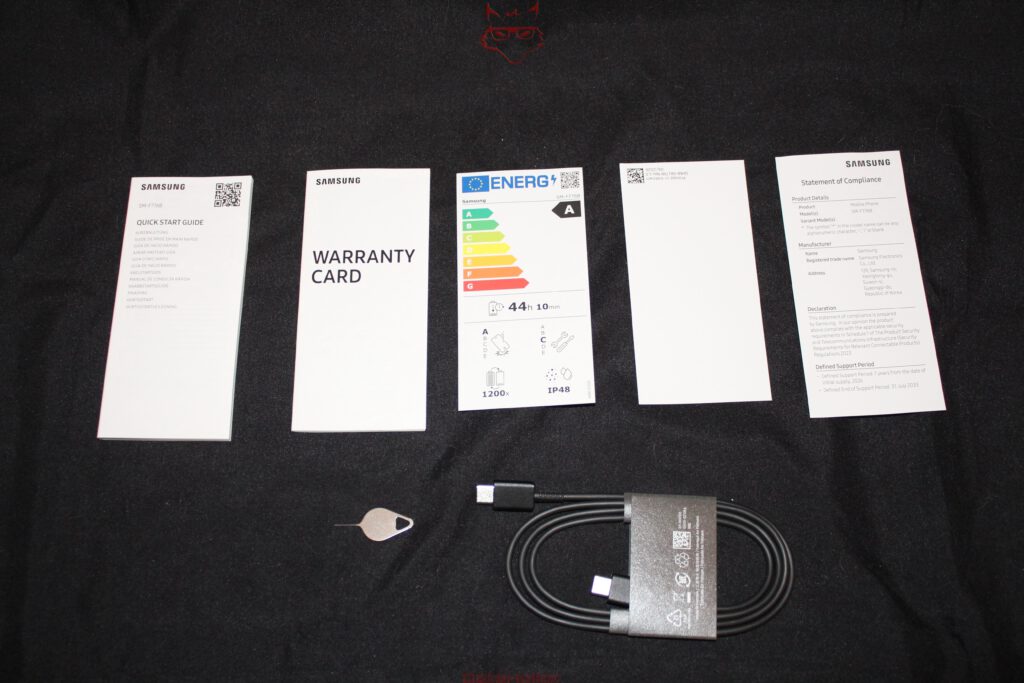
The included EU energy label is surprisingly interesting for a smartphone. The review unit achieves energy efficiency class A. The label also lists 44 hours and 10 minutes of standardised battery endurance, at least 1,200 charging cycles, the IP48 rating and further information relating to durability and repairability.
The charging-cycle figure deserves particular attention. A single cycle does not necessarily correspond to one connection to the charger. In simplified terms, the accumulated amount of recharged energy is counted until it reaches the equivalent of 100 percent of the battery capacity. Two 50-percent charges therefore add up to roughly one full cycle.
A rating of 1,200 cycles therefore implies a substantial service life before the specified remaining-capacity threshold is reached. Actual ageing will still depend on temperature, charging behaviour, state of charge, usage patterns and other factors.
Values like these matter far more for the long-term assessment of a premium smartphone than whether one synthetic benchmark finishes five percent faster. A device costing more than €1,000 should not only be impressive during its first weekend.
Seven operating-system upgrades – the software is allowed to age without becoming obsolete
Samsung promises seven operating-system upgrades and security updates for the Galaxy Z Flip8. The official product specification lists 31 July 2033 as the end of the security-update period.
That matters particularly for a foldable. A technically complex and correspondingly expensive smartphone makes little sense if software support ends while the display, battery and hinge are still functioning perfectly well.
The long support period shifts an interesting question from software to hardware. Android and One UI can remain current well into the 2030s. Whether the hinge, flexible panel and battery will survive the same period without issue cannot be answered responsibly after a short review period.
This is exactly where a technical review needs to draw a clear line. The review unit makes a very good mechanical impression. That does not translate into proof of seven years of use. Tens of thousands of folding cycles, years of thermal cycling and natural material ageing cannot be reproduced credibly within a short test.
The long update commitment is still a strong argument because the software at least does not become an artificial expiry date for the device.
One UI 9 – the real translator between two halves of a chassis
The Galaxy Z Flip8 runs Android 17 with One UI 9. On a conventional smartphone, the interface essentially sits between the hardware and the applications, managing windows, input, permissions, notifications and all the other processes that ideally happen quietly in the background. On the Flip8, another layer is added. The software has to know not only which app is active but also which physical state the device is currently in. Closed, the 4.1-inch FlexWindow is available. Opened, the 6.9-inch main display takes over. Between those two states are several angle ranges in which the hinge itself becomes part of the interaction model. Software therefore has far more influence on whether the unusual hardware becomes genuinely useful or merely creates additional complexity.
Technically, this means One UI has to react constantly to state changes. If an application is started on the FlexWindow and the device is then opened, the interface needs to decide whether and how that app continues on the main display. In Flex Mode, supported applications can split their layout while the camera and video-calling interfaces move additional controls to the lower half. Widgets require completely different information density on 4.1 inches than they do on the larger panel. Even closing the phone is not a trivial event: depending on the application, content can continue on the outside, pause or terminate altogether. Behind what appears to be a simple opening and closing movement lies a whole series of software decisions that need to be made within fractions of a second.
This is where Samsung’s experience across several generations of foldables becomes valuable. One UI 9 does not treat the Flip8 like a conventional smartphone that happens to have received a second display. The two surfaces are assigned clearly separated roles. The FlexWindow is optimised for short interactions, while the main display handles the full workspace. That distinction prevents the outer display from becoming nothing more than a miniature version of the standard Android interface. A weather card, calendar appointment or media control does not need an additional six inches of space. Conversely, trying to squeeze complex settings or full websites permanently onto 4.1 inches would be about as sensible as running a spreadsheet on a smartwatch display.
The most impressive part therefore lies in the transitions. After a short adjustment period, the software largely disappears from conscious attention. A message is checked on the outside, the phone is opened for a longer reply and the application is ready on the main display. With the device half open, the camera reacts to the angle without forcing a separate mode through layers of menus. These processes feel unremarkable even though quite a lot is happening technically. That is exactly how it should be. A foldable whose interface constantly reminds everyone how complicated the hardware is would simply be a normal smartphone with extra problems. One UI 9 instead turns the hinge, two displays and several physical operating states into one coherent system.
Galaxy AI, Now Brief and Gemini – useful where 4.1 inches are genuinely enough
Galaxy AI, Now Brief and Google Gemini are deeply integrated into One UI 9. Samsung now groups a fairly broad range of capabilities under this umbrella, including summaries, translations, image editing, contextual information and assistant functions, as well as services that bring content together from multiple applications. On the Flip8, however, the more interesting question is not which individual AI feature is available. More relevant is how these features behave on hardware that can move between a 4.1-inch information surface and a 6.9-inch main display.
Now Brief is one of the features that fits the FlexWindow particularly well. Weather, appointments, activity information and other compact updates are already built around small blocks of information. Opening the entire phone just to see them would be a little like starting a notebook simply to check the time. On the cover display, these pieces of information are available exactly where they make sense: visible quickly without forcing a transition to the larger surface. That is where a software feature becomes part of the form factor.
Gemini also benefits from this separation, at least for shorter prompts and responses. An assistant that demanded the full display every time would undermine part of the FlexWindow’s purpose. Short answers, reminders and contextual information fit naturally on the smaller screen. Longer text, extensive research or more complex interaction can move to the main display. The hardware therefore creates a natural boundary for the software instead of forcing every task through the same interface.
Beneath these functions sits the NPU inside the Exynos 2600. Samsung claims a 41 percent increase in NPU performance compared with the previous generation. A Neural Processing Unit is designed to perform mathematical operations efficiently that occur particularly often in neural networks, including matrix multiplication and highly parallelised calculations. Running such workloads entirely through the CPU or GPU would be possible, but often less efficient. The NPU therefore takes over specialised workloads and can reduce both processing time and energy consumption depending on the task.
That is particularly relevant on the Flip8 because the thermal reserves of a 6.1-millimetre-thin foldable are limited. Any workload that can be handled more efficiently places less stress on the battery and cooling system. This does not mean that every Galaxy AI feature is processed locally on the NPU. Depending on the service, cloud components may also be involved. The more important point is that Samsung is increasingly designing the hardware specifically around these workloads.
AI still remains an addition rather than the reason for the Flip8 to exist. Services change, features expand, are renamed or migrate between platforms. A hinge that doubles as a stand, a FlexWindow for short interactions and a main display that folds down after use remain physical properties of the product. If Gemini ever really does go on holiday, the central concept of the Flip8 will continue working just fine.
The real everyday test begins when the phone is closed
The Galaxy Z Flip8’s most important characteristic has no dedicated benchmark. Folded, it simply becomes small. A height of 166.9 millimetres drops to 85.7 millimetres. Thickness rises to 13.1 millimetres, but that number only partly describes how the device actually feels to carry. The key difference is the much smaller footprint. A long smartphone creates leverage between the hip, trouser pocket and thigh when sitting down. The Flip8 distributes its volume across a shorter body and therefore fits into pockets where large conventional flagships constantly seem to argue with human anatomy.
Its 180-gram weight helps as well. A foldable of this size could quickly feel like a small metal block if the added thickness were accompanied by significantly more mass. Samsung keeps the weight low enough for the folded state to feel genuinely compact rather than merely smaller on paper. After prolonged use of large premium phones, this difference is more noticeable than another few percentage points of CPU performance. It is almost unfortunate that benchmark suites still do not include a “sitting down with the phone in a trouser pocket” test. For the Flip8, it might be more meaningful than the third decimal place in a synthetic score.
The construction does add an extra interaction step. Longer text, websites, extensive settings and video still require the device to be opened. A conventional smartphone comes out of a pocket at full size immediately. On the Flip8, there is one mechanical movement in between. It takes only a moment, but it remains part of the experience.
That is exactly why the FlexWindow matters so much. Without the cover display, the hinge would quickly become a compulsory ritual. With 4.1 inches available on the outside, many short tasks can be completed before opening the phone even becomes a question. Check a notification, change a track, open the calendar, look at the weather and the task is done. Only when more space is genuinely needed does the main display come into play.
The form factor therefore does not simply exchange size for mechanics. It separates two levels of interaction. Closed, the device offers a compact information and quick-access surface. Opened, it becomes a full 6.9-inch smartphone. This separation will not suit every usage pattern. Frequent switching between short and complex tasks can eventually make the extra movement feel repetitive. When interactions are more clearly divided, however, the concept works extremely well.
The real benefit is therefore less that the Flip8 becomes smaller. What matters more is that it only needs to be large when that size is actually useful. That difference makes the construction more convincing in daily use than the bare 85.7-millimetre figure suggests.
Closing the phone after a call – mechanical feedback instead of a red icon
A modern smartphone can be operated almost entirely through touch surfaces. That has worked very well for years and has removed most forms of mechanical interaction. A call ends through a red icon, the display is locked and the device goes back into a pocket. Functionally, there is little wrong with that.
The Flip8 adds one movement to this routine that is technically unnecessary and surprisingly satisfying.
After a call, the phone is closed. The display disappears, both chassis halves meet and the physical state of the device changes in a visible and tactile way. The action therefore provides feedback that a touchscreen alone cannot deliver. The call is over and the smartphone has simultaneously returned to its compact state.
That sounds minor, yet it belongs to the overall quality of the product. Smartphones are picked up, turned, unlocked and put down dozens of times every day. Materials, weight, surfaces and movement therefore affect perception constantly. In that context, a well-tuned hinge matters in much the same way as the actuation point of a high-quality switch or the resistance of a properly damped rotary dial.
Old flip phones had a remarkably effective trick in this respect: hanging up actually felt like hanging up.
The Flip8 carries that idea forward without turning itself into a retro exercise. The hinge remains a modern part of the construction while reintroducing a kind of mechanical interaction that has disappeared from most smartphones. It is not a purchase argument on its own. In daily use, however, it is one of those small details that explain why the device feels different from the next black rectangle made of glass and metal.
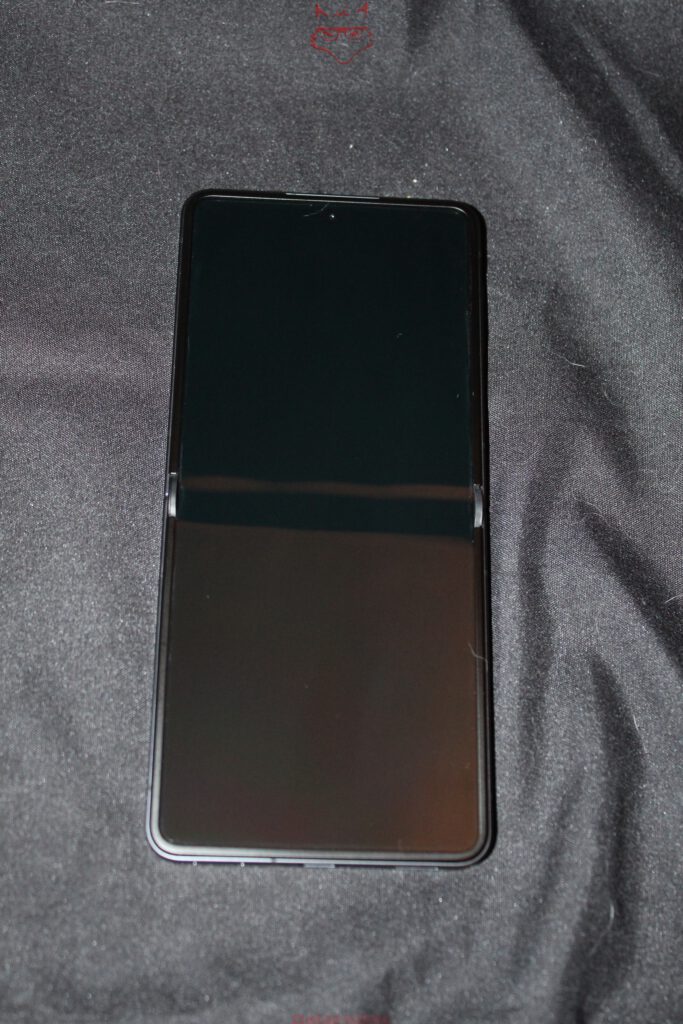
Against the Galaxy S26 Ultra – two designs with completely different priorities
A comparison with the Galaxy S26 Ultra makes technical sense as long as both devices are not treated as the same type of product. The Ultra uses a large rigid chassis and can distribute its internal volume accordingly. Battery cells can be larger, cooling structures can spread across one continuous body and multiple camera modules have more room in depth. Its display does not need a flexible folding area, the chassis does not require a hinge and sealing against very fine dust is structurally easier.
The Flip8 pays for its form factor in several areas. The 4,300 mAh battery remains smaller than those found in large conventional flagships. A true telephoto lens is absent. Thermal headroom under sustained heavy load is more limited. IP48 does not offer the same fine-particle protection as a fully sealed rigid premium device. The surface of the flexible internal display is also inherently more sensitive than solid cover glass.
These differences cannot be removed through software. They are direct consequences of the construction.
Conversely, the S26 Ultra cannot solve its biggest disadvantage compared with the Flip8 through an update either: it remains permanently large. A 6.9-inch display there always requires the full body length, regardless of whether a film is playing or the phone is switched off inside a pocket.
That is why a pure comparison of battery, camera and processor leads in the wrong direction. The S26 Ultra uses its volume to accommodate as much hardware as possible. The Flip8 dedicates part of its available space to the ability to halve that space after use.
Those who regularly use telephoto photography, play for long periods or need maximum battery reserve will find a conventional Ultra model the more logical tool. A larger battery and more extensive camera hardware offer direct practical value for those tasks. Those who want a large display without carrying 16 or 17 centimetres of smartphone at all times receive something from the Flip8 that a rigid device cannot provide in principle.
Neither concept is universally superior. The comparison instead shows why the Flip8 should not be viewed as a stripped-down Ultra. Samsung allocates the same premium price bracket to different technical priorities. On the Ultra, more engineering effort goes into cameras, battery and cooling. On the Flip8, a substantial part is spent on the hinge, flexible display, second panel and a body structure that can physically fold in half.
Physics therefore does not merely create limitations here. It determines what kind of smartphone emerges at the end.
€1,299 – the form factor has to do more than impress
The Galaxy Z Flip8 with 256 GB of storage carries a recommended retail price of €1,299. That places it well beyond the category in which an unusual hinge alone can justify the cost. At this level, every structural novelty competes directly with better camera hardware, larger batteries, faster charging systems and extremely capable conventional flagships.
That is why the weaknesses need to be stated clearly. There is no true telephoto lens. The 25-watt wired charging rate feels conservative in 2026. IP48 protects against water and larger foreign objects but does not match the fine-dust resistance of many conventional premium devices. The flexible main display remains more sensitive than a rigid glass surface. Those points do not become less relevant merely because the mechanism is technically impressive.
The price does, however, fund components that a conventional smartphone does not need. The 4.1-inch outer AMOLED consumes space, power and electronics. The hinge requires mechanically durable parts manufactured to precise tolerances. The main display has to remain flexible while still delivering premium image quality. Flexible connections between both halves need to carry power and data. One UI requires additional logic for multiple display states and opening angles. All of that then has to fit inside a 180-gram body.
None of this produces a higher benchmark result. That is exactly why foldables often look weaker in a direct price-to-performance comparison with conventional smartphones. Part of the budget goes into mechanics instead of a larger telephoto camera or an additional battery cell.
The decisive question is therefore not whether €1,299 is objectively cheap. It is not. The real question is whether the form factor is actually used.
If the Flip8 remains open most of the time and the FlexWindow serves mainly as an attractive clock, a substantial part of the construction goes largely unused. A conventional premium smartphone would then be the more rational technical choice. If the compact transport size, cover display, Flex Mode and rear-camera preview are used regularly, however, the device creates value that stronger hardware inside a rigid chassis cannot reproduce.
At this price, folding cannot be a purpose in itself. It has to perform a function. On the Flip8, it does so far more often than it did on early generations.
Eight generations later – when the foldable stops constantly trying to be a foldable
Perhaps the most important development of the Galaxy Z Flip8 cannot be tied to a single specification. After a few days, the device loses its novelty effect. That is a good thing.
At first, the hinge naturally receives attention. The crease is examined from different angles, the FlexWindow gets every remotely sensible app and the phone is opened and closed more often than any real task requires. Moving technology tends to invite a certain amount of play. A new office-chair backrest is usually adjusted more often than necessary as well, until it eventually becomes clear that it is still just a backrest.
The same process happens with the Flip8. The hinge becomes ordinary. A message appears on the FlexWindow and is read there. For a longer reply, the phone is opened. During a video call, it sits half folded on the table. For a group photo, the outer display becomes the viewfinder. Afterwards, the phone closes and disappears back into a pocket.
That normality is technically remarkable. Beneath the surface are two displays, a mechanical joint, flexible interconnects, a multi-layer folding screen, several sensors and software that constantly reacts to the physical state of the chassis. As little of that as possible should be noticeable during actual use.
Earlier foldables often had to justify their existence simply by folding reliably at all. That created fascination but not necessarily compelling practical value. The Flip8 reverses that relationship. The folding action itself becomes less interesting while the functions created by it become more important.
That is probably the real sign of maturity for the category. A notebook is not purchased because it has a hinge either. It is purchased because that hinge connects two functional assemblies in a way that creates a useful device.
The Flip8 is approaching exactly that point.
Conclusion – the technical strength lies not in the hinge, but in the system built around it
The Galaxy Z Flip8 is not a smartphone designed to top every individual line of the specification sheet. Its construction imposes too many clear limits for that. Two chassis halves, a mechanical hinge, a flexible main display and an additional outer AMOLED all consume space, increase complexity and directly determine which components Samsung can physically fit. An extra telephoto module competes with battery volume and electronics. A larger cooling system competes with the extremely slim 6.1-millimetre body. Complete dust sealing competes with a mechanism that moves every time the phone opens and closes. The 4,300 mAh battery, 25-watt charging, dual-camera system and IP48 rating therefore only make complete sense when the Flip8 is treated not as a smaller Galaxy Ultra but as a distinct engineering concept.
The technical core of the device consequently lies not in any single component but in the way those components work together. The 6.9-inch Dynamic AMOLED 2X panel provides the workspace of a conventional premium smartphone and then folds down to half the body height after use. The 4.1-inch FlexWindow handles short interactions and prevents the main display from needing to be opened for every notification, music control or calendar check. At the same time, the same surface acts as a viewfinder for the 50-megapixel main camera. Without adding another camera or separate accessory, the cover display therefore becomes both a second interaction layer and a camera tool. This is where the Flip8 starts to make genuine use of its form factor.
The hinge follows the same logic. Its most obvious role is to connect the two halves and guide the flexible OLED through a controlled fold. In practice, it does more. Because the mechanism can hold different angles securely, the lower half becomes a built-in stand when needed. Video calls, group photos, time-lapse recordings and low-angle shots no longer necessarily require a separate tripod. This is not a software trick layered on top of the hardware. It is a function produced directly by the mechanical design. Connections like these separate a foldable that merely folds from one whose construction creates practical value.
The Exynos 2600 also makes more sense when judged within that same framework. A foldable measuring 6.1 millimetres when open offers no luxurious conditions for cooling. Large vapor chambers, extensive metal heat spreaders or massive cooling structures cannot simply be added without consuming space elsewhere. The processor therefore needs not only to be fast but also efficient. In daily use, the Exynos 2600 together with 12 GB of RAM provides enough headroom for One UI 9, multitasking, camera processing, gaming and local AI workloads without making the Flip8 feel like a premium device deliberately held back for thermal reasons. Within this form factor, that matters more than a brief peak score in a benchmark.
The same principle applies to the battery. A 4,300 mAh capacity does not look especially remarkable in 2026, particularly beside conventional flagships with substantially larger cells. Inside the Flip8, however, the available volume is divided between two extremely thin sections that also have to accommodate the mainboard, cameras, speakers, antennas, hinge mechanism and flexible interconnects. The fact that Samsung has not sacrificed battery capacity despite making the device thinner and lighter than its predecessor is therefore more relevant than a simple comparison of milliamp-hours. Battery life will not set records, but it is sufficient for a normal day and no longer feels like an unavoidable penalty for choosing the foldable construction.
The weaknesses remain clear. A genuine telephoto lens is missing, and at a recommended price of €1,299, a true 3x optical option would have strengthened the camera system considerably. The 25-watt wired charging speed is functionally adequate but conservative compared with much faster systems from other manufacturers. IP48 protects well against water and larger foreign objects but still leaves very fine dust as a weakness of the moving structure. The flexible internal display also remains a fundamentally different material stack from solid cover glass. The crease is visible, can be felt under a fingertip and the surface deserves more care around concentrated pressure from hard objects.
None of these points becomes smaller because the product is called innovative. Nor does it need to. The more important question is whether the advantages of the construction have become substantial enough to make those compromises understandable. On the Galaxy Z Flip8, the answer is far clearer than it was on early foldables.
The most important advantage is surprisingly simple: the phone becomes small. A height of 166.9 millimetres drops to 85.7 millimetres when folded. The 6.9-inch display remains available without requiring the full body length to be carried permanently in a trouser or jacket pocket. The FlexWindow handles short interactions, the outer screen turns the main camera into a much better selfie camera and the hinge replaces a small stand in a surprising number of situations. One UI 9 connects these states cleanly enough that the hardware stops feeling like a special case after a short adjustment period.
That is where the Flip8’s real maturity becomes visible. Earlier foldables lived heavily on the spectacle of the display folding at all. The hinge was the event, the talking point and often the greatest uncertainty at the same time. On the Flip8, it increasingly fades into the background. It performs its mechanical role, enables additional functions and then becomes boring. For such a technically complex component, that is close to the best possible outcome.
The same change is visible in software. The FlexWindow no longer feels like a secondary screen used for parking the time and a handful of notifications. It plays a clearly defined role within the system. One UI 9 distributes information and interaction according to the physical state of the device, preventing the two displays from becoming simple duplication without purpose. Closed, the Flip8 provides a compact information and quick-access layer. Opened, it becomes a full smartphone. Half open, it creates additional options for photography and video calls. The hardware therefore does not merely have two screens. It has several deliberately separated operating states.
That is also where the considerable engineering effort becomes easier to justify than through any individual specification. A conventional smartphone could accommodate a larger battery, an additional telephoto camera or a more powerful cooling system. It could not, however, shrink to roughly half its height after use. That ability cannot be added through a software update or substituted with more processing power. It is part of the architecture.
The Flip8 therefore answers the question of why a foldable should still matter in 2026. Not because an OLED panel can bend. That technical effect lost its novelty years ago. The device becomes interesting where folding produces concrete consequences. Transport size changes. The camera gains new possibilities through the cover display. The hinge becomes a stand. The software separates short interactions from longer ones. A large display only needs to be large when its full surface is actually useful.
That sounds almost obvious. The engineering required to make it happen is anything but.
The Galaxy Z Flip8 is therefore not a compromise-free smartphone, and it does not need to be. Its purpose is not to beat a Galaxy S26 Ultra in every discipline. Instead, it follows a different priority and now does so with remarkable consistency. The compromises remain visible, but they no longer feel like the unavoidable construction sites of an immature product category. They are part of a deliberate engineering decision.
For maximum telephoto performance, the largest possible battery reserve or hours of sustained heavy load, a conventional flagship remains the more appropriate tool. For a large display without carrying a permanently large slab of glass, however, the Flip8 offers something a rigid smartphone cannot provide by construction.
That is ultimately where the real strength of this device lies.
The Galaxy Z Flip8 is not convincing merely because Samsung can fold a smartphone in half. After eight generations, that argument would be far too weak. It becomes convincing because that fold has developed into a coherent technical concept in which the display, hinge, camera, software, battery and chassis all work toward the same underlying idea.
The form factor is no longer simply one characteristic of the smartphone.
It is the reason this smartphone works the way it does.
Transparency notice in accordance with EU requirements:
The Samsung Galaxy Z Flip8 featured in this review was provided by Samsung as a non-binding loan unit for testing purposes. This does not constitute paid advertising.
Samsung had no influence over the content, assessment or editorial independence of this article. All opinions expressed are based solely on editorial hands-on experience.
Our thanks go to Samsung for providing the smartphone and for the trust placed in dataholic.de.