
EPOMAKER TH87 ISO Review: A Lot of Keyboard, Less Desk Space, and the Question of Finding the Right Compromise
- Packaging and Accessories: Understated but Well Considered
- Design and Build Quality: Subtle Styling with Carefully Chosen Color Accents
- TKL and German ISO Layout: A Sensible Middle Ground
- Gasket Mount and Five Damping Layers: What Lies Beneath the Keycaps
- Mechanical Switches: Two Different Personalities
- Connectivity: USB, Bluetooth, and 2.4 GHz
- Battery and Runtime: 10,000 mAh with Some Limitations
- RGB Lighting: Visually Appealing, but Not Without Functional Weaknesses
- Software and Customization: Versatility with Platform Limitations
- Price and Market Position: Not Quite as Affordable as the Concept Suggests
- Conclusion: A Thoughtful Foundation with Some Clear Limitations
- Transparency Statement
Mechanical keyboards have long since stopped being simple input devices. Between aluminum cases, interchangeable switches, different damping materials, and increasingly elaborate lighting systems, a market has emerged in which even relatively affordable models offer features that were reserved for considerably more expensive keyboards just a few years ago. At the same time, a fairly simple question arises: How much of all this is actually necessary in everyday use? The EPOMAKER TH87 ISO attempts to provide a pragmatic answer. Instead of relying on an unusual layout or a construction primarily designed to impress with technical specifications, the manufacturer has opted for a traditional tenkeyless format, mechanical and interchangeable switches, three connectivity options, and programmable RGB lighting. There is also an ISO version, which is particularly important for the German market. After all, even the most attractive keyboard is of little use if umlauts are missing, the Enter key has an unfamiliar shape, or special characters can only be accessed through additional key combinations. What makes the TH87 interesting is not any single feature but how everything works together. A mechanical keyboard should not only sound pleasant and feel good during the first few keystrokes. It should also provide a consistent typing experience over extended writing sessions, switch reliably between devices, remain stable on the desk, and ideally stay repairable even after several years of use. These are the factors that ultimately determine whether a keyboard continues to satisfy its owner or is replaced once the initial enthusiasm has faded. At least on paper, the TH87 ISO provides a sensible foundation. Its design eliminates the number pad while retaining the function keys, navigation keys, and a dedicated arrow-key cluster. This makes it an interesting alternative for workstations where writing longer texts, occasional gaming, and productivity applications are all part of everyday use.
Packaging and Accessories: Understated but Well Considered
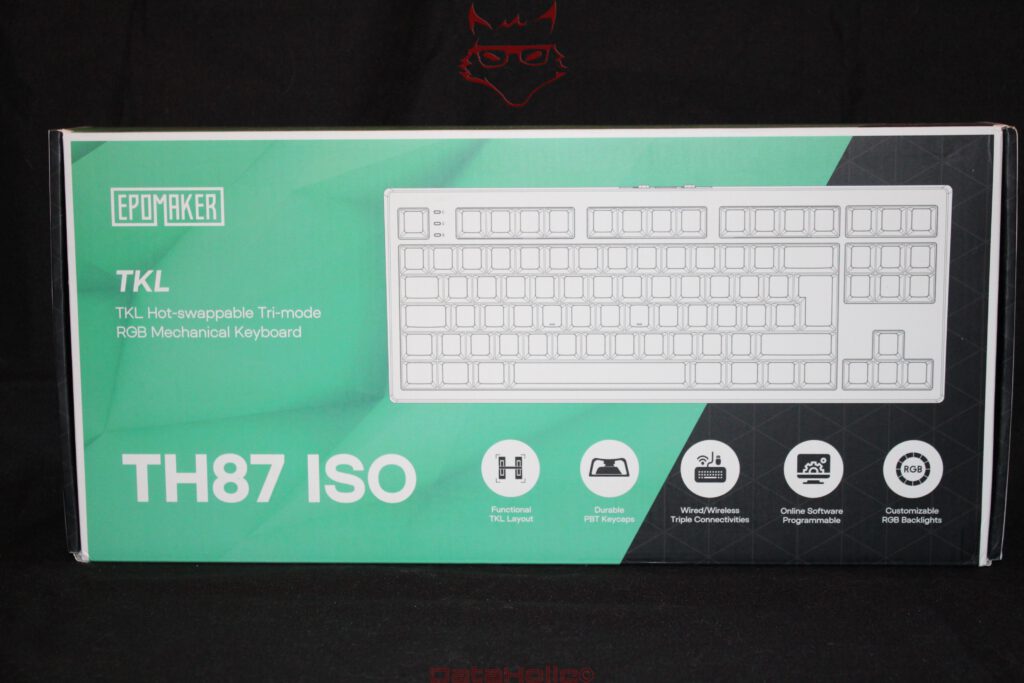
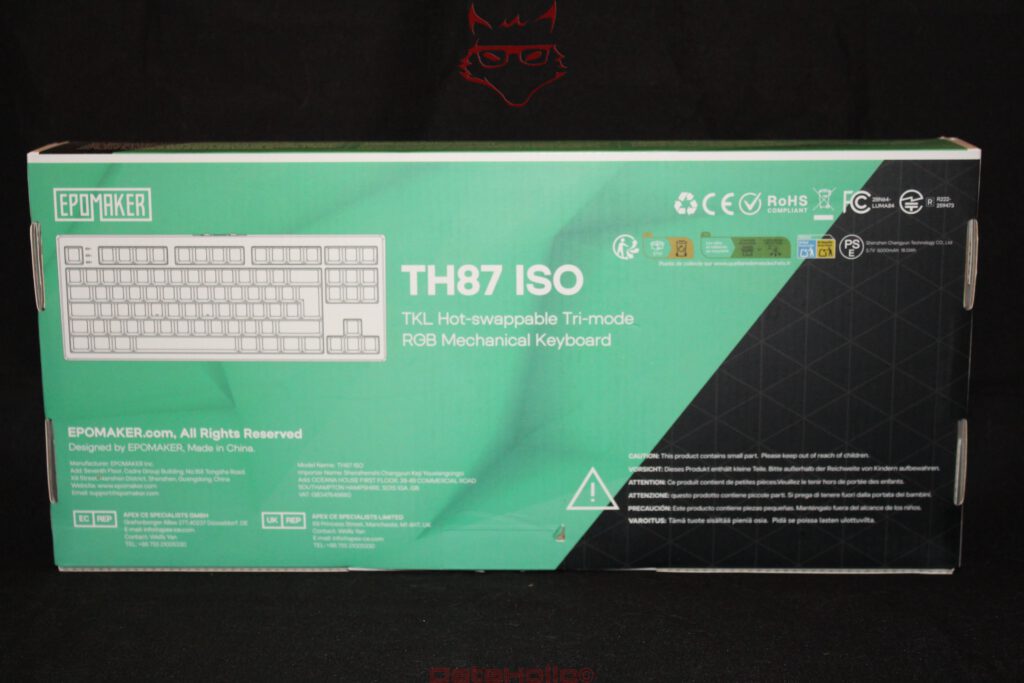
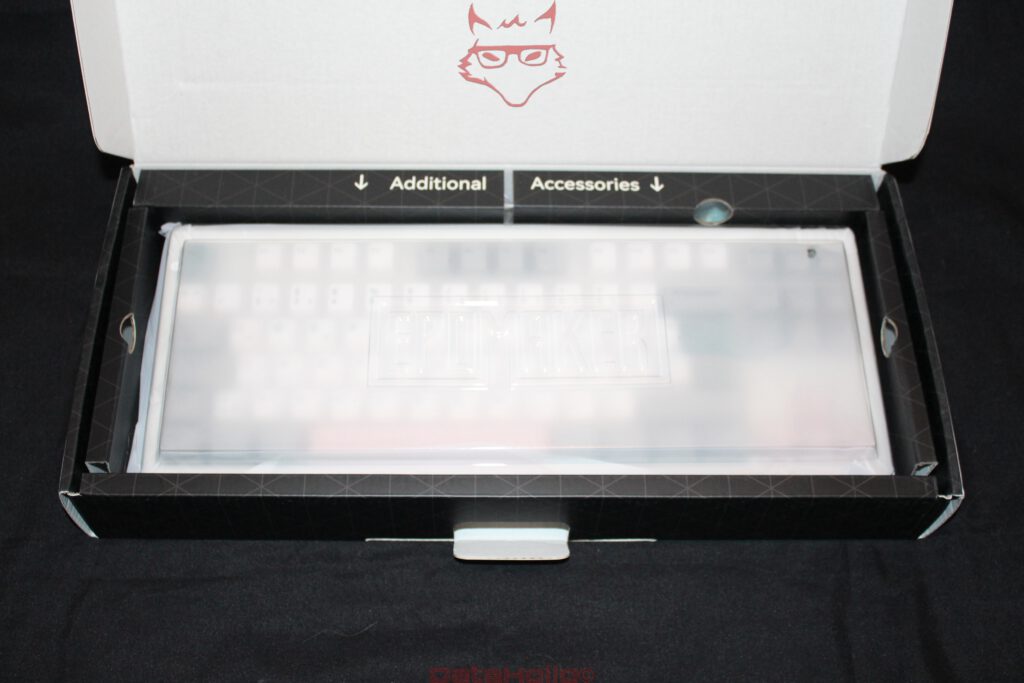
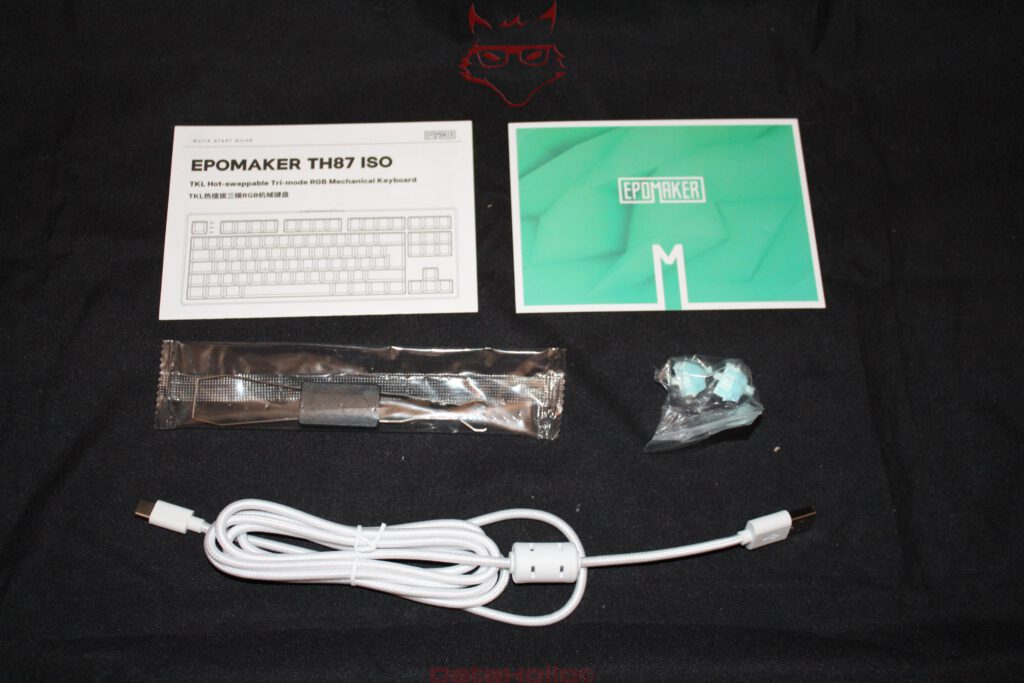
EPOMAKER sticks to its familiar packaging design. The box combines a large green surface with black elements and a schematic illustration of the keyboard. The front highlights the main features: hot-swap support, three connectivity modes, RGB lighting, and the TKL layout. The back contains the usual manufacturer information, regulatory markings, and safety notices. Inside, the keyboard rests in a precisely fitted cardboard structure. A translucent protective cover prevents direct contact between the keycaps and packaging while protecting the surface against dust and minor damage. There is also a separate compartment for the accessories. This arrangement makes sense because smaller components cannot move freely between the keyboard and the box during transportation. The accessories documented in the photographs include a quick-start guide, an additional information card, a white USB-C cable with a braided sleeve, a tool for removing keycaps and switches, and two spare mechanical switches. The cable features a ferrite core intended to reduce high-frequency interference along the cable. Although its practical benefit for a keyboard is limited under normal conditions, it remains a technically understandable measure for reducing electromagnetic interference. The included removal tool is more important than it might initially appear. A hot-swappable keyboard only reveals its real advantages when individual switches can be replaced without considerable effort. A defective switch does not automatically require replacing the entire keyboard. Individual keys can also be fitted with different switch types, allowing frequently used keys to receive a different operating characteristic. The two spare switches are a small but useful addition. They allow an initial replacement without having to order additional components immediately. However, the exact switch variants installed in the photographed unit and their electrical characteristics cannot be conclusively identified from the packaging and available images. The quick-start guide focuses on basic setup. This is particularly relevant for a keyboard with several operating modes, as connections through Bluetooth, the 2.4 GHz receiver, and USB need to be configured correctly. An extensive printed manual is not necessarily required. What matters is that the necessary keyboard shortcuts and operating states are documented clearly.
Design and Build Quality: Subtle Styling with Carefully Chosen Color Accents
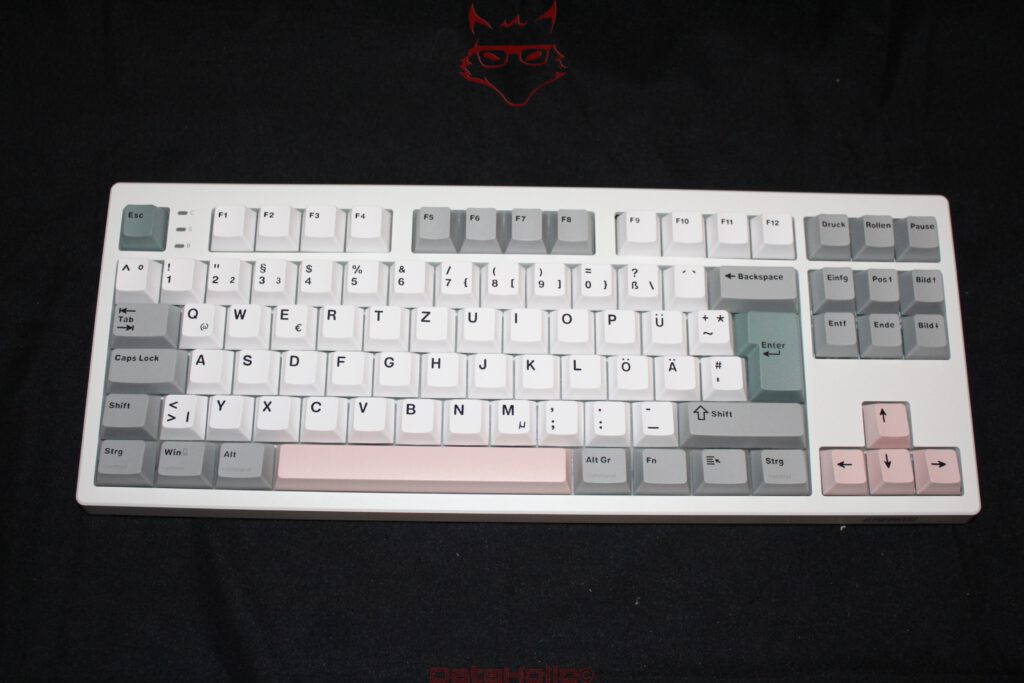
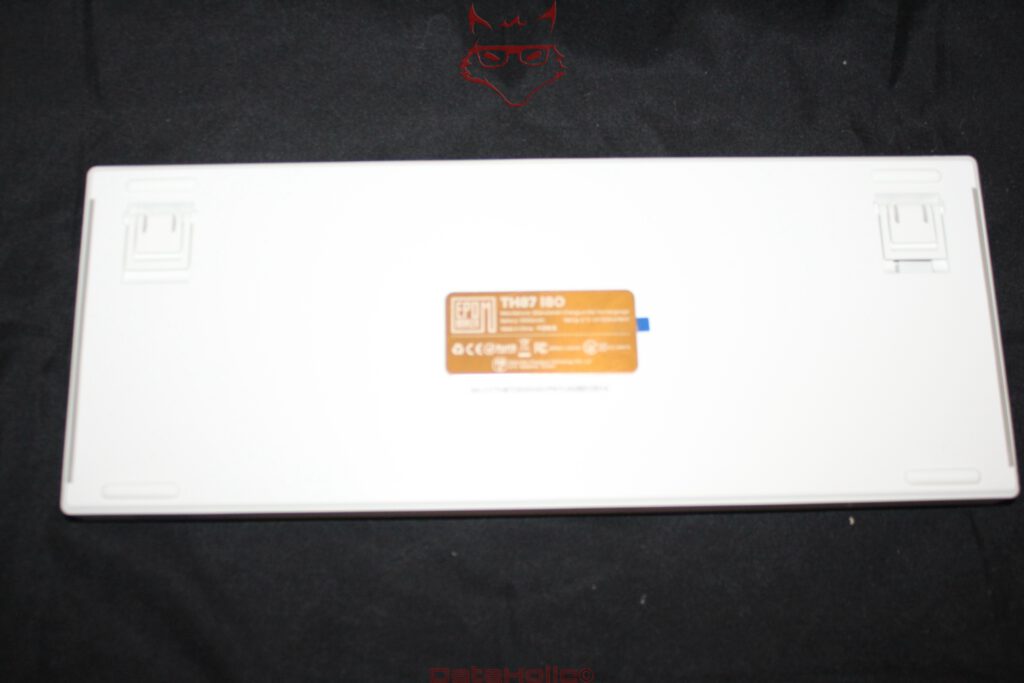
Visually, the TH87 ISO belongs to a category of keyboards that are not exclusively aimed at traditional gaming enthusiasts. The photographed model combines a white case with white, gray, muted green, and pink keycaps. The colors are deliberately restrained, creating an appearance closer to modern custom keyboards than traditional gaming hardware. The color distribution also serves a functional purpose. Function keys and navigation keys are divided into visually distinct groups. The Escape and Enter keys receive additional emphasis through their greenish coloring, while the spacebar and arrow keys are highlighted in pale pink. This makes certain sections easier to identify without requiring additional labels. The case has a relatively low-profile, largely enclosed design with rounded corners. EPOMAKER has largely avoided conspicuous decorative elements, oversized manufacturer logos, or additional controls on the upper surface. As a result, the keyboard looks clean and organized. This restraint can be particularly beneficial on workstations already occupied by multiple monitors, input devices, and other peripherals. The relatively wide upper edge of the case is noticeable. It gives the keyboard a clearly defined outline and creates some distance between the function keys and the outer edge. At the same time, it contributes to the overall footprint. While a TKL keyboard is considerably more compact than a full-size keyboard with a number pad, that does not automatically make it particularly small. When considering the materials, an important distinction is necessary. The packaging identifies PBT as the keycap material. Due to its relatively high abrasion resistance and lower tendency to develop shiny surfaces, PBT provides a good foundation for durable keycaps. However, actual longevity does not depend on the plastic alone. Wall thickness, surface texture, and the manufacturing process used for the legends are equally important. The German ISO legends appear clean and easy to read in the photographs. Alongside the standard letters, the keycaps include special characters and, in some cases, additional labels for different operating systems. The keyboard therefore attempts to accommodate both Windows and macOS within the same keycap set. Interestingly, the legends are not designed exclusively for one operating system. The combination of Windows, Option, and Command labels makes switching between different computers easier. However, it also requires some attention because not every printed label applies to the currently selected operating mode. The underside features a largely enclosed case with four elongated contact surfaces and two fold-out feet. The latter allow the typing angle to be adjusted. This is a simple but important feature because the height of the rear edge directly affects hand positioning. A steeper angle is often perceived as more comfortable, but it is not automatically better from an ergonomic perspective. If the wrist remains bent upward for extended periods, the load on the extensor muscles increases. The flatter setting may therefore be preferable during longer typing sessions. The feet use a conventional construction. Whether their hinges will retain their original stability over several years cannot be determined from the external design alone. The same applies to the case’s torsional rigidity and the quality of its internal fastening points. A targeted stress test or disassembly would be necessary to evaluate those aspects.
TKL and German ISO Layout: A Sensible Middle Ground
The tenkeyless format has been one of the most sensible alternatives to the traditional full-size keyboard for years. Removing the number pad significantly reduces the width without sacrificing important key groups. Function keys, navigation keys, Insert, Delete, and the arrow keys remain available. This makes a considerable difference when working with text, spreadsheets, programming code, or content management systems, particularly compared with highly compressed 60% or 65% keyboards. On those layouts, numerous functions are only accessible through additional layers. While this saves space, it also shifts part of the interaction toward keyboard shortcuts that first need to be learned. The TH87 ISO stays close to the traditional PC keyboard. The function keys are arranged in groups of four, the navigation block is positioned separately, and the arrow keys form their own dedicated cluster. This creates a familiar control layout that does not require fundamental adjustment. The German ISO layout is particularly important. The reviewed model features a large, double-height Enter key, an additional key next to the left Shift key, and the familiar QWERTZ arrangement, including Ä, Ö, and Ü. This eliminates one of the most common drawbacks of imported mechanical keyboards, which may be technically interesting but are frequently available only with an American ANSI layout. The German layout is not merely a matter of habit. Anyone regularly writing longer texts benefits from immediately accessible umlauts and familiar special characters. A different layout can also be inconvenient for programming, at least initially, because characters such as curly brackets, backslashes, and certain operators occupy different positions. One compromise remains. Without a number pad, entering large quantities of numerical data becomes less convenient. For occasional spreadsheet work, this is not a significant problem. However, regular accounting tasks, extensive calculations, or data-heavy applications may benefit from a separate numeric keypad. In return, there is more room for the mouse to the right of the keyboard. This reduces the lateral distance between the typing position and mouse operation in many desk configurations. During longer working sessions, that difference can be more relevant than a few additional function keys. The TH87 ISO does not pursue a radical ergonomic concept. It has neither a split design nor ortholinear keys or independently positioned thumb clusters. Its strength lies in saving space within a familiar layout without fundamentally changing how the keyboard is operated.
Gasket Mount and Five Damping Layers: What Lies Beneath the Keycaps
Beneath the relatively understated exterior is a construction that is considerably more elaborate than its appearance suggests. EPOMAKER uses a gasket-mount system, a polycarbonate plate, and several layers of acoustic damping. The combination is intended to produce a softer keystroke and reduce unwanted resonance inside the case. On a conventional mechanical keyboard, the switch plate is often mounted relatively rigidly to the case. As a result, the forces generated while typing are transmitted directly into the case structure. Depending on the materials, mounting method, and internal cavities, this can produce undesirable sounds. Particularly with inexpensive constructions, the result may be hollow rattling or a metallic-sounding resonance. The TH87 takes a different approach. Its switch plate is supported by compliant elements, creating a degree of mechanical isolation from the case. Both the polycarbonate plate and the printed circuit board also feature so-called flex cuts. These precisely positioned openings locally reduce rigidity and allow controlled flexibility. Polycarbonate is not a random material choice. Compared with a rigid metal plate, it can help create a less harsh bottom-out feel. However, the actual effect depends on the complete construction. A polycarbonate plate alone does not guarantee a pleasant typing experience, just as gasket mounting does not automatically result in a noticeably flexible keyboard. EPOMAKER combines this foundation with five different damping elements. These include PORON foam between the plate and PCB, an IXPE layer, an additional acoustic layer, EPDM material around the switch sockets, and a silicone layer in the bottom of the case. The materials serve different purposes. PORON can absorb mechanical vibrations and reduce the direct transmission of impact energy. IXPE influences the acoustic properties around the switches. EPDM offers elastic and damping characteristics, while the silicone layer in the lower case is intended to reduce additional resonance. What matters, however, is that these layers cannot be considered independently. Excessive damping may calm the sound profile but also significantly reduce acoustic feedback. An overly soft construction, meanwhile, may produce a vague or mushy sensation during forceful typing. The technical challenge lies in combining noise control with clearly defined feedback. The TH87 is designed to provide a controlled, consistent keystroke. Whether the tuning actually matches personal preferences also depends on the installed switches. A quiet linear switch changes the character of a keyboard considerably more than a different case color or an extra millimeter of damping material. With a specified weight of approximately one kilogram, the TH87 is relatively heavy for a plastic keyboard. Its dimensions are 366.5 × 142.1 × 41.4 millimeters. The case is made from ABS plastic, while the switch plate is manufactured from polycarbonate. This combination of materials makes economic sense. A fully machined aluminum case would significantly increase production costs without necessarily being required for the intended design. ABS can be molded precisely, provides considerable design freedom, and can offer a stable foundation when sufficient wall thickness is used. Actual long-term durability, however, depends on the construction and the mechanical loads affecting the fastening points.
Mechanical Switches: Two Different Personalities
EPOMAKER offers the TH87 with different switch options. The Sea Salt Silent V2 and Creamy Jade switches are particularly relevant. Both use a linear mechanism but differ in their acoustic characteristics and typing feel. The Sea Salt Silent V2 switches are designed for particularly quiet operation. According to the manufacturer, they require an actuation force of 45 ± 5 gf and have a pre-travel distance of 1.8 ± 0.4 millimeters. Total travel is 3.5 ± 0.4 millimeters, while the bottom-out force is approximately 51 ± 5 gf. These specifications place the switches in the lightweight mechanical category. Actuation occurs relatively early without requiring the user to overcome a pronounced tactile bump. This can be comfortable during longer writing sessions because less finger pressure is required. At the same time, very light switches may increase the likelihood of accidental keypresses, particularly when fingers remain resting on the keys. The noise-reducing construction of the Sea Salt Silent V2 pursues a different objective from conventional linear gaming switches. Rather than emphasizing a pronounced mechanical sound, the design aims to limit the noise generated when the switch bottoms out and returns to its original position. This makes such switches particularly suitable for shared workspaces or environments where loud typing would be disruptive. The Creamy Jade switches also have a specified actuation force of 45 ± 5 gf. Their pre-travel distance is 2.0 ± 0.4 millimeters, with a total travel distance of 3.6 ± 0.4 millimeters. At approximately 50 ± 5 gf, the bottom-out force is comparable. The main difference therefore lies less in the nominal force specifications than in the acoustic and mechanical tuning. The Creamy Jade switches are not explicitly designed as silent switches and are intended to provide a more noticeable mechanical response. Despite their name and occasional descriptions emphasizing feedback, the technical specifications also identify them as linear switches. Both variants are factory-lubricated. This is intended to reduce friction noise and unevenness during switch movement. However, the quality of factory lubrication cannot be determined from specifications alone. Consistency between individual switches and the durability of the lubricant over extended use are the decisive factors. The TH87 supports mechanical 5-pin switches and features hot-swap sockets. Compatible switches can therefore be replaced without soldering. This is a considerable advantage for a keyboard intended for long-term use. A single defective switch does not necessarily render the entire device unusable. However, replacement requires some care. If switches are not inserted straight, their contact pins can bend. The hot-swap sockets themselves are not designed to withstand unlimited mechanical stress either. Frequent or careless replacement can compromise their lifespan. Although the photographs document the included spare switches, they do not allow the variant installed in the reviewed unit to be identified with certainty. A reliable assessment of actual typing noise, switch friction, and consistency across the keyboard would therefore require corresponding practical testing.
Connectivity: USB, Bluetooth, and 2.4 GHz
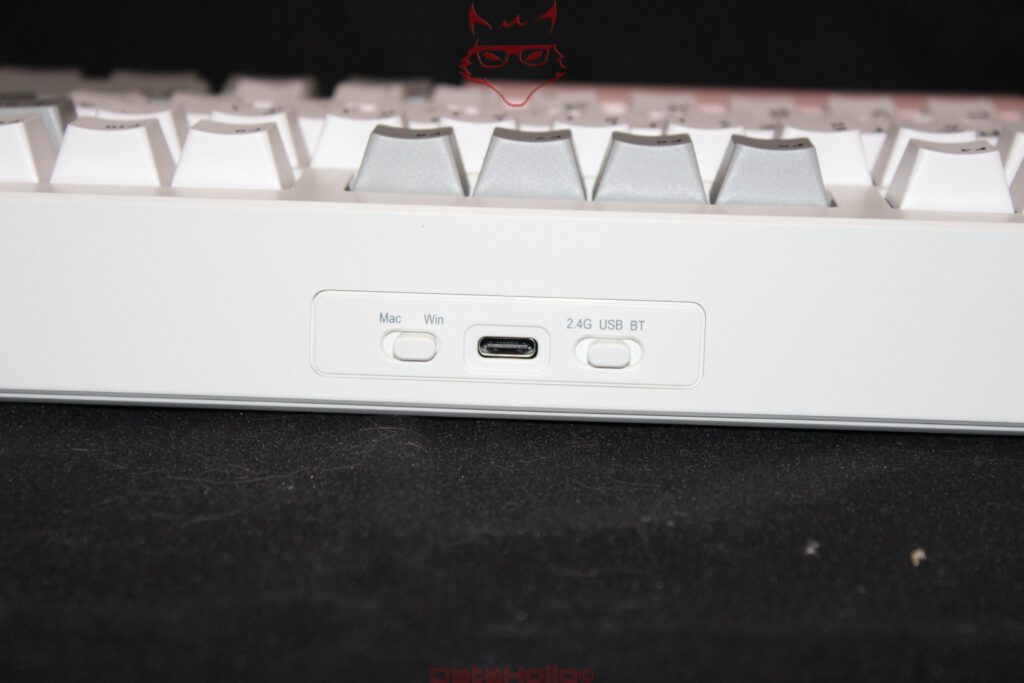
The TH87 offers three operating modes, selected through a physical sliding switch on the rear of the case. The USB-C port is located in the same area. A second switch allows users to select between Windows and macOS operation. This arrangement has one significant advantage over entirely software-based controls: the current operating mode is directly visible on the device. Particularly when switching between several computers, this reduces uncertainty about whether an unresponsive keyboard is caused by its connection, the operating system, or an accidentally activated shortcut. For the most stable connection, USB is the obvious choice. The keyboard operates through a wired connection and does not require an active wireless link. The integrated battery can also be charged simultaneously. Positioning the port on the rear makes sense for stationary use because the cable can be routed directly behind the keyboard. The 2.4 GHz mode uses a dedicated USB receiver. According to EPOMAKER, this is stored in a recess beneath one of the fold-out feet. It is a practical solution because the small dongle does not need to be stored separately during transportation. From a technical perspective, the 2.4 GHz connection is particularly interesting in situations where low input latency and a high polling rate are desirable. EPOMAKER specifies a polling rate of 1,000 Hz for both wired operation and its proprietary wireless connection. Bluetooth operates at 125 Hz. The polling rate describes how frequently input information can be transmitted or requested. At 1,000 Hz, this corresponds to a theoretical interval of one millisecond, while 125 Hz corresponds to eight milliseconds. However, these values do not directly represent actual input latency. Switch detection, debouncing, internal signal processing, and communication with the host all contribute to the final delay. EPOMAKER quotes latency figures of two milliseconds over USB, five milliseconds over 2.4 GHz, and eleven milliseconds over Bluetooth. These figures should be regarded as manufacturer specifications rather than substitutes for independent measurements of complete input latency. For ordinary office work, the differences between connection modes are often less important than reliability. In fast-paced games, however, additional milliseconds can become relevant. With USB and 2.4 GHz, the TH87 offers two operating modes designed for comparatively fast signal transmission. Bluetooth extends compatibility to notebooks, tablets, and other suitable devices. EPOMAKER lists Windows, macOS, and Android as supported platforms. The operating system switch is particularly useful because the assignment of important modifier keys differs between Windows and macOS. One limitation concerns software support. Hardware compatibility with several operating systems does not automatically mean that all configuration features are available on every platform.
Battery and Runtime: 10,000 mAh with Some Limitations
With a stated capacity of 10,000 mAh, the TH87 features an exceptionally large battery for a mechanical keyboard. This is particularly interesting because RGB lighting can account for a significant proportion of total power consumption. EPOMAKER specifies approximately 45 hours of operation with the backlighting at maximum brightness and up to 200 hours with the lighting switched off. The difference clearly demonstrates the impact of the LEDs on energy consumption. At eight hours of daily use, 200 hours theoretically translates into around 25 working days. With maximum lighting, that figure drops to approximately five and a half days. Actual battery life may vary depending on the connection mode, brightness, lighting effects, standby behavior, and usage intensity. Battery capacity alone does not allow a direct comparison with every other keyboard. What matters is the energy available in watt-hours, calculated from capacity and nominal cell voltage. Assuming a lithium-cell voltage of 3.7 volts, 10,000 mAh would correspond to approximately 37 watt-hours. This is a theoretical calculation rather than an independently verified measurement of the battery pack. A large battery also has structural consequences. It requires space, increases weight, and gradually loses capacity as it ages. For a keyboard intended for long-term use, it would therefore be particularly interesting to know how easily the battery can be replaced. However, a corresponding repair guide or explicitly guaranteed spare-parts supply is not among the documented features. The option of wired operation at least reduces dependence on the battery. Even if its capacity decreases significantly after several years, USB remains available as an alternative connection, provided the electronics and power supply continue to function.
RGB Lighting: Visually Appealing, but Not Without Functional Weaknesses
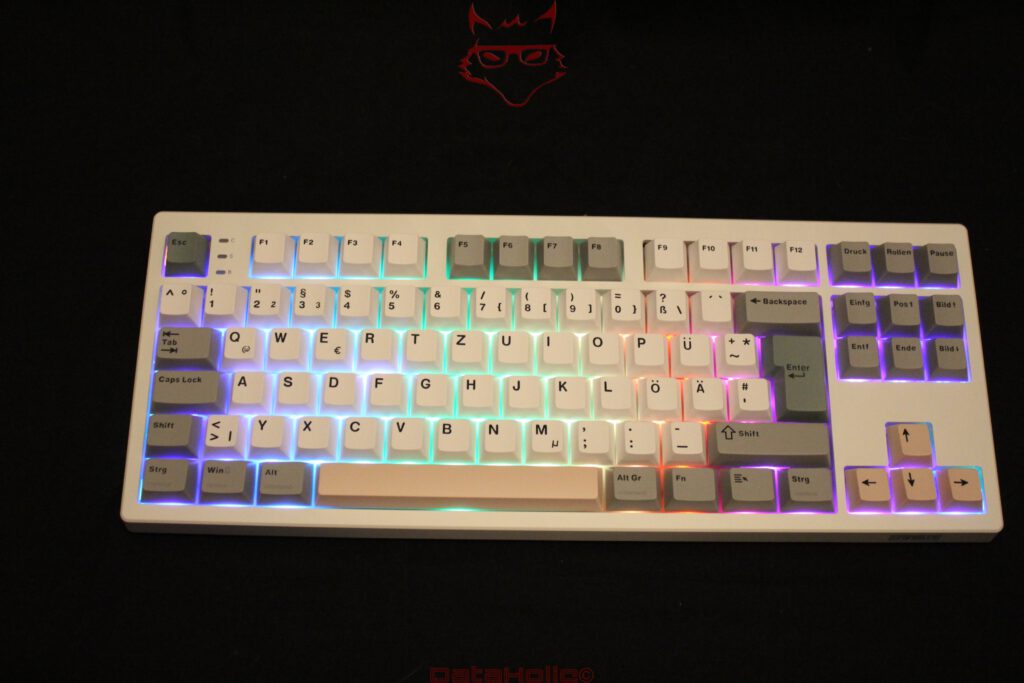
RGB lighting is one of the TH87’s most visually distinctive features. In the photographs, different colors are distributed across the entire keyboard. Blue, turquoise, green, orange, pink, and violet transition into one another, creating rich, relatively even illumination between the keys. EPOMAKER uses south-facing LEDs. These are positioned on the side of the switch facing the user. This arrangement can provide mechanical advantages with certain Cherry-profile keycaps because it reduces the risk of interference between the switch housing and the keycap. The TH87 features individually addressable RGB LEDs and supports different static and dynamic lighting modes. This allows both restrained single-color configurations and more conspicuous color gradients. However, an important distinction must be made between illuminating the keyboard and illuminating its legends. Double-shot PBT keycaps are not automatically translucent. On the TH87, the primary emphasis is on illuminating the spaces between the keys. The legends themselves remain largely dark. In daylight, this is not a problem. The black legends provide sufficient contrast against the light-colored keycaps. In a completely dark room, however, orientation becomes more difficult because the lighting does not shine directly through the characters. This is a design decision that may be judged differently depending on the intended application. In a well-lit workspace, subtle background illumination is often perfectly sufficient. Anyone who regularly works in darkness and wants to identify key legends reliably will find keyboards with translucent legends more practical. The visual separation of the individual keyboard sections is a positive aspect. In the photographs, the illumination extends across the main typing area, function keys, navigation block, and arrow keys. No large, obviously unlit sections are visible. The images do not allow a definitive assessment of LED consistency at different brightness levels or whether individual colors exhibit noticeable deviations. Similarly, static photographs cannot reliably reveal potential flickering or the quality of dynamic lighting transitions.
Software and Customization: Versatility with Platform Limitations
The TH87 supports programmable key assignments and customizable lighting settings. EPOMAKER advertises a software solution that allows macros and alternative key mappings to be configured, among other functions. This is particularly relevant for a mechanical keyboard without dedicated macro keys. Frequently used key combinations can be assigned to less commonly used keys, simplifying certain workflows. Examples include media controls, text editing, and recurring commands in applications. However, according to the German product listing, the configuration software is limited to Windows. This creates a discrepancy between the keyboard’s broad hardware compatibility and its customization options. Although the TH87 can be used with macOS, that does not automatically mean its full configuration capabilities are available on macOS. The same restriction applies to Linux. For an input device explicitly aimed at several platforms, an operating-system-independent solution would be preferable. Browser-based configuration can partially address this problem, provided the browser and device connection are supported. What matters is which functions the specific driver offers and whether settings remain permanently stored on the keyboard afterward. Explicit support for QMK or VIA cannot be established from the published TH87 specifications. It would therefore be incorrect to classify the keyboard as a fully open, programmable custom keyboard without further verification. This does not fundamentally disqualify it from productive use. Many users have no need for complex layer systems or freely configurable firmware functions. Nevertheless, a proprietary configuration solution limits long-term flexibility, particularly if the manufacturer eventually discontinues software maintenance. The secondary functions also deserve attention. The function keys do not feature consistently visible additional symbols for media controls and lighting adjustments. As a result, corresponding shortcuts either need to be memorized or looked up in the manual. For a keyboard intended for both productivity and gaming, clearer labeling would have been useful. Frequently accessed features should be available without an extended search.
Price and Market Position: Not Quite as Affordable as the Concept Suggests
The TH87 ISO-DE is currently listed at €119.95 in EPOMAKER’s German store. This places it beyond the traditional entry-level category and into a price range already populated by numerous mechanical keyboards offering different case materials, switch concepts, and software solutions. For the price, the feature set is fundamentally extensive. Gasket mounting, multilayer damping, hot-swap sockets, double-shot PBT keycaps, three connection options, and a large battery create a technically interesting combination. However, the sheer number of features is not a reliable measure of quality. What matters is how carefully the individual components are coordinated. A good switch plate and several damping layers cannot compensate for weak firmware, just as a large battery cannot make up for an unreliable wireless connection. The price therefore requires a differentiated assessment. The TH87 offers numerous features absent from basic mechanical keyboards. At the same time, it does without an aluminum case, additional hardware controls, and a clearly platform-independent configuration solution. The choice between Sea Salt Silent V2 and Creamy Jade switches is an advantage because it accommodates two different usage profiles. Those seeking the quietest possible keyboard will be more inclined toward the Silent variant, while the Creamy Jade version is more interesting for a more pronounced mechanical response. Long-term value also depends on spare-parts availability. Hot-swap sockets significantly improve repairability at switch level. Whether the battery, PCB, or other internal components can be replaced in the long term remains uncertain.
Conclusion: A Thoughtful Foundation with Some Clear Limitations
The EPOMAKER TH87 ISO is one of those mechanical keyboards whose concept is primarily defined by balance. Its traditional TKL layout retains the most important key groups while eliminating the number pad to create more room for a potentially more ergonomic mouse position. The German ISO layout also removes a significant obstacle that remains common among internationally marketed mechanical keyboards. From a technical standpoint, the internal construction is particularly interesting. Gasket mounting, a flexible polycarbonate plate, flex cuts, and five different damping layers demonstrate that EPOMAKER has deliberately attempted to influence the keyboard’s mechanical and acoustic properties. Combined with the factory-lubricated switches, this creates a foundation that goes beyond a basic conventional construction. Hot-swap functionality improves flexibility and makes replacing individual switches easier. The large battery and three connectivity modes broaden the keyboard’s potential applications, from stationary workstations to notebooks and wireless gaming setups. The physical switches for the operating system and connection mode are also sensible because they make essential functions accessible without relying on software. The platform strategy is less convincing. A keyboard that explicitly supports Windows, macOS, and Android should ideally provide an equally versatile configuration solution. Limiting the software to Windows reduces its usefulness, particularly in more technically demanding working environments. The RGB lighting is also more of a visual feature than a functional one. It complements the light-colored case and multicolored keycaps effectively, but because the legends are not translucent, it provides only limited improvements in readability in dark environments. At just under €120, the TH87 must also compete in an increasingly crowded market. Its feature set certainly warrants closer consideration, but an unconditional recommendation would depend on factors such as long-term wireless stability, actual battery life, switch consistency, and the reliability of the configuration software. The TH87 ISO is therefore an interesting keyboard for workspaces where familiar controls, wireless flexibility, and interchangeable mechanical switches are more important than an elaborate case or completely open firmware. Its greatest strengths lie in its construction and versatile underlying concept. Its limitations become apparent primarily in the software, the illumination of the legends, and the long-term characteristics that have yet to be conclusively assessed.
Transparency Statement
The EPOMAKER TH87 ISO was provided to DataHolic by EPOMAKER as a review unit for independent editorial evaluation. This review is neither sponsored nor paid advertising. EPOMAKER had no influence over the editorial content or the final assessment. Special thanks go to EPOMAKER and the entire team for providing the review unit and supporting independent editorial work.