
Epomaker HE75 V2 TMR Conclusion – When a Keyboard Bridges Quantum Physics and Everyday Use
- A keyboard where three letters suddenly matter quite a lot
- TMR instead of conventional Hall Effect: quantum physics beneath the keycaps
- Rapid Trigger: the point where a key stops being just a key
- Creamy Jade switches: light, linear and surprisingly mature
- The hybrid hot-swap PCB may secretly be the most interesting feature
- 8,000 Hz: impressive, but no reason for mathematical euphoria
- Wireless does not automatically mean slow here
- 8,000 mAh: a lot of battery inside a surprisingly compact case
- The 75-percent layout finds a very practical middle ground
- ANSI-US remains the biggest obstacle for the German market
- Transparent PC keycaps: visually striking, practically a matter of taste
- RGB all around: somewhere between an ice laboratory and a cyberpunk bar
- Gasket mount, FR4 and multiple damping layers: construction instead of acoustic cosmetics
- Ergonomics: three angles, but no miracle cure
- Software: this decides whether TMR becomes more than a sticker
- Gaming keyboard or work tool? Surprisingly, the answer is both
- Conclusion: the most interesting feature is not written in the largest font
- Notice in accordance with EU transparency requirements:
A keyboard where three letters suddenly matter quite a lot
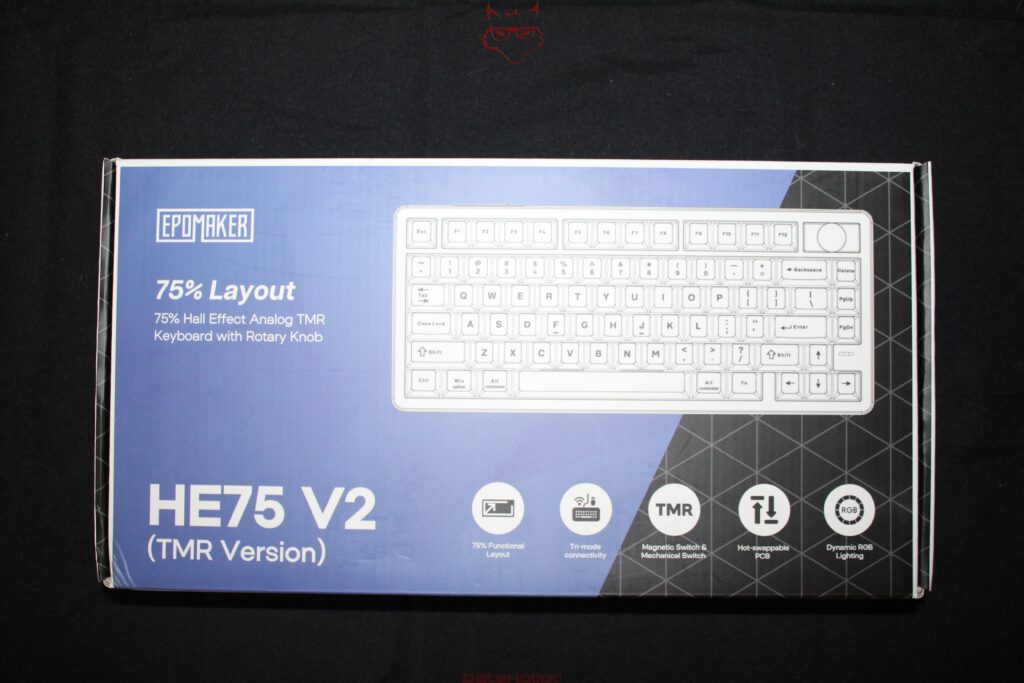
TMR. Three letters that initially carry about as much emotional weight on a keyboard box as the model designation of an industrial valve. With the Epomaker HE75 V2 TMR, however, they stand for considerably more than the next abbreviation pulled from the gaming industry’s increasingly crowded dictionary. Tunnel Magneto Resistance describes a sensor technology whose foundations belong more naturally in a physics laboratory than between an Escape key and a spacebar. That is exactly where the appeal of this keyboard begins. Sitting on the desk is a relatively compact 75-percent model with transparent keycaps, RGB lighting, a rotary knob and a white plastic chassis. Beneath that visible surface, however, operates a technology whose relatives can be found in hard-drive read heads, automotive systems and high-precision position sensing. Arthur C. Clarke once wrote: “Any sufficiently advanced technology is indistinguishable from magic.” The HE75 V2 TMR does not quite reach the level of magic, but the basic idea fits surprisingly well. A key moves by only a few millimetres, a magnet changes position, and that movement becomes highly precise digital information describing exactly how far the key has travelled. No conventional metal contact has to close, and no permanently fixed electrical actuation point dictates when an input is registered. After spending some time with the concept, an ordinary mechanical keyboard suddenly starts to resemble a light switch sitting next to a dimmer. Both perform their job. One of them simply understands more than on and off.
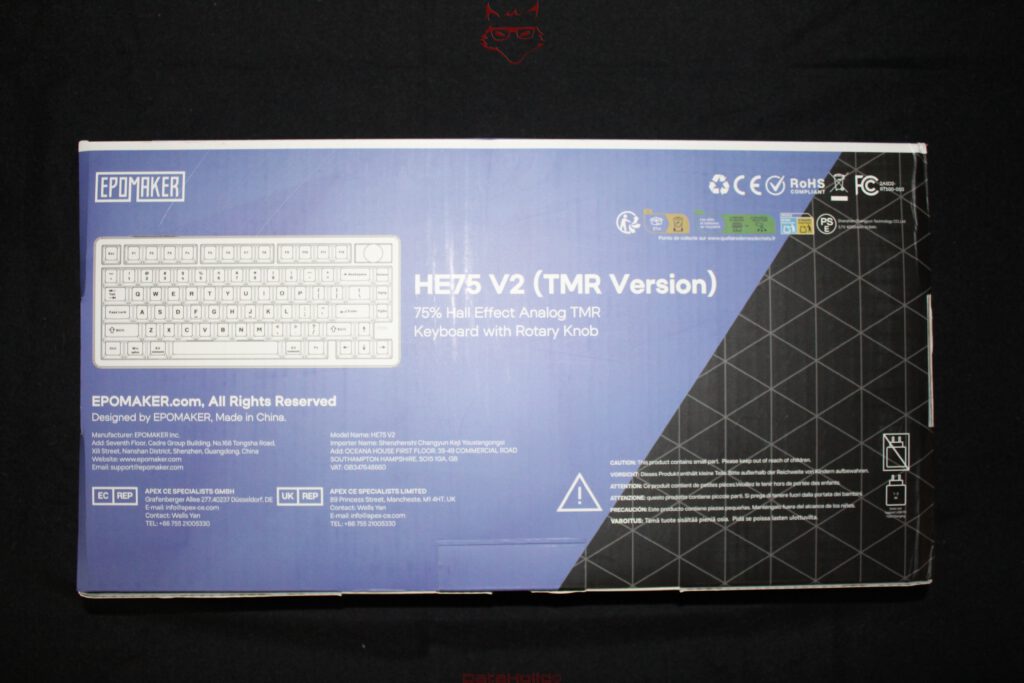
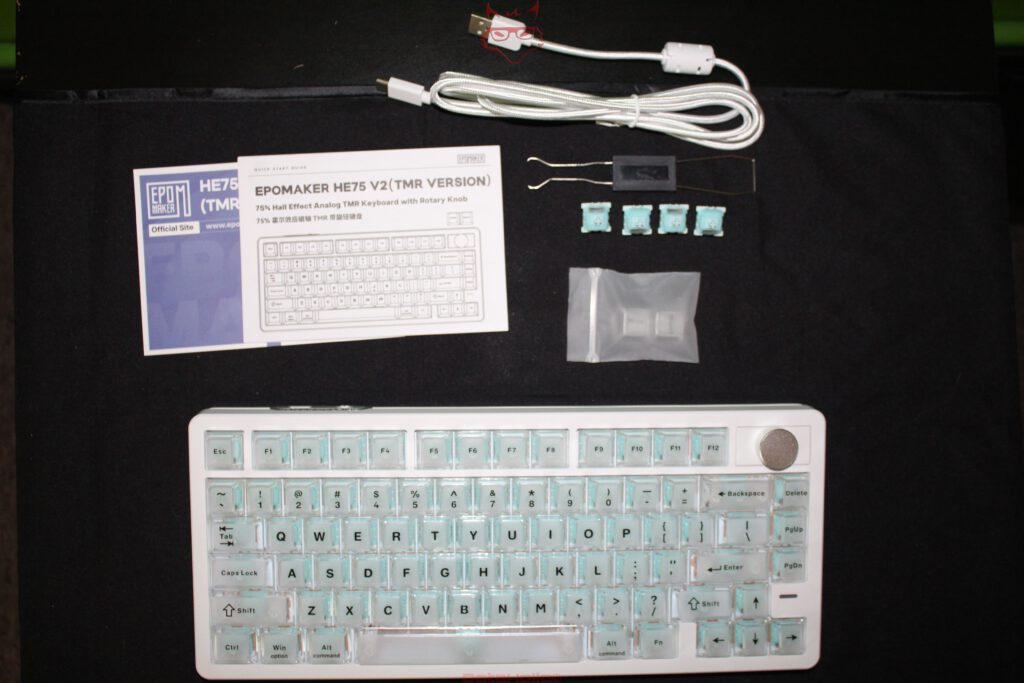
That is also why the HE75 V2 TMR should not be reduced to its maximum polling rate or to the smallest millimetre figure printed on a specification sheet. Its real strength lies in the way Epomaker combines several different worlds. The 75-percent layout remains compact without sacrificing the function row or dedicated arrow keys. Creamy Jade Magnetic Switches provide a very light linear travel. A gasket-mounted construction and several damping layers handle acoustics. An 8,000 mAh battery enables wireless operation, while 2.4 GHz, Bluetooth and USB cover three rather different usage scenarios. On top of that comes a hybrid hot-swappable PCB that accepts both magnetic switches and conventional 3-pin and 5-pin mechanical switches. That detail is far more significant than the next record figure on a product page, because one of the biggest weaknesses of earlier magnetic keyboards was their strong dependence on specific switch and sensor ecosystems. The HE75 V2 TMR attempts to loosen that restriction, at least to a meaningful degree.
TMR instead of conventional Hall Effect: quantum physics beneath the keycaps
The term Hall Effect has become almost inseparable from magnetic gaming keyboards. The basic principle is elegant: beneath each key sits a sensor, while a magnet moves inside the switch. Changes in the magnetic field reveal the position of the key. TMR pursues the same practical objective but uses a different physical measurement principle. Tunnel magnetoresistance is based on changes in electrical resistance caused by an external magnetic field. In simplified terms, a TMR element consists of two magnetic layers separated by an extremely thin insulating barrier. One magnetic layer has a fixed orientation, while the other reacts to the surrounding magnetic field. Depending on the relative alignment of those layers, electrical resistance changes.
The underlying tunnelling effect genuinely belongs to quantum mechanics and is considerably older than the current enthusiasm surrounding magnetic keyboards. TMR sensors are already established in industrial, automotive and consumer applications because their high sensitivity can be combined with low power consumption and precise measurement.
For a keyboard, that sensitivity is interesting because the sensor can detect very small positional changes in the magnet. Epomaker specifies an adjustment resolution of 0.01 millimetres and an actuation range of roughly 0.1 to 3.5 millimetres for the HE75 V2 TMR. The Creamy Jade Magnetic Switches provide approximately 3.5 millimetres of total travel, start at a comparatively light 30 gf and reach around 55 gf at bottom-out.
Strictly speaking, the unusual technology is not located inside the switch itself. The switch primarily contains a magnet attached to the moving stem. The actual distinction comes from the sensing technology on the PCB. The fact that Epomaker still describes the supplied Creamy Jade units as Hall Effect magnetic switches can therefore appear confusing at first. The switch supplies the magnetic field; the TMR sensor measures how that field changes. It sounds like a fairly academic distinction, but it prevents the wrong impression of how the keyboard is actually constructed.
Whether a 0.01-millimetre adjustment can genuinely be controlled reproducibly by a fingertip during normal use is another question entirely. The elasticity of a fingertip alone is likely to introduce larger variations in many situations. The important point is therefore not whether 0.37 instead of 0.38 millimetres can be consciously selected. What matters is the high sensing resolution in the background, because it provides enough data for Rapid Trigger, variable actuation points and dynamic inputs to work cleanly. A digital caliper also displays more decimal places than most everyday tasks strictly require. The extra resolution still creates useful headroom.
Rapid Trigger: the point where a key stops being just a key
With a traditional mechanical switch, the electrical actuation point sits at a mechanically defined position. Once that point is crossed, the keyboard registers an input. When the key is released, the mechanism has to return to a certain reset position before another press can be recognised. For typing, this behaviour is completely unproblematic. In fast games, however, that additional travel can become relevant, particularly when directions are changed repeatedly.
Rapid Trigger fundamentally alters this behaviour. Instead of waiting for a fixed reset point, the keyboard follows the actual movement of the switch. As soon as the key begins moving upwards, the previous press can be reset extremely quickly. If it starts moving down again, the next input can be recognised correspondingly early. The practical difference becomes particularly noticeable during rapid directional changes. A conventional key behaves a little like a door with a defined latch. Rapid Trigger is closer to a sliding door whose exact position is constantly monitored. The system does not wait for one permanently specified point; it reacts to the direction of movement.
Epomaker expands this concept with DKS and SOCD. DKS, Dynamic Keystroke, can assign multiple actions to different positions within a single key travel. A shallow press could trigger one command, while a deeper press activates another. That starts to resemble an analogue controller trigger more closely than a traditional keyboard switch. SOCD handles simultaneously pressed opposing directions and is particularly relevant for rapid movement changes in competitive games.
There is an important caveat here. Not every game, tournament organiser or competitive platform treats such features identically. Functions that prioritise inputs or automatically resolve conflicting directions may be unwanted or prohibited under certain rule sets. Technical capability therefore does not replace checking the applicable competitive rules.
In normal writing, none of this creates an automatic advantage. Extremely shallow actuation distances can even have the opposite effect. At 0.1 millimetres, a slight touch can be enough to trigger a key, turning relaxed finger placement into a surprisingly efficient typo generator. For longer writing sessions, a deeper actuation point is noticeably more relaxed. That is the real luxury of an analogue magnetic keyboard: the hardware does not have to remain locked to one single personality. It can be nervous and hyper-responsive for gaming, then deliberately calmer for writing. A race car could technically drive to the bakery as well. That still would not make the race setup the most sensible choice for the trip.
Creamy Jade switches: light, linear and surprisingly mature
The supplied Creamy Jade Magnetic Switches fit the character of the HE75 V2 TMR well. With an initial force of roughly 30 gf, they feel distinctly light without becoming completely weightless at the bottom of the travel. Force increases toward approximately 55 gf at bottom-out. The result is a linear progression with enough resistance to prevent each key from feeling like a loose slider under the finger. A POM stem and factory lubrication contribute to smooth movement. Scratchy switches or noticeably inconsistent movement would be especially undesirable on a keyboard built around analogue position sensing, because the mechanical motion should remain as predictable as possible.
The sound is equally noteworthy. Hall Effect and other magnetic keyboards carried a reputation for sounding rather hollow or hard for quite some time. That was less a consequence of magnetic sensing itself than of the construction of many early models. Maximum reaction speed often ranked considerably higher in the design priorities than acoustics or typing feel. The HE75 V2 TMR belongs to a newer generation where speed and sound are no longer treated as mutually exclusive goals.
Epomaker combines an FR4 plate with a gasket mount and a multi-layer damping structure using foam, pads and silicone elements. This removes much of the empty resonance that could otherwise come from a plastic case, without muting all feedback into a lifeless thud.
The resulting sound is more damped and rounded than metallic or sharp. Larger keys benefit particularly from this approach. Plate-mounted stabilisers are not automatically regarded as the pinnacle of enthusiast keyboard construction, but execution matters far more than the label. A badly implemented screw-in stabiliser can rattle just as convincingly as a shopping trolley with a damaged wheel. On the HE75 V2 TMR, the overall result remains controlled. The spacebar has enough body without overpowering every other key, while Enter, Backspace and Shift integrate cleanly into the acoustic profile. These are exactly the details that determine whether a keyboard impresses for five minutes or remains pleasant after five hours.
The hybrid hot-swap PCB may secretly be the most interesting feature
8,000 Hz looks better on a product page. A 0.01-millimetre figure sounds more spectacular. Yet the hybrid hot-swap PCB may turn out to be one of the most valuable characteristics of the HE75 V2 TMR over the long term. It supports magnetic switches while also accepting conventional mechanical 3-pin and 5-pin models.
That difference is substantial. Magnetic switches provide variable actuation points, Rapid Trigger and position-dependent functions. Mechanical switches open access to an enormous market of different characteristics: tactile, linear, clicky, heavy, light, long-travel or deliberately damped. This creates an unusual degree of flexibility. Magnetic switches may be the sensible choice for a weekend filled with fast shooters. A set of tactile or particularly quiet mechanical switches may be much more attractive during a week dominated by writing. The underlying keyboard remains the same.
This freedom is not without limits. The advanced TMR features naturally require a magnetic switch whose position can be measured by the sensor. A conventional mechanical switch does not suddenly become analogue simply because it sits on a hybrid PCB. Rapid Trigger and variable actuation distances therefore disappear in that configuration. Even so, Epomaker solves a genuine problem: choosing the keyboard does not permanently force the same choice of switch technology.
The concept is somewhat reminiscent of the early appeal of interchangeable-lens cameras. The body defines the platform, while the character can change later. Systems built around that kind of flexibility usually age more gracefully than completely closed designs. Charles Eames is often credited with the line: “The details are not the details. They make the design.” On the HE75 V2 TMR, the hybrid PCB is exactly that kind of detail.
8,000 Hz: impressive, but no reason for mathematical euphoria
According to Epomaker, the HE75 V2 TMR reaches a polling rate of up to 8,000 Hz over both USB and the 2.4 GHz wireless connection. Bluetooth operates at 125 Hz. Epomaker also specifies a scan rate of 128 kHz and latency figures of roughly 0.1 milliseconds wired, 0.58 milliseconds over 2.4 GHz and around 15 milliseconds via Bluetooth. These figures are manufacturer specifications and should not be confused with independently measured end-to-end system latency.
Mathematically, 8,000 Hz polling means that communication with the host can occur every 0.125 milliseconds. At 1,000 Hz, that interval is one millisecond. The difference is real and can matter as part of a complete latency chain. It does not mean that every input suddenly appears on screen eight times faster. Between a finger movement and visible feedback sit sensor scanning, firmware, USB or radio transmission, the operating system, game engine, rendering pipeline and display. Every stage contributes its own share.
On a fast monitor running high frame rates with an otherwise latency-optimised system, a high polling rate becomes technically more meaningful. On a 60 Hz display during a relaxed strategy game, the practical benefit is likely to remain considerably more theoretical. That does not diminish the technical quality of the keyboard. It simply places a number into the context it deserves. Marketing often likes to put one figure alone on the stage even though an entire orchestra is performing behind it.
More interesting is the fact that Epomaker offers 8,000 Hz over 2.4 GHz as well. High-frequency wireless operation places greater demands on controller design and energy management than leisurely Bluetooth operation. This is where the TMR concept and the battery configuration make sense together. TMR sensing can operate with relatively low power consumption, while Epomaker equips the keyboard with a total battery capacity of 8,000 mAh across two 4,000 mAh cells. That is generous for a keyboard of this size.
Wireless does not automatically mean slow here
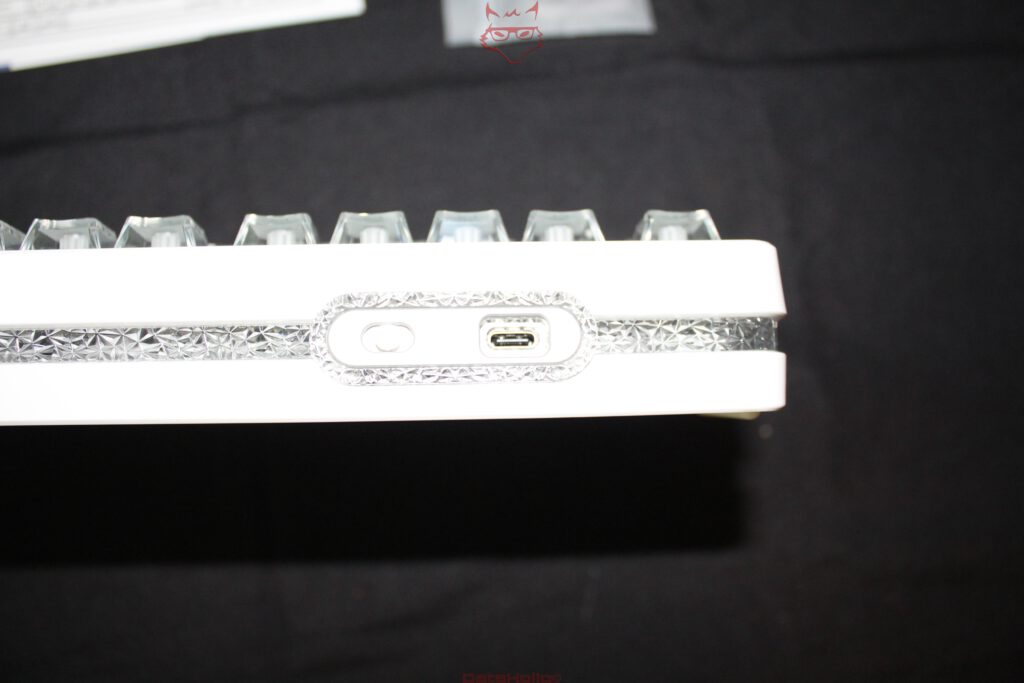
The three connection methods initially appear conventional, but they give the keyboard distinctly different personalities. The cable remains the simplest choice for maximum consistency and simultaneous charging. The 2.4 GHz mode suits a cleaner desk without making a major sacrifice in transmission performance. Bluetooth is primarily useful for tablets, notebooks and systems where energy efficiency matters more than minimum latency.
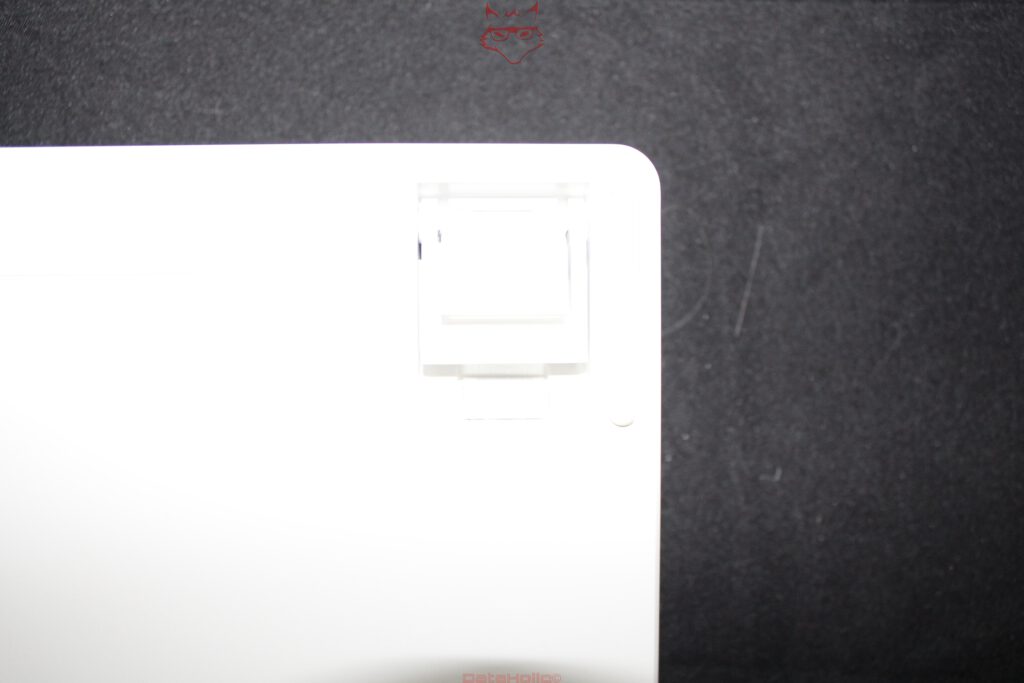
The storage compartment for the 2.4 GHz receiver beneath one of the folding feet is a small but genuinely useful detail. Dongles possess an almost supernatural ability to disappear precisely when the associated device needs to be transported. Giving the receiver a defined storage position on the keyboard solves that problem far more elegantly than placing it in a small plastic bag somewhere in a drawer. It sounds trivial, but these are the details that become increasingly valuable after months rather than minutes.
Bluetooth also supports pairing with multiple devices. For switching between a desktop, notebook and tablet, that is practical, although Bluetooth at 125 Hz and with considerably higher specified latency remains clearly the convenience mode. That division of responsibilities works well. Not every wireless technology needs to fulfil exactly the same purpose. A delivery van does not lose to a sports car simply because both happen to have four wheels.
8,000 mAh: a lot of battery inside a surprisingly compact case
Two battery cells with a combined capacity of 8,000 mAh are substantial, particularly in a keyboard measuring roughly 32.4 centimetres wide. High polling rates, continuous sensor operation and RGB lighting can all increase power consumption significantly, so generous battery reserves are sensible.
The more interesting point is the constructional consequence. Despite the large battery, the keyboard remains below one kilogram, with Epomaker specifying approximately 980 grams. That is enough weight for a stable position on the desk without turning the compact 75-percent format into a brick. There are lighter boards for frequent transport, but the HE75 V2 TMR clearly feels like a desktop keyboard that can travel occasionally rather than an ultralight mobile accessory.
The 75-percent layout finds a very practical middle ground
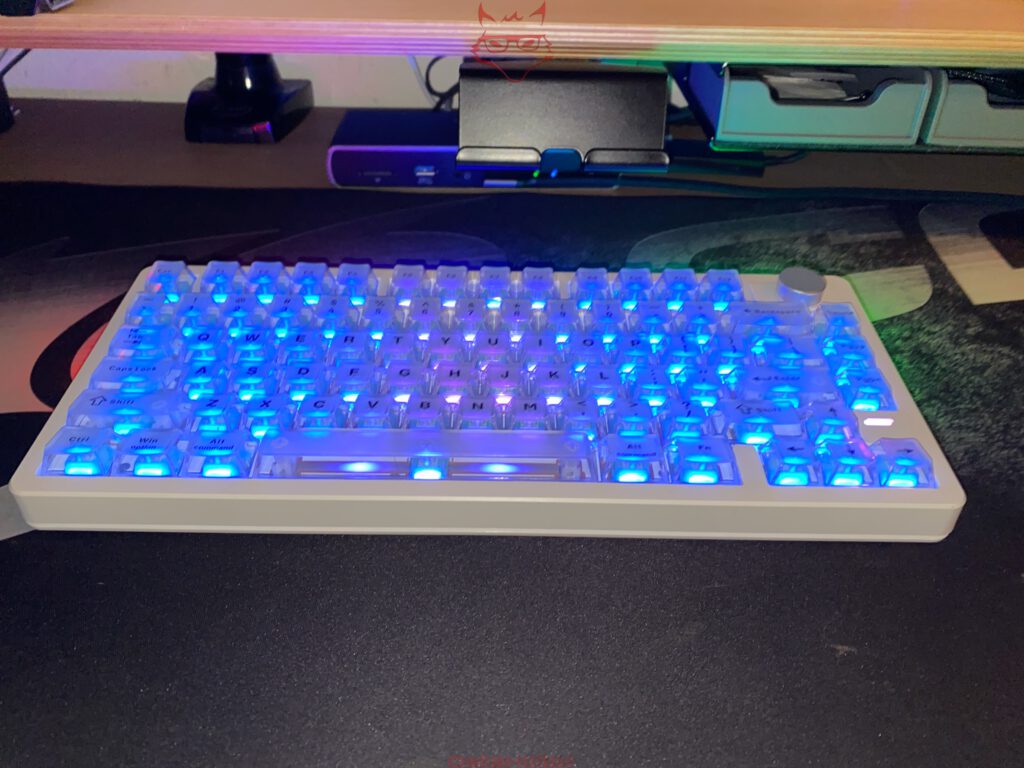
The HE75 V2 TMR uses 80 keys plus a rotary knob. The function row remains intact, as do the arrow keys and a narrow navigation column. The number pad disappears. This reduces the width to roughly 32.4 centimetres while retaining the functions most frequently required on a desktop.
The saved space is particularly noticeable when a mouse sits to the right of the keyboard. The arm does not need to move as far outward, and large mouse movements gain additional room. At the same time, the keyboard does not immediately require a function layer every time an application needs F5, F11, Page Up or Delete. 60- and 65-percent layouts can be even smaller, but demand considerably more secondary assignments. A 75-percent design sits neatly between those extremes and therefore makes sense for both work and gaming.
The rotary knob in the top-right corner also fits this concept. Volume changes can be made immediately, while pressing the control provides another function. Even more interesting is the modular construction: Epomaker allows the knob to be replaced by two regular keys, and the corresponding keycaps are included. It is hardly a revolution in human interface design, but it is a charming example of genuine hardware customisation rather than another checkbox hidden in software.
ANSI-US remains the biggest obstacle for the German market
As useful as the layout is in principle, the tested version carries a significant limitation: the HE75 V2 TMR is offered in ANSI-US/QWERTY form. For German-speaking users who write extensively, this matters. Umlauts, the position of several special characters and particularly the shape of the Enter key differ from the familiar ISO-DE arrangement. An operating-system layout can compensate for some of the logical differences, but it cannot alter the legends on the keycaps or the physical ANSI construction.
Anyone already comfortable with ANSI receives a coherent layout. For a conventional German office setup, however, this limitation can matter more than any technical advantage offered by the sensor system.
That is particularly unfortunate because the HE75 V2 TMR otherwise functions remarkably well as a mixture of gaming keyboard and productivity tool. A genuine ISO-DE version would broaden its usefulness in German-speaking markets considerably.
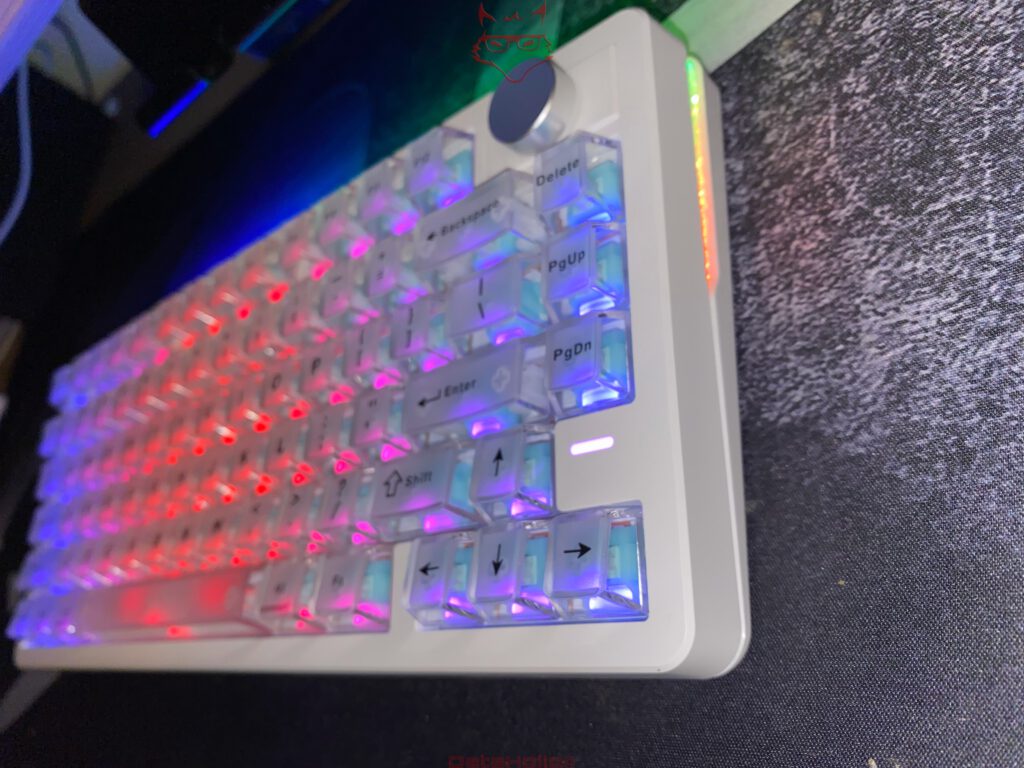
Transparent PC keycaps: visually striking, practically a matter of taste
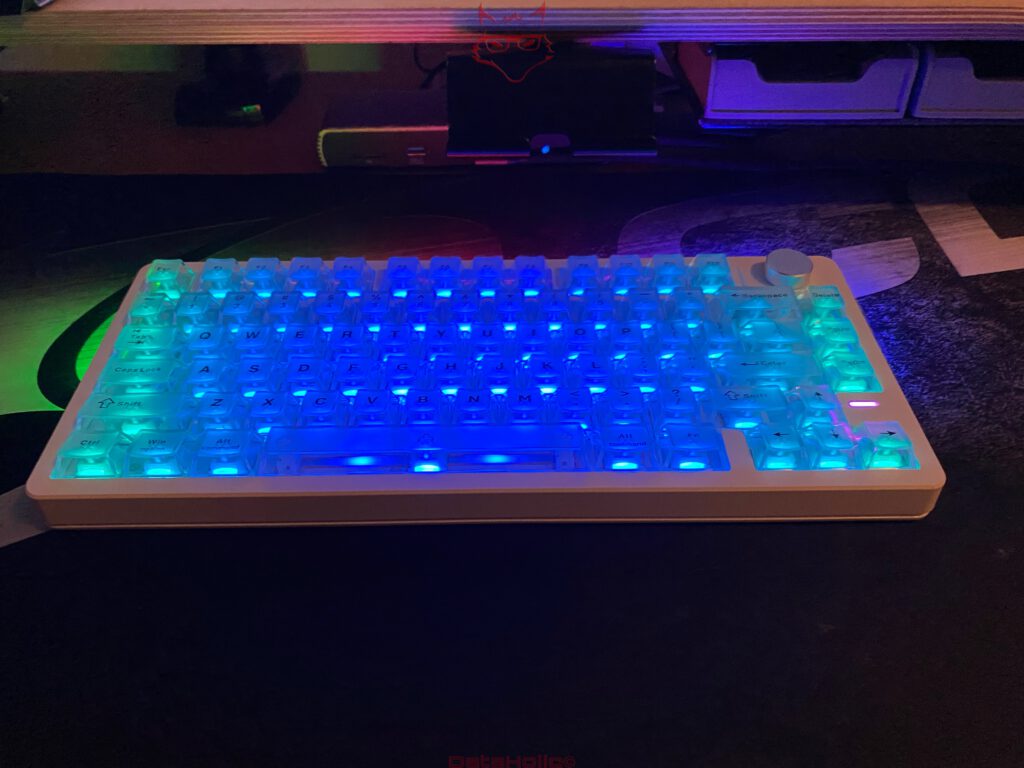
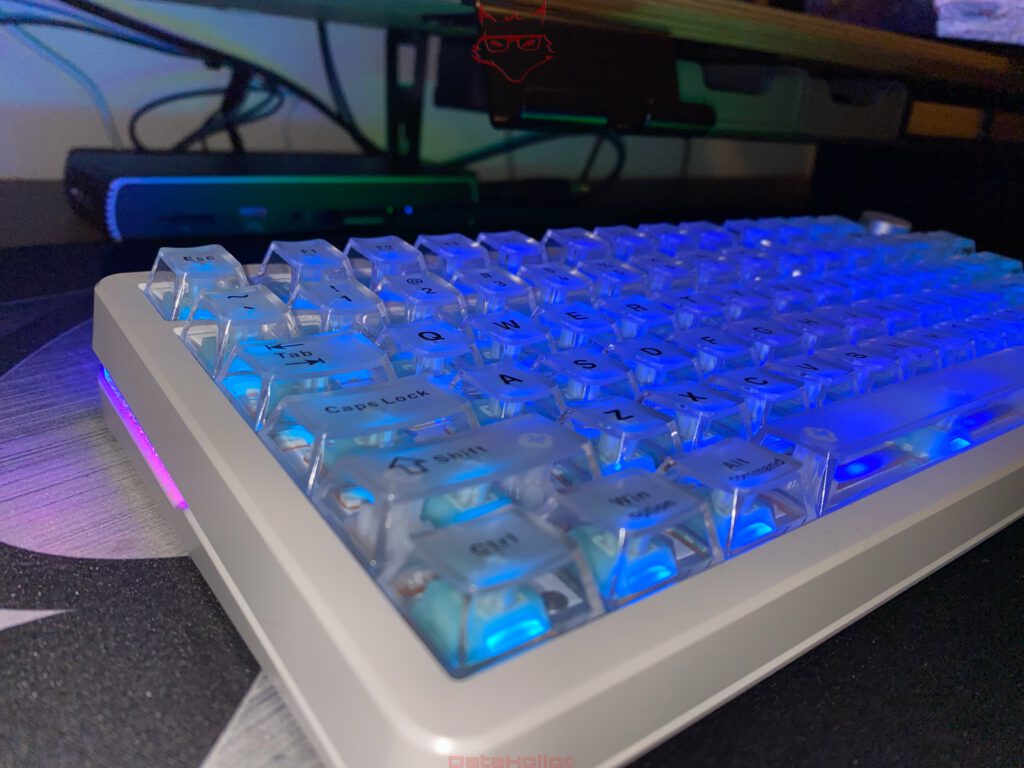
The matte transparent PC keycaps define the appearance of the keyboard almost more strongly than any other component. With the lighting disabled, the white version has an almost icy character. Once RGB is active, the personality changes completely. Light does not emerge only through small legends. Instead, it spreads across the translucent caps and through the crystal-like illumination strip running along the edge of the case. In low ambient light, the result becomes intense and almost glass-like.
Epomaker uses south-facing LEDs, which is a sensible technical choice because this orientation generally improves compatibility with different keycap profiles and switch configurations. At the same time, illumination through transparent keycaps behaves differently from conventional shine-through legends. RGB is more than a subtle background feature here. It is an integral part of the visual design.
Polycarbonate also feels different from thick PBT. Its surface is smoother and may show the effects of repeated finger contact more clearly over time. That does not make it inferior by definition, but it gives the keyboard a different tactile character from a conventional enthusiast board with thick textured PBT caps.
RGB all around: somewhere between an ice laboratory and a cyberpunk bar
Subtlety is not one of the HE75 V2 TMR’s dominant talents. Once the lighting is enabled, the keys are only part of the show. A crystal-textured lighting zone stretches through the chassis edge and distributes colour around the side. On the white version, the effect works surprisingly well because the housing, transparent keycaps and diffusion structure all participate in the same visual concept.
RGB remains entirely subjective, of course. The keyboard performs identically without a single illuminated LED. Even so, the lighting feels more deliberately integrated than on boards where a handful of LEDs appear to have been added between the switches as an afterthought. The case itself was visibly designed around the illumination.
There is a distant resemblance to classic hi-fi equipment with illuminated VU meters. Nobody needs the light for the underlying function, but a well-integrated visual element can make technical hardware significantly more engaging.
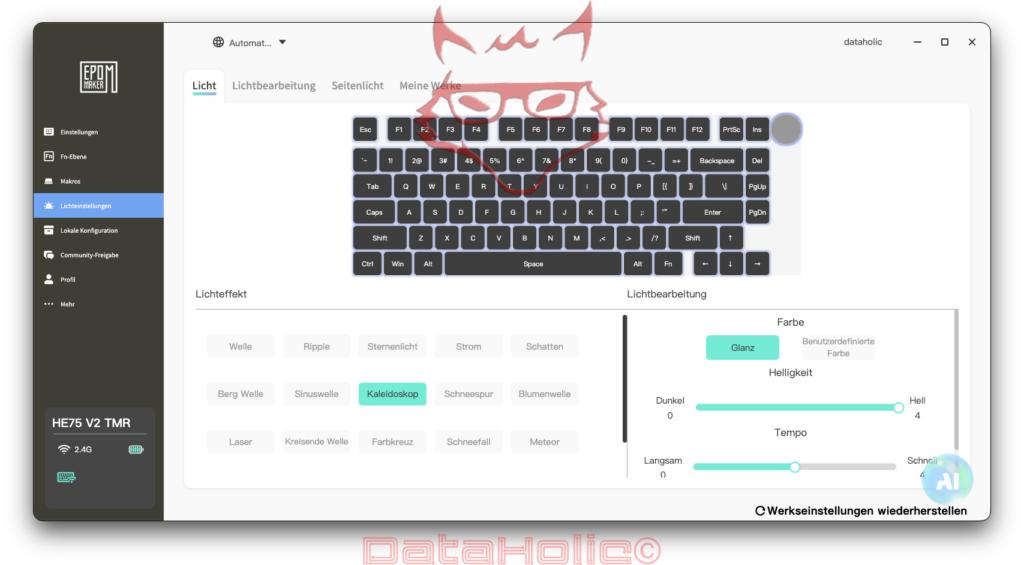
The ability to adjust the effect is important. A keyboard that looks like a miniature amusement arcade at night does not need to put on the same performance during the working day. At lower brightness, the lighting merely emphasises the outlines. At maximum intensity, the cyberpunk bar comparison becomes considerably more accurate. Both approaches have their place.
Gasket mount, FR4 and multiple damping layers: construction instead of acoustic cosmetics
The internal structure deserves closer attention because it illustrates how dramatically prebuilt gaming keyboards have evolved. An FR4 plate is essentially built from the same glass-fibre-reinforced epoxy material commonly used for PCBs. Compared with a metal plate, the feedback is often somewhat less rigid. Combined with gasket mounting, the keyboard gains a degree of mechanical isolation from the outer case.
Epomaker avoids flex cuts on the HE75 V2 TMR. That is not automatically a disadvantage. Flex cuts can create a very soft typing feel, but they also alter sound and structural stability. The decision to use a solid FR4 plate is understandable here: the gasket mount already provides some movement, while the plate preserves sufficient definition.
Additional layers include foam, switch pads, a PET layer, sound-absorbing material and silicone in the lower case. The exact naming of individual materials varies slightly between Epomaker’s product descriptions, but the overall concept is clear: this is a multi-layer acoustic structure.
The construction does not attempt to eliminate every sound. That would make little sense. A completely dead keyboard can feel just as artificial as a hollow one. The goal is to reduce unwanted resonance while allowing the actual switch character to remain audible. The HE75 V2 TMR handles that balance convincingly.
Ergonomics: three angles, but no miracle cure
The front edge sits at approximately 1.9 centimetres, while the rear reaches around 3.29 centimetres. Two-stage feet provide typing angles of roughly 5.8, 9 and 12 degrees.
This provides enough flexibility to accommodate different desk heights and typing habits. The shallowest position will often feel most relaxed during long writing sessions, while the steeper settings create a more traditional mechanical-keyboard posture. No wrist rest is included, so the need for one depends heavily on individual hand position and desk setup.
The more important point is that the basic chassis height remains sensible. Despite the gasket construction, battery and additional sensor technology, the keyboard has not become unnecessarily tall. Compact mechanical keyboards occasionally sacrifice ergonomics in pursuit of a substantial, imposing housing. The HE75 V2 TMR remains pleasantly grounded in this respect.
Software: this decides whether TMR becomes more than a sticker
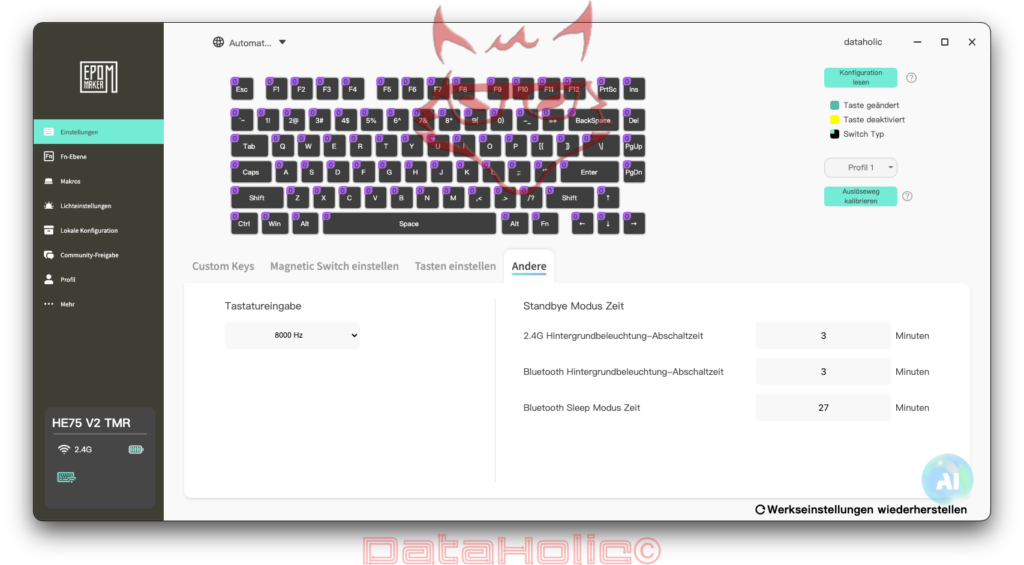
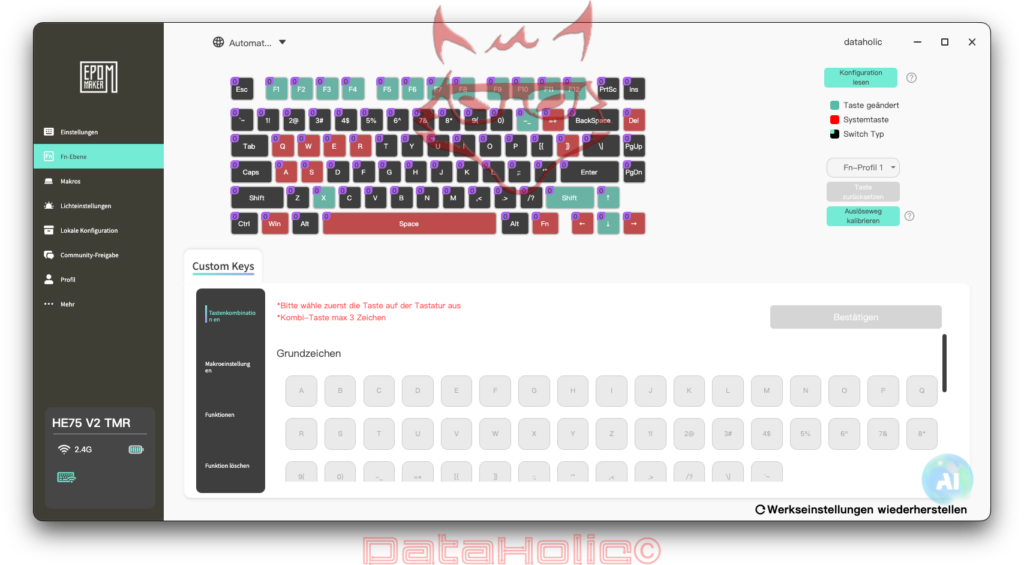
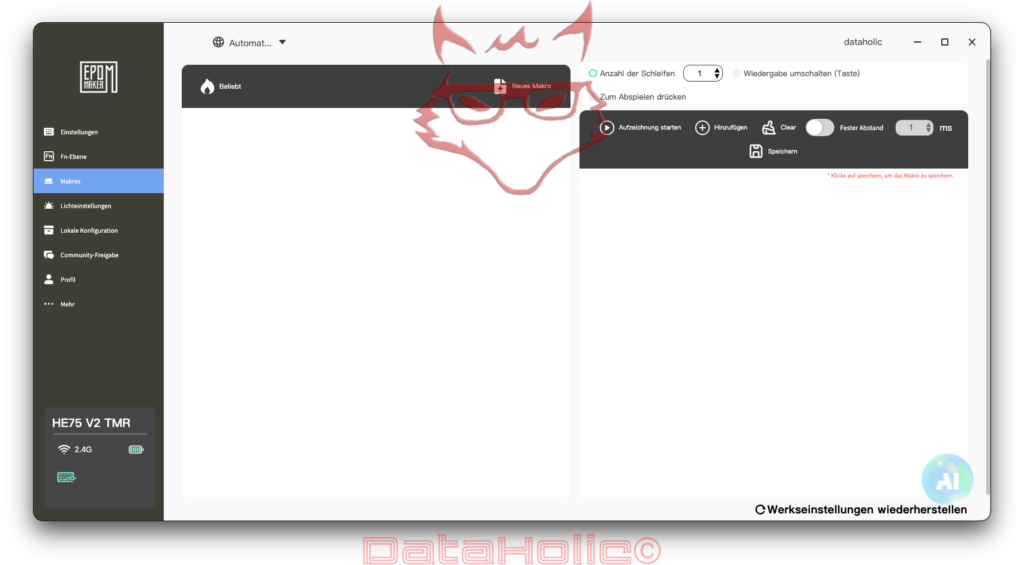
A magnetic keyboard can contain excellent sensors and still fail because of poor software. Variable actuation, Rapid Trigger, DKS and SOCD all require an interface that allows these features to be configured without turning the process into a technical puzzle.
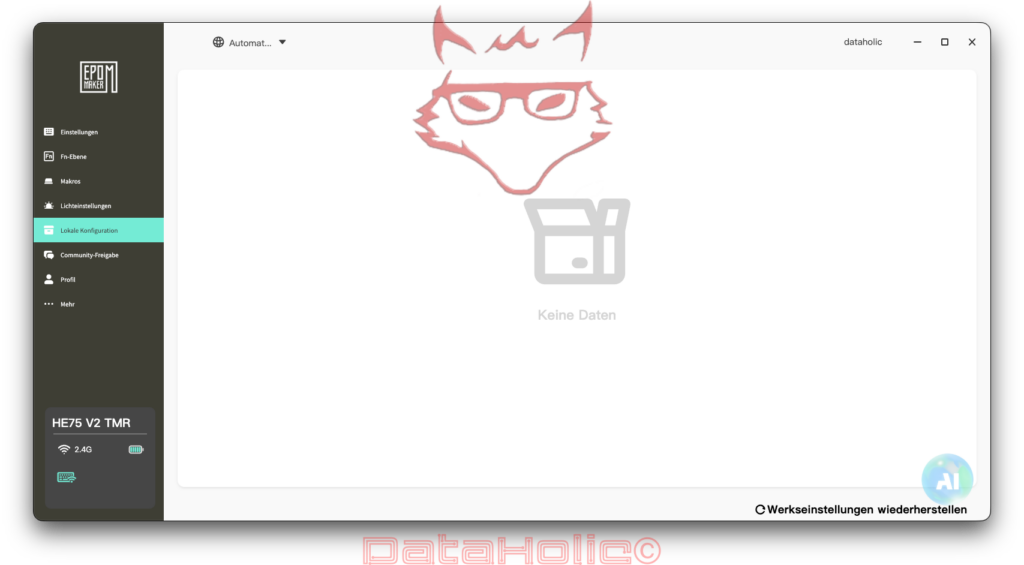
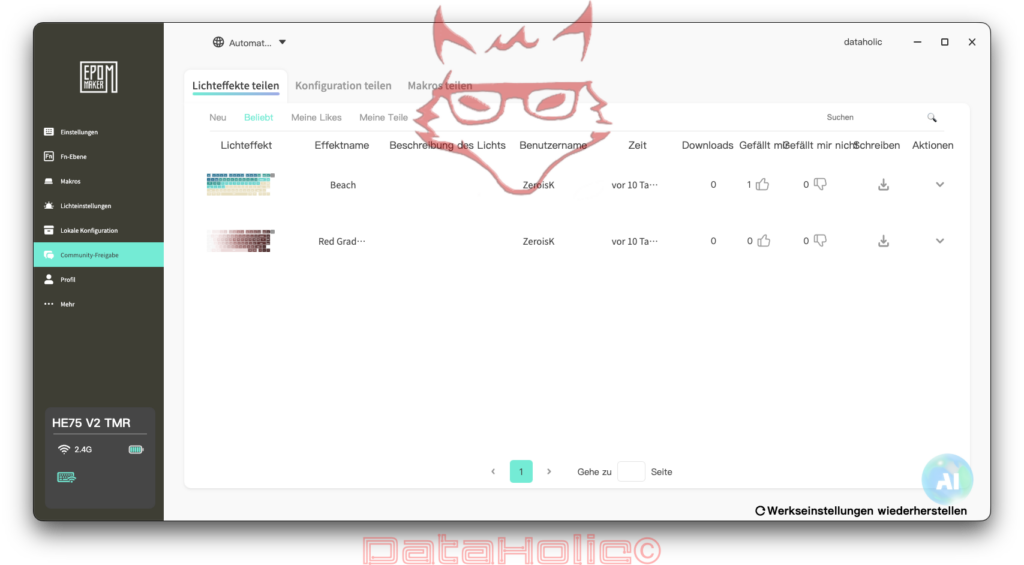
Epomaker supports both its desktop software and a browser-based configuration interface for the HE75 V2 TMR. Key assignments, macros and the advanced magnetic functions can be adjusted there.
The browser option is particularly appealing because it avoids the need for a permanently installed application. With peripherals, that is increasingly close to becoming a quality feature. A keyboard utility does not need to start a second career as an operating system inside the operating system. Once the preferred configuration has been stored, hardware should ideally be allowed to return to simply being hardware.
Factory calibration lowers the initial barrier as well. Even so, after changing magnetic switches or making significant configuration changes, checking calibration remains sensible. The more precisely a system is expected to measure, the more important a clean reference point becomes. The principle is familiar from countless technical fields: a highly precise instrument with the wrong zero point is still a highly precise instrument producing the wrong result.
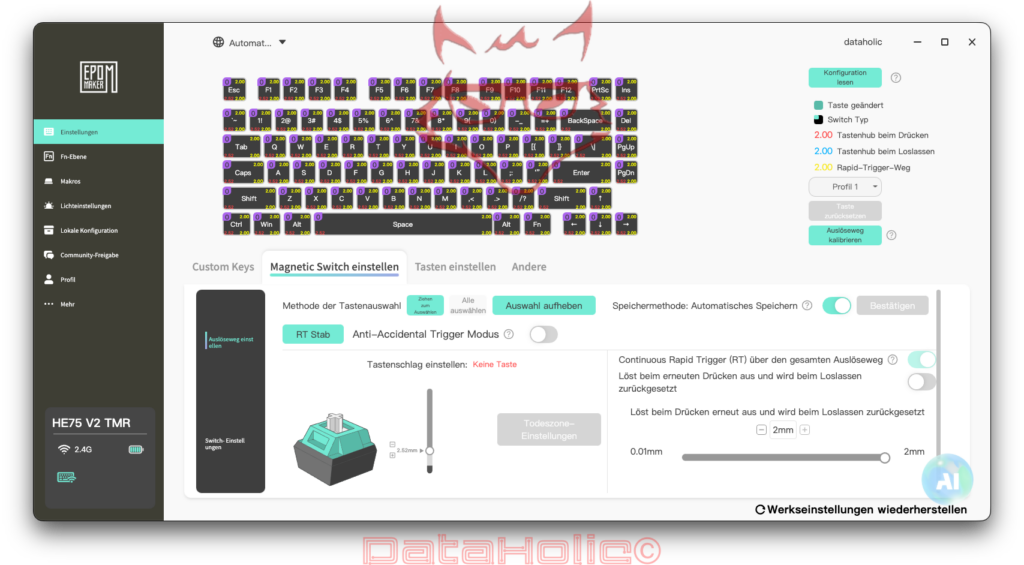
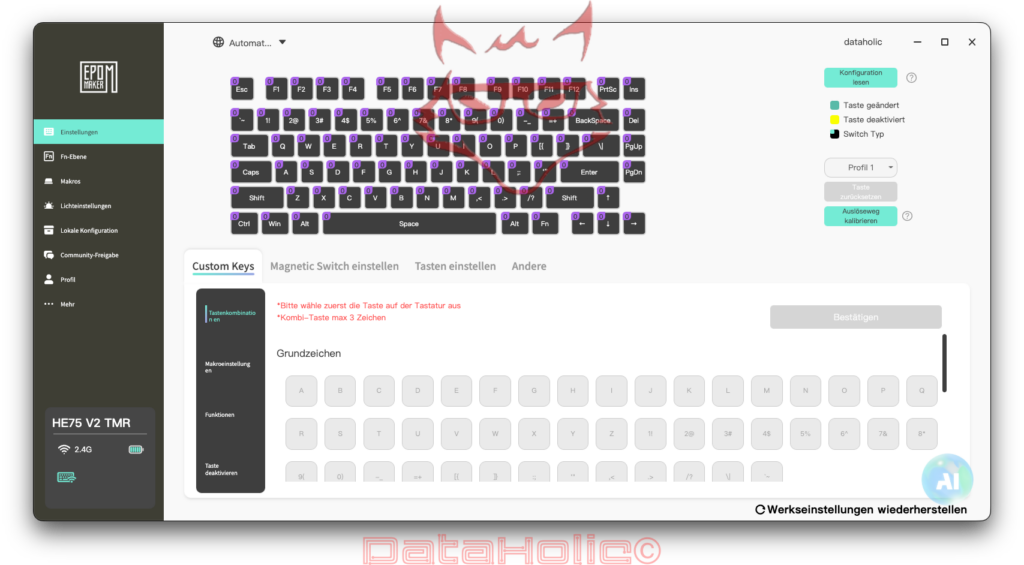
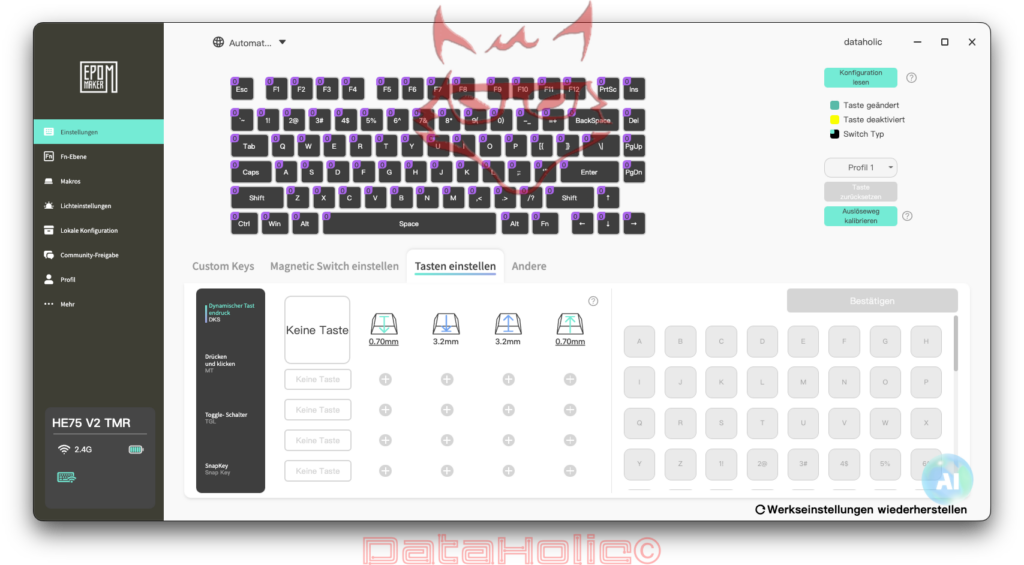
Gaming keyboard or work tool? Surprisingly, the answer is both
The HE75 V2 TMR is clearly designed with gaming in mind, but it refuses the traditional division between gaming hardware and writing tool. That is precisely what makes it interesting. A light linear switch suits rapid input. The compact layout creates room. Rapid Trigger and variable actuation points provide genuine technical advantages in certain games. At the same time, gasket mounting, damping, the rotary knob, a full function row and the ability to use conventional mechanical switches prevent the board from becoming useless as soon as the game closes.
That matters more than it may initially appear. Hardware spends a considerable part of its life outside the idealised scenarios shown on product pages. A keyboard does not experience only ranked matches. Between those moments sit emails, articles, terminal windows, spreadsheets, browsers, image editing and the very serious question of why a particular application insists on using F11 for full-screen mode. Good peripherals should tolerate those transitions without requiring a second device for every different task.
The HE75 V2 TMR handles that balancing act remarkably well. Its biggest limitation is not the technology but the ANSI-US layout. An ISO-DE version would make the concept substantially more attractive for German-speaking users who type extensively.
Conclusion: the most interesting feature is not written in the largest font
At first glance, the Epomaker HE75 V2 TMR looks like another compact RGB keyboard entering an already crowded market. After spending more time with it, that impression changes considerably. Its appeal does not come from one single feature but from the way several technical layers work together.
TMR sensing provides very fine positional detection of the magnetic switches. Rapid Trigger makes meaningful use of that information rather than merely turning it into another small number on a specification sheet. DKS and adjustable actuation points expand the possibilities further. 8,000 Hz polling over USB and 2.4 GHz creates a powerful transmission system, even if its practical benefit always has to be viewed in the context of the entire hardware chain. The large battery prevents those technical ambitions from immediately becoming dependent on a charging cable. At the same time, the hybrid hot-swap PCB opens the door to conventional mechanical switches and protects the keyboard from becoming trapped by its own specialisation.
Almost more importantly, Epomaker has not forgotten the basic qualities that make a keyboard pleasant to use. Exotic sensor technology does not excuse a rattling chassis. 8,000 Hz does not replace properly tuned stabilisers. A 0.01-millimetre sensing resolution does not make hollow acoustics any more enjoyable. That is exactly why the HE75 V2 TMR works as a complete product. The FR4 plate, gasket mount, multiple damping layers and factory-lubricated Creamy Jade switches ensure that the keyboard does not merely react quickly. It also remains pleasant after hours of use.
The white housing and transparent PC keycaps will not suit every taste. With RGB enabled, the appearance sits somewhere between a frozen laboratory instrument and a miniature cyberpunk installation. Subtlety looks different. Even so, the design has a coherent identity and never feels like a conventional keyboard that received an LED strip as a last-minute addition.
The largest criticism remains the ANSI-US layout. For a product that positions itself so convincingly between gaming and productive use, ISO-DE would be more than a niche alternative. It would make the HE75 V2 TMR significantly more attractive to German-speaking users who spend substantial time writing.
The result is a keyboard that offers a remarkable amount of hardware for its category. Not every 0.01-millimetre adjustment will ever be consciously used. Not every system will visibly benefit from 8,000 Hz. SOCD is not suitable for every competitive environment. None of that counts as an argument against the HE75 V2 TMR. Instead, it shows how far modern keyboards have moved beyond simple questions about switch colour and RGB mode.
A final anecdote captures the character of this board rather well. The moment TMR enters the discussion, the conceptual journey quickly leads from a keyboard to magnetic fields, electrical resistance, tunnel barriers and quantum mechanics. A few minutes later, the exact same hardware is once again producing perfectly ordinary letters inside a WordPress editor. Only a few millimetres of key travel separate those two worlds. Technology can be wonderfully absurd.
Notice in accordance with EU transparency requirements:
The Epomaker HE75 V2 TMR featured in this review was provided to us by Epomaker as a non-binding loan unit for testing purposes. This is not paid advertising.
Epomaker had no influence on the content, evaluation or editorial independence of this article. All opinions expressed are based exclusively on our own practical experience.
We would like to thank Epomaker for providing the keyboard and for the trust placed in dataholic.de.