
EPOMAKER HE68 Lite ISO in Review – Hall Effect Grows Up and Loses Its Premium Surcharge
- A keyboard that initially looks far less spectacular than it actually is
- 65 percent: compact, but not amputated
- Plastic instead of metal: less prestige, more pragmatism
- Hall Effect: the magnet replaces the classic electrical contact
- 0.1 millimetres sounds fantastic until the fingers develop their own opinion
- Rapid Trigger: more important than the race for tenths of a millimetre
- SOCD: technically fascinating, competitively not welcome everywhere
- DKS and Mod-Tap: one key no longer has to be just one key
- 8,000 Hz and 128 kHz: impressive figures with diminishing practical returns
- Clear Mag switches: light, smooth and better than the name suggests
- Typing feel: surprisingly mature
- RGB: somewhere between workplace and miniature light show
- Wired, and better for it
- Small details that reveal more about the product than a specification sheet
- Where the cuts were made, and why they barely matter
- Price and market position: this is where things become uncomfortable for more expensive keyboards
- Perhaps the most important point: the keyboard works even without obsessing over numbers
- Conclusion: “Lite” applies more to the case than to the technology
- Notice in accordance with EU transparency requirements:
A keyboard that initially looks far less spectacular than it actually is
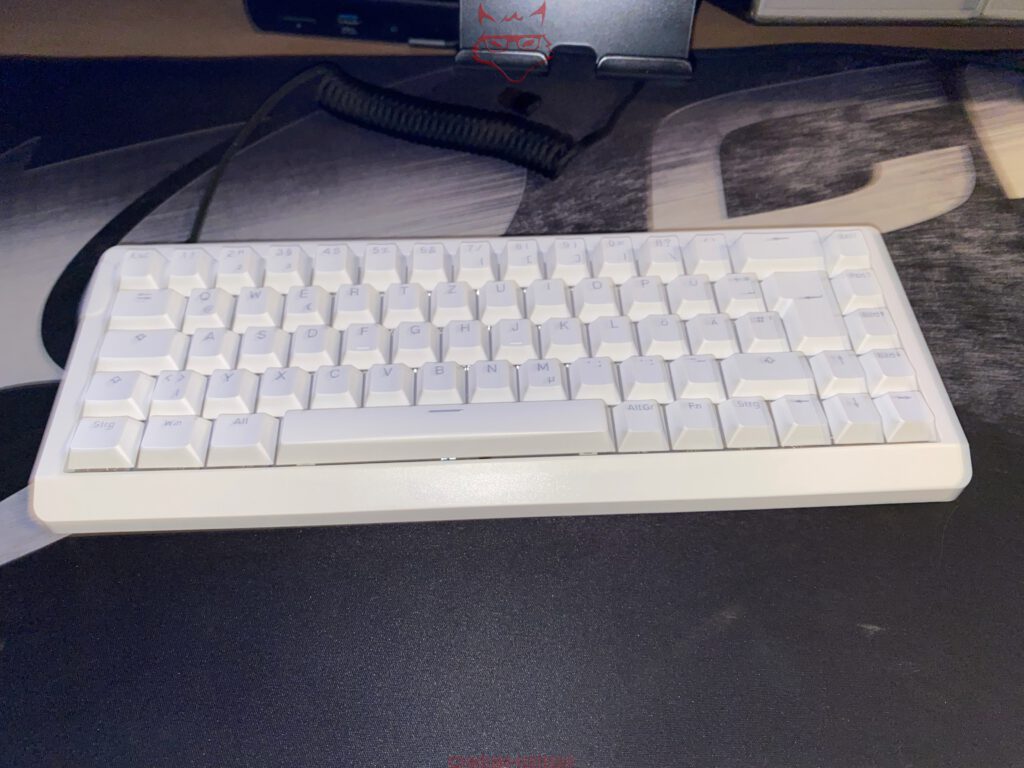
On the desk, the EPOMAKER HE68 Lite ISO initially presents itself with surprising restraint. A white case, white and grey keycaps, compact dimensions and a design that looks more like a clean working tool than a piece of digital combat equipment. With the lighting switched off, the keyboard could easily disappear between a notebook, a graphics tablet and a cup of coffee without demanding much attention. Once connected, however, its character changes. The A-RGB lighting becomes clearly visible throughout the layout, the translucent areas around the keycaps begin to glow and the understated 65-percent keyboard suddenly turns into a considerably more playful piece of hardware. That contrast fits the HE68 Lite ISO remarkably well. Beneath the relatively simple plastic case sits considerably more technology than the first impression suggests. Hall Effect switches, an adjustable actuation point between 0.1 and 3.4 millimetres, Rapid Trigger, SOCD, DKS, Mod-Tap, 8,000 Hz polling and a scan rate of up to 128 kHz read more like the specification sheet of a keyboard from a considerably higher price bracket. Only a few years ago, functions like these belonged to a rather exclusive corner of the gaming market. Today, they are finding their way into devices priced only slightly above better conventional mechanical keyboards. The HE68 Lite is therefore interesting less because of a single feature and more because of one fundamental question: how far can Hall Effect technology be scaled down in price without technical democratisation turning into technical cheapness? That is exactly where this keyboard delivers its biggest surprise. The “Lite” designation initially sounds like the familiar industry formula for “quite a lot has been removed here.” In the case of the HE68 Lite, however, it really means less material luxury with surprisingly little sacrifice in the electronics. The housing is made of ABS, the plate uses polycarbonate, the construction follows a classic tray-mount design and wireless connectivity is absent altogether. Those are understandable cost-saving measures. Sensor technology, signal processing and configuration options, however, have not been reduced to a decorative short version. As a result, the keyboard lands in a category that has become considerably more interesting than the ongoing race for aluminium blocks, brass weights and cases whose mass occasionally approaches that of small household appliances.
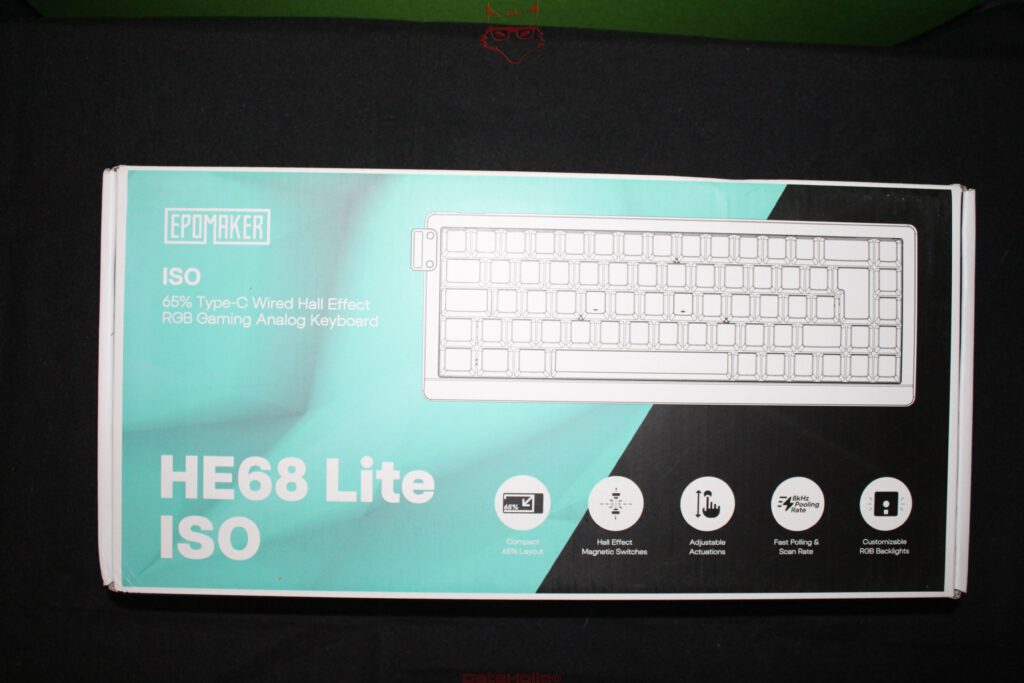
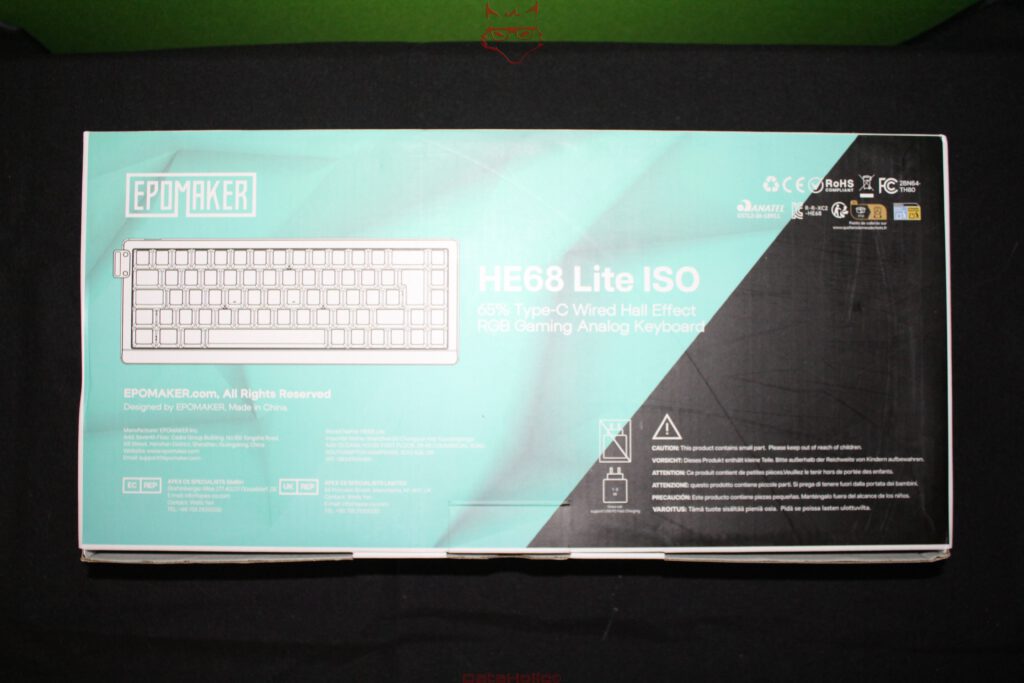
65 percent: compact, but not amputated
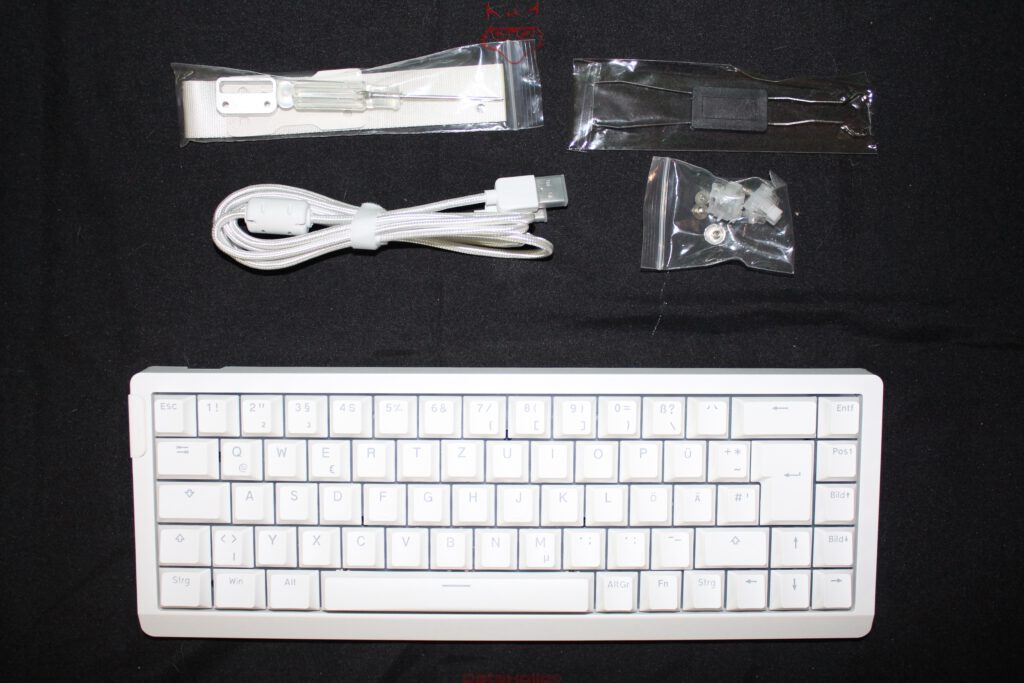
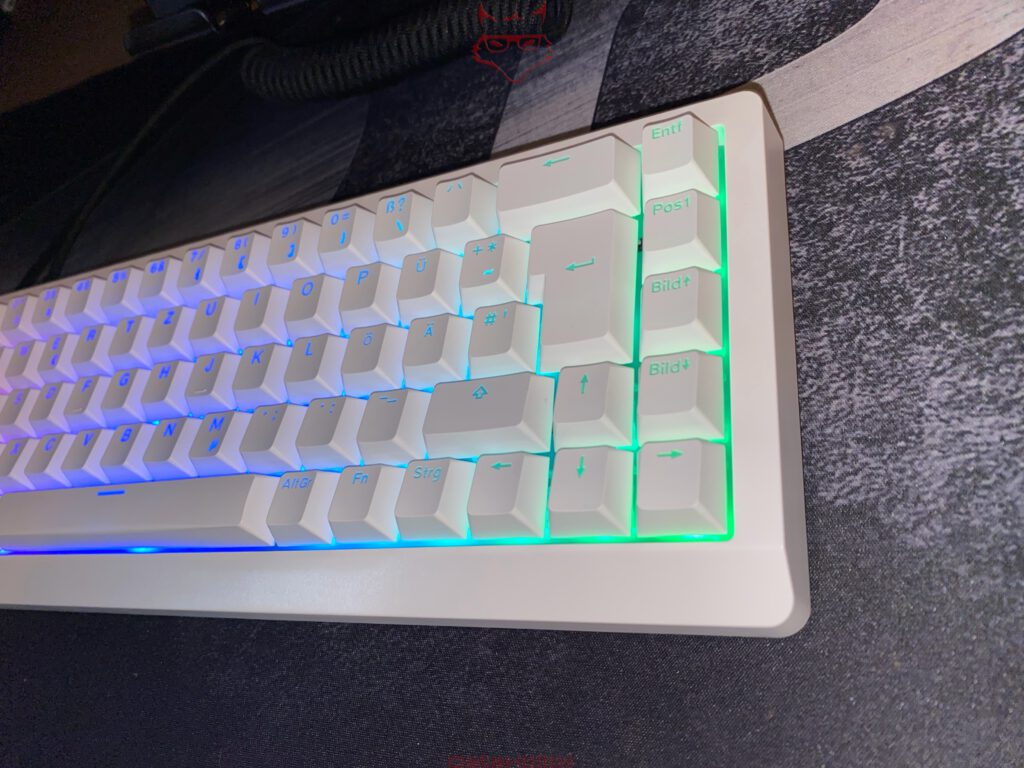
Compact keyboards are a little like small apartments: every square centimetre needs a purpose. With a 65-percent layout, the traditional number pad stays outside, as does the function row. In return, dedicated arrow keys remain, along with a small navigation column containing Delete, Home, Page Up and Page Down. On paper, that difference may sound insignificant, but in everyday use it decides whether a compact keyboard feels pleasantly reduced or unnecessarily complicated. The HE68 Lite ISO strikes a good balance here. Gaming benefits from considerably more room for wider mouse movements, while text editing, file management and navigation do not constantly require Fn combinations. Especially at low mouse sensitivities, the space saved is genuinely relevant. A full-size keyboard can force the right arm surprisingly far outward because the number pad, navigation cluster and outer edge of the chassis all sit between the letter block and the mouse. A 65-percent layout brings both input devices closer together. Ergonomics, after all, are not created solely by wrist rests and typing angles, but also by the position of the arms in front of the body. The German ISO-DE layout is more important than it may initially sound. Many interesting magnetic keyboards launched exclusively in ANSI-US form. For gaming, that is often no major obstacle, but longer German texts quickly start a debate once umlauts, special characters and the large ISO Enter key become relevant. The version tested here solves that problem cleanly. Ä, Ö and Ü sit exactly where expected, the Enter key uses the familiar ISO geometry and even the navigation labels are presented in German. For a keyboard that is not limited to short gaming sessions, that makes a substantial difference. “Form follows function,” architect Louis Sullivan wrote in the 19th century. With compact keyboards, the sentence remains surprisingly accurate today. A small layout only makes sense when the remaining keys are arranged sensibly. On the HE68 Lite, that works convincingly. Losing the F-row is easy enough to accept, while the missing number pad depends entirely on the intended workload. For spreadsheet-heavy work and large columns of figures, another keyboard would be more suitable. For gaming, writing, programming and ordinary desktop work, however, 65 percent remains a very well-balanced size.
Plastic instead of metal: less prestige, more pragmatism
The HE68 Lite uses an ABS plastic housing. In the keyboard world, that sentence can quickly sound like an apology because aluminium has almost become synonymous with quality. Yet the material alone says surprisingly little about the actual construction. A poorly tuned aluminium chassis can sound hollow and produce unwanted resonance, while a properly damped plastic design can deliver a significantly more pleasant acoustic result. EPOMAKER combines the ABS housing with a polycarbonate plate and a total of five damping layers: PRO Sandwich Foam, IXPE Switch Pad, PET Sound Enhancement Pad, Switch Socket Pad and Bottom Foam. At first glance, that sounds like a catalogue filled with foam terminology, but the purpose is very concrete. Every keypress creates mechanical vibrations between switches, plate, PCB and housing. Without damping, part of that energy radiates through the case. The result can range from a bright plastic clack to the infamous hollow echo associated with inexpensive gaming keyboards. Different foam and pad layers alter that resonance behaviour, absorb parts of the energy and reduce high-frequency side noises. EPOMAKER likes to describe the result as “creamy.” An entire dissertation could probably be written on culinary adjectives used for keyboard acoustics. What matters more is that the HE68 Lite sounds far more controlled than its simple enclosure would suggest. Keystrokes are damped, comparatively deep and largely free from unpleasant rattling. Larger keys stand out more clearly acoustically, but without immediately becoming irritating. The plate-mounted stabilisers do not quite reach the calmness of more elaborate enthusiast boards, yet they perform well for this price class. Polycarbonate also has a slightly more forgiving character than harder metal plates. As a result, the bottom-out does not feel unnecessarily sharp. The tray-mount structure remains fundamentally firm and does not provide the springy movement of modern gasket designs, but the overall system feels neither harsh nor cheap. This is where the cost-cutting strategy begins to make sense. Instead of putting money into a heavy metal case, a noticeable portion of the engineering effort has gone into the areas that can actually be felt and heard while typing. “Less is more” is famously associated with Ludwig Mies van der Rohe. On the HE68 Lite, the phrase fits almost suspiciously well. Less case material does not automatically mean less keyboard.
Hall Effect: the magnet replaces the classic electrical contact
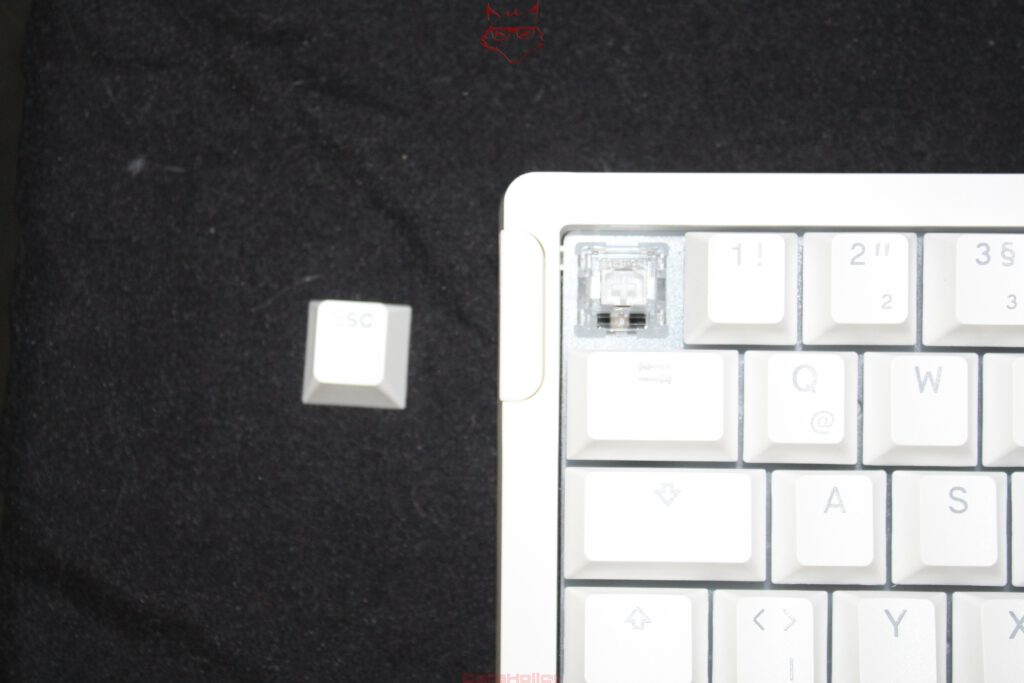
The true technical core sits beneath the keycaps. EPOMAKER’s Clear Mag switches work magnetically and differ fundamentally from traditional mechanical MX-style switches. In a conventional mechanical switch, an electrical contact is closed once the stem reaches a mechanically defined point. For the electronics, there are essentially two states: key not actuated or key actuated. Hall Effect switches follow a different approach. A magnet sits inside the moving stem, while a Hall sensor is positioned on the PCB underneath the switch. The further the key is pressed, the more the magnetic field at the sensor changes. The electronics therefore receive not just a simple on-off signal, but a continuous positional value. This permanent position measurement forms the basis for practically all the functions with which modern magnetic keyboards advertise themselves. The actuation point can be changed because no metal contact fixes the exact position at which a signal must occur. Rapid Trigger can evaluate the direction of movement because the firmware knows whether the key is currently travelling downward or upward again. Multiple actions can even be assigned within a single keystroke. The Hall Effect itself, incidentally, is anything but new gaming magic. Edwin Hall described the underlying physical phenomenon as early as 1879. What is new is the inexpensive and precise integration of corresponding sensors into keyboards.
The Clear Mag switches are linear and factory-lubricated. EPOMAKER specifies an initial force of at least 25 gf, an actuation force of 37 ± 5 gf and a maximum force of 45 gf at bottom-out. Total travel is 3.4 ± 0.1 millimetres. That places the switches on the lighter side. Particularly during fast directional changes or rhythmic inputs, the result feels pleasantly direct. Longer typing sessions are equally smooth, provided the actuation point has not been configured unnecessarily aggressively. The frequently quoted service life of one billion actuations sounds almost absurdly high and should initially be regarded as a manufacturer specification. Technically, however, there is a legitimate reason to expect high durability because signal detection is contactless and no conventional metal contact needs to be mechanically closed with every keystroke.
0.1 millimetres sounds fantastic until the fingers develop their own opinion
One of the most eye-catching figures in the specification sheet is the adjustable actuation range from 0.1 to 3.4 millimetres. The software allows very fine adjustments. On paper, an actuation point of 0.1 millimetres naturally sounds like the ideal setting. Less travel should automatically mean faster response. In practice, biology quickly enters the discussion. Fingers do not float contactlessly above keycaps during use. They rest on them, alter pressure slightly and move by tiny amounts without any deliberate intention to trigger a command. An extremely short actuation distance can quickly turn those movements into inputs. While typing, the result resembles the digital equivalent of a nervous passenger who hits the brake at every bump in the road. For WASD, Shift, Ctrl or individual game-relevant keys, extremely short actuation can make sense. For letters, Escape and other frequently touched keys, a little more reserve is often preferable. That is precisely where Hall Effect technology shows its real advantage: there is no need to use one global setting. Different keys can have different characteristics. A gaming profile can make movement commands trigger extremely early, while chat or function keys require noticeably more travel. That is technically far more interesting than the old question of whether red, brown or blue switches are the better choice. The character of the keyboard is no longer determined solely by the physical switch. Software increasingly becomes part of the switching system.
A small anecdote fits surprisingly well here. With extremely aggressive settings, a Hall Effect keyboard initially feels almost supernaturally fast. A few minutes later, movements suddenly appear that were definitely never intended. The first suspect is traditionally the game, followed by the network connection and eventually personal coordination. The actual cause sits a few millimetres beneath the fingertips: the actuation point was simply configured so short that resting pressure already counted as a command. Speed without control is ultimately just a more efficient way of sending the wrong instruction sooner.
Rapid Trigger: more important than the race for tenths of a millimetre
Even more interesting than a short static actuation point is Rapid Trigger. A traditional mechanical switch normally has both an actuation point and a fixed reset point. After actuation, the key must return far enough before another signal can occur. Hall Effect sensing can make this behaviour dynamic. As soon as the key travels upward by the configured distance, it resets; the moment it begins moving downward again, another input can be registered immediately. Full release is no longer required. This produces a noticeable difference during very fast alternating movements. Counter-strafing in shooters is the classic example: A is released, D is pressed, then the direction changes again. The less unnecessary travel exists between those states, the more immediate the control feels. The same applies to rhythm games and titles that rely on extremely fast repeated inputs. Rapid Trigger is therefore more than a decorative checkbox in the software. It genuinely changes the relationship between finger movement and digital input.
That effect still should not be mystified. A keyboard does not suddenly turn average reaction times into esports-level performance. Network latency, frame rate, display speed, game engine behaviour and, above all, motor precision remain part of the complete response chain. The HE68 Lite can only shorten one section of that chain. What matters is that it does so convincingly. With sensible settings, input feels extremely immediate without requiring the switch itself to become harsh or unpleasantly nervous. That difference is important. Traditional speed switches shorten response through a fixed early actuation point. Hall Effect technology can offer similarly fast or even faster reaction while preserving the full mechanical travel of the switch.
SOCD: technically fascinating, competitively not welcome everywhere
With SOCD, or Snap Key, things become somewhat political. The feature controls how simultaneous opposite directional inputs such as A and D are handled. A conventional keyboard reports both keys, leaving the game to decide what should happen. A priority system inside the keyboard can instead determine which input wins. Under “Last Input Priority,” for example, the most recently pressed direction takes precedence. That enables extremely fast directional changes without requiring the first key to be fully released.
Technically, the concept is clever. In competitive environments, however, it is not permitted everywhere. Counter-Strike 2 became the best-known example of a title in which corresponding input assistance can be undesirable or actively restricted. A hardware function is therefore not automatically legitimate in every tournament simply because the driver offers it.
For the HE68 Lite itself, the relevant point is that EPOMAKER integrates these functions at all. The keyboard does not belong to the luxury price class, yet its software provides tools that only a short time ago were marketed as unique selling points of considerably more expensive models. That says a great deal about how quickly this market is moving. A feature is introduced as revolutionary, copied a year later and shortly afterwards appears in products costing a fraction of the original price. Technology history in fast-forward.
DKS and Mod-Tap: one key no longer has to be just one key
Dynamic Keystroke, or DKS, uses the positional information from the magnetic switches even more consistently. Instead of a single command, one key can contain multiple actions across its travel. A light press could trigger one function, while a deeper press could trigger another. Depending on the implementation, further actions can even be assigned to release points. Conceptually, the keyboard begins to approach an analogue input device.
Especially outside traditional shooters, this opens interesting possibilities. Different press depths can perform different tasks, macros can be structured more compactly and frequently combined functions can be placed on a single key. Mod-Tap follows a related concept: tapping and holding the same key can perform different actions. A quick press may type a character, while holding the key turns it into a modifier.
Not every one of these functions will become part of daily use. That is not a weakness. A modern keyboard is allowed to offer capabilities that are only useful in specific situations. What matters is whether those options are cleanly integrated and easy to disable. The HE68 Lite remains uncomplicated in normal operation. Without extensive configuration, it initially behaves like an ordinary keyboard. The software only reveals the second layer. That restraint is welcome, because an input device should not require a semester of signal processing before the first sentence can be written.
8,000 Hz and 128 kHz: impressive figures with diminishing practical returns
EPOMAKER specifies a USB polling rate of 8,000 Hz and a scan rate of up to 128 kHz. Polling rate describes how frequently the keyboard can transmit its state to the computer. At 1,000 Hz, the theoretical polling interval is one millisecond; at 8,000 Hz, it drops to 0.125 milliseconds. The scan rate, meanwhile, describes the keyboard’s internal reading frequency for key positions and should not be confused with USB polling. Both figures show that the electronics were designed around low latency. EPOMAKER accordingly states a latency figure of 0.125 milliseconds.
Some perspective is still useful. The difference between 125 Hz and 1,000 Hz is technically significant. Between 1,000 and 8,000 Hz, the absolute time saving becomes much smaller. That does not make 8,000 Hz pointless. In a system running very high frame rates, a fast monitor and an optimised input chain, fractions of a millisecond can accumulate into measurable improvements. For normal desktop work, however, no miracle occurs. An email does not suddenly open with philosophical urgency because the keyboard communicates with the USB controller eight times more frequently. The more important point is that high polling rates no longer need to be reserved for premium hardware. The HE68 Lite provides the technical headroom without attaching an equally dramatic price increase.
Clear Mag switches: light, smooth and better than the name suggests
The factory-lubricated Clear Mag switches are one of the keyboard’s stronger elements. Their linear movement is smooth and free from any tactile bump. That suits Hall Effect technology because the electrical actuation point is software-defined anyway. A tactile event at a mechanically fixed position would only partially align with an electronic actuation point that can move freely.
The relatively low spring force makes rapid repeated inputs comfortable, although extremely short actuation settings demand controlled fingers. The transparent upper polycarbonate housing also helps distribute the lighting. The green POM stem and PA base mostly disappear from view once installed, but the material combination makes technical sense: POM offers good sliding characteristics, polycarbonate allows light transmission and the entire design remains economical to manufacture.
EPOMAKER specifies a magnetic flux of approximately 90 ± 10 Gauss in the resting position and 550 ± 50 Gauss at bottom-out, based on the 1.6 mm PCB used in the keyboard. Those figures matter less in daily use than the positional measurement derived from them, but they demonstrate that the “magnetic” part of the name refers to a properly defined sensor system rather than a vague marketing label.
One important issue concerns switch compatibility. Magnetic switches may look externally similar to MX-compatible switches, yet a Hall Effect PCB cannot simply read arbitrary mechanical MX switches. The PCB expects a magnetic field, not a conventional electrical contact. Magnetic switches from different manufacturers can also differ in magnet placement and field strength. In this context, “hot-swap” does not mean universal compatibility. The keycaps are considerably easier to replace thanks to the familiar cross-shaped stem than the switches themselves. That limitation belongs to any fair assessment of current Hall Effect platforms.
Typing feel: surprisingly mature
For a gaming keyboard at the lower end of the price spectrum, a functional but rather unsophisticated typing feel would hardly be surprising. The HE68 Lite performs better than expected. The linear switches move lightly, the Cherry-profile keycaps provide familiar finger geometry and the multi-layer damping prevents the plastic case from amplifying every keypress.
Sound remains subjective, of course. Anyone who prefers heavy tactile switches or pronounced clicking will deliberately get something different here. The HE68 Lite aims for a smooth, fast travel and a relatively soft bottom-out.
Interestingly, longer writing sessions benefit from a more conservative configuration. Setting the actuation point somewhere in the middle range reduces accidental characters considerably while the light spring still keeps fatigue low. That creates an unusual degree of versatility. For gaming, one profile can be configured very aggressively; for writing, the same hardware can behave much more calmly. In the past, changing that characteristic would have required a different switch set or an entirely different keyboard. Today, a software adjustment is enough.
That may ultimately be the greater revolution of Hall Effect technology. Pure speed is not the only thing changing the keyboard market. The more significant development is the separation of electrical actuation behaviour from a mechanically fixed switch geometry.
RGB: somewhere between workplace and miniature light show
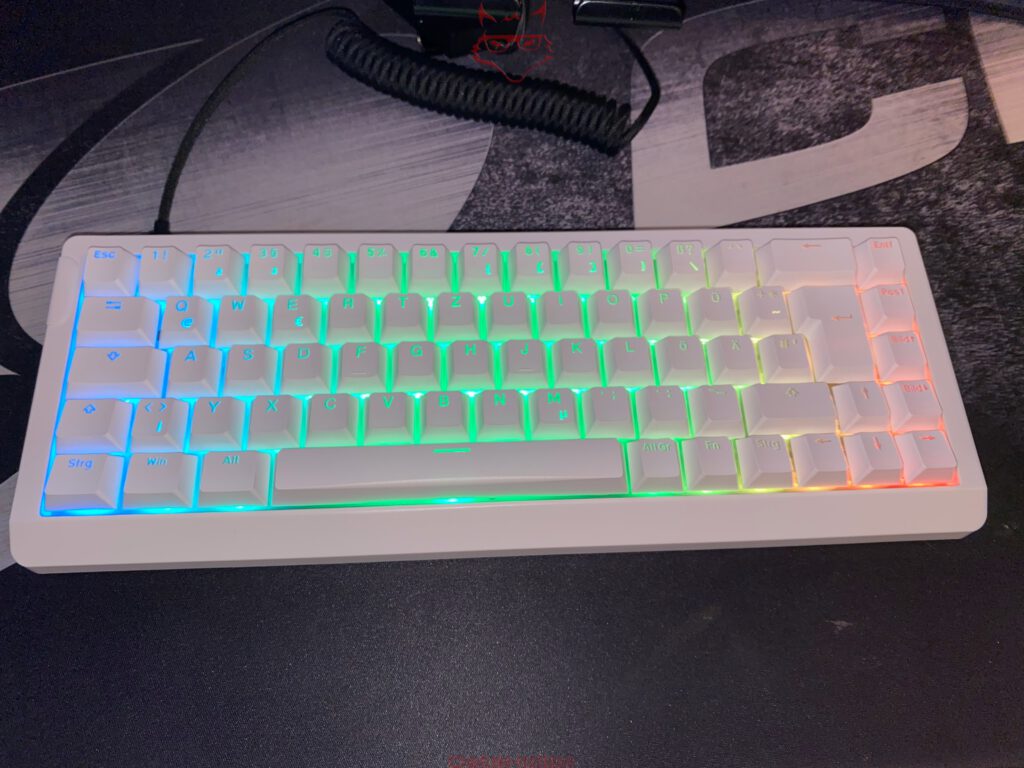
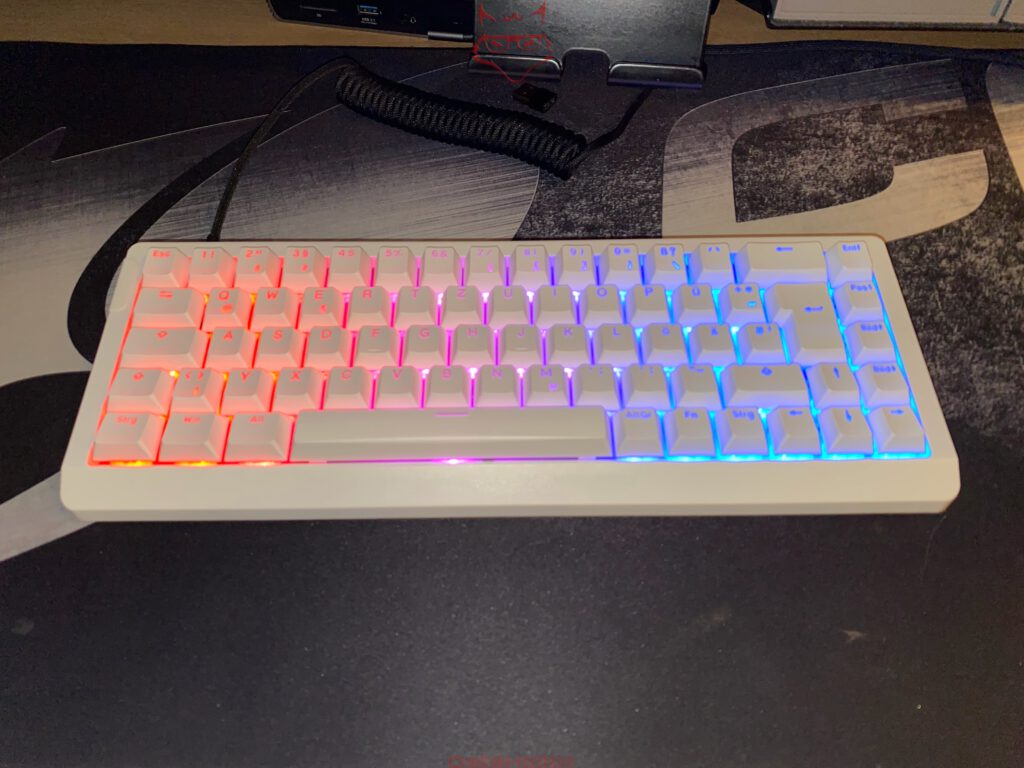
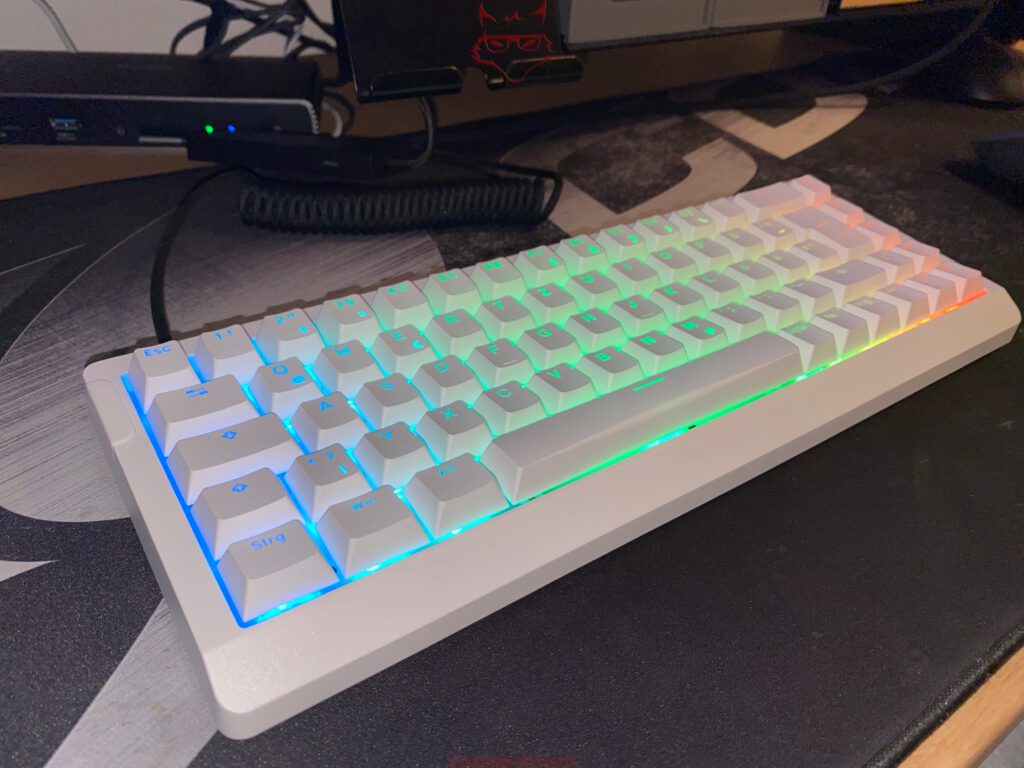
With the lighting switched off, the white HE68 Lite is almost understated. Once illumination is active, that changes immediately. South-facing A-RGB LEDs sit beneath every key and, combined with the light-coloured keycaps, produce a strong underglow effect. Depending on the chosen mode, colour gradients travel across the board, react to keypresses or remain static in a selected colour. A rainbow profile quickly transforms the compact chassis into a miniature light show. That is naturally a matter of taste, and the lighting can also be disabled completely.
On the white version, illumination has one practical side effect: legends become easier to identify in darker environments. The light materials also allow some illumination to spill between the keycaps. Perfectly isolated points of light are therefore not the goal here. That is more of a characteristic than a flaw. Anyone who sees RGB exclusively as precise accent lighting may prefer a darker construction. As a visible contrast to the otherwise restrained white case, however, the lighting works extremely well.
Wired, and better for it
Bluetooth is absent. So is 2.4 GHz wireless. The HE68 Lite communicates exclusively through USB-C. At a time when even inexpensive keyboards often offer three connection methods, that initially seems old-fashioned. For this concept, however, it makes sense.
A device built around 8,000 Hz polling, very low latency and maximum signal consistency does not necessarily need a battery and wireless controller. Plug in the cable, the connection is established and power remains permanently available. No battery level, no sleep mode, no debate over which polling rate is actually supported wirelessly.
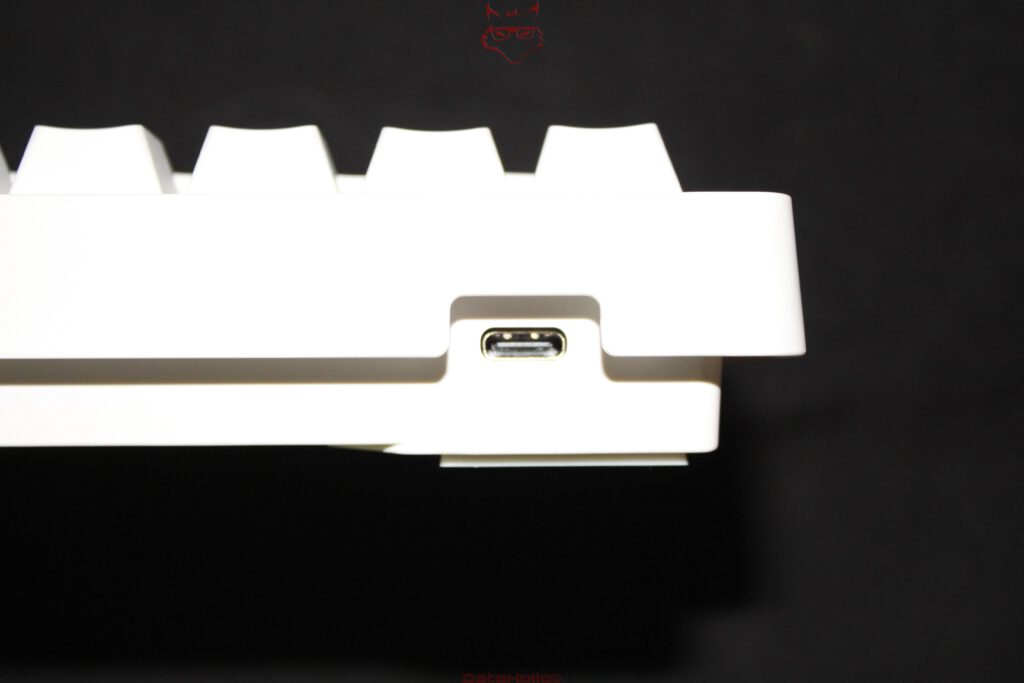
The USB-C port sits centrally, or slightly recessed, along the rear edge of the case and remains easy to access. The included cable does its job, although any suitable USB data cable can be used instead. On a stationary desk, the wired connection is hardly restrictive. For frequently changing devices or mobile use, wireless would be more convenient. The HE68 Lite, however, clearly prioritises response time and price.
Small details that reveal more about the product than a specification sheet
The included accessories are surprisingly interesting. Alongside the cable and combined keycap/switch puller, EPOMAKER includes spare switches, screws, a small screwdriver and even hardware for attaching a side-mounted wrist strap. The strap is one of those accessories that initially produces a slight raised eyebrow. A keyboard is, after all, rarely carried through a pedestrian zone like a compact camera. At the same time, the detail shows that EPOMAKER deliberately designed the housing with corresponding attachment points. For LAN parties, tournaments or frequently changing workplaces, the strap can genuinely be useful. Necessary? No. Charmingly strange? Absolutely.
More importantly, the board shows a welcome degree of serviceability. Spare switches and tools at least indicate that the product was not conceived as a completely sealed disposable block. In affordable hardware, that is far from guaranteed. A failed switch does not automatically need to mean the end of the entire keyboard. Magnetic technology already reduces mechanical contact wear, but replaceability remains a useful advantage.
Where the cuts were made, and why they barely matter
There are compromises, of course. The plastic housing does not provide the same sense of mass as a CNC-machined aluminium frame. There is no adjustable typing angle. Connectivity is wired only. Plate-mounted stabilisers are functional, but not the highest level of keyboard construction. The software also does not match the visual polish and organisation of the best web-based configurators. Anyone who already owns a large collection of conventional MX switches cannot simply install them here either.
The more important question is where EPOMAKER did not cut costs. The central Hall Effect functionality remains intact. Actuation can be adjusted very finely, Rapid Trigger is present, SOCD is implemented, DKS and Mod-Tap are available, N-key rollover is supported and the internal signal processing is designed for high speed. The PBT keycaps are also not something to take for granted at this price. Add the elaborate sound damping and the priorities become clear.
The savings mostly affect material luxury and additional convenience, not the technical core.
That is probably the most sensible definition of a “Lite” product: the essentials remain, prestige is removed.
Price and market position: this is where things become uncomfortable for more expensive keyboards
At the time of research, the HE68 Lite in ISO-DE form was listed in EPOMAKER’s German store at around 71 euros, although international prices can vary and short-term changes are always possible. That places it in a segment still crowded with conventional mechanical gaming keyboards. Only a few years ago, the combination of Hall Effect sensing, Rapid Trigger and a configurable actuation point would easily have cost several times as much.
That is why the HE68 Lite is interesting not only as an individual product, but also as evidence of a broader market shift.
Hall Effect is no longer exclusive high-end technology. Sensors, controllers and firmware have become inexpensive enough to appear in keyboards whose price barely needs justification. For established premium manufacturers, that becomes increasingly uncomfortable. Aluminium housings, better software, more precise stabilisers and superior overall construction remain legitimate reasons for higher prices. Simply offering Rapid Trigger or 8,000 Hz polling, however, is no longer sufficient as a premium argument.
The HE68 Lite shifts expectations. That is what regularly happens when technology reaches the mass market. Yesterday’s innovation becomes tomorrow’s standard equipment.
Perhaps the most important point: the keyboard works even without obsessing over numbers
Technical products make it tempting to build an entire verdict around extreme figures. 0.1 millimetres. 8,000 Hz. 128 kHz. 0.125 milliseconds. One billion keystrokes. Numbers like these look excellent on packaging.
The real quality of the HE68 Lite, however, is that it remains convincing even when all those superlatives are ignored. The case sits firmly on the desk. The layout makes sense. The switches feel pleasant. The keycaps are decent. The acoustic damping is better than expected. The lighting works cleanly. The German ISO layout makes the keyboard straightforward in daily use. That is what separates a useful technical platform from a collection of attractive specification-sheet values.
A keyboard with 8,000 Hz polling that sounds bad, has unstable keys or becomes irritating during writing would simply be a bad keyboard with fast USB communication. The HE68 Lite avoids that mistake. It works first as a keyboard and only then as a highly configurable input system.
That order matters.
Conclusion: “Lite” applies more to the case than to the technology
The EPOMAKER HE68 Lite ISO belongs to that category of hardware where the price gets mentally rechecked several times during testing. Not because the product is flawless, but because the technical feature set has travelled surprisingly far down the price ladder. The ABS housing immediately reveals where costs were reduced. Tray-mount construction, plate-mounted stabilisers, the absence of wireless connectivity and the fixed typing angle also make clear that this is not a multi-hundred-euro enthusiast model.
Then the typing starts.
The Clear Mag switches move lightly and smoothly, the five damping layers prevent unpleasant chassis resonance and the 65-percent ISO-DE layout proves impressively practical in everyday use. Then the software opens, and the simple white keyboard turns into an input system whose behaviour can be altered within extremely small movement ranges. Actuation from 0.1 to 3.4 millimetres, Rapid Trigger, adjustable dead zones, SOCD, DKS and Mod-Tap are not cosmetic extras. They genuinely change when and how an input is generated.
Strangely enough, one of the keyboard’s greatest strengths is the freedom not to use everything aggressively. Not every key needs a 0.1-millimetre actuation point. Not every game benefits from SOCD. Not every PC needs 8,000 Hz polling. The HE68 Lite does not force any of these functions into daily use. It simply provides the tools and works equally well with sensible, less extreme settings. That makes it more than a specialised shooter keyboard. It also works for extended writing sessions and ordinary desktop tasks.
The real winner is therefore not an individual benchmark, but the overall concept. EPOMAKER reduced cost in the expensive areas without cutting exactly where the keyboard gets its identity. Plastic instead of aluminium is acceptable. One cable instead of three connection methods is acceptable as well. Sacrificing Hall Effect sensing, decent switches, PBT keycaps and extensive configuration would have been far more problematic. The priorities are right.
And then there is the name. “HE68 Lite” almost sounds apologetic. After a few days, the designation becomes slightly amusing. The “Lite” part mostly applies to the housing, not to the technology underneath.
Perhaps an old engineering principle fits better: the best design is not the one to which nothing more can be added, but the one from which nothing essential should still be removed.
Quite a lot has already been removed from the HE68 Lite.
Fortunately, the important parts are still there.
Notice in accordance with EU transparency requirements:
The EPOMAKER HE68 Lite ISO featured in this review was provided to us by EPOMAKER as a non-binding loan unit for testing purposes. This does not constitute paid advertising.
EPOMAKER had no influence on the content, evaluation or editorial independence of this article. All opinions expressed are based solely on our own practical experience.
We would like to thank EPOMAKER for providing the keyboard and for the trust placed in dataholic.de.