
EPOMAKER GX1 Review: When a Keyboard Manufacturer Suddenly Wants to Know What Gaming Should Sound Like
- Open Back: The Most Important Feature Is Almost Hidden on the Spec Sheet
- 50 Millimetres Are No Guarantee of Sound Quality
- Spatial Presentation Instead of an Acoustic Wrecking Ball
- 25 Milliseconds: Why 2.4 GHz Matters More Than Bluetooth for Gaming
- A Cable Is Not a Surrender for the GX1
- Two Microphones and a Surprisingly Sensible Decision
- 320 Grams: Comfort Is More Than a Number on a Scale
- Plastic, Metal and a Red Exoskeleton Look
- RGB: Attractive, Completely Unnecessary and Surprisingly Expensive for the Battery
- 2,000 mAh and Up to 70 Hours: A Larger Battery Than Expected
- Software: Function Before Beauty
- Gaming Is Only Half the Story
- An Affordable Headset With Surprisingly Few Signs of Cost Cutting
- Conclusion: The First Headset Feels Surprisingly Little Like a First Attempt
- Transparency notice in accordance with EU requirements:
EPOMAKER is one of those manufacturers whose name has so far triggered a fairly reliable association: keyboards. Mechanical switches, Hall Effect, TMR, unusual layouts, keycaps and a product release cadence that occasionally raises the suspicion that somewhere in Shenzhen there must be a machine that spits out new keyboards made of aluminium, plastic and switches overnight. With the GX1, EPOMAKER ventures quite a long way outside that familiar territory. After all, a gaming headset is not simply a keyboard with two speakers attached to a headband. Acoustics, wireless technology, microphones, ergonomics, signal processing and power management all have to work together. On top of that, the company is entering a market where Logitech, Razer, SteelSeries, HyperX, Corsair and numerous other manufacturers have been competing for heads and ears for years.
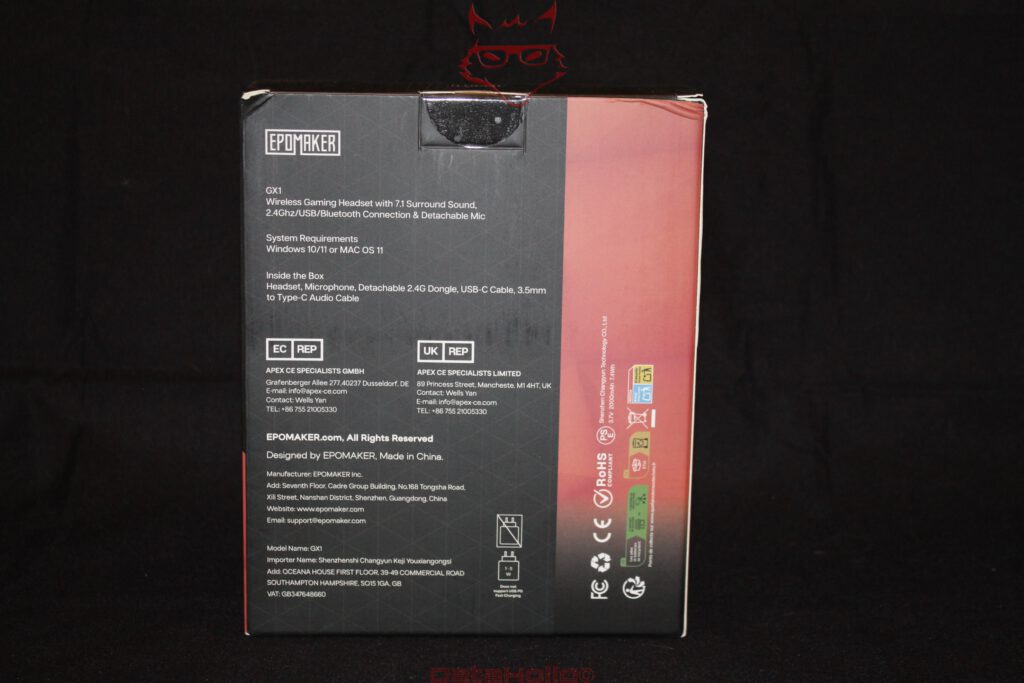
That is precisely where EPOMAKER enters with a headset that currently costs around 50 US dollars and offers an almost suspicious amount on paper. 50 mm drivers, open-back earcups, virtual 7.1 surround sound, 2.4 GHz wireless, Bluetooth, wired operation, two microphone solutions, RGB lighting and a 2,000 mAh battery sound more like a feature list created during a product meeting that ended with the question: “What else could we possibly put in there?”
The real surprise, however, is not the length of that list. EPOMAKER could easily have built an ordinary closed-back gaming headset, added some RGB and called it a day. Instead, the GX1 uses an open-back design. That decision defines the character of the headset far more strongly than the lighting, virtual surround sound or the size of its drivers.
That makes the GX1 an interesting debut. Not because EPOMAKER is attempting to overtake established competitors with spectacular technology, but because it creates an unusually complete system for comparatively little money, with technical decisions that fit together surprisingly well.
Open Back: The Most Important Feature Is Almost Hidden on the Spec Sheet
Closed-back gaming headsets dominate the market for good reason. A closed earcup provides at least some isolation from ambient noise, keeps much of the generated sound inside the cup and makes it easier to achieve a powerful bass response. The downside is often a narrower sense of space and poorer ventilation.
The GX1 takes the opposite approach. Behind the large grilles on the earcups, the dynamic 50 mm drivers do not operate inside an acoustically sealed chamber. Air and sound can escape through the rear. At first glance, that might seem like a minor construction detail, but it significantly changes the way the headset sounds.
A speaker driver moves air. Its diaphragm oscillates forwards and backwards, creating pressure fluctuations on both sides. In a closed earcup, the rearward energy has to be controlled within a defined volume. In an open design, that pressure can equalise much more freely. The result is often a more airy presentation with a soundstage that feels considerably more spacious.
That is precisely where one of the GX1’s greatest strengths lies.
Games do not sound as though every effect is happening just a few centimetres away from the eardrum. Environmental sounds have room to breathe. Voices occupy more convincing positions in the soundscape, footsteps are easier to separate from one another and music benefits from a presentation that feels less confined. This is not genuine surround sound, nor is it some form of acoustic magic. Two drivers remain two drivers. The brain performs a substantial part of spatial interpretation by analysing differences in level, timing and frequency between both ears.
The open housing, however, provides an exceptionally pleasant foundation for exactly that.
The price of this design is just as physical as it is unavoidable: isolation is not one of the GX1’s talents. Sounds from the room remain audible, and music also escapes to the outside world. For a late-night gaming session in the same room as someone trying to sleep, an open-back headset is about as diplomatic as a mechanical keyboard fitted with clicky switches.
The openness does provide an everyday advantage that receives surprisingly little attention in the gaming world. The acoustic environment never disappears completely. A doorbell, telephone, voices or other sounds in the room remain perceptible. In a quiet office or gaming room, that can be considerably more pleasant than the artificial isolation created by a strongly sealed headset.

50 Millimetres Are No Guarantee of Sound Quality
“50 mm drivers” looks excellent on a box. A larger number appears more impressive than a smaller one, after all. Acoustics, however, has the unfortunate habit of refusing to automatically agree with marketing departments.
The diameter of a driver alone says very little about its actual quality. Diaphragm material, mass, magnetic drive system, voice coil, damping, enclosure volume and tuning all play equally important roles. An excellently engineered 40 mm driver can easily demonstrate to a poorly tuned 50 mm model where the acoustic hammer hangs.
The GX1’s 50 mm drivers nevertheless make sense. The specified frequency response of 20 Hz to 20 kHz corresponds almost exactly to the conventional range of human hearing and is refreshingly unspectacular. There are no fantasy specifications extending to 40 or 50 kHz that look impressive on a box while offering little practical relevance to human ears.
Sonically, the GX1 avoids an extreme V-shaped tuning with enormous bass and aggressively boosted treble. That is a positive thing. Low frequencies have substance, although the open construction means they are not delivered with the physical pressure of a closed-back bass monster. Explosions have body, electronic music retains its foundation and engine sounds do not become thin. At the same time, the bass does not constantly attempt to bury every other frequency beneath an acoustic carpet.
The midrange benefits from this restraint. Voices remain present, dialogue stays intelligible and instruments can be separated convincingly. Games with dense soundscapes benefit particularly from this approach. Once music, ambience, dialogue and effects occur simultaneously, maximum bass output becomes far less important than a headset’s ability to keep those elements distinct.
The GX1 handles that surprisingly well.
There is enough energy in the upper frequencies to ensure footsteps, metallic sounds and smaller details do not disappear. At the same time, the tuning does not constantly become sharp or fatiguing. At very high volumes, the headset loses some of its composure. That is neither surprising nor particularly dramatic at this price point. Normal listening levels are far more relevant, and this is where the GX1 produces a balanced sound that feels considerably more mature than its price and gaming aesthetics initially suggest.
Spatial Presentation Instead of an Acoustic Wrecking Ball
A good gaming headset does not need to reproduce an explosion with enough force to make the desk require a structural engineer afterwards. It is often far more important that different sound events can be distinguished spatially.
Once again, the open construction pays off.
Shooters provide convincing directional information. A sound coming from behind and to the left does not merely feel quieter on the right side; it occupies a recognisable position within the virtual soundstage. Games with sophisticated audio engines benefit particularly strongly.
This is also where the advertised 7.1 surround sound deserves a critical look. There are not eight discrete speakers positioned around the head inside the GX1. The surround effect is created through digital signal processing. The audio signal is altered so that timing and frequency information creates the impression of sounds arriving from different directions.
That can certainly be enjoyable in films and atmospheric games. Rooms appear larger, effects spread more broadly across the soundstage and a single-player game can gain a more cinematic presentation.
For competitive gaming, however, more processing does not automatically mean better positioning.
If a game already generates high-quality binaural or object-based audio, adding another layer of virtualisation can actually blur positional information. A precisely calculated position is effectively interpreted for a second time. It is a little like seasoning a dish that has already been seasoned. Occasionally, something wonderful happens. Occasionally, everything just tastes of pepper.
Stereo should therefore never be considered an inferior operating mode. With the GX1, the combination of stereo playback and the open housing is particularly convincing.

25 Milliseconds: Why 2.4 GHz Matters More Than Bluetooth for Gaming
The GX1 supports three fundamental connection methods: 2.4 GHz wireless, Bluetooth and cable. This versatility initially sounds like a matter of convenience, but there is a technical reason behind it.
Bluetooth works extremely well for smartphones, tablets and music. For time-sensitive gaming, Bluetooth audio is more problematic because encoding, transmission, buffering and decoding introduce additional latency. EPOMAKER specifies Bluetooth latency between 34 and 200 milliseconds depending on the operating conditions. That enormous range alone explains why Bluetooth should not be the first choice for fast-paced games.
For the proprietary 2.4 GHz connection, however, EPOMAKER specifies 25 milliseconds.
Twenty-five milliseconds equals 0.025 seconds. On paper, even that sounds like a measurable delay, but in practice the value is low enough to keep image and sound closely synchronised. A weapon fires and its sound does not appear to follow a perceptible moment later. Lip movements and speech do not visibly drift apart.
The included wireless receiver therefore provides the most important connection for PCs and consoles. Support extends to devices including PC, Mac, PlayStation 4, PlayStation 5 and Nintendo Switch. Xbox Series consoles remain dependent on wired operation because of Microsoft’s wireless architecture.
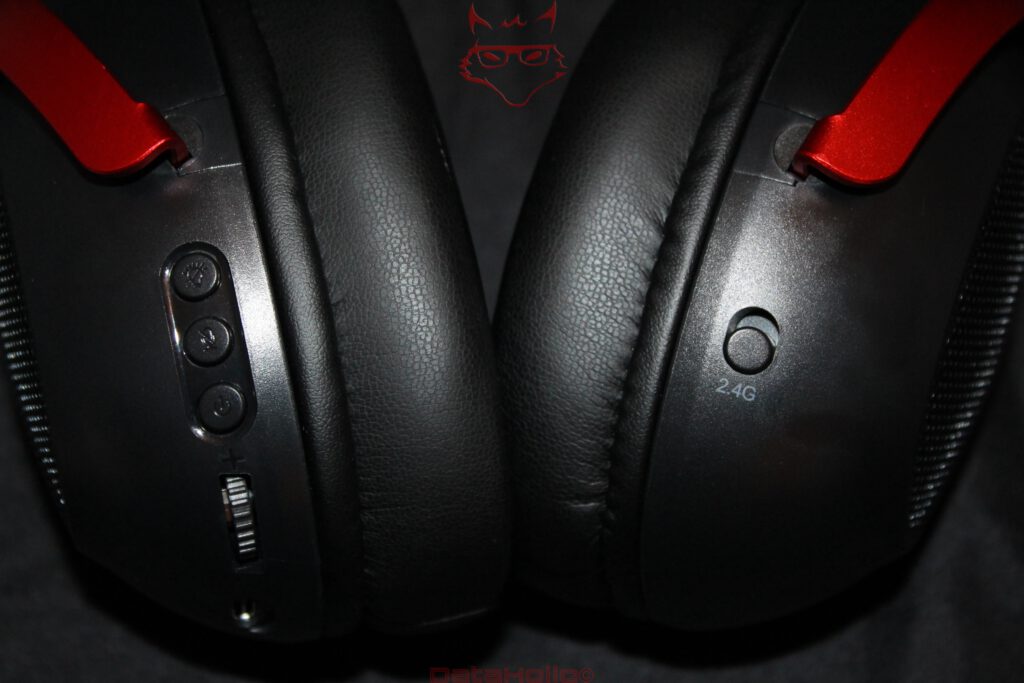
The physical switch between 2.4 GHz and Bluetooth is particularly appealing precisely because it is so uneventful. There is no guessing which source currently has priority and no intelligent switching system occasionally trying to be more intelligent than its owner. A switch determines the mode. Done.
Sometimes the best user interface really is a piece of plastic with two positions.
A Cable Is Not a Surrender for the GX1
Wireless headsets have spent years making cables look almost like a symbol of technological regression. The GX1 treats wired operation with refreshing pragmatism.
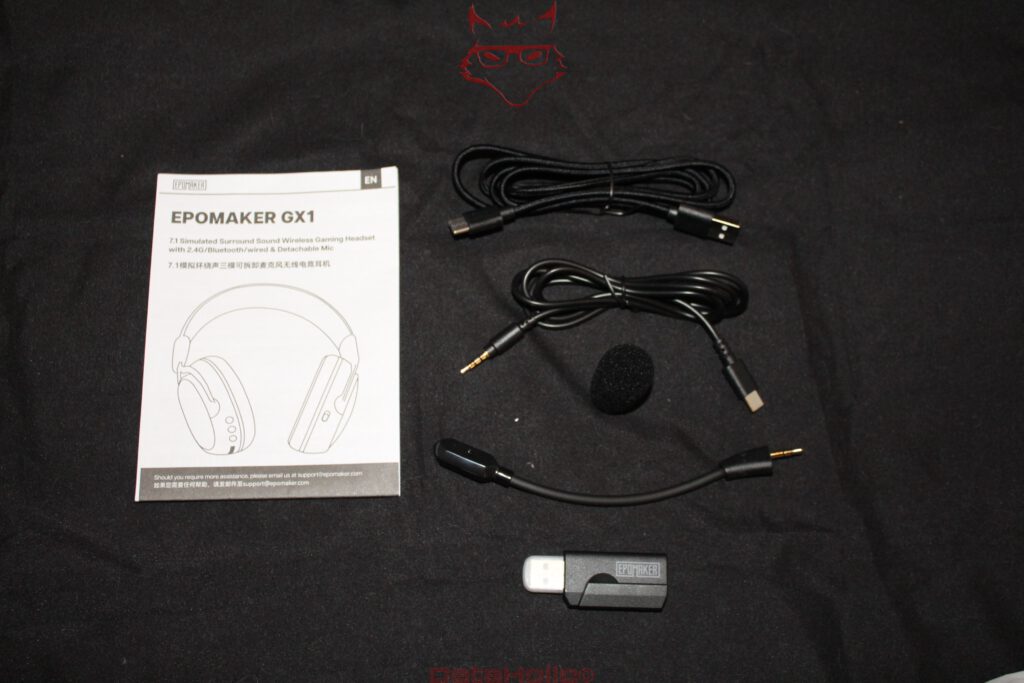
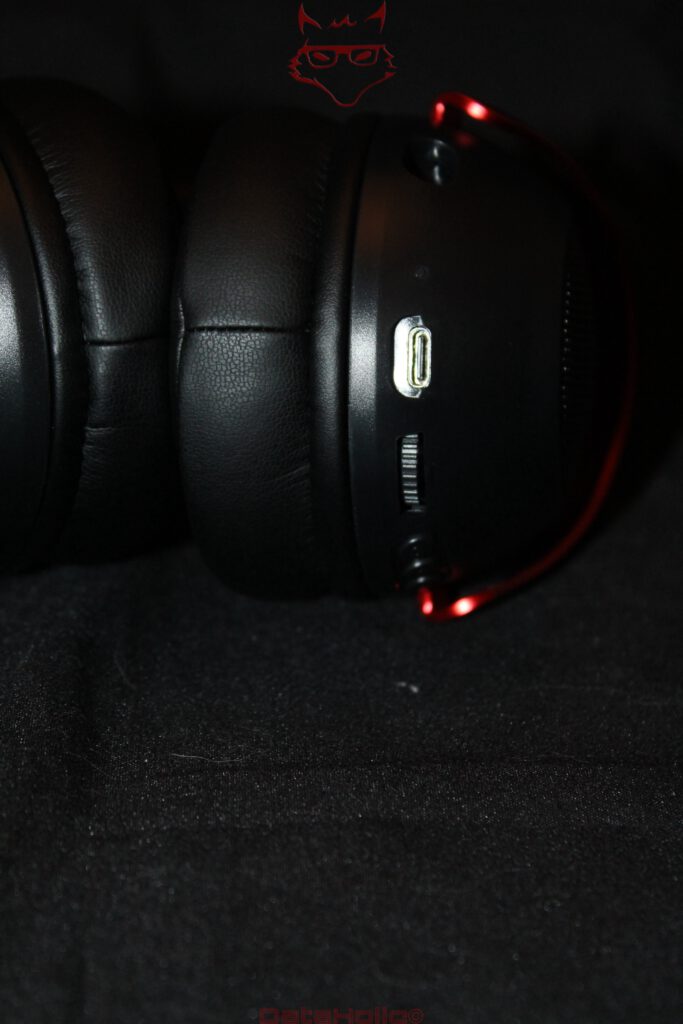
The package includes both a USB-A to USB-C cable and a USB-C to 3.5 mm connection. This means the headset remains usable when wireless operation is undesirable or when the battery happens to be empty. It can also be charged while in use.
That sounds trivial, but it prevents one of the classics of wireless peripherals: the battery dies at exactly the wrong moment, turning a wireless product into a remarkably decorative piece of plastic for the next few hours.
With the GX1, an empty battery simply results in an involuntary return to 2010: plug in the cable and continue.
This redundancy is one of the headset’s most sensible qualities. Bluetooth covers mobile devices, 2.4 GHz handles latency-sensitive gaming and the cable remains a universal fallback.
Two Microphones and a Surprisingly Sensible Decision
EPOMAKER also takes an unusually comprehensive approach to the microphone system. There is an integrated microphone inside the headset, while a detachable boom microphone with ENC is also included.
ENC stands for Environmental Noise Cancellation. Unlike ANC on the playback side, ENC is not intended to make the room quieter for the ears. Instead, it attempts to reduce unwanted ambient noise in the microphone signal. Fan noise, air conditioning and relatively constant background sounds can therefore be attenuated.
No magic takes place here.
A keyboard sitting directly in front of the microphone remains a keyboard sitting directly in front of the microphone. Particularly hard keystrokes and mouse clicks can still be transmitted. Signal processing can reduce interference, but it cannot abolish acoustic reality.
The detachable boom microphone has one crucial constructional advantage: it sits closer to the mouth. This allows the voice to be captured at a higher useful level while more distant sounds are relatively quieter. It is a simple physical advantage that even sophisticated algorithms struggle to overcome.
For Discord, TeamSpeak, in-game chat and ordinary conversations, the design provides useful speech intelligibility. It does not replace a studio microphone, and expecting that from a headset in this price category would be rather absurd. Voices remain sufficiently clear, while ENC primarily helps to reduce consistent background noise.
Removing the boom microphone does not eliminate microphone functionality altogether because the integrated microphone remains available. The voice then sounds more distant and less immediate, but the solution is highly practical for spontaneous calls. At the same time, the microphone arm disappears completely when the GX1 is used purely for listening to music.
Small decision, substantial everyday benefit.
320 Grams: Comfort Is More Than a Number on a Scale
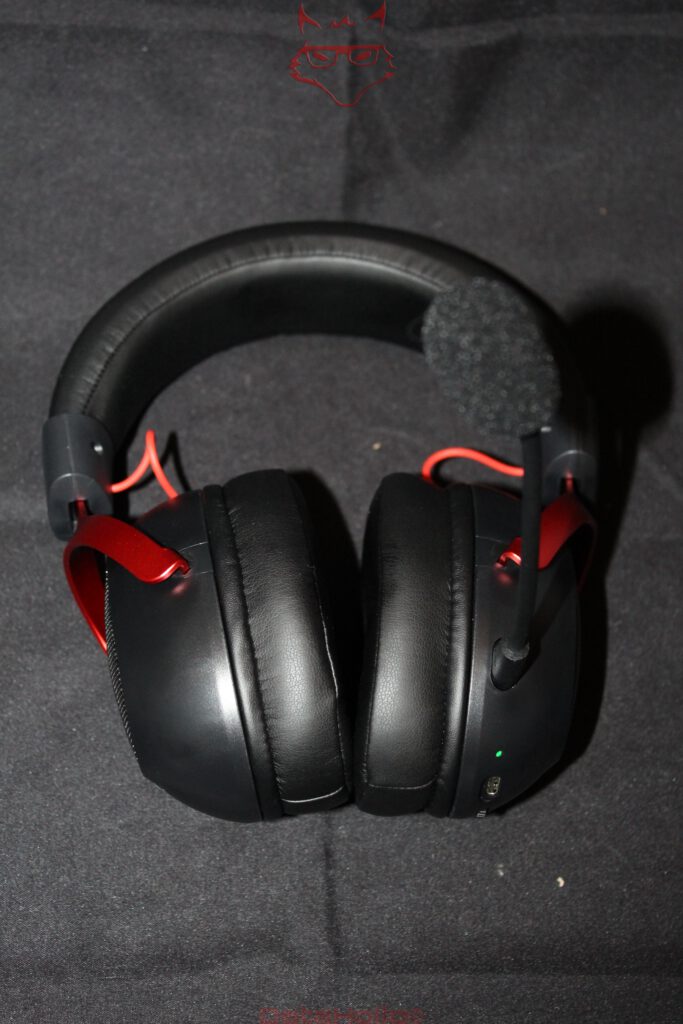
At around 320 grams, the GX1 is neither exceptionally light nor particularly heavy for a gaming headset. Weight distribution matters more than mass alone anyway.
The padded headband spreads the weight across a relatively large area. Size adjustment is available in seven steps, allowing the position of the earcups to accommodate different head shapes. The large cushions completely surround the ears.
The art of creating a comfortable over-ear headset lies in resolving a small mechanical contradiction. Too little clamping force allows it to move whenever the head turns quickly. Too much pressure transforms a three-hour gaming session into a very slow demonstration of why bench vises are not sold as headwear.
The GX1 finds a reasonable middle ground.
The cushions are soft enough to distribute lateral pressure across a broad area. Glasses also benefit from the fact that the temples are not brutally trapped between the head and the pads. At the same time, the open design helps reduce thermal build-up.
Synthetic leather cushions still do not remain completely cool. Physics cannot be bribed by RGB either. Heat develops after several hours, but it feels less trapped than with completely sealed earcups.
The seven-step adjustment also deserves attention. Defined increments make it easier to return to a preferred position after transport or adjustment. At the same time, the construction feels sufficiently stable without making the headband unnecessarily massive.
Plastic, Metal and a Red Exoskeleton Look
The GX1 hides its gaming heritage about as convincingly as a sports car with a rear wing parked outside an accounting office.
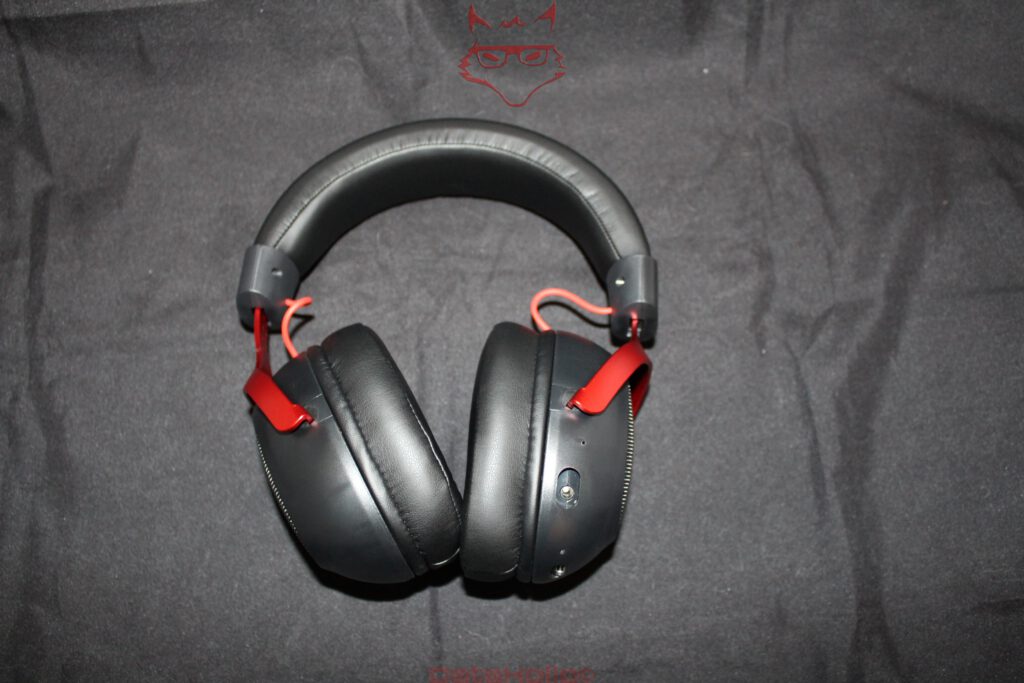
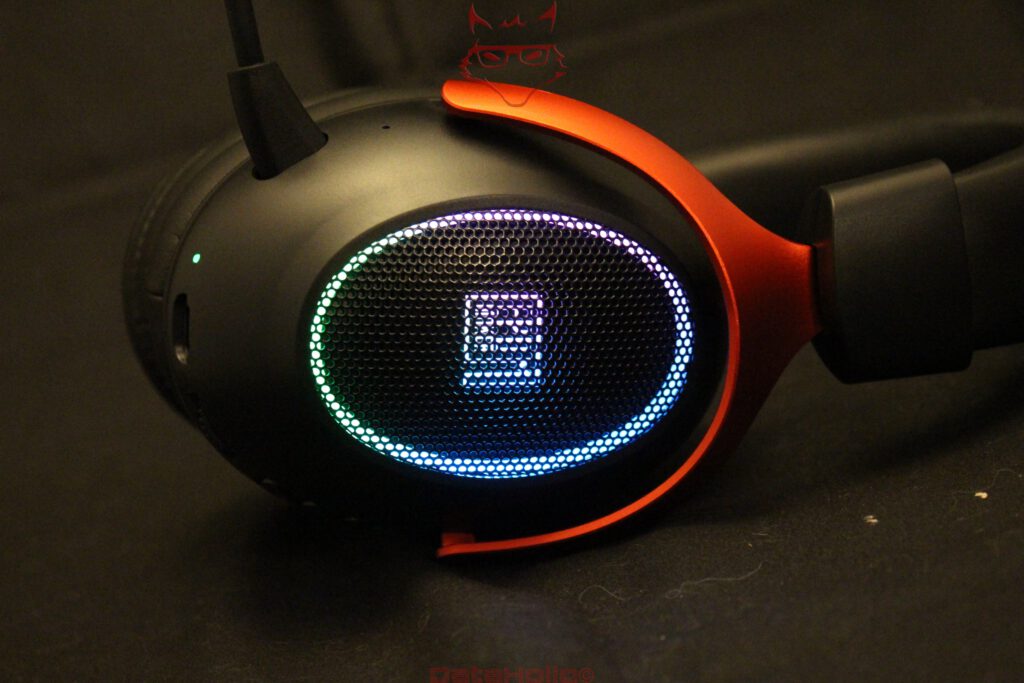
Black dominates the surfaces, red metal struts run around the outside of the earcups and RGB lighting shines through the open grilles. Behind them sits an illuminated EPOMAKER logo. Subtle is not the word.
The construction underneath the lighting is more interesting. EPOMAKER combines plastic with metallic elements and uses painted or otherwise surface-treated components. With a headset costing around 50 dollars, an entirely metal construction would neither be economically sensible nor automatically desirable. Metal also increases weight.
Plastic is therefore not inherently a sign of poor quality. Material thickness, geometry and the loads placed on joints matter far more. The red external struts in particular give the GX1 additional visual and mechanical structure.
The result does not feel like a premium headset costing several hundred dollars. It also does not feel like a product whose life expectancy is destined to end at the first creaking noise.
The controls are similarly straightforward. Buttons for the central functions, a conventional volume wheel, a physical wireless selector and USB-C require virtually no learning period. The buttons could be easier to distinguish by touch, as their similar shapes make blind operation less intuitive. After a little familiarisation, however, the control layout works reliably.
RGB: Attractive, Completely Unnecessary and Surprisingly Expensive for the Battery
The RGB lighting sits behind the open earcup grilles and works visually extremely well with their honeycomb structure. The light does not simply shine through a plastic ring; the grille gives it a certain depth.
Its practical value is exactly zero.
That is perfectly fine.
Not every feature of a gaming product needs to provide a measurable competitive advantage. An illuminated headset simply looks more interesting on a desk or headset stand. Lighting does not require a better justification than that.
RGB only becomes technically interesting when battery consumption enters the equation.
EPOMAKER specifies up to 70 hours of battery life with the lighting disabled and around 30 hours with RGB enabled. That represents a difference of up to 40 hours. Put differently, those small light sources and their control circuitry manage to reduce the theoretical operating time by more than half.
Suddenly, the term “gaming lighting” comes with an unexpectedly tangible electricity bill.
The person wearing the headset cannot see the lighting anyway. From a purely economical perspective, the most sensible RGB setting is therefore “Off”. For photographs and an illuminated gaming setup, however, the GX1 looks considerably more distinctive with RGB enabled.
2,000 mAh and Up to 70 Hours: A Larger Battery Than Expected
A 2,000 mAh battery is remarkably generous for a headset in this price category. The resulting runtime of up to 70 hours without lighting changes everyday use more significantly than spectacular sound modes ever could.
Battery life in wireless peripherals becomes truly good once it starts becoming boring. A headset that demands attention to its charge level every day has only partially understood the concept of wireless freedom. With several dozen hours between charging cycles, the GX1 comes much closer to that ideal.
The specified charging time of approximately three hours and twenty minutes seems plausible given the battery capacity, although it is certainly no fast-charging record. It does not need to be. The ability to charge while using the headset largely removes the problem.
The more interesting choice lies between 30 and 70 hours. With RGB enabled, there is still enough runtime for several long sessions. Without RGB, charging changes from a regular task into occasional maintenance.
It is the sort of decision where technical common sense and the tiny illuminated gaming goblin sitting on the shoulder will probably offer very different recommendations.
Software: Function Before Beauty
Hardware in this price category is frequently undermined by companion software that demands an account, cloud access, updates, autostart and presumably, eventually, a blood type. The software side of the GX1 is considerably more restrained.
More advanced configuration is handled through Xear ONE or a solution based on C-Media technology. It provides equaliser functions, virtual 7.1 audio, microphone settings and various audio effects.
Visually, the software is unlikely to find its way into the Museum of Modern Art. Functionally, it does what it needs to do.
The equaliser is considerably more interesting than the various spatial effects. Different ears, games and music genres benefit from different tuning. Additional low-frequency emphasis can be added where desired. Voices can be pushed forward, treble reduced or specific frequency ranges emphasised for gaming.
Less convincing is the fact that the software does not provide the same depth of integration found in the ecosystems of major peripheral manufacturers. A genuinely elegant battery indicator or more comprehensive RGB management, for example, would be welcome.
For a headset costing around 50 dollars, however, that criticism feels more like identifying an unfinished corner than discovering a fundamental flaw.
Gaming Is Only Half the Story
What makes the GX1 interesting is that its characteristics work almost equally well outside gaming.
For music, the open construction creates a broad presentation that is particularly pleasant with acoustic recordings, rock, jazz, orchestral soundtracks and live performances. Bass remains more controlled than with many closed-back gaming headsets. Anyone who judges music exclusively by whether every kick drum rearranges the hairstyle will find more suitable candidates elsewhere.
Films benefit even more from the spatial character. Dialogue remains intelligible in the centre while environmental effects have room to expand. The virtual surround mode can add atmosphere here without necessarily being essential.
In everyday work, Bluetooth, the integrated microphone and long battery life become useful. A video call does not necessarily require attaching the boom microphone. For longer conversations, the boom subsequently provides better voice quality.
It is precisely this versatility that makes the GX1 more interesting than a headset designed exclusively around gaming.
An Affordable Headset With Surprisingly Few Signs of Cost Cutting
With a product in this price category, testing usually begins with the search for the areas where money has been saved. Somewhere, after all, the red pen must have been used.
Those areas certainly exist on the GX1. Material quality does not reach premium levels. The software could be more modern and more deeply integrated. Virtual 7.1 is an optional extra rather than a compelling reason to buy the headset. The open construction is poorly suited to noisy environments and prevents any serious passive isolation. Bass carries less physical pressure than it would from a closed headset. The buttons could also be easier to distinguish by touch.
What is more remarkable is what has not fallen victim to cost cutting.
Wireless operation uses a dedicated 2.4 GHz receiver. Bluetooth is also present. Wired operation remains possible. USB-C handles charging and connectivity. The boom microphone can be removed without eliminating microphone functionality entirely. The 2,000 mAh battery provides substantial reserves. The earcups are genuinely open rather than merely decorated with a grille. The 50 mm drivers deliver a balanced and spacious presentation.
EPOMAKER has therefore not attempted to place one spectacular number on the packaging and somehow build everything else around it. Instead, the GX1 forms a surprisingly complete technical platform.
Conclusion: The First Headset Feels Surprisingly Little Like a First Attempt
The EPOMAKER GX1 is a strange product in the best possible way. A manufacturer whose name has become almost synonymous with mechanical keyboards enters an entirely different product category and chooses an open-back construction for its first attempt. Add three connection methods, 50 mm drivers, two microphone options, a 2,000 mAh battery and RGB, and there are plenty of opportunities for the concept to collapse under its own ambitions.
It could have gone spectacularly wrong.
Instead, the combination makes a surprising amount of sense.
The most important element is neither the virtual 7.1 sound nor the RGB lighting. It is the open acoustic concept. The GX1 sounds more spacious and airy than many typical affordable gaming headsets as a result. Voices and effects have room to breathe, positional information works convincingly and longer sessions benefit from the less enclosed construction.
The 2.4 GHz wireless connection with a nominal latency of 25 milliseconds handles gaming, Bluetooth takes care of mobile devices and the cable saves the day whenever wireless operation or battery life should no longer matter. This technical redundancy is exactly what makes the GX1 practical in everyday use.
The same approach is evident in the microphone system. The detachable boom provides better voice capture, while the integrated microphone remains available as an uncomplicated alternative. It is not a revolutionary concept, but it is a very sensible one.
The biggest conflict therefore comes from the very feature that makes the GX1 special. Open back is not universally superior. In a noisy room, it is worse than a closed headset. Sound travels both in and out. The concept is only partially suitable for trains, aircraft or a shared living room with a television running in the background.
In a quiet PC room, that relationship changes. There, the open construction creates exactly the kind of spaciousness that has given high-quality open headphones a loyal following for decades.
“There is no such thing as a free lunch” is an English saying that fits technology particularly well. Greater openness means less isolation. More RGB means shorter battery life. More signal processing does not automatically produce more accurate positioning.
The GX1 makes surprisingly sensible compromises between those competing priorities.
Perhaps that is the real surprise. The headset does not attempt to disguise its affordable price through one absurdly extravagant feature. It accepts its limitations and invests most of the available budget in things that are actually used: decent drivers, multiple connection methods, a large battery, usable microphones and a comfortable construction.
Only the RGB lighting remains gloriously irrational. Trading roughly 40 hours of theoretical battery life for an illuminated ring while the headset is sitting on the wearer’s own head, where the lighting is guaranteed to remain invisible, is difficult to defend from a technical perspective.
Gaming would also be rather boring without decisions like that.
The EPOMAKER GX1 ultimately demonstrates something far more important: a good gaming headset does not need to batter the head with bass, distribute eight imaginary speakers around the ears or charge a three-digit price for basic functionality. Clean stereo imaging, a broad soundstage, low wireless latency and sensible ergonomics matter far more in everyday use.
For a first excursion into an entirely new product category, that is a remarkably clear understanding of what actually matters.
Transparency notice in accordance with EU requirements:
The EPOMAKER GX1 featured in this review was provided to us by EPOMAKER as a non-binding loan unit for testing purposes. This is not paid advertising.
EPOMAKER had no influence on the content, evaluation or editorial independence of this article. All opinions expressed are based exclusively on our own practical experience.
We would like to thank EPOMAKER for providing the headset and for the trust placed in dataholic.de.