
EPOMAKER TH87 ISO-DE Review: A Lot of Keyboard, Very Little Drama, and a Battery With Delusions of Grandeur
- TKL Without Layout Experiments: The Function Keys Get to Stay
- Pastel Colors Instead of a Stealth Bomber
- A Plastic Chassis That Does Not Feel Like a Plastic Toy
- Gasket Mount: When the PCB Is Not Nailed to the Chassis
- Five Layers Against the Great Hollow-Chassis Concert
- Creamy Jade: Linear, Light, and Free From Mechanical Theatre
- Hot-Swap: The Keyboard Is Allowed to Change Its Personality
- 10,000 mAh: Apparently There Is a Power Bank Living Inside
- Three Connections and Two Small Switches
- Windows, macOS, and the Keycaps’ Small Identity Crisis
- Software: One Less Windows Application Is Already a Victory
- RGB Is Decoration, Not a Substitute for Good Keycaps
- Writing Instead of Specification-Sheet Bingo
- Gaming Without Artificial Racing Stripes
- The Small Details Become More Important After Several Weeks
- Conclusion: Remarkably Mature for Around €119
- Transparency Notice in Accordance With EU Requirements:
Mechanical keyboards have undergone a remarkable transformation over the past few years. Not that long ago, fitting Cherry MX-compatible switches, RGB lighting, and a detachable USB cable into a reasonably solid chassis was enough to qualify as a well-equipped mid-range keyboard. Today, features that once required a soldering iron, lubricant, sheets of foam, several free weekends, and a surprisingly high tolerance for frustration have migrated into considerably more affordable products. Gasket mounts, hot-swappable sockets, factory-lubricated switches, multi-layer acoustic damping, double-shot PBT keycaps, and several wireless connection options are rapidly becoming standard equipment.
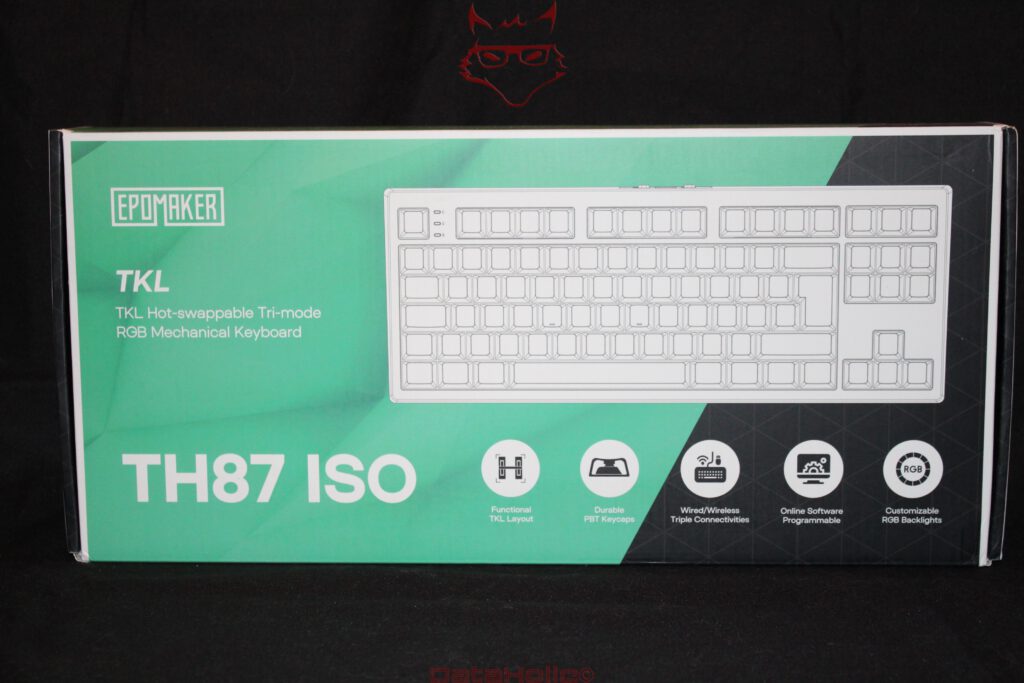
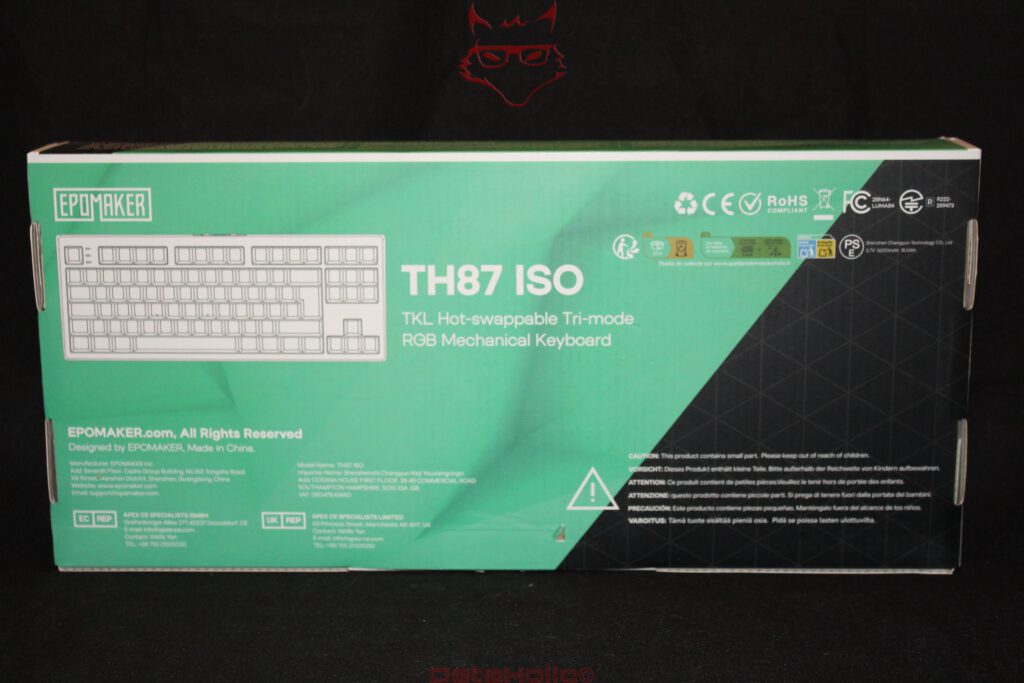
The EPOMAKER TH87 ISO-DE is a particularly good example of this development. At around €119, it arrives with almost the entire checklist expected from a modern mechanical keyboard while deliberately avoiding some of the gimmicks that have become almost inflationary in recent years. There is no display playing cat GIFs. There is no rotary knob waiting for an accidental swipe to send the volume straight to maximum. There is no tiny screen pretending that a keyboard requires a second operating system. Instead, there are 87 keys in a traditional TKL layout, hot-swappable mechanical switches, a gasket-mounted construction, three connectivity options, RGB lighting, a surprisingly large battery, and, most importantly for the German market, a proper ISO-DE layout.
None of this initially sounds particularly spectacular. Yet that restraint is a significant part of the TH87’s appeal. This keyboard is not trying to become a spaceship.
It is trying to be a very good keyboard.
And remarkably often, that is exactly what it is.
TKL Without Layout Experiments: The Function Keys Get to Stay
The TH87 name already reveals an important part of the concept. Eighty-seven keys form the familiar Tenkeyless layout, usually shortened to TKL. Compared with a full-size keyboard, the numeric keypad disappears while the function row, arrow keys, and navigation cluster remain intact. The TH87 ISO-DE measures roughly 366.5 × 142.1 × 41.4 millimeters and weighs around one kilogram.
That places it in an interesting middle ground between compact 75-percent keyboards and traditional full-size models. For a workstation used for both productivity and gaming, the format makes considerable sense. Removing the numeric keypad creates several extra centimeters of mouse space on the right without forcing the F-keys, Delete, Home, End, Page Up, Page Down, or the arrow cluster onto secondary layers.
That may sound insignificant until those keys are used every day. A 75-percent keyboard can work extremely well, but it often demands some adjustment. The TH87 places almost everything where decades of keyboard muscle memory expect it to be. Fingers do not need to embark on an archaeological expedition just because the Delete key is required.
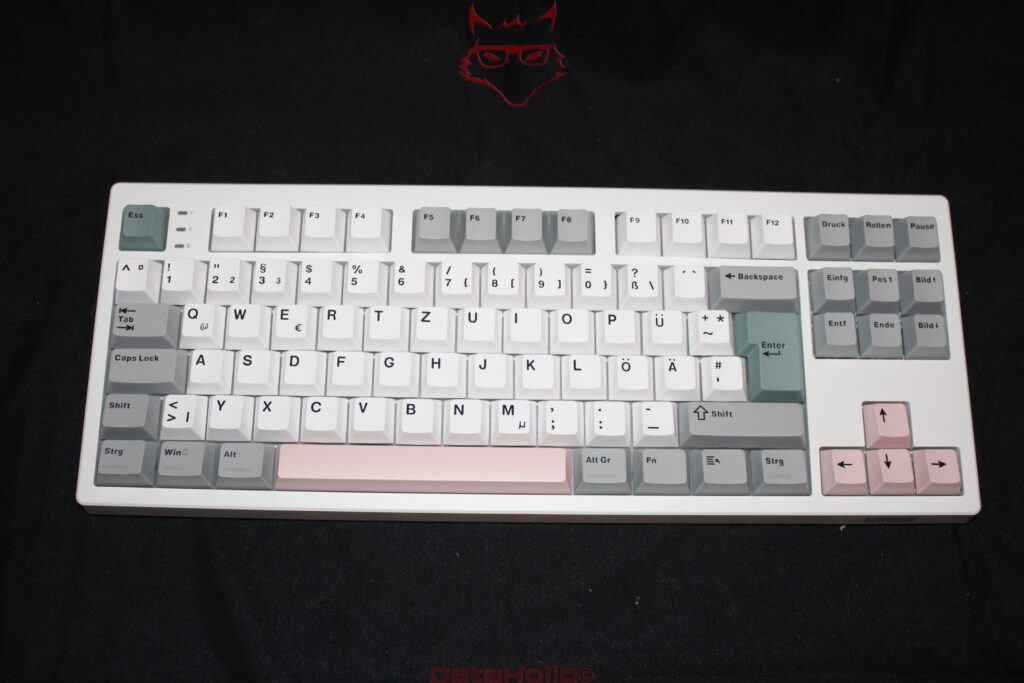
Particularly important is the tested ISO-DE version. Ü, Ö, and Ä are exactly where they belong, the large ISO Enter key is present, and the special characters correspond to the German QWERTZ layout. In 2026, that should arguably be unremarkable. Within the mechanical custom-keyboard market, it still is not.
Plenty of interesting keyboards launch in ANSI-US first, with German versions arriving later or never appearing at all. The TH87 ISO-DE therefore does not feel like a hastily localized afterthought. The German layout feels like an integral part of the product.
Pastel Colors Instead of a Stealth Bomber
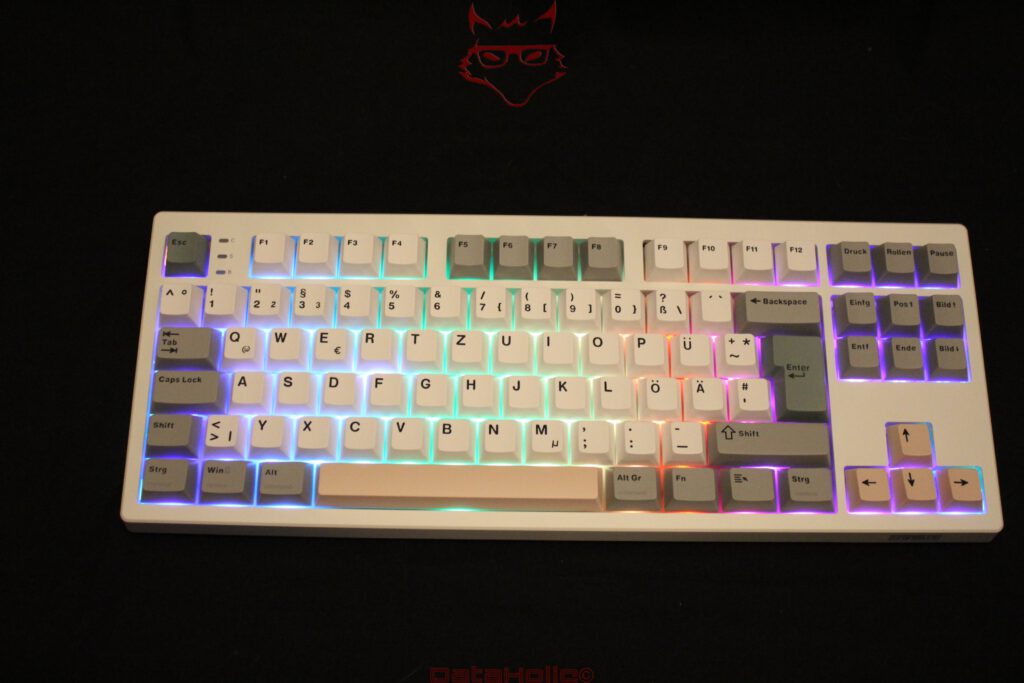
Visually, the TH87 takes a pleasantly relaxed approach. The white chassis is paired with predominantly white alphanumeric keys, gray function and modifier keys, and restrained green and pink accents. The space bar and arrow cluster introduce additional color, while Enter and Escape provide further visual contrast.
The result looks less like a traditional gaming peripheral and more like something designed after an industrial designer finally decided that computer desks do not necessarily need to resemble the cockpit of a stealth bomber.
With the RGB lighting disabled, the TH87 looks surprisingly calm. Its design fits into an office environment just as easily as it does next to a gaming PC. Turning on the illumination changes the character considerably. RGB light spills between the keycaps, allowing the understated pastel board to transform into the familiar miniature nightclub whenever required.
The LEDs use a south-facing orientation, meaning they sit on the side of the switch facing the typist. This configuration has become common among modern custom keyboards because it reduces compatibility issues with certain Cherry-profile keycaps. EPOMAKER provides per-key RGB lighting as well as static and animated effects.
The double-shot PBT keycaps themselves are not translucent. RGB therefore illuminates primarily the spaces between and underneath the keycaps rather than the legends. In a dark room, this creates an attractive pool of light, but it does not turn the key legends into illuminated signposts.
That is not so much a flaw as a design decision. Non-transparent double-shot PBT legends are perfectly normal in the custom-keyboard segment. For typing at night without ambient lighting, however, shine-through keycaps can still be more practical.
A Plastic Chassis That Does Not Feel Like a Plastic Toy
The enclosure is made from ABS plastic. Anyone expecting aluminum because of the keyboard’s approximately one-kilogram weight will therefore initially be heading in the wrong direction.
The more important question is not the name of the material but how it has been used. Plastic does not automatically mean cheap, just as aluminum does not automatically create a good keyboard. With mechanical keyboards, the enclosure also plays an important acoustic role. A poorly designed metal chassis can ring and resonate unpleasantly, while a properly damped plastic enclosure can produce a controlled and surprisingly substantial sound.
The TH87 feels considerably more substantial than its material specification might suggest. Its weight prevents nervous movement across the desk and gives the keyboard a welcome sense of mechanical stability. The edges are clean, and the enclosure feels properly assembled rather than hollow or loosely clipped together.
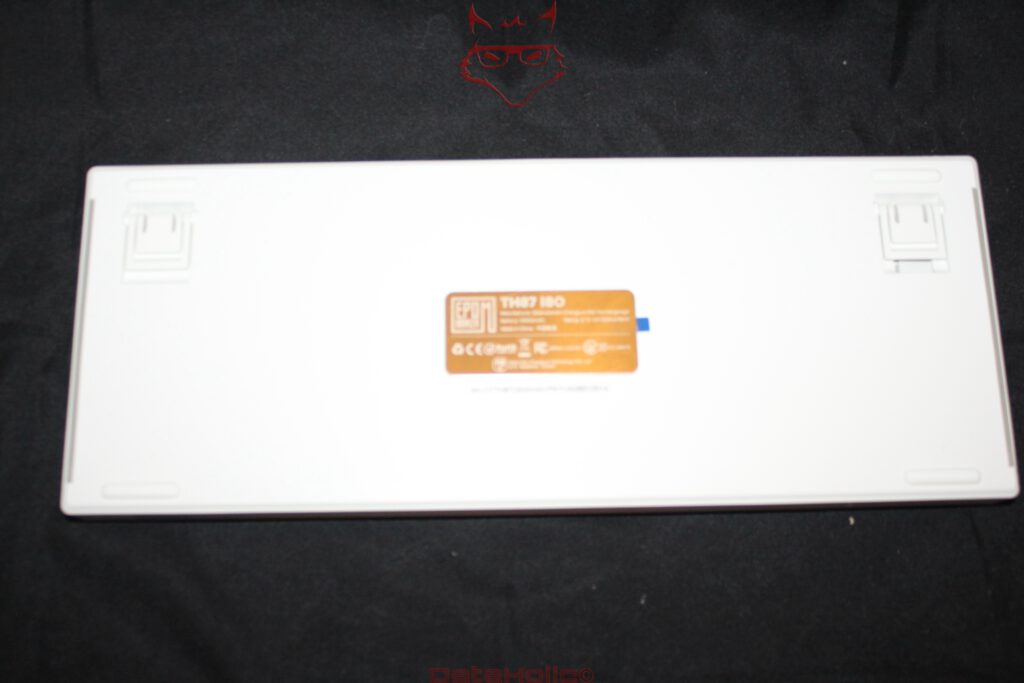
Large rubber pads sit underneath the keyboard alongside two-stage folding feet. These provide three typing angles of approximately 6, 8, and 10.5 degrees.
The front edge, at around 18.5 millimeters, remains reasonably low, although the keyboard as a whole is relatively tall. A wrist rest is not included. During longer writing sessions, a low-profile wrist rest can therefore make sense, particularly when the rear feet are extended.
The more interesting part of the construction, however, sits underneath the visible surface.
Gasket Mount: When the PCB Is Not Nailed to the Chassis
EPOMAKER uses a gasket-mounted internal structure for the TH87. The term has appeared on so many keyboard product pages in recent years that it almost seems as though any keyboard without gaskets should immediately be transported to the nearest recycling center.
There is, however, a sensible engineering principle behind it.
In simpler mechanical keyboards, the plate and PCB assembly can be mounted relatively rigidly inside the enclosure. Energy generated by each keystroke is then transferred directly into the chassis. The result can be a hard bottom-out sensation accompanied by unwanted resonance.
A gasket-mounted construction isolates the plate and PCB assembly from the surrounding chassis using softer damping elements. The entire assembly is therefore allowed to move slightly under heavier keystrokes.
This does not mean the TH87 bounces like a trampoline while typing. That would be equally undesirable. The effect is subtle. Bottoming out feels less abrupt, and the typing experience loses some of the harshness historically associated with inexpensive mechanical keyboards.
EPOMAKER combines the gasket structure with a polycarbonate plate and flex cuts in both the plate and PCB. Polycarbonate is less rigid than many metal plates and therefore complements the slightly softer nature of the construction.
The result is rather like a well-tuned suspension system. A car that continues bouncing several seconds after every bump would be terrible. A completely rigid connection between the wheels and the body would hardly be better. The useful part exists between those two extremes.
That is roughly where the TH87 positions itself.
Five Layers Against the Great Hollow-Chassis Concert
Acoustics form another major part of the TH87’s construction. Inside are PORON foam, an IXPE switch pad, a sound-enhancement pad, an EPDM switch-socket pad, and a silicone layer in the bottom of the enclosure. EPOMAKER accordingly describes this as a five-layer acoustic treatment.
There is a simple reason for this considerable collection of materials: acoustically, a keyboard is a small resonance chamber.
Every keystroke moves the switch, keycap, plate, and PCB. Some of that energy travels through the structure as vibration. Empty cavities inside the enclosure can amplify certain frequencies. Larger keys introduce stabilizers into the equation as well. The familiar rattling sound of inexpensive mechanical keyboards therefore rarely originates from a single component.
The different damping layers are intended to control this transfer of energy. Foam between the plate and PCB reduces resonances, additional pads alter the way sound propagates around the switches, and the silicone layer at the bottom reduces the hollow character of the enclosure.
As a result, the TH87 sounds remarkably cohesive.
Particularly with the tested Creamy Jade switches, there is very little high-frequency plastic clatter. Keystrokes have a relatively deep and compact character. The increasingly overused description “creamy” is actually not entirely inappropriate here, although keyboards still contain neither cream nor vanilla and should probably remain that way.
The technical description is more useful: there is little distracting reverberation, individual keys sound relatively consistent, and the larger keys do not suddenly introduce an entirely different acoustic personality.
The space bar and Enter key are particularly important tests. Large keycaps behave like small resonance surfaces. Poor stabilizers can therefore turn an otherwise decent keyboard into something resembling a toolbox being dragged over cobblestones with a single press of the space bar.
The TH87 remains considerably more controlled.
Creamy Jade: Linear, Light, and Free From Mechanical Theatre
The tested version uses EPOMAKER Creamy Jade switches. These are factory-lubricated linear 5-pin mechanical switches with an actuation force of 45 ± 5 gf, a bottom-out force of around 50 ± 5 gf, 2.0 ± 0.4 millimeters of pre-travel, and 3.6 ± 0.4 millimeters of total travel.
Translated from switch-specification language, the key moves downward without a tactile step. There is no tactile bump and no deliberately generated click. The keystroke is registered after approximately two millimeters, leaving around another 1.6 millimeters before the switch reaches its mechanical limit.
The required force sits on the lighter side of the spectrum. That makes longer writing sessions comfortable because every letter does not become a miniature finger workout. At the same time, the springs are not so light that simply resting a finger on a key constantly produces accidental inputs.
Factory lubrication matters more than the dry specification sheet might suggest. Mechanical switches contain several contact surfaces between the stem and housing. Proper lubrication reduces friction and creates a smoother, more consistent movement.
Not too many years ago, disassembling and lubricating dozens of switches was practically an initiation ritual within the keyboard community. Open 87 switches, remove stem and spring, carefully apply lubricant, reassemble everything, then discover that switch number 43 somehow sounds different from all the others. A wonderful Sunday activity for anyone with patience and a remarkable relationship with personal free time.
The TH87 avoids that ritual.
The Creamy Jade switches feel smooth and consistent straight from the factory. Industrial lubrication will not necessarily match the perfection of switches painstakingly lubricated by hand, but for a production keyboard the result is convincing.
Hot-Swap: The Keyboard Is Allowed to Change Its Personality
If the Creamy Jade switches eventually lose their appeal, one of the TH87’s most important features becomes relevant: the switches are not soldered permanently to the PCB.
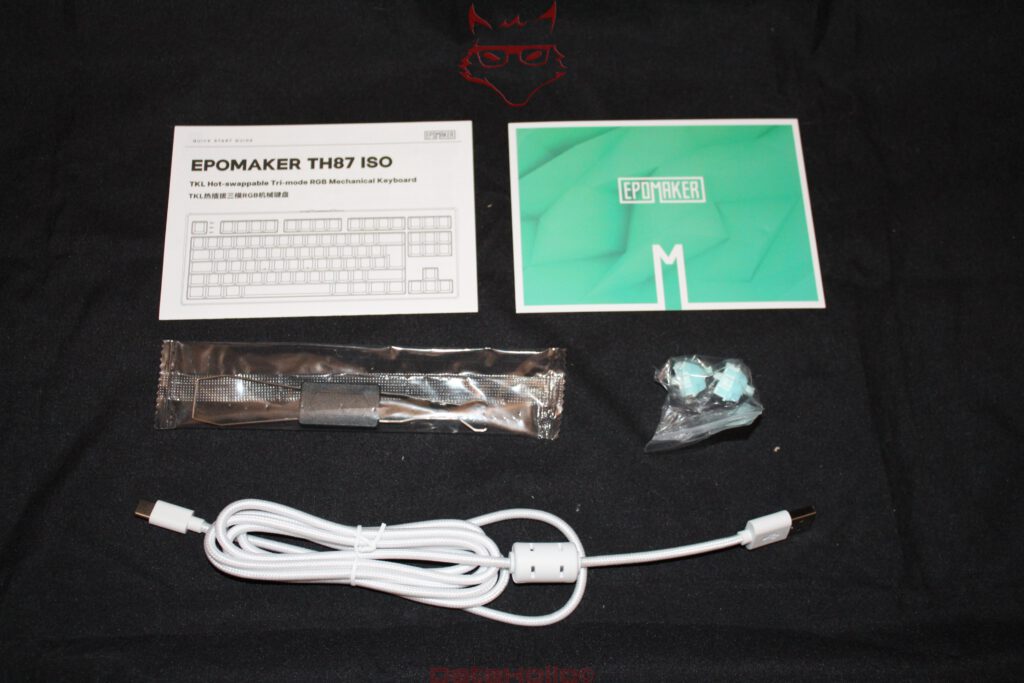
The board uses hot-swap sockets and supports conventional 3-pin and 5-pin MX-style mechanical switches. The included tool allows the keycaps and switches to be removed and replaced without soldering.
That fundamentally changes the product’s long-term usefulness.
A failed switch does not mean a failed keyboard. One defective switch can be replaced within minutes. Likewise, the entire typing character can be transformed. Linear can become tactile. Loud can become quiet. Heavy can become light.
Two spare switches are included in the box.
Hot-swap is therefore much more than a feature for keyboard enthusiasts. It represents a practical form of repairability. A failed switch on a soldered keyboard requires a soldering iron, desoldering equipment, and at least some experience. Here, a switch puller and replacement switch are enough.
The old engineering expression “If it ain’t broke, don’t fix it” only works to a limited degree in the mechanical-keyboard world anyway. Sooner or later, another switch set appears that supposedly sounds even creamier, deeper, softer, or more “thocky.” Hot-swap at least ensures that this curiosity does not require purchasing an entirely new keyboard.
10,000 mAh: Apparently There Is a Power Bank Living Inside
One of the TH87’s most unusual specifications is hidden completely out of sight. Its battery has a capacity of 10,000 mAh. EPOMAKER specifies approximately 45 hours of operation with RGB at maximum brightness and around 200 hours with the lighting disabled.
For a keyboard, 10,000 mAh is exceptionally generous. It also helps explain the approximately one-kilogram total weight.
A theoretical 200 hours corresponds to 25 eight-hour working days. RGB predictably reduces that figure dramatically because LEDs have a remarkable enthusiasm for turning electrical energy into light.
The large battery therefore addresses one of the most irritating characteristics of wireless peripherals: the persistent suspicion that another charging cable must already be required somewhere.
Lithium batteries inevitably age, of course. Starting with 10,000 mAh nevertheless provides a considerable reserve. Even if usable capacity decreases after several years, there should still be plenty of headroom before charging becomes a constant part of daily life.
Charging takes place through USB-C. A white braided USB-A-to-USB-C cable is included, and the USB-C connection simultaneously provides wired data transmission.
Three Connections and Two Small Switches
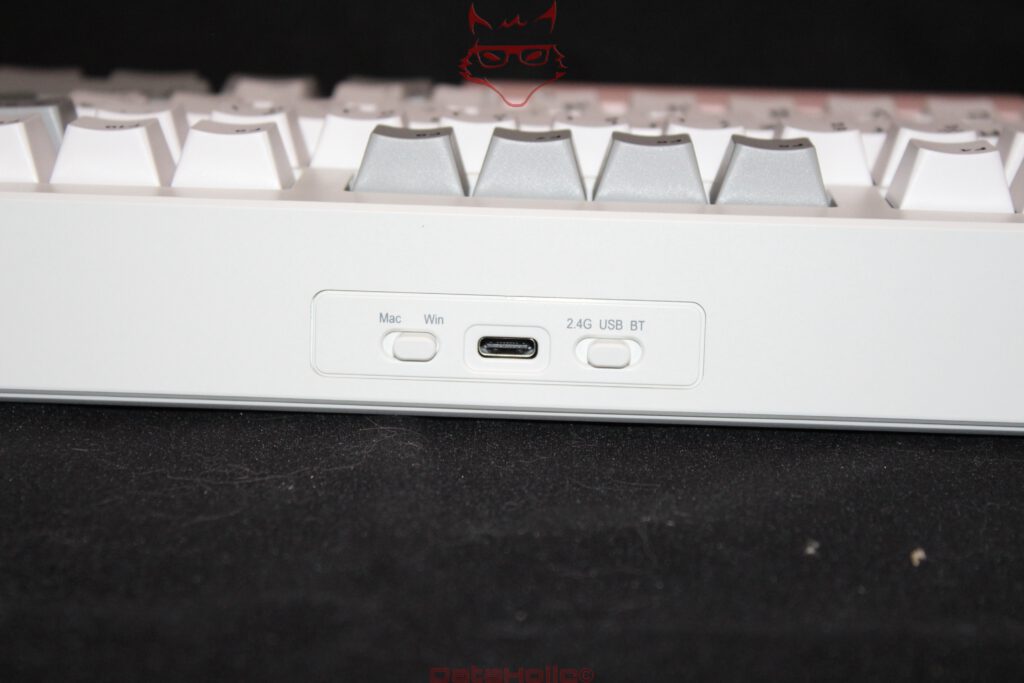
The rear of the keyboard contains a refreshingly uncomplicated control section. One switch selects Mac or Windows mode, while the second chooses between 2.4 GHz wireless, USB, and Bluetooth. The USB-C port sits between them.
This is excellent.
Not because sliding switches represent a technological breakthrough, but because physical controls are unambiguous. A quick glance at the rear of the keyboard immediately reveals the selected operating mode. There is no need to hold a mysterious key combination for five seconds, interpret LED Morse code, or consult the manual simply to discover why the keyboard is talking to the wrong computer.
In wired and 2.4 GHz modes, the TH87 operates at polling rates of up to 1,000 Hz. Bluetooth drops to 125 Hz. The corresponding latency figures are approximately 2 ms over USB, 5 ms through 2.4 GHz wireless, and 11 ms via Bluetooth.
Bluetooth is therefore entirely adequate for everyday productivity. For fast gaming, the 2.4 GHz connection is the more sensible wireless option. A 1,000 Hz polling rate means the keyboard can theoretically report its state to the computer up to one thousand times per second. At 125 Hz, the polling interval rises to eight milliseconds.
None of this turns the TH87 into a Hall-effect keyboard with adjustable actuation points and Rapid Trigger. That distinction matters. Creamy Jade switches are conventional mechanical switches. For everyday gaming, office work, and extensive writing, they work extremely well. Competitive players specifically searching for Rapid Trigger, extremely short adjustable actuation distances, or analog input need a different switch technology.
N-key rollover and anti-ghosting are also present. Multiple simultaneous keystrokes are therefore registered reliably instead of disappearing because the keyboard matrix cannot keep up.
Windows, macOS, and the Keycaps’ Small Identity Crisis
The rear Mac/Windows switch deserves more attention than its physical size suggests. The keyboard itself obviously remains mechanically identical, but the logical assignment of several modifier keys changes between operating systems.
Some keycaps carry secondary legends for the different platforms. That is practical, although visually slightly busier than a keycap set designed exclusively for Windows.
In return, the TH87 can move relatively easily between different computers. Windows, macOS, and Android are supported.
Combined with Bluetooth and 2.4 GHz wireless, that makes the keyboard a flexible working tool. A desktop PC can remain connected through the wireless receiver while a notebook or tablet uses Bluetooth.
The 2.4 GHz receiver can also be stored underneath one of the folding feet. This sounds like a tiny detail until a wireless dongle disappears.
Anyone who has used wireless peripherals for long enough knows the peculiar technical tragedy involved: the €100 device is sitting directly on the desk, fully functional and perfectly intact, while the tiny receiver required to use it has apparently left this dimension of reality.
A storage compartment does not make for exciting marketing material.
It does, however, prevent swearing.
Software: One Less Windows Application Is Already a Victory
Modern keyboards almost inevitably require some form of configuration interface. Key assignments, macros, and RGB settings can therefore be customized on the TH87 as well.
The interesting development is EPOMAKER’s browser-based Hub. It allows key remapping, macro configuration, and lighting adjustments without requiring a permanently installed configuration suite. On desktop systems, the web interface requires a compatible Chromium-based browser such as Chrome or Edge because direct communication with the keyboard depends on browser support. Safari and Firefox cannot provide the same direct access.
In principle, this is a welcome direction.
Peripheral software has become one of the stranger excesses of the modern PC ecosystem. A mouse, keyboard, headset, motherboard, and lighting system can quickly result in several applications, background services, and startup processes. Eventually, changing the color of a keyboard can feel as though it requires more software than installing an entire Linux distribution used to.
A web configurator significantly reduces that clutter.
The solution is not entirely platform-neutral because of its browser dependency. Safari users, in particular, require an additional compatible browser. Even so, being able to configure a keyboard without installing another permanent driver package is a considerable improvement.
RGB Is Decoration, Not a Substitute for Good Keycaps
The RGB implementation works well and produces relatively even illumination between the keys. South-facing LEDs cooperate nicely with the Cherry-profile keycaps and provide numerous lighting effects.
Even so, RGB is not one of the TH87’s most important qualities.
The opaque PBT keycaps prevent the legends from lighting up. Anyone searching for a special character in a completely dark room therefore receives no illuminated assistance. The RGB merely surrounds the keys.
The double-shot PBT keycaps offer more meaningful advantages elsewhere. PBT is more resistant than commonly used ABS keycaps to the glossy surface that gradually develops through prolonged finger contact. Double-shot construction means the legends are formed from a second piece of plastic rather than simply printed onto the surface.
As a result, the lettering cannot simply wear away after months of use.
The lightly textured surface also suits the character of the keyboard. Fingers receive enough grip without the keycaps feeling rough.
The Cherry profile provides a relatively traditional sculpted arrangement across the rows. It is lower than something like SA and less unusual than various proprietary profiles. Anyone already familiar with mechanical keyboards should adapt almost immediately.
Writing Instead of Specification-Sheet Bingo
The real strength of the TH87 becomes apparent during longer writing sessions.
No single technical feature fully explains the result. Gasket mounting alone does not create a good keyboard. Five layers of foam guarantee nothing either. Factory-lubricated switches can still be poorly lubricated. PBT keycaps can be thin and acoustically unpleasant.
The interaction between all these parts determines the final result.
With the TH87, those components work remarkably well together. The Creamy Jade switches move easily, the polycarbonate plate removes some harshness from the bottom-out, the gasket mounting introduces a small degree of compliance, and the internal damping keeps resonance under control. The PBT keycaps add sufficient substance to each keystroke.
The resulting typing feel is neither vague nor unnecessarily hard.
The acoustic consistency is particularly pleasant. Letter keys, modifiers, and larger keys do not inhabit completely different sonic universes. Naturally, a space bar sounds different from the letter G simply because it is much larger. Not even five layers of foam can negotiate a cancellation of the laws of physics. The overall character nevertheless remains coherent.
The Creamy Jade switches are not silent switches. Writing a novel next to a sleeping baby would be better suited to EPOMAKER’s Sea Salt Silent V2 option. Those switches are also linear and actuate at 45 ± 5 gf, with slightly shorter pre-travel of around 1.8 ± 0.4 millimeters.
The Creamy Jade switches provide more audible feedback and feel livelier as a result.
Gaming Without Artificial Racing Stripes
For gaming, the TH87 benefits primarily from its traditional layout and the 1,000 Hz polling rate available through USB and 2.4 GHz wireless.
WASD sits exactly where WASD has been sitting for decades. The linear switches work well for rapid directional changes and require relatively little actuation force. At the same time, the entire function row remains available. Games with extensive key bindings benefit considerably from that.
Removing the numeric keypad also creates more room for mouse movement. With low mouse sensitivity, that is more than a cosmetic advantage. Additional horizontal space reduces the chance of the mouse and keyboard developing an involuntary close-combat relationship during frantic movements.
For conventional shooters, role-playing games, strategy titles, and everyday gaming, the technology is easily sufficient.
The limitations begin where specialized competitive features become important. Rapid Trigger, individually adjustable actuation points, and magnetic Hall-effect switches are not part of the concept. The TH87 does not attempt to disguise that fact.
That clarity is refreshing.
This is a versatile mechanical keyboard, not a specialized esports control system.
The Small Details Become More Important After Several Weeks
A good keyboard is rarely defined by its most spectacular feature. After several days, RGB effects tend to disappear into the background. What remains are the details.
The physical operating-system selector is one such detail. The straightforward choice between wireless, USB, and Bluetooth is another. The ability to store the dongle inside the keyboard matters. Hot-swap functionality may remain unused for years, only to rescue the entire keyboard from a defective switch in five minutes.
The large battery also becomes valuable precisely because it rarely demands attention.
Those are the characteristics that separate an impressive specification sheet from a genuinely well-designed everyday product.
There are still points to criticize.
A wrist rest would have complemented the relatively tall chassis nicely. The illumination between the keys looks attractive but offers little practical assistance in darkness because the legends are not translucent. A plastic enclosure, despite the substantial weight, cannot provide quite the same material character as a properly machined aluminum chassis.
The combination of conventional mechanical switches and a 1,000 Hz polling rate also establishes a clear technical boundary compared with current Hall-effect gaming keyboards.
None of these weaknesses are hidden, though. They are consequences of the TH87’s positioning rather than unpleasant surprises.
Conclusion: Remarkably Mature for Around €119
The EPOMAKER TH87 ISO-DE belongs to a new generation of mechanical keyboards that demonstrates just how far the mid-range segment has developed. Only a few years ago, much of this specification would have sounded like a custom keyboard project. Gasket mounting, a polycarbonate plate, flex cuts, five layers of internal acoustic treatment, hot-swap sockets, factory-lubricated linear switches, and double-shot PBT keycaps now arrive fully assembled in a keyboard that simply works after being switched on.
Bluetooth, 2.4 GHz wireless, and USB connectivity join 1,000 Hz polling over wireless and cable, a 10,000 mAh battery, N-key rollover, RGB lighting, and a complete German ISO layout. At roughly €119, that creates an unusually comprehensive technical package.
More important than the number of features, however, is how well they work together.
The TH87 does not feel like a keyboard whose specification sheet was assembled independently by several departments. Switches, plate, gasket mounting, damping materials, and keycaps form a coherent system. The Creamy Jade switches deliver a smooth linear movement without becoming characterless. The sound is substantial and controlled without being artificially muted.
The TKL layout also strikes a sensible balance. It removes the numeric keypad but retains almost every key regularly required during everyday use. That is precisely why the TH87 works equally well on a productivity workstation and a gaming PC.
Its design manages the same balancing act. Pastel colors replace the usual black plastic armor, RGB appears only when required, and there are no screens or rotary controls demanding attention. In that respect, the TH87 almost feels unusually conservative.
Perhaps that is one of its greatest strengths.
It does not need to represent a revolution. A keyboard has a very old and clearly defined job: every keystroke needs to arrive reliably where it belongs while preferably feeling good along the way. The TH87 accomplishes exactly that with remarkably little theatre.
An old design principle says, “Form follows function.”
For the TH87, a contemporary addition might be appropriate: function is apparently allowed to have a pink space bar.
And somewhere underneath all those pastel colors sits a 10,000 mAh battery, patiently waiting for someone to remember that the charging cable still exists.
Transparency Notice in Accordance With EU Requirements:
The EPOMAKER TH87 ISO-DE featured in this review was provided to us by EPOMAKER as a non-binding review sample for testing purposes. This is not paid advertising.
EPOMAKER had no influence on the content, evaluation, or editorial independence of this article. All opinions expressed are based exclusively on our own practical experience.
We would like to thank EPOMAKER for providing the keyboard and for the trust placed in dataholic.de.