
EPOMAKER RT98 Review: A Mechanical Keyboard Between a Traditional Typing Tool, Modular Construction, and a Miniature Display
- Construction and Layout: A Familiar Concept with an Unusual Arrangement
- Housing, Gasket Mount, and Mechanical Construction
- Hot-Swap Technology and the Importance of Replaceable Switches
- The Mini TV Display: Between Information and Design
- Three Connectivity Options and a Large Battery
- Package Contents, Compatibility, and Practical Considerations
- Software and Customization: The Essential Complement to the Hardware
- Conclusion: An Interesting Construction Whose Value Is Determined by the Details
- Transparency Statement
Mechanical keyboards have evolved considerably over the past few years. While switch types, lighting, and keycap quality once largely determined the character of a model, sophisticated housing constructions, multi-layer damping systems, hot-swap sockets, and wireless connectivity have now become common features even in the mid-range segment. The differences increasingly lie in the details. How well is the construction tuned? Which components can be replaced? And which additional features actually offer practical benefits rather than merely serving as visual distinguishing features compared with the competition?
With the RT98, EPOMAKER takes an approach that differs from many current keyboards. The model combines a nearly full-size keyboard layout with a detachable numeric keypad, a gasket-mount construction, three connectivity options, and a small display whose housing resembles a vintage cathode-ray tube television. This Mini TV module is not permanently integrated but can be removed through a magnetic connection. The unusual combination of modular construction and nostalgic design gives the RT98 a distinctive identity.
What makes the keyboard interesting, however, is less its external appearance than the question of whether EPOMAKER successfully combines these different concepts. A detachable numeric keypad can improve workplace ergonomics, a display can provide additional information, and a mechanically isolated PCB can make typing more comfortable. Each of these features, however, introduces specific construction requirements. In particular, the connection between the two housing sections and the integration of a detachable screen must remain reliable over time.
The RT98 is therefore aimed at users looking for a traditional mechanical keyboard while expecting greater flexibility than a conventional full-size model can provide. Compared with the compact and ergonomic keyboards recently examined from EPOMAKER, including the Split70, TH87, and Luma40, the RT98 clearly does not attempt to minimize the number of keys. Instead, it aims to preserve an extensive range of functions without permanently tying every component to a fixed housing arrangement.
Construction and Layout: A Familiar Concept with an Unusual Arrangement
The EPOMAKER RT98 is based on an 1800 layout, which retains many characteristics of a conventional full-size keyboard while arranging the keys more compactly. The model features 101 keys and an additional display. A complete numeric keypad, the function-key row, and important navigation keys remain available. At the same time, the layout eliminates the generous spacing traditionally found between the main typing area, navigation cluster, and numeric keypad.
This decision has an immediate impact on operation. The distance between the hands and the mouse is reduced compared with a traditionally arranged full-size keyboard, provided the numeric keypad remains attached. This can reduce lateral movement of the right arm. However, some navigation keys are positioned closer together, which may require a short adjustment period. Particularly when frequently using combinations involving arrow keys, scrolling, and text navigation, positioning plays a greater role than the sheer number of available keys.
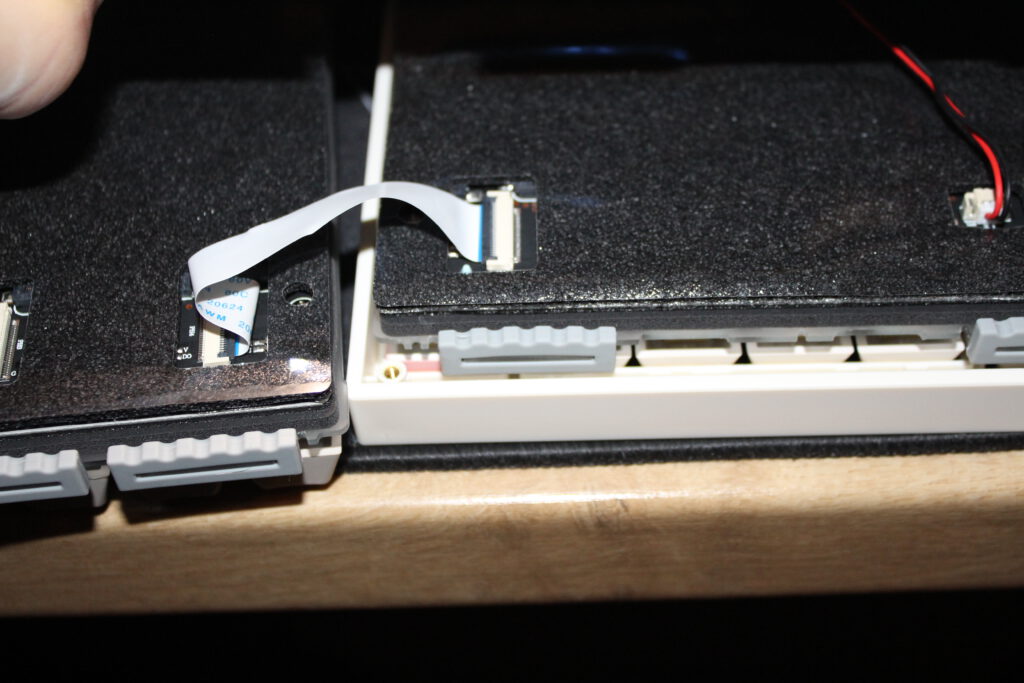
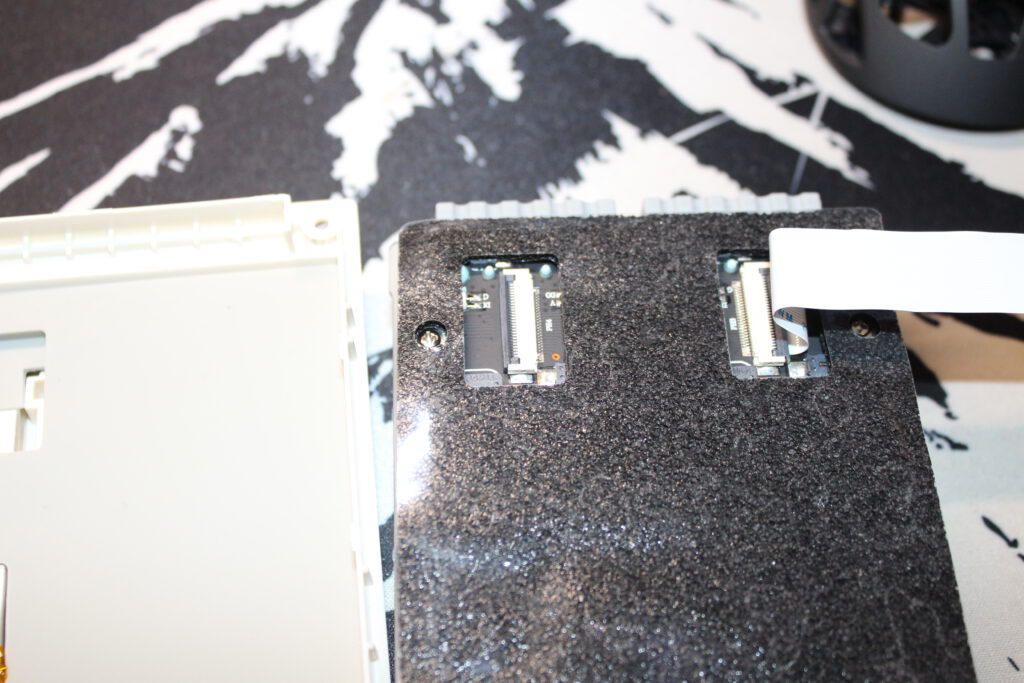
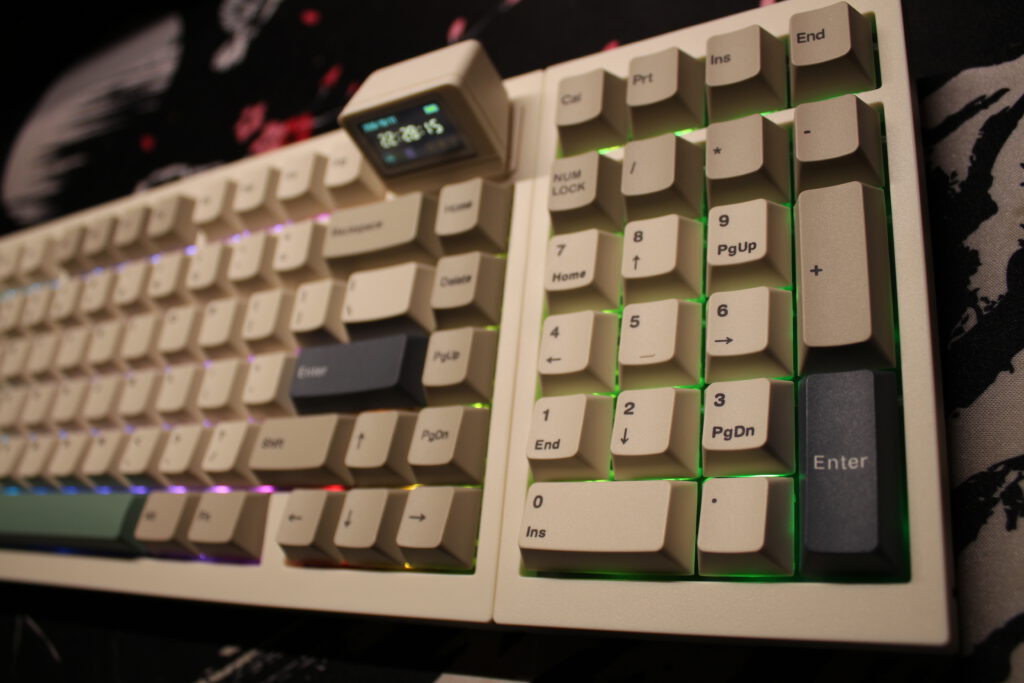
The actual distinguishing feature is the separately constructed numeric keypad. EPOMAKER divides the keyboard into two housing sections. The numeric keypad sits to the left of the main typing area and forms an independent unit. This arrangement is unusual because numeric input on conventional keyboards is almost exclusively performed on the right-hand side.
A left-positioned numeric keypad offers genuine ergonomic advantages. The right hand can remain closer to the mouse during numeric input, while the left hand enters numbers. This division of tasks can be useful, particularly when working with spreadsheets, accounting applications, or data-intensive software. At the same time, it requires adjustment for anyone accustomed to entering numbers with the right hand.
Separating the two housing sections is also an interesting approach for workplaces with changing requirements. During extended writing sessions, a numeric keypad is often unnecessary. When working with spreadsheets or numerical data, however, it becomes particularly useful. The modular construction accommodates these different scenarios without fundamentally abandoning an extensive key layout.
However, the actual benefit of such a solution is not determined solely by its mechanical detachability. What matters is how reliably the connection between the two units works and whether the numeric keypad can be positioned independently. The separated construction creates additional possibilities, although the operating modes actually supported by the detached module are decisive for its practical flexibility.
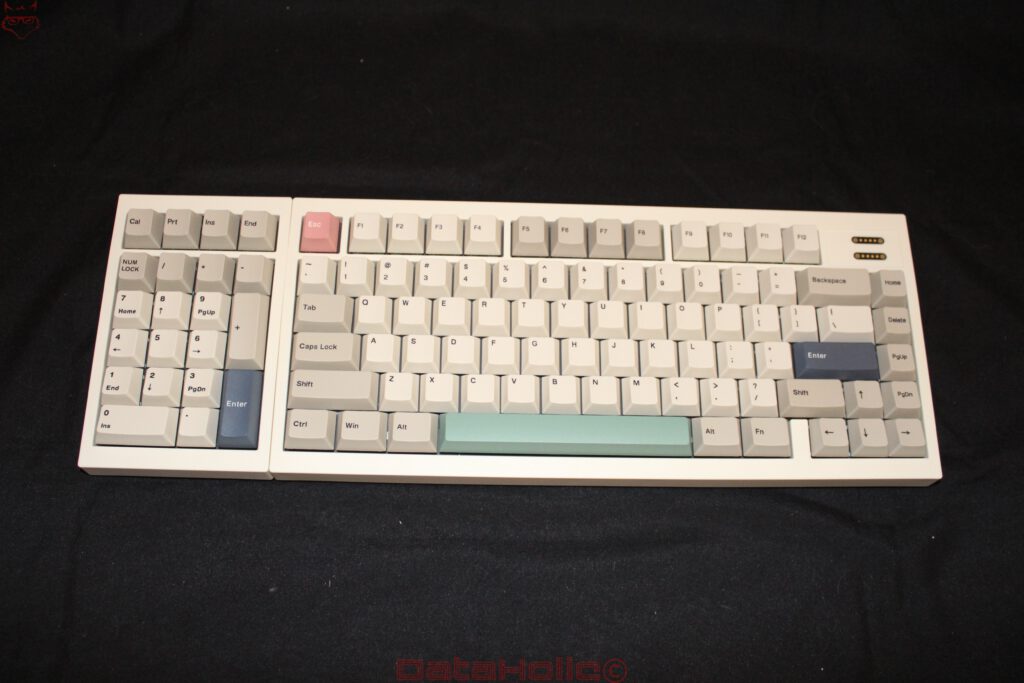
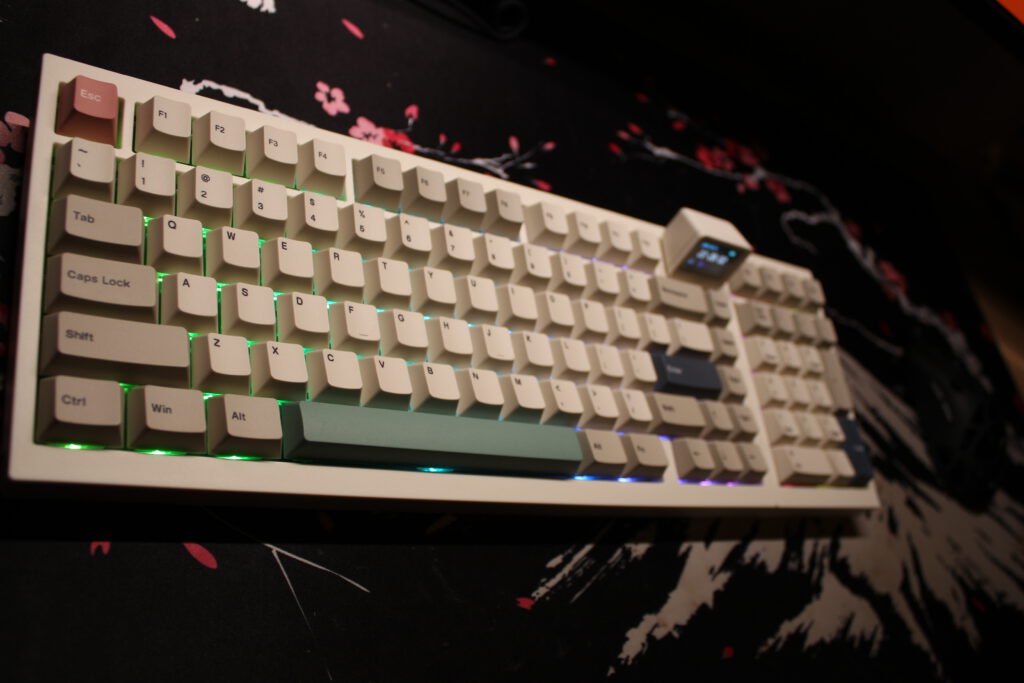
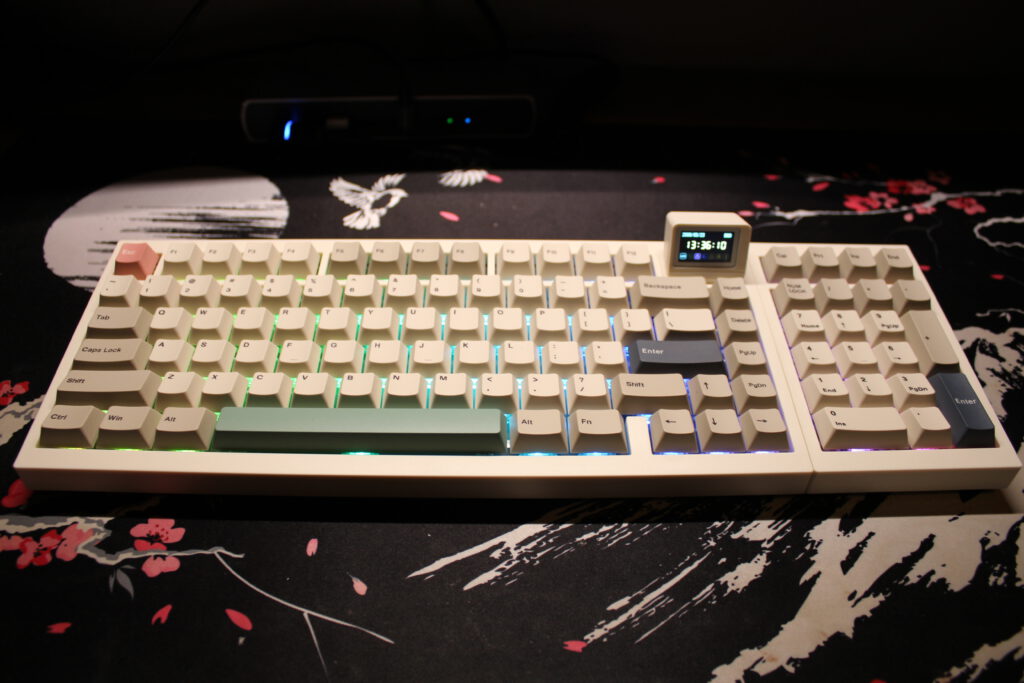
The housing design remains comparatively understated. The light-colored case is combined with predominantly cream-colored keycaps. Individual colored accents add some visual variation. The Escape key features a subtle pink tone, while the spacebar has a light green finish. The Enter keys introduce another contrast with their muted blue coloring.
This color scheme appears considerably less aggressive than the frequently encountered black gaming keyboards with strongly contrasting RGB lighting. Visually, the RT98 is more closely aligned with traditional computer workstations and incorporates individual elements of historical keyboard designs without fully embracing a retro aesthetic.
One notable detail is the ANSI layout used by the review unit. The horizontal Enter key and long left Shift key correspond to the American arrangement. This is particularly relevant for the German market because not only the legends but also individual key positions differ from an ISO-DE layout. Although the keyboard layout can be changed within the operating system, the physical arrangement of the keys remains unchanged.
Anyone regularly writing German texts must therefore consider that umlauts and special characters are not directly indicated on the corresponding keycaps. This is especially relevant for everyday work involving longer documents, programming code, and different keyboard layouts. Additional keycaps labeled Command and Option are included, making it easier to visually adapt the keyboard to macOS.
Housing, Gasket Mount, and Mechanical Construction
EPOMAKER advertises the RT98 with a gasket-mount construction. This refers to a mechanical mounting system in which the internal keyboard assembly is not connected to the housing exclusively through rigid screws. Instead, elastic intermediate elements are used to absorb some of the movement and vibration.
The technical advantage lies in the isolation between the keyboard PCB and the housing. When a key is pressed, mechanical impulses are generated and transmitted through the switch, mounting plate, and circuit board. In a completely rigid construction, these vibrations reach the housing relatively directly. Depending on the material, internal cavities, and mounting method, this can produce resonances that significantly influence the sound of individual keys.
A gasket-mount system can reduce such effects. The elastic elements alter the transmission of vibrations and, depending on their design, allow a certain degree of flexibility within the internal construction. However, this does not automatically result in a softer or particularly quiet typing experience. The actual effect depends on the stiffness of the mounting plate, the PCB construction, the damping materials used, and the design of the gaskets.
This tuning is particularly demanding for keyboards with additional modularity. The RT98 must not only absorb the mechanical forces generated during typing but also maintain a sufficiently stable connection between the main housing and the numeric keypad. An overly flexible construction could cause unwanted movement at the separation point. A very rigid connection, on the other hand, could partially limit the intended isolation effect.
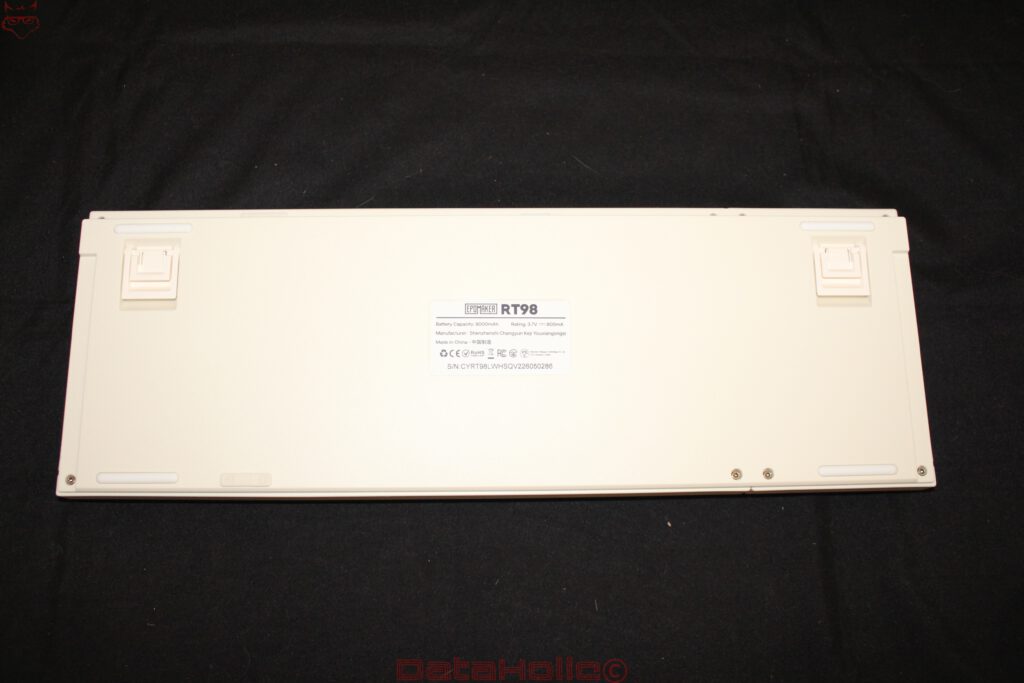
The underside features fold-out feet that allow the typing angle to be adjusted. The multi-stage construction makes it possible to adapt the height of the rear housing section to different typing habits. Several elongated support elements are also present, intended to ensure stable contact with the desk surface.
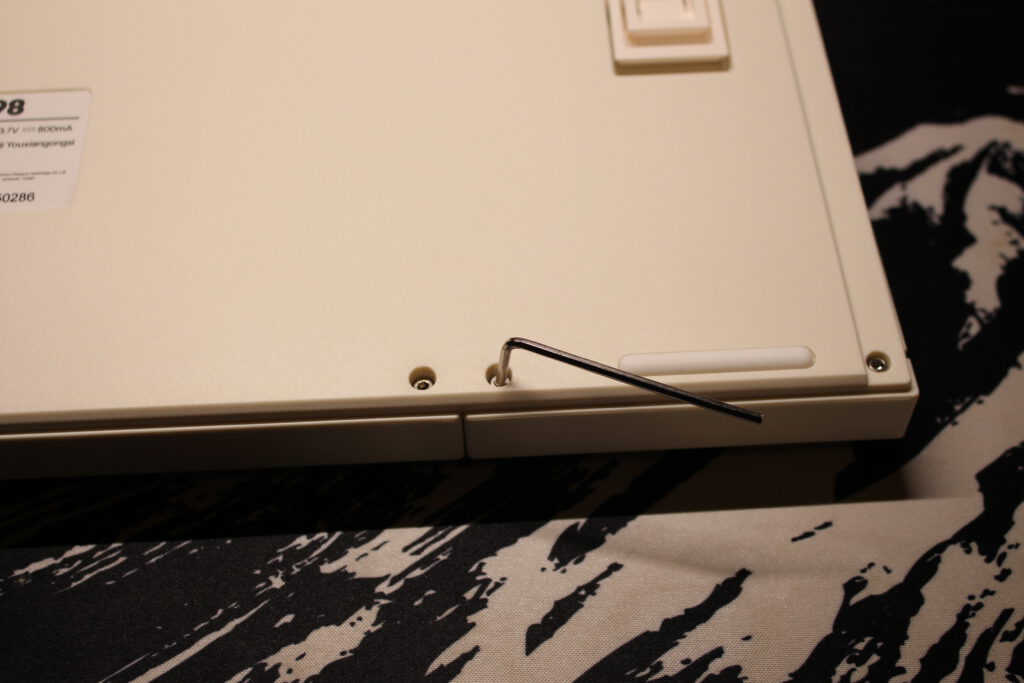
The underside itself is largely enclosed and avoids conspicuous design elements. The housing uses screws for assembly, which generally indicates a construction that can be disassembled. Whether all internal components can be removed without damage and how complicated replacing individual parts might be, however, depends on the internal design.
Another consideration is the overall housing height. The RT98 uses a traditional mechanical keyboard profile with noticeably raised keycaps. This creates a different hand position compared with low-profile keyboards. The fold-out feet further change the inclination without lowering the front edge of the housing. For extended typing sessions, the maximum available angle is therefore less important than maintaining a relaxed wrist position.
Compared with the EPOMAKER Split70 or more consistently ergonomic models such as the Dygma Defy, the RT98 follows a considerably more traditional approach. It neither fundamentally changes the angle of the two hands nor offers separate keyboard halves for individually adjusting shoulder positioning. Its modularity focuses on the numeric keypad and display rather than a complete ergonomic redesign.
Hot-Swap Technology and the Importance of Replaceable Switches
Alongside the gasket-mount construction, hot-swap support is one of the RT98’s essential technical features. Corresponding sockets allow compatible mechanical switches to be replaced without having to desolder them directly from the PCB.
This feature is particularly interesting for long-term use. Mechanical switches are wear components, even though their designed service life is generally specified in very high numbers of actuations. Individual contacts can nevertheless fail, springs can become damaged, or the actuation characteristics can change over time. In a permanently soldered construction, replacement requires suitable tools and experience working with electronic components.
Hot-swap sockets considerably simplify this process. A defective switch can generally be replaced individually, provided a mechanically and electrically compatible replacement is available. Different switch characteristics can also be tested without purchasing an entirely new keyboard.
The practical significance extends beyond repairs. Different switches change both the required actuation force and the progression of key travel, as well as the acoustic characteristics. Linear switches have a largely consistent movement throughout their travel, while tactile models provide a noticeable resistance point. Clicky switches supplement this feedback with an additional audible signal.
The exact designation of the installed switch variant has not been conclusively established. The precise socket compatibility and characteristics of the factory-installed switches also require clear identification. Assessing actuation force, travel distance, or contact behavior requires corresponding technical specifications or measurements.
For evaluating the RT98, however, the important point is that EPOMAKER provides a replaceable switch architecture. This gives the keyboard a significantly better foundation for repairs and individual customization than models with permanently soldered switches.
Nevertheless, hot-swap sockets should not be confused with unlimited mechanical durability. Repeated insertion and removal can place stress on the contacts. The switch pins must also be correctly aligned, as bent contacts can cause malfunctions during installation. The technology simplifies maintenance but does not replace careful handling of the components.
The keycaps also play an important role. They feature a traditional sculpted profile. The different heights and angles of the key rows are intended to improve accessibility. The legends are high-contrast and clearly recognizable. The exact plastic composition and printing method are also important factors in long-term durability.
Material selection is particularly relevant for a long-term evaluation of light-colored keycaps. Depending on surface treatment and usage, ABS can develop a more pronounced shine over time. PBT is generally more resistant to such changes, although it also comes in different quality grades. A clear identification of the material is therefore necessary before drawing conclusions about expected aging characteristics.
The Mini TV Display: Between Information and Design
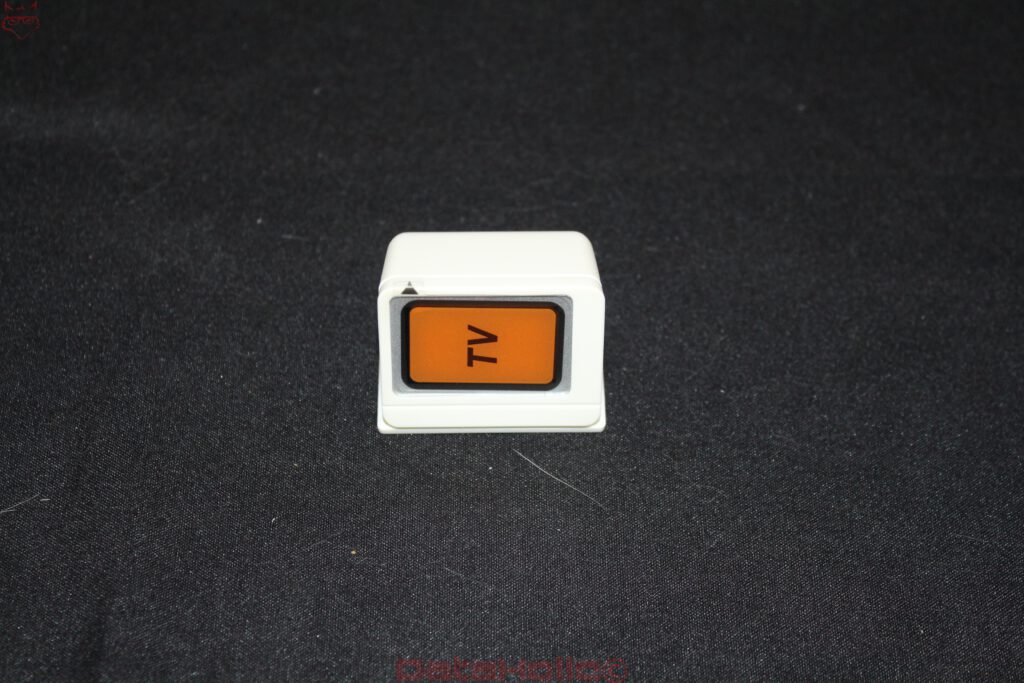
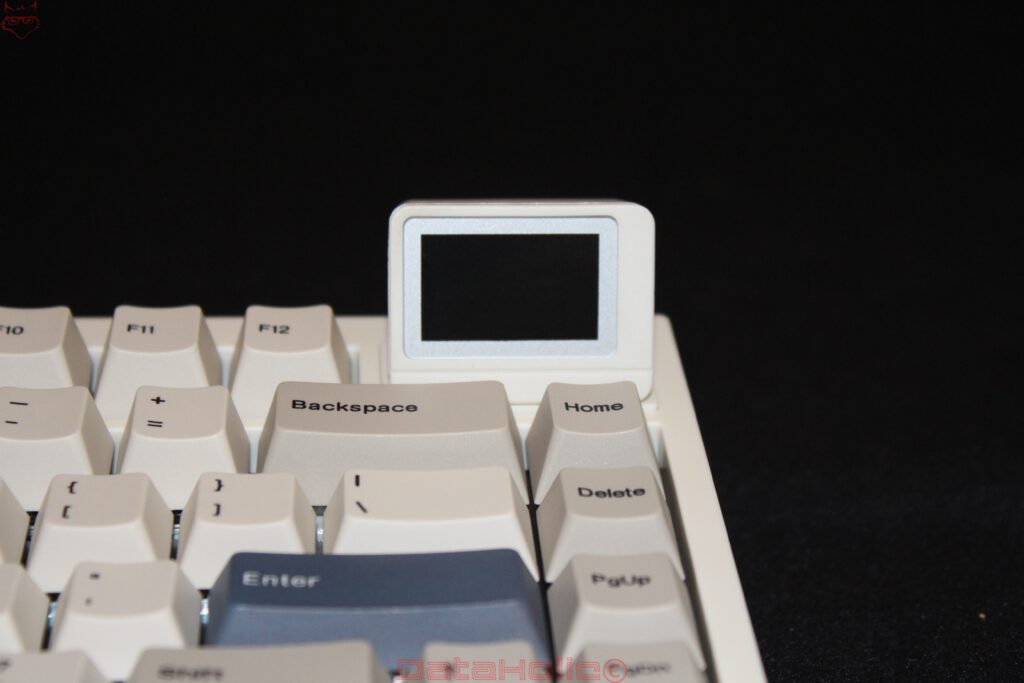
The most striking element of the RT98 is undoubtedly the small display positioned above the right-hand section of the keyboard. EPOMAKER calls the unit the „Mini TV“ and explicitly advertises it as a replaceable, magnetically attached module.
The housing resembles a heavily miniaturized cathode-ray tube television. The display surface is surrounded by a light-colored frame that blends into the overall design. Unlike the flat integrated displays found on other keyboards, the module extends noticeably above the upper edge of the keycaps.
This positioning has a functional advantage. The screen sits outside the actual typing area and is not directly obscured by the hands. At the same time, the display is easier to see from a normal seated position than a screen installed horizontally into the upper surface of the housing.
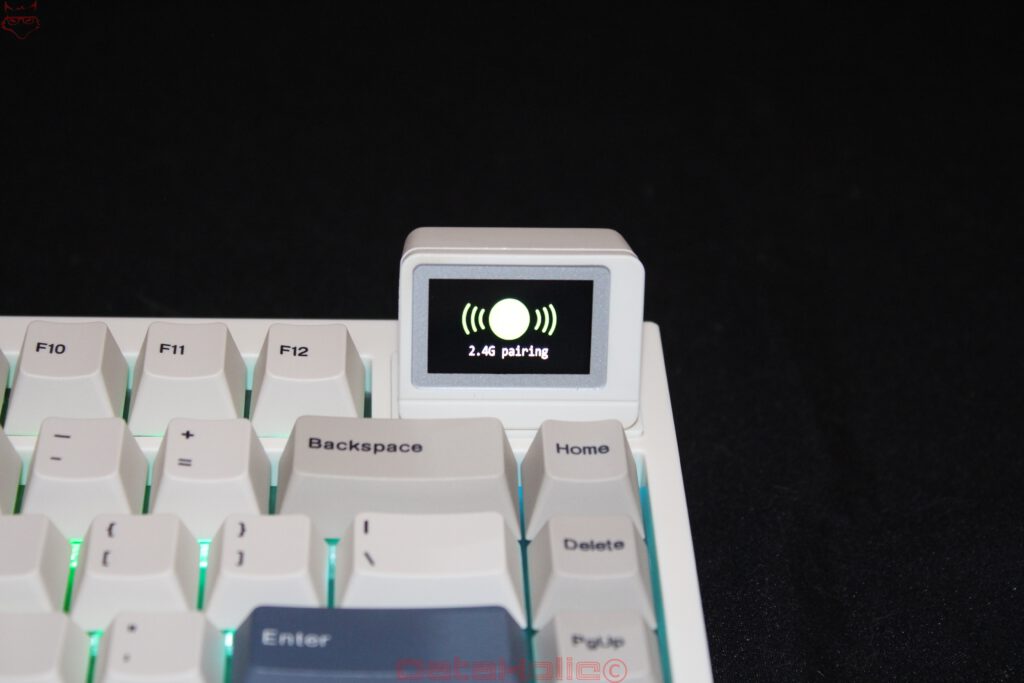
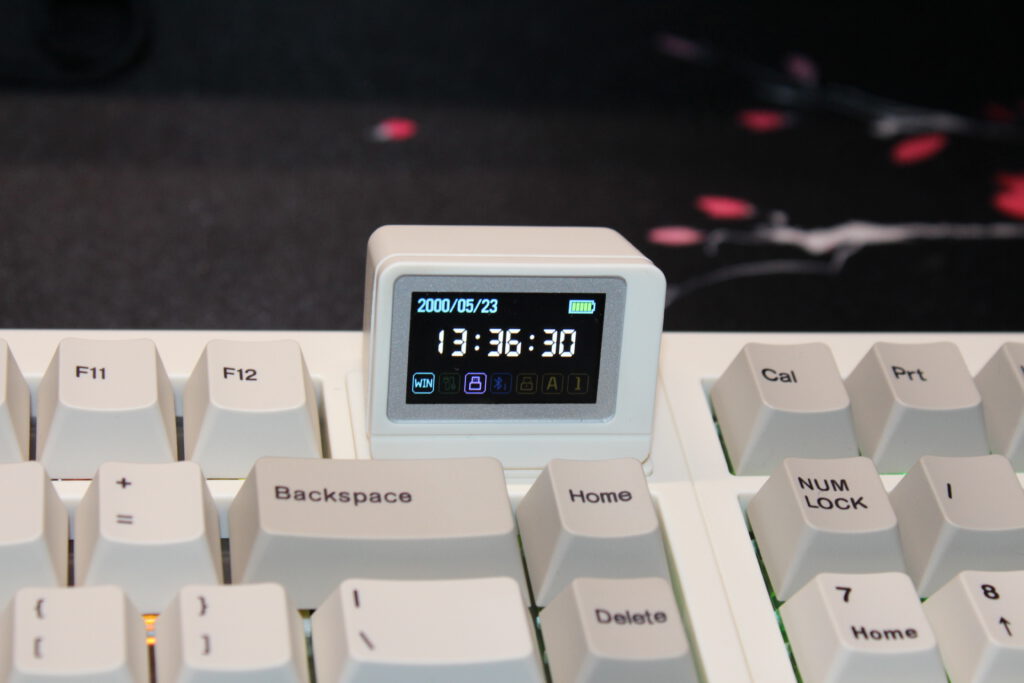
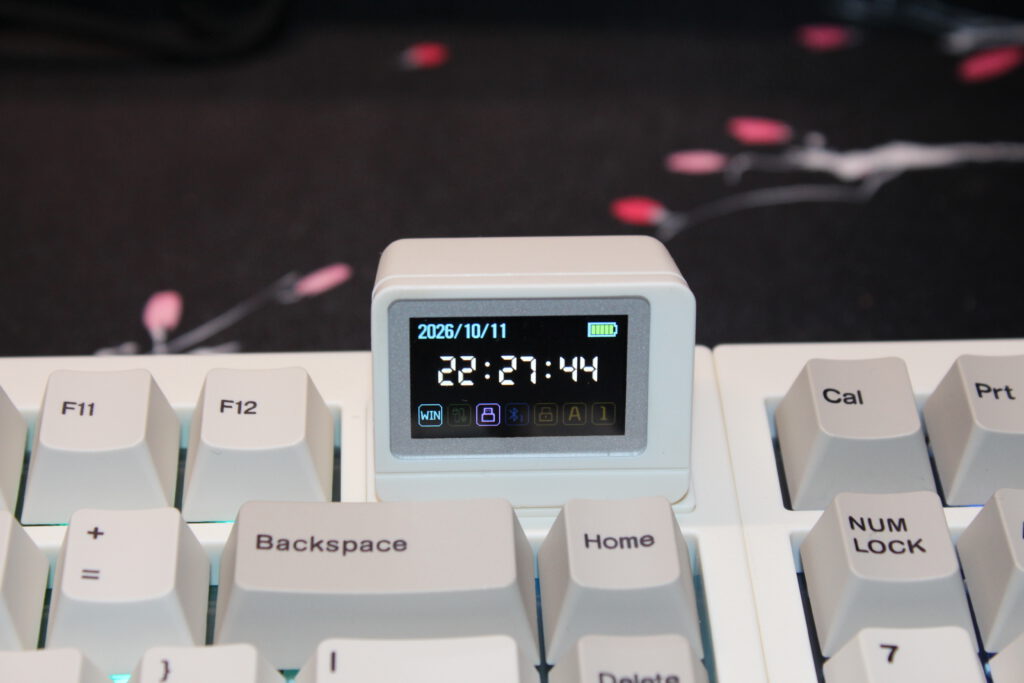
The display provides several operating screens. During connection establishment, it presents a 2.4 GHz pairing indicator. During regular operation, it shows information including the time, date, battery level, and various status symbols. The available information includes indicators for the operating system, connection type, and additional operating states.
The display therefore serves a comprehensible purpose. It consolidates information that, on many other keyboards, is accessible only through small LEDs or keyboard shortcuts. Battery status is particularly relevant for wireless input devices because an unexpectedly depleted battery can interrupt work.
The connection-mode indicator is equally useful. Keyboards supporting Bluetooth, 2.4 GHz wireless, and USB operation often use several keyboard shortcuts to switch between devices or connections. A visible status message reduces uncertainty about which mode is currently active.
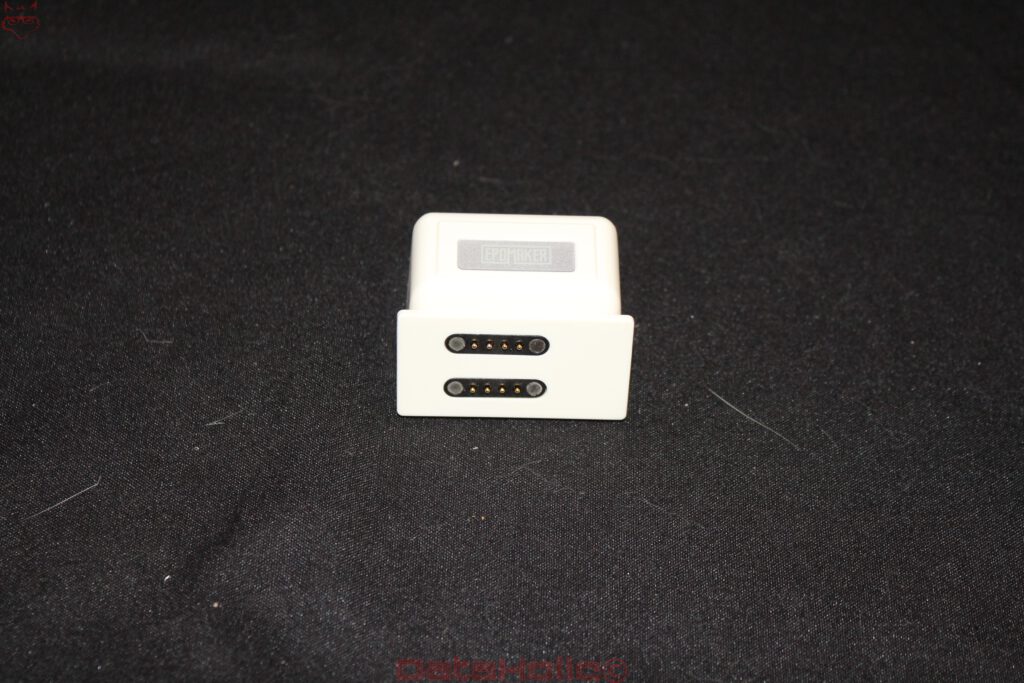
The magnetic connection of the display is technically interesting. Two contact rows, each featuring four gold-colored contacts, are located on the underside of the module. Larger metallic elements are positioned alongside them and may serve for mechanical positioning or magnetic attachment.
Such a contact arrangement enables an electrical connection without a separate cable. The display can be removed while the contact surfaces transmit the required signals when correctly positioned. Compared with a permanently soldered solution, this fundamentally improves replaceability and simplifies assembly.
However, the design also introduces additional contact points whose reliability becomes important over time. Dust, contamination, or mechanical damage can cause connection problems with exposed contacts. The magnetic holding force must also be sufficiently strong to prevent the module from accidentally shifting when the keyboard is moved.
The construction appears fundamentally appropriate thanks to its wide contact surface and clearly defined positioning. Nevertheless, a definitive assessment of long-term contact stability is only possible after extended use.
Another interesting question concerns the actual informational value. A time and date display is convenient but not essential, since this information is normally already available on the computer screen. Battery status and connection-mode indicators, on the other hand, have a direct relationship to the keyboard’s operation.
The Mini TV module therefore occupies a position between a functional addition and a decorative design element. It gives the RT98 a recognizable identity without its currently available functions suggesting a fundamental change to everyday workflows.
One detail stands out in the status display: the screen shows the date May 18, 2000. This suggests that the internal clock had not been correctly configured or synchronized at the time of observation. Whether the RT98 automatically obtains the date and time through software or requires separate configuration remains unclear. However, this question is relevant to the everyday usefulness of such a display. A clock that needs to be reset regularly after the keyboard is switched off loses a significant part of its practical value.
Three Connectivity Options and a Large Battery
The EPOMAKER RT98 supports three operating modes: Bluetooth, a proprietary 2.4 GHz wireless connection, and wired operation via USB.
This covers the most important usage scenarios for a modern mechanical keyboard. Bluetooth is particularly suitable for notebooks, tablets, and other devices where occupying as few USB ports as possible is desirable. The 2.4 GHz mode, meanwhile, is intended for situations where a dedicated wireless connection is preferred.
Actual input latency does not depend solely on the wireless technology used. Important factors include firmware, polling rate, signal processing, and wireless connection quality. Without corresponding measurements, it would therefore be unjustified to attribute a specific response time to the RT98 or claim that it is fundamentally superior to other wireless keyboards.
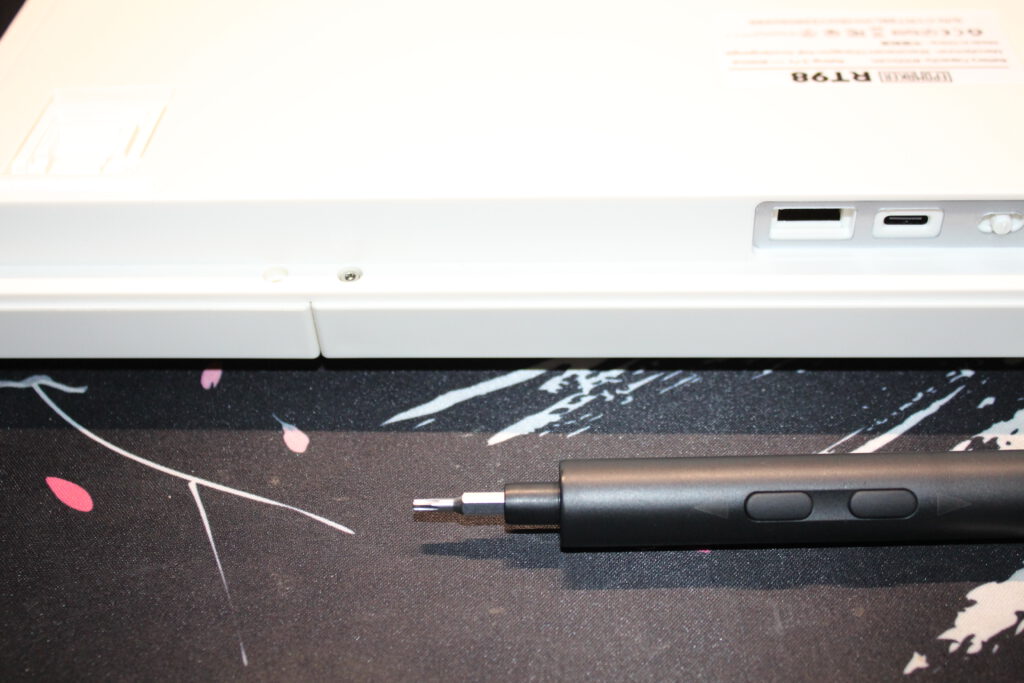
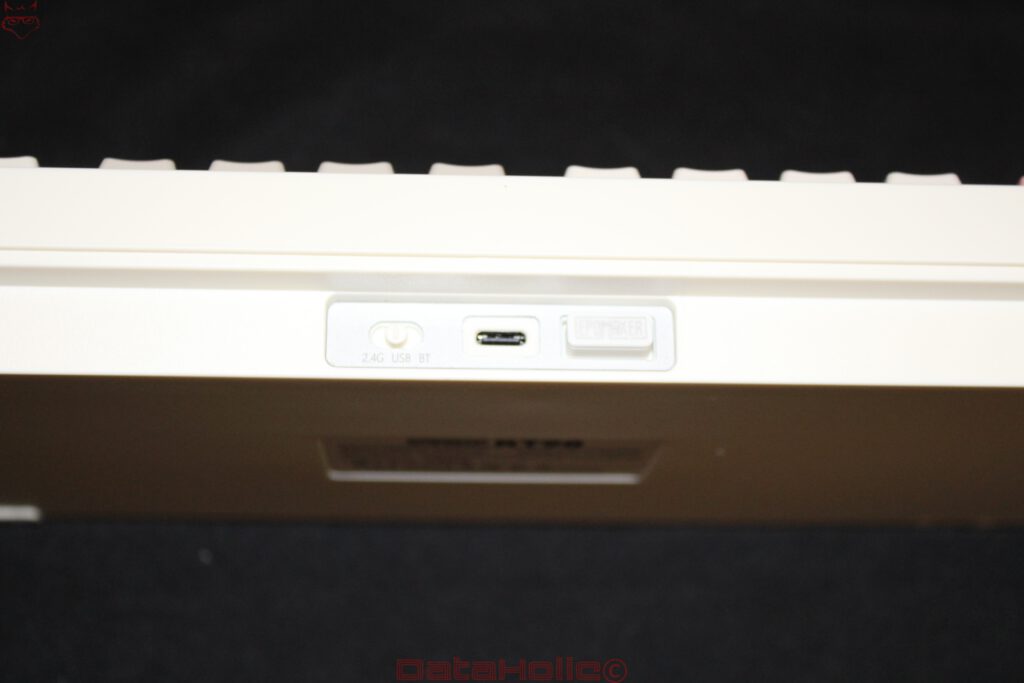
For wired operation, the keyboard features a USB-C port on the rear of the housing. A sliding switch for selecting between operating modes is located beside it. The labeling shows positions for 2.4 GHz, USB, and Bluetooth. Another small compartment or corresponding holder is positioned directly next to the connection area.
The central arrangement of the controls is sensible because all connection options are grouped in one location. The switch can be reached from the rear without turning the keyboard over. At the same time, it remains outside the normal typing area and is therefore unlikely to be activated accidentally.
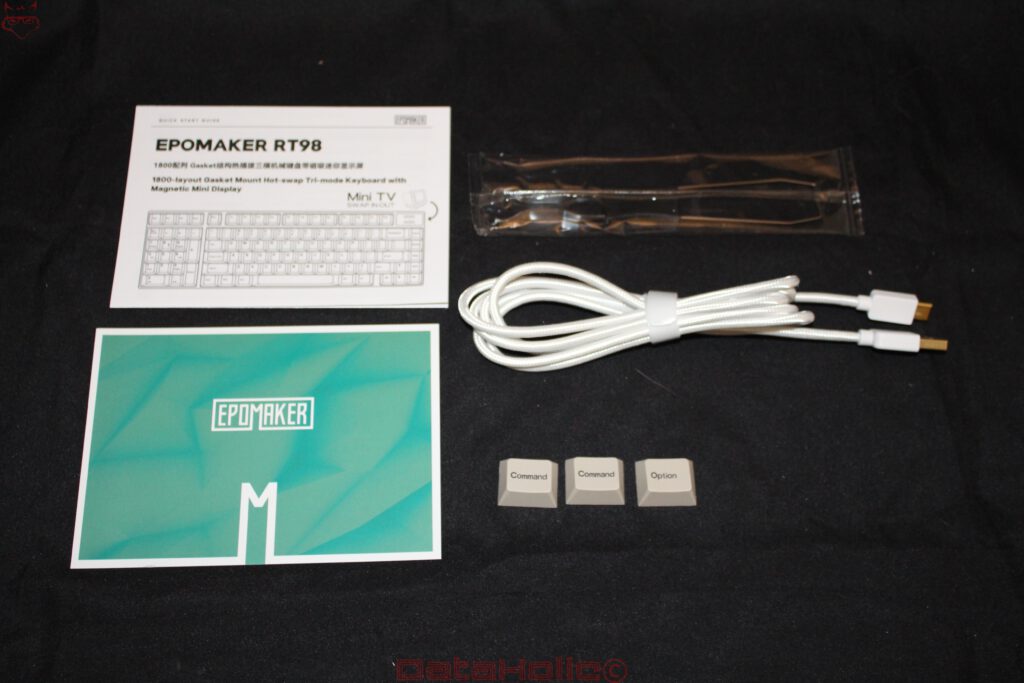
A braided USB cable is included in the package. The connectors and light-colored sleeving visually match the keyboard. A detachable cable is not only practical for transportation but also makes replacement easier if it becomes defective.
The battery capacity is particularly striking. The label on the underside specifies 8,000 mAh at a nominal voltage of 3.7 volts. This results in a calculated stored energy capacity of approximately 29.6 Wh.
For a mechanical keyboard, this represents a substantial energy reserve. However, capacity alone does not allow a reliable conclusion about actual battery life. Power consumption is influenced by several factors, including RGB lighting, wireless connectivity, display brightness and activity, and the efficiency of the internal electronics.
The Mini TV module in particular could consume additional power compared with simple status LEDs. The extent of this consumption depends on the display technology and its control system. Automatic shutdown during inactivity would therefore be useful, although this has not been conclusively confirmed.
The high battery capacity at least provides the technical foundation for longer wireless operating intervals. At the same time, a larger battery increases weight and requires additional space inside the housing. Whether EPOMAKER has found the optimal compromise depends on the battery life actually achieved.
Battery replaceability is also relevant for long-term use. Lithium-ion batteries lose capacity as they age and undergo repeated charging cycles. A device whose battery cannot reasonably be replaced therefore has a limited economic lifespan, even if the switches and housing continue to function perfectly.
The screw-based housing construction at least suggests that the RT98 can, in principle, be opened. Whether the battery can be accessed without major intervention and whether suitable replacement parts are available remains unclear.
Package Contents, Compatibility, and Practical Considerations
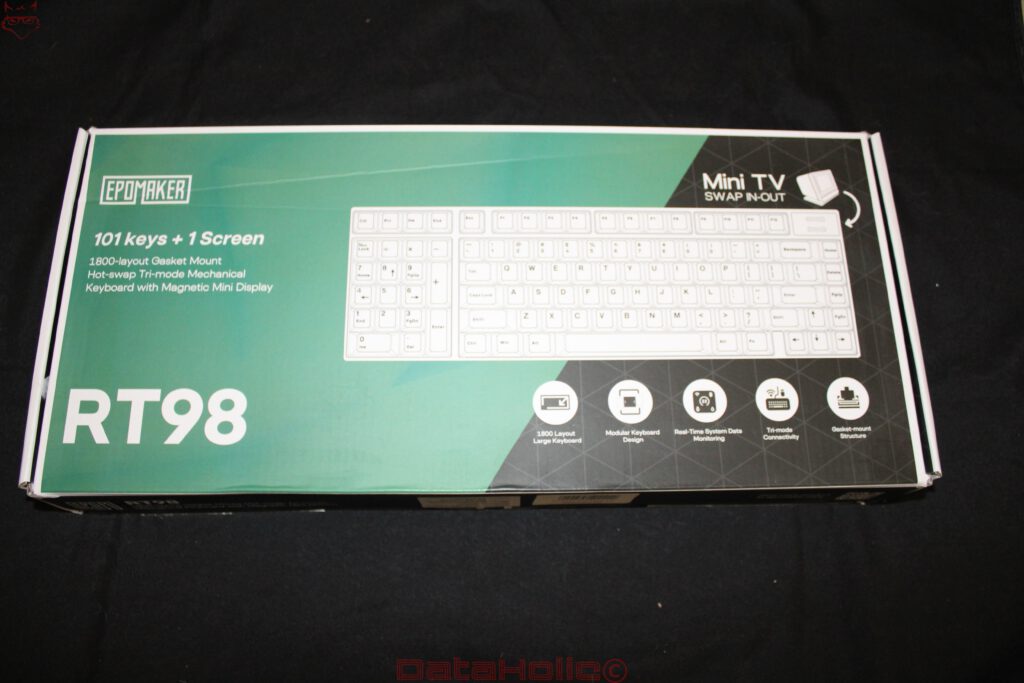
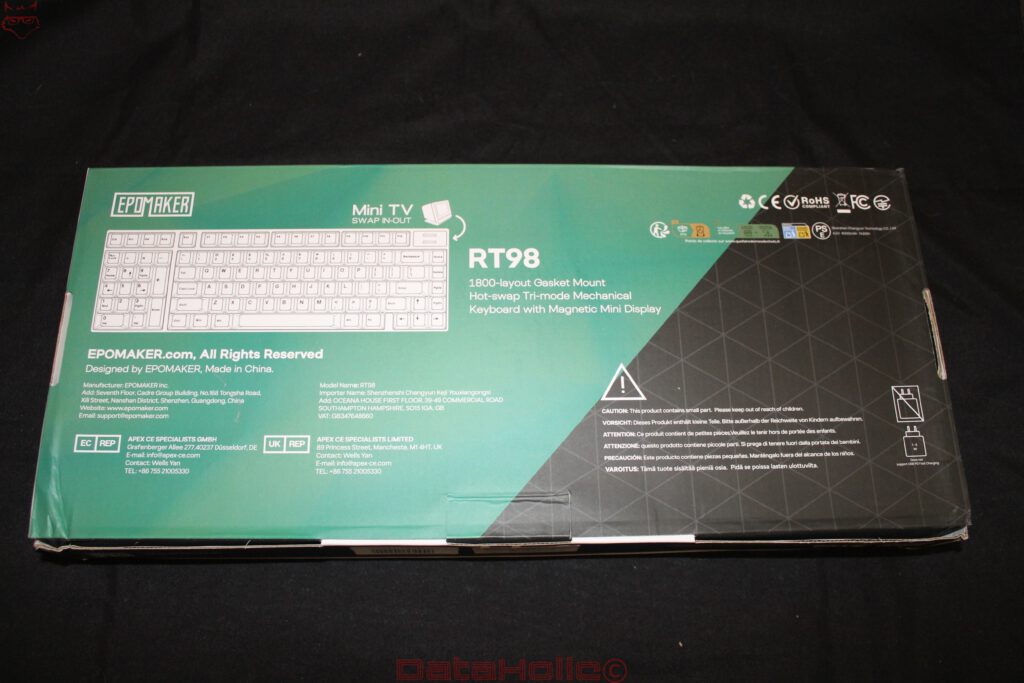
EPOMAKER supplies the RT98 in a large-format package whose design highlights the product’s essential features. Alongside the 1800 layout, the gasket-mount construction, hot-swap support, three connection modes, and magnetic display are explicitly mentioned.
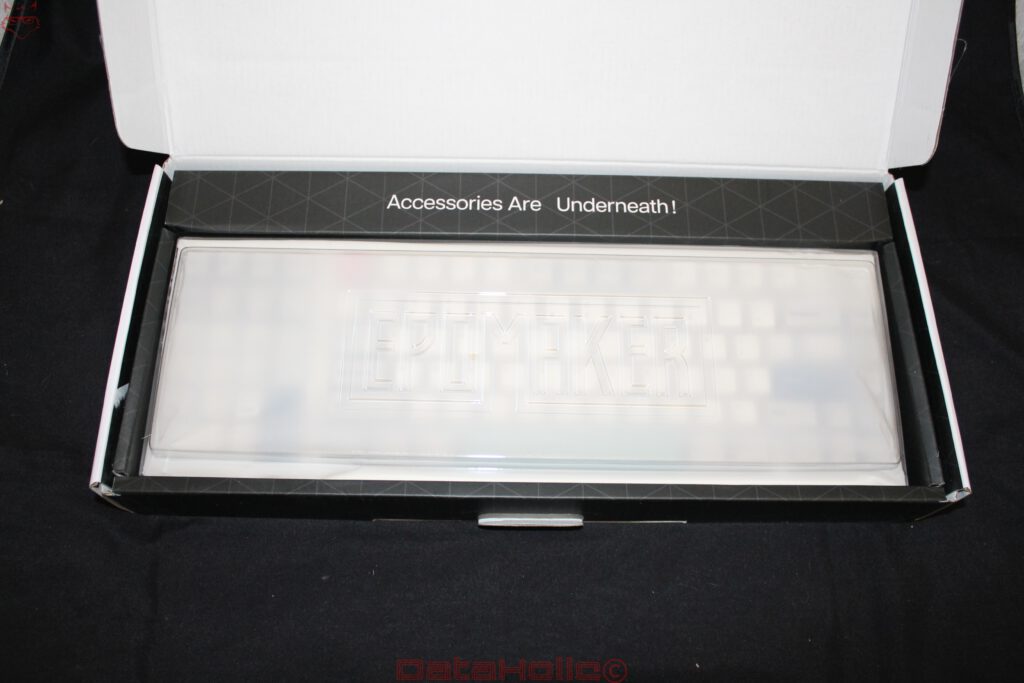
Inside, the keyboard is secured by a molded protective cover. The accessories are located beneath the keyboard itself. This arrangement separates sensitive surfaces from the additional components and reduces the risk of loose accessories striking the keycaps during transportation.
The package contents include a quick-start guide, a braided USB cable, a tool for removing keycaps or switches, and three additional keycaps for macOS. The Mini TV module is also included.
The additional Command and Option keycaps demonstrate that EPOMAKER has considered compatibility with Apple computers. However, physical labeling represents only one aspect of compatibility. Equally important are the correct assignment of modifier keys, support for function keys, and, where applicable, the availability of configuration software.
The RT98 can generally be classified as a traditional mechanical keyboard with extensive features. Compared with the EPOMAKER TH87, it offers additional numeric input options and the Mini TV display. The TH87, by contrast, follows a more compact approach focused on reducing the required desk space.
The EPOMAKER Split70 takes a different conceptual direction. Its spatial separation of the keyboard sections is a fundamental ergonomic feature. The RT98, on the other hand, uses modularity primarily to make the functionality of a nearly full-size keyboard more flexible.
The difference becomes even more pronounced when compared with the EPOMAKER Luma40. While the latter uses a substantially reduced number of keys and makes many functions accessible through additional layers, the RT98 preserves most traditional direct-access keys. Both concepts pursue different priorities. The Luma40 reduces physical dimensions, while the RT98 attempts to keep as many functions directly accessible as possible.
This distinction is important because a high number of keys does not automatically result in better usability. The RT98 can offer advantages for extensive writing, spreadsheets, and applications involving numerous keyboard shortcuts. On smaller desks or in situations involving frequent switching between keyboard and mouse, a more compact solution may be preferable.
The position of the numeric keypad is also not equally suitable for every working method. Anyone accustomed to entering numbers with the right hand must adapt to the left-sided arrangement. The separation of the two housing sections provides an interesting construction concept here, although its practical flexibility depends on the actual supported connection and positioning options.
Software and Customization: The Essential Complement to the Hardware
The RT98 hardware offers several opportunities for individual customization. Replaceable switches, different connection options, and a detachable display, however, can only realize their full potential if the software adequately supports these features.
Flexible key assignment is particularly important with an unusual layout. The position of individual navigation keys differs from a traditional full-size keyboard. Remapping options could help make frequently used functions easier to reach and reduce the adjustment period.
Reliable configuration would also be relevant when using different operating systems. Although the included macOS keycaps allow visual adaptation, they do not replace correct assignment of the corresponding functions. Permanently storing settings directly on the keyboard would be particularly practical because the configuration would remain available independently of the computer being used.
Another question concerns the display. The various status screens demonstrate that the RT98 can present different types of information. Whether custom graphics, animations, or alternative display pages are supported has not been conclusively confirmed.
Extensive customization would be particularly desirable for a display advertised as one of the keyboard’s essential distinguishing features. A freely configurable information field could, for example, show system status information or individually selected notifications. Such functions would, however, require corresponding software support and potentially a connection to the operating system.
The scope of the configuration software is particularly relevant for a definitive assessment. This includes availability for Windows and macOS, support under Linux, the ability to store custom profiles, and the long-term handling of firmware updates.
Software is therefore not a minor accessory but an important part of the overall system. A mechanically well-constructed keyboard can lose considerable flexibility through restricted configuration options. Conversely, thoughtfully designed software can make even unusual layout decisions significantly more practical in everyday use.
Conclusion: An Interesting Construction Whose Value Is Determined by the Details
The EPOMAKER RT98 distinguishes itself from many mechanical keyboards through an unusual combination of technical features. An extensive 1800 layout, a separately constructed numeric keypad, a gasket-mount design, hot-swap support, and three connection modes form its functional foundation. Added to this is a magnetically attached Mini TV display that gives the model an unmistakable appearance.
The modular construction deserves particular attention. While numerous manufacturers attempt to make mechanical keyboards more compact through smaller layouts and the elimination of additional keys, EPOMAKER follows a different approach. The RT98 preserves important direct-access keys and supplements them with a spatially separated numeric input unit. This makes it suitable for workplaces where both extensive text and numerical data are processed.
The gasket-mount construction and hot-swap sockets are also sensible features. They provide the foundation for individually adjusting the typing experience and simplify the replacement of individual switches. The large 8,000 mAh battery also offers a considerable energy reserve, although its actual usefulness can only be assessed through battery-life measurements under different operating conditions.
The Mini TV display is the most noticeable feature, but not necessarily the most important. Displaying battery status and connection mode provides genuine practical value. Time and date, by contrast, are more supplementary information. The magnetic attachment is technically interesting but introduces additional contact points whose reliability can only be evaluated over an extended period.
Several essential characteristics remain insufficiently established for a definitive assessment. Neither the exact behavior of the switches nor the quality of the acoustic tuning, actual battery life, or the scope of the software functions has yet been conclusively evaluated. Long-term spare-part availability and the practical flexibility of the detachable numeric keypad are also important factors in the overall evaluation.
The EPOMAKER RT98 therefore offers a convincing technical foundation whose quality is not determined solely by the number of features. Its particular appeal lies in combining a familiar keyboard architecture with modular elements. Whether this results in a permanently convincing working tool ultimately depends on the implementation: stable connections, carefully tuned mechanics, reliable firmware, and software that does justice to the available possibilities.
Transparency Statement
The EPOMAKER RT98 was provided to DataHolic by EPOMAKER as a permanent review loan for independent testing and long-term evaluation. The device remains the property of EPOMAKER.
This review is neither sponsored nor paid advertising. EPOMAKER had no influence on the testing process, editorial content, or final assessment.
Sincere thanks go to EPOMAKER and the entire team for their trust and continued support. The permanent review loan enables thorough long-term evaluation, including future software updates and everyday reliability, while maintaining complete editorial independence.