
AYN Thor in a Technical Unboxing: When an Android Handheld Suddenly Unfolds Two Screens
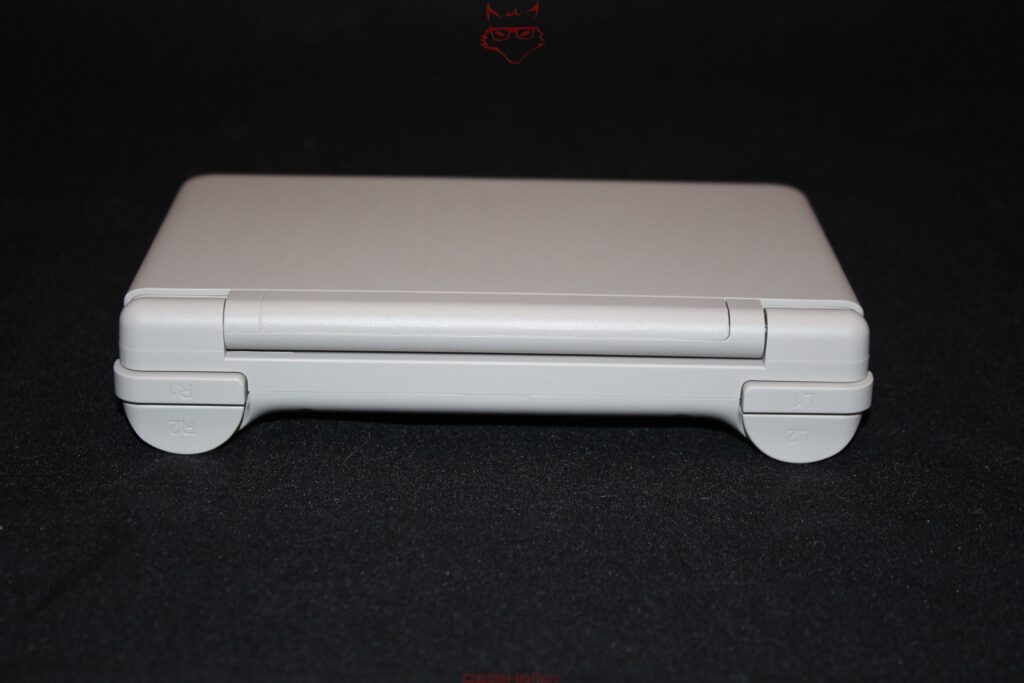
There are devices whose technical concept becomes fairly obvious even while they are still switched off. And then there is the AYN Thor. Folded shut, the compact chassis initially looks more like an unusually muscular Nintendo DS than a modern Android handheld with a Snapdragon platform, active cooling and two AMOLED panels. Only after opening it does it become clear why AYN chose the name of the Norse god of thunder. Thor does not carry its technological hammer on the outside. Instead, it distributes it across two display halves, two analogue sticks, traditional gaming controls and a chassis that, at 150 × 94 × 25.6 millimetres, manages to concentrate an impressive amount of hardware into a very small footprint.
The first physical encounter therefore creates an interesting contradiction. Sitting on the desk is not an elongated handheld following the Steam Deck school of design, but an almost square clamshell device that actually looks genuinely portable when closed. Its 380-gram weight immediately puts that impression into perspective once picked up. The Thor is compact, but certainly not lightweight. Or, loosely borrowing from Antoine de Saint-Exupéry: “Perfection is achieved, not when there is nothing more to add, but when there is nothing left to take away.” AYN appears to have read that sentence with a certain sense of humour. Very little has been removed. Quite a lot has simply been folded together.
Packaging: More Instrument Case Than Toy Box
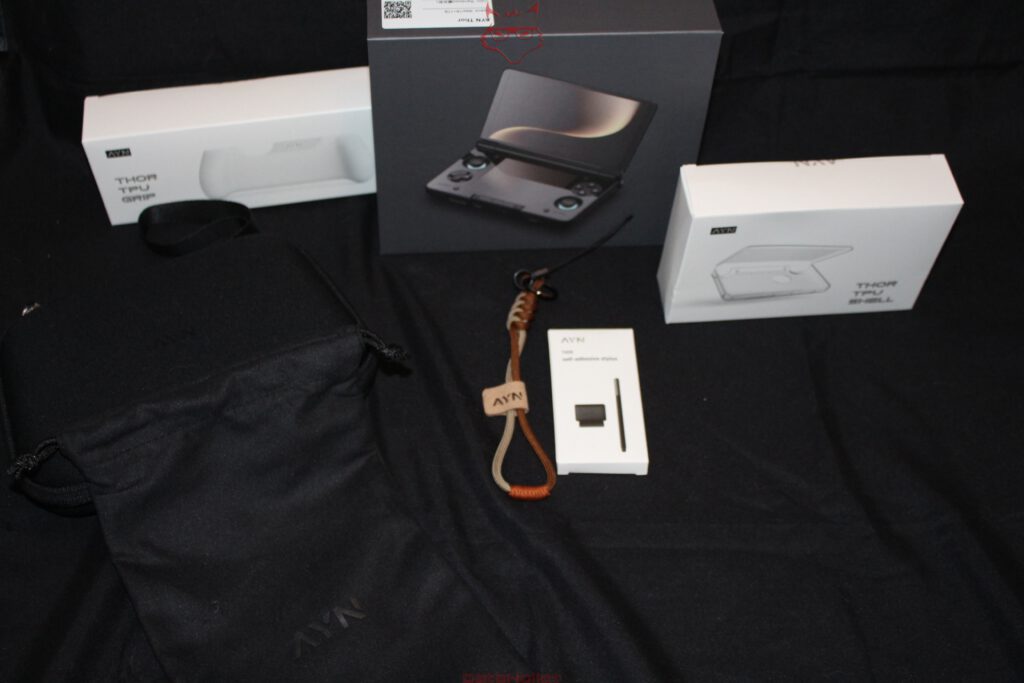
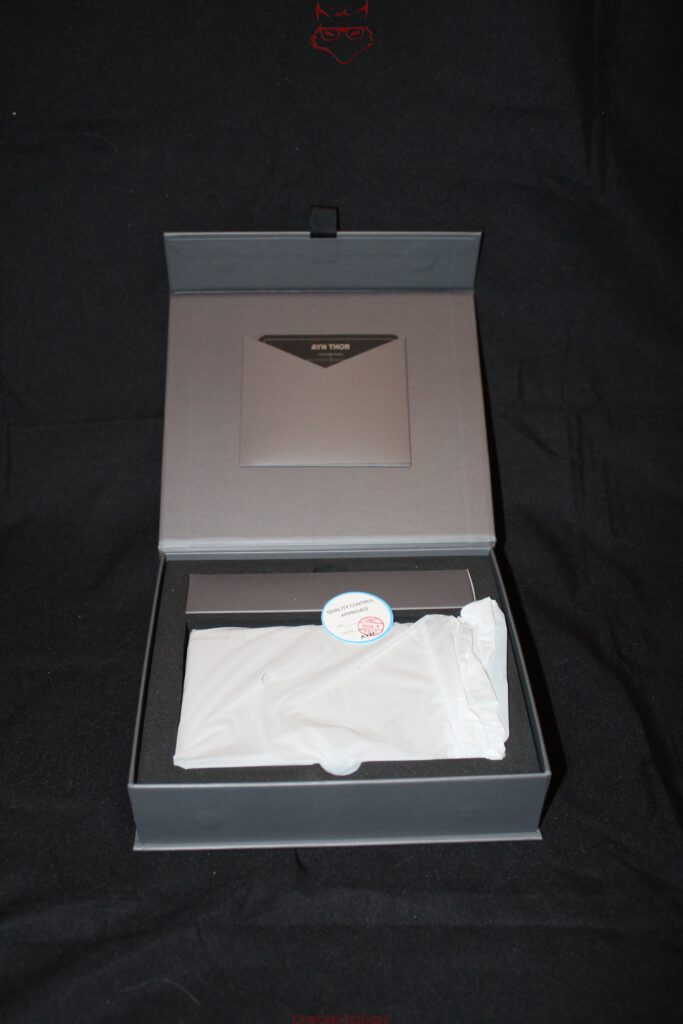
AYN does not ship the Thor in a thin retail carton dominated by oversized product photography. Instead, it arrives in a comparatively substantial box with a hinged lid. Once opened, the handheld sits securely inside a precisely cut foam insert and is additionally protected by a soft sleeve. A QC sticker indicates that the unit has passed quality control, while a separate compartment above houses the documentation and accessories.
The presentation feels surprisingly grown-up. Smaller handheld manufacturers cover a spectrum ranging from genuinely premium packaging to cardboard constructions whose structural integrity begins raising philosophical questions after their first encounter with international shipping. The Thor sits firmly at the more substantial end of that spectrum. The foam insert holds the device securely in place while keeping the accessories separated. Pressure on the display lid and hinge assembly during transportation is therefore significantly reduced.
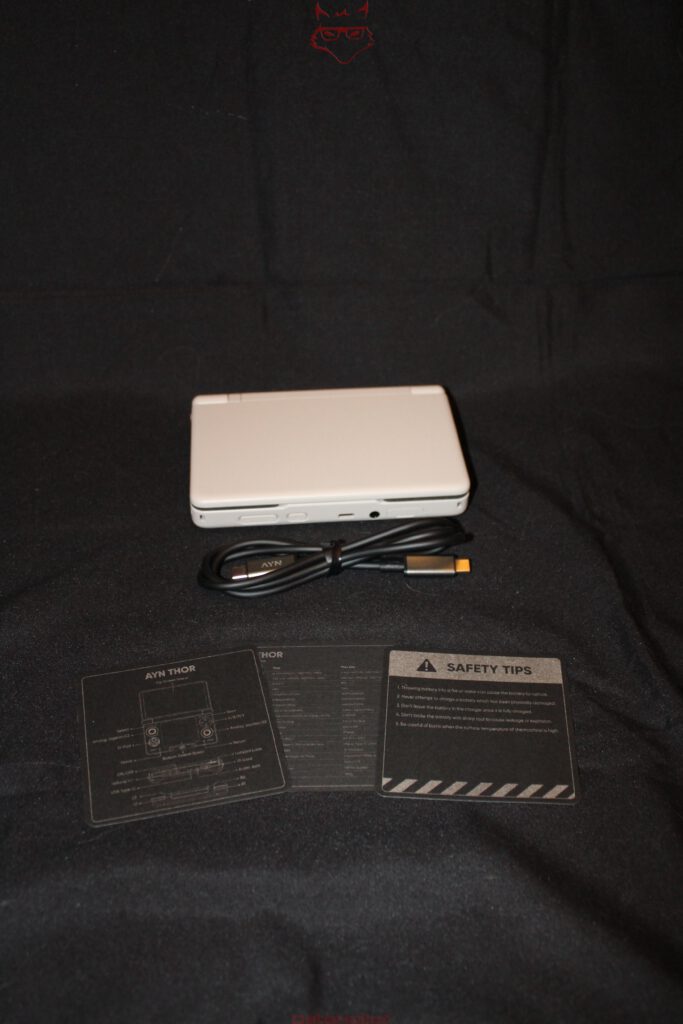
The package includes a USB-C cable, quick-start documentation, safety information and additional paperwork. A power adapter is not visibly included. Technically, that is hardly a disaster, since the Thor charges via USB-C and supports charging at up to 27 watts. In a world already overflowing with USB-C chargers, the omission is understandable, although the definition of “fully equipped” consequently becomes slightly narrower.
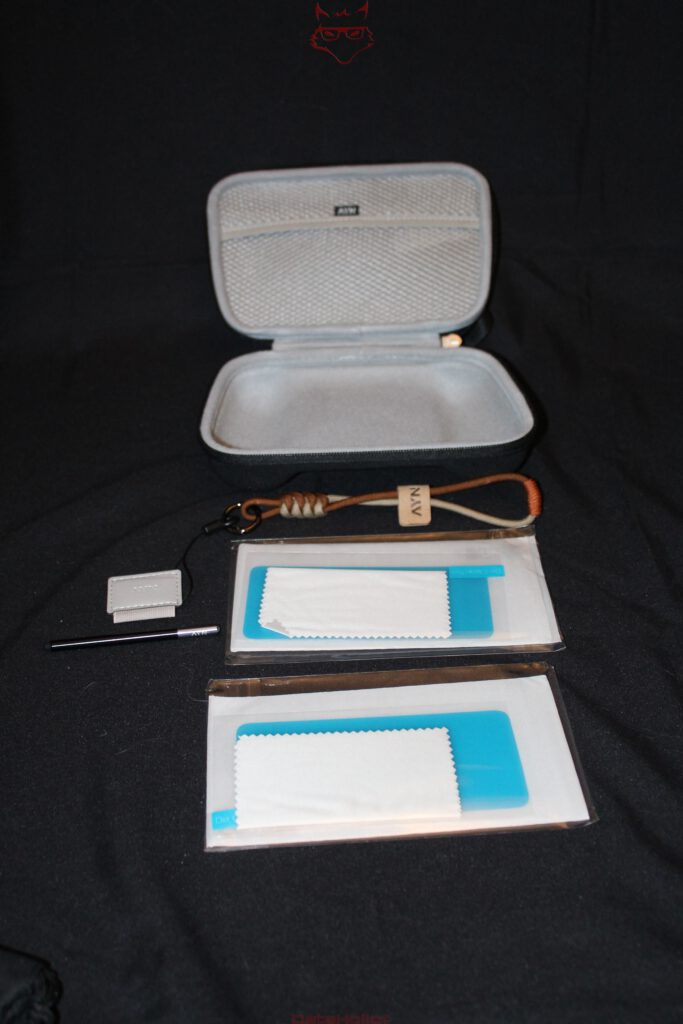
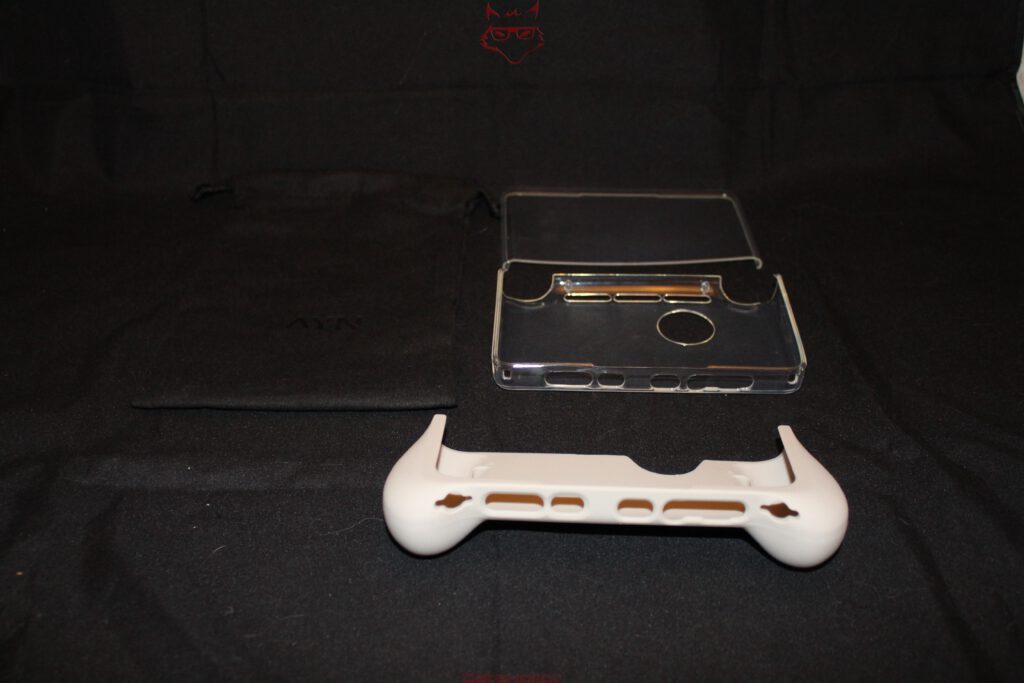
The unit shown here also comes with additional accessories and protective components. These include a transparent protective shell and a separate grip attachment. The latter is particularly interesting because the base chassis has deliberately been designed around compact dimensions and therefore inevitably accepts certain ergonomic compromises. Rather than solving all of those compromises directly within the handheld itself, AYN offers expansion options. The principle is somewhat reminiscent of cameras: the compact body remains portable, while an additional grip takes over the ergonomic heavy lifting during longer sessions.
The Clamshell Chassis: Nintendo DNA Without Becoming a Nintendo Copy
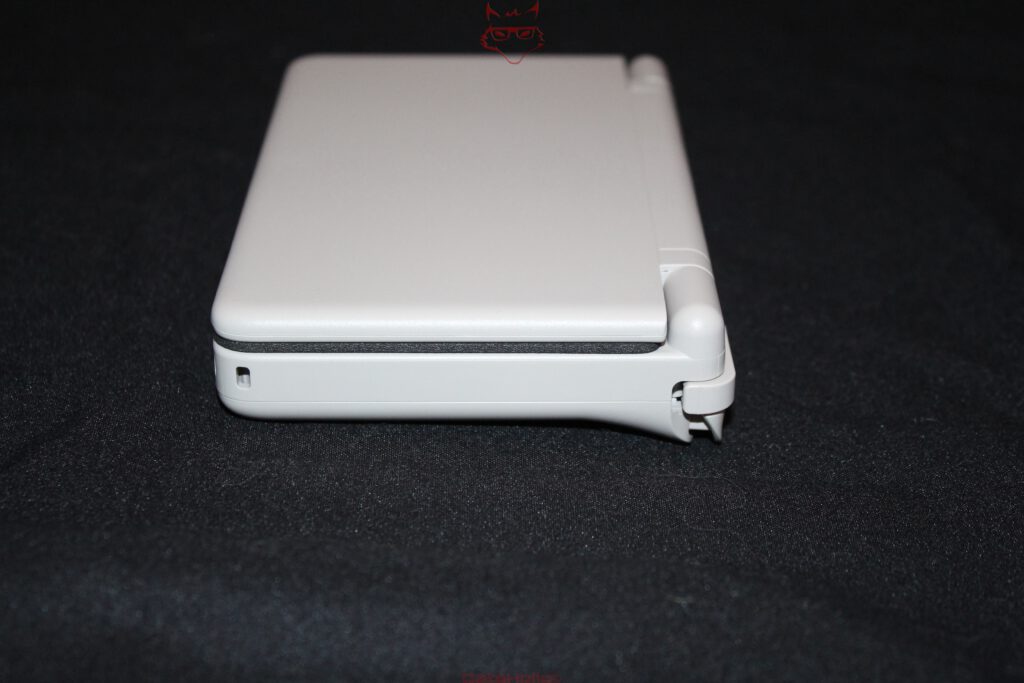
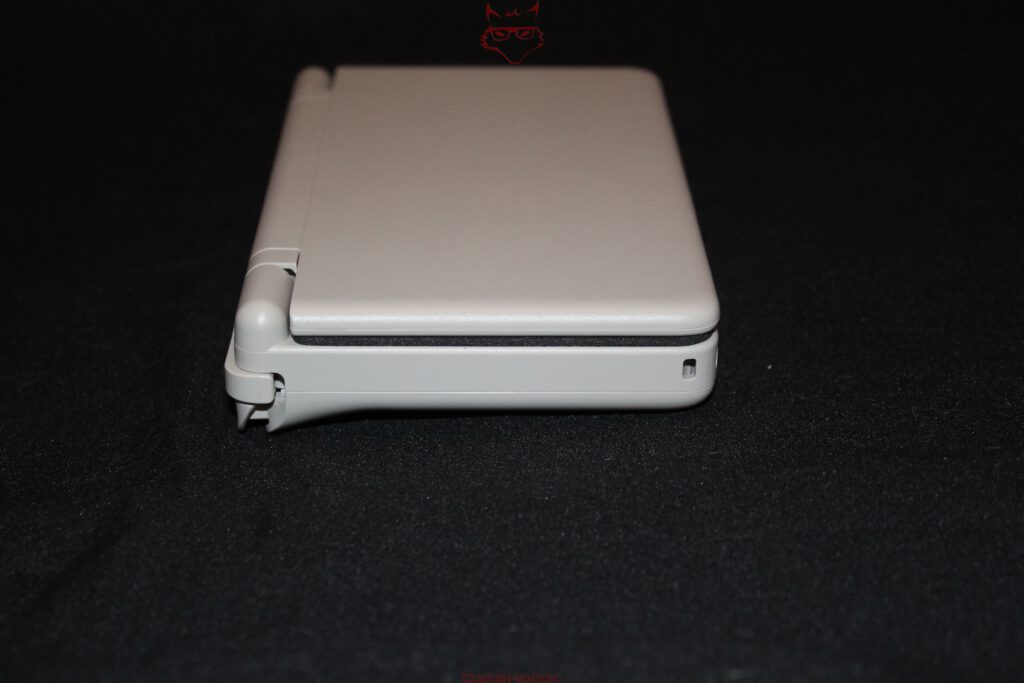
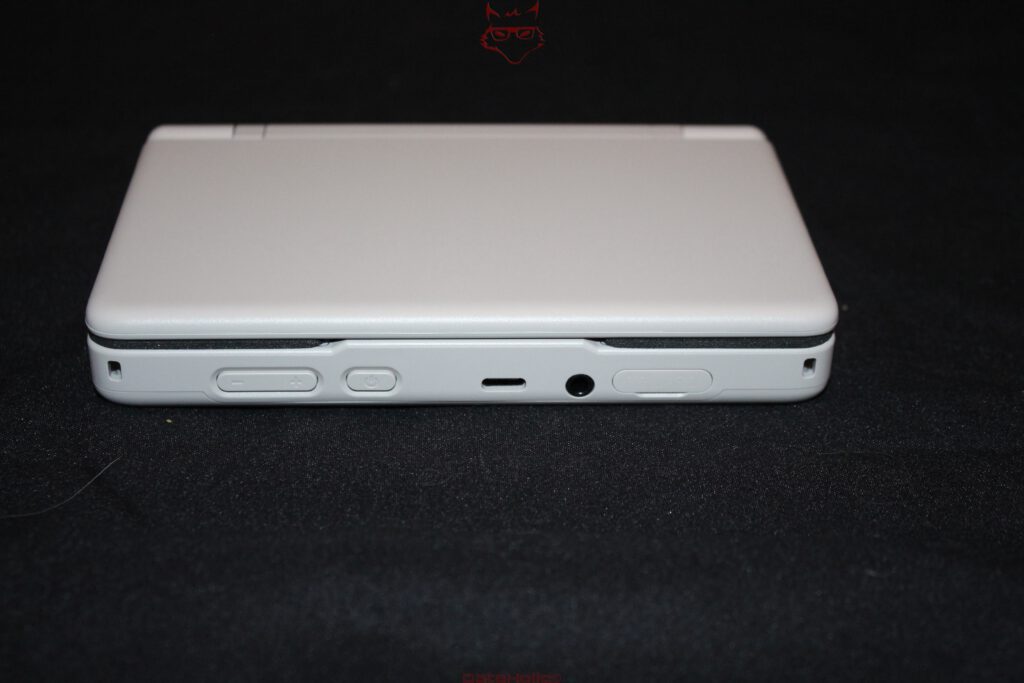
The defining structural element of the Thor is, of course, its hinge. AYN adopts the familiar clamshell principle but scales it into an entirely different performance class. When closed, both display surfaces are protected inside the device. The upper lid rests flat over the lower half, while a narrow gap remains visible between the two sections. That space serves an important mechanical purpose: the controls on the lower half must not apply pressure to the upper display when the handheld is closed.
The hinge extends across a large portion of the rear. The shoulder and trigger areas remain exposed at either side. Opening the device does not create a fragile impression. The upper display section offers enough resistance to maintain its position without feeling excessively stiff. With a device of this weight, that balance matters. A hinge with insufficient resistance could allow the display to shift simply through normal movements during gaming.
Visually, AYN exercises considerable restraint. The white plastic chassis has a slightly matte surface and largely avoids decorative elements. There is no oversized branding across the lid. When closed, the Thor could almost pass for an unusual miniature computer. Only the shoulder controls at the rear reveal its actual purpose.
That brings to mind Dieter Rams’ famous principle: “Good design is as little design as possible.” The philosophy obviously cannot be transferred completely to a dual-screen gaming handheld. AYN does, however, resist the temptation to cover every unused surface with RGB lighting, oversized ventilation patterns and aggressive geometric detailing.
Two AMOLED Displays as the Technical Centrepiece
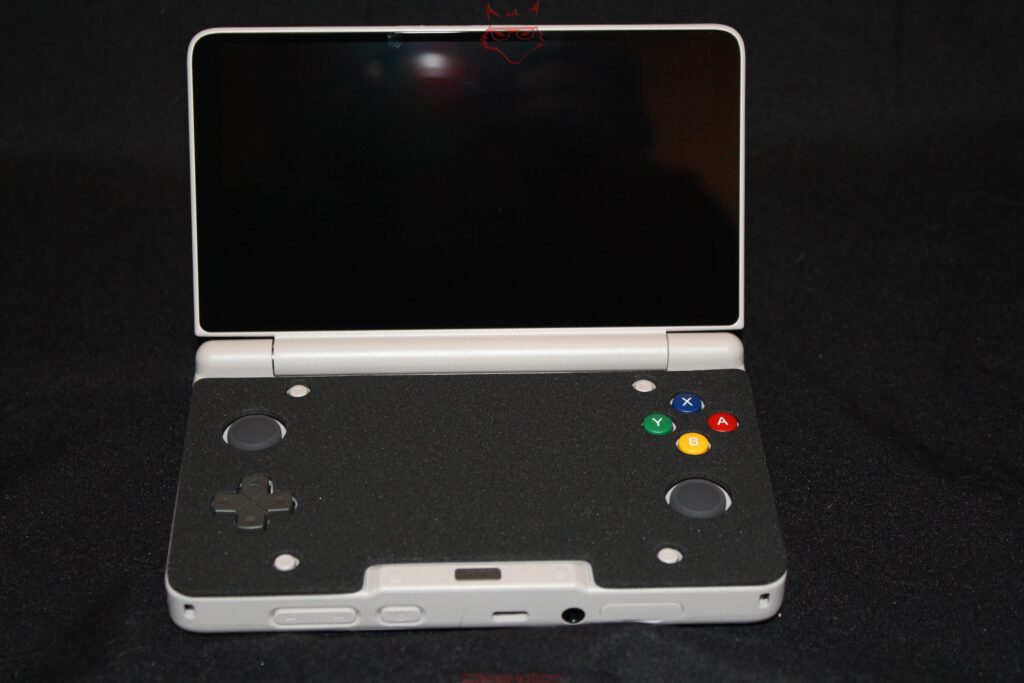
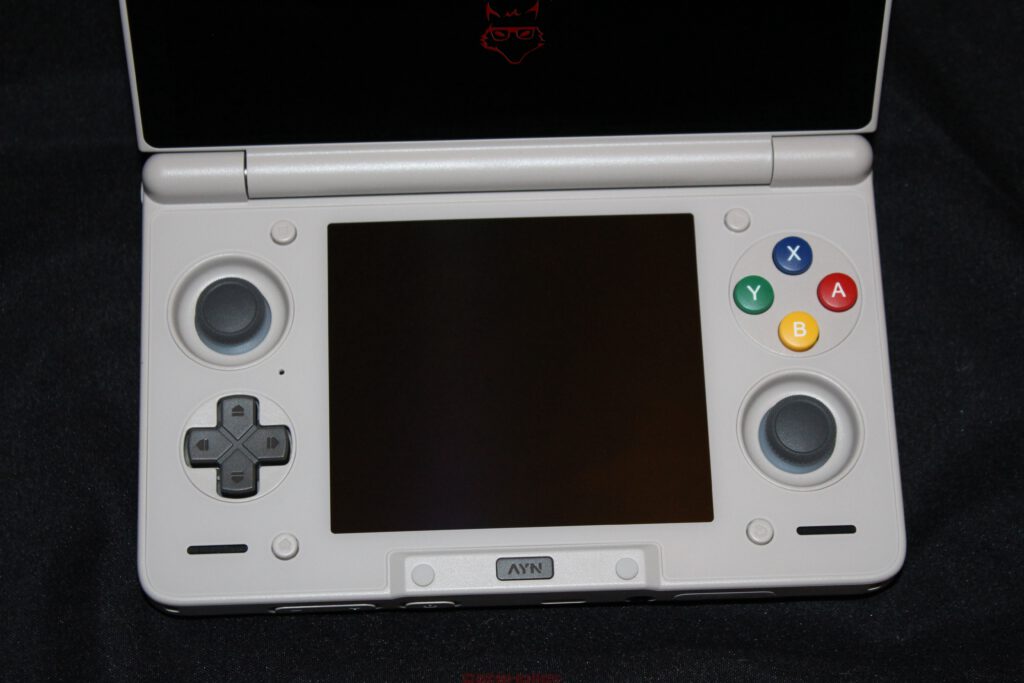
Opening the Thor completely changes its character. The upper section houses a 6-inch AMOLED touchscreen with a resolution of 1,920 × 1,080 pixels and a refresh rate of up to 120 Hz. Beneath it sits a second 3.92-inch AMOLED touchscreen with 1,080 × 1,240 pixels and a refresh rate of 60 Hz. This combination defines the Thor more strongly than its processor, memory capacity or internal storage.
The upper panel assumes the conventional role of the primary display. Its 16:9 aspect ratio is well suited to Android games, streaming, modern emulators and other content designed around widescreen presentation. The lower panel sits directly between the physical controls and, with its almost square aspect ratio, moves conceptually much closer to traditional dual-screen systems.
Its placement alone fundamentally changes the construction of the handheld. On conventional devices, analogue sticks, directional controls and action buttons are positioned directly around a central display. The Thor has to accommodate all of those elements while simultaneously leaving enough space for a second screen. The left analogue stick therefore moves far towards the upper edge, with the D-pad positioned beneath it. On the right, the ABXY cluster mirrors the upper placement, while the second analogue stick sits lower down.
At first glance, the layout looks almost familiar. A second glance reveals how unusual it actually is. That is precisely where much of the engineering appeal lies. AYN has not built a tablet with a controller attached to it. It has organised an entire input system around two displays.
Both panels use AMOLED technology. Deep blacks are therefore technically produced by switching individual pixels off rather than attempting to disguise the glow of a conventional backlight. AYN specifies peak brightness levels of around 650 nits for the upper panel and approximately 550 nits for the lower display. For a device likely to spend most of its operating life indoors, those figures provide a solid technical foundation. Any qualitative assessment of the panels, however, belongs in the later practical review.
Controls: Hall Sticks, Traditional Buttons and Almost No Wasted Space
Both analogue sticks use Hall-effect sensing. Instead of relying on mechanically wearing potentiometers, their position is detected through magnetic fields. That does not automatically guarantee eternal durability, but it does eliminate at least one familiar source of conventional stick-drift problems.
The sticks themselves are comparatively compact and rise only moderately above the surrounding surface. That is a direct consequence of the clamshell construction. Full-height desktop-controller sticks would make it almost impossible to close the lid without substantially increasing the thickness of the entire device.
Below the left stick sits a cross-shaped D-pad with clearly separated directional sections. On the right, A, B, X and Y form the familiar four-button cluster. Their colour scheme deliberately evokes classic console layouts, with green, blue, red and yellow providing small visual accents against the white chassis. Several system buttons occupy the remaining spaces between these primary controls.
Available surface area has been exploited almost to the point of geometric discomfort. There is barely a section of the lower half without a function. A second display, two analogue sticks, D-pad, four action buttons, system controls, speaker openings and additional buttons all share an area roughly comparable to a large postcard.
At the rear are L1, L2, R1 and R2. The shoulder controls are stacked and protrude slightly beyond the chassis when the Thor is closed. This allows them to remain reasonably large without increasing the overall footprint. It is hardly the most spectacular detail on the device, but mechanically it matters. A handheld this small still needs somewhere to provide sufficient trigger travel, and even Norse mythology cannot create physical space out of nothing.
Connectivity: USB-C, microSD and, Remarkably, Still a Headphone Jack
The front edge houses several practical components. Alongside the volume and power controls sits the USB-C port, positioned centrally within the chassis. Next to it is a 3.5 mm headphone jack. In 2026, its mere presence almost feels like a small technological statement.
A microSD slot is also available. On an emulation-focused handheld, expandable storage is considerably more relevant than it has become on many smartphones and tablets. ROM libraries, game installations, media and other files can be separated from the internal storage. The amount of built-in storage depends on the particular Thor configuration.
AYN offers several variants. The Thor Lite is based on the older Snapdragon 865 and combines it with 8 GB of RAM and 128 GB of storage. Base, Pro and Max configurations use Qualcomm’s Snapdragon 8 Gen 2 and primarily differ in memory and storage capacity. Depending on the version, configurations extend to 16 GB of RAM and now up to 1 TB of internal storage.
On Snapdragon 8 Gen 2 models, USB-C additionally supports DisplayPort output at up to 4K and 60 Hz. The small clamshell computer can therefore theoretically be connected to an external monitor. Its USB-C port consequently handles power, data and video output. One connector, three jobs. USB-C is allowed to feel important again.
Cooling: A Smartphone Processor Suddenly Gets a Fan
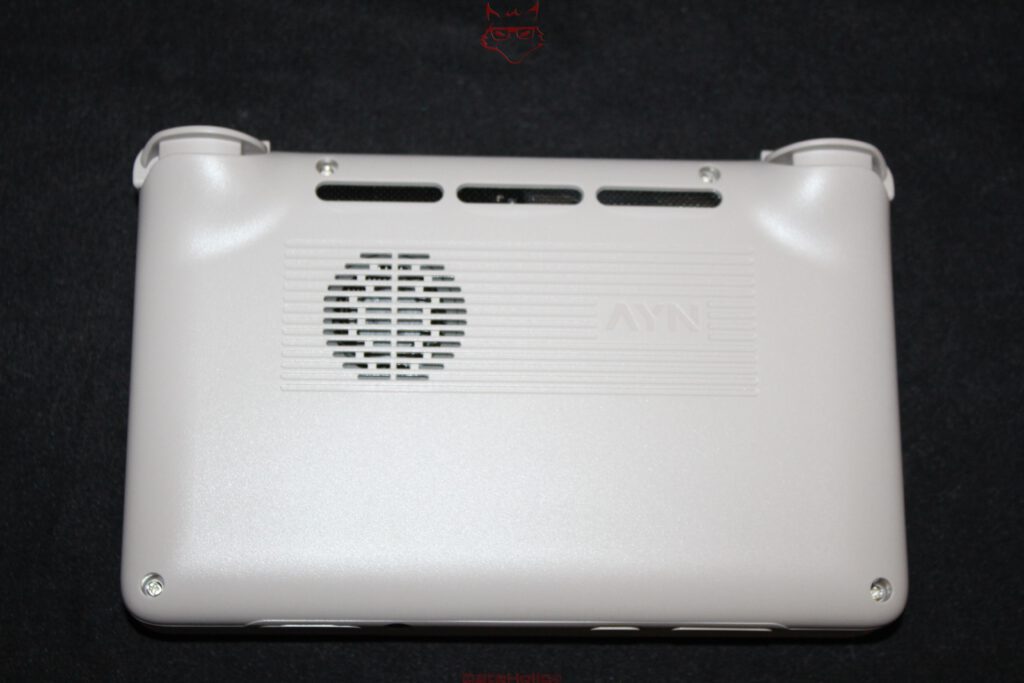
A clearly visible fan intake occupies part of the underside. Additional ventilation openings sit towards the rear and around the hinge area. The Thor uses active cooling, which is considerably more than a decorative feature when a Snapdragon 8 Gen 2 is operating inside such a compact enclosure.
Qualcomm’s chip was originally developed for smartphones, but a handheld can operate it within a very different thermal envelope. Smartphones generally have to rely on passive cooling and frequently reduce clock speeds during sustained workloads. A gaming handheld has the luxury of using a fan. That changes the relationship between short bursts of peak performance and performance that can potentially be maintained over longer periods.
Airflow is routed through openings on the underside and rear. Crucially, the folding display does not completely obstruct the exhaust areas. AYN therefore also uses the region surrounding the hinge as part of the thermal architecture.
“Heat is energy looking for the wrong exit,” goes an engineering saying in various forms. On the Thor, the idea becomes unusually tangible. A six-inch AMOLED panel, a second display, Snapdragon SoC, battery and charging electronics all occupy a volume barely larger than two smartphones stacked together. Without deliberate thermal management, this concept would be considerably more difficult to execute.
6,000 mAh Beneath Two Displays
Inside the chassis sits a 6,000 mAh battery. That is a substantial capacity for a device of this size, although the battery has to power considerably more than a single display and mobile processor. Two AMOLED panels, a high-performance SoC and, when required, an active cooling system all draw from the same energy reserve.
Charging is supported at up to 27 watts. The Thor therefore avoids chasing smartphone fast-charging records, but it also avoids unnecessarily aggressive charging rates. In a device already generating heat through the processor and displays during operation, a more controlled charging strategy is hardly unreasonable.
The closed construction provides another advantage: both displays are completely covered during transportation. A separate screen cover becomes unnecessary. At the same time, the design introduces an obvious thermal consequence. Under sustained load, the Thor is intended to operate while open, because its ventilation openings, hinge region and display positioning form part of the overall thermal architecture.
Accessories: The Protective Shell and Grip Change the Concept
The included or separately available grip attachment is particularly interesting. The base device prioritises portability, which means it lacks the pronounced handgrips found on larger gaming handhelds. The grip therefore extends the lower sides significantly and creates two more substantial contact areas for the hands.
Structurally, this is a clever compromise. Permanently integrated grips would make the Thor larger and thicker at all times. A removable component creates two operating states instead: compact for transport and more substantial for longer gaming sessions.
The transparent protective shell follows a similar philosophy. It wraps around the chassis without completely obstructing mechanical openings or connectors. Designing a case for a clamshell device is inherently more complicated than producing one for a conventional handheld, because hinge movement, ventilation and shoulder controls all need to remain accessible.
A First Technical Impression Without Entering the Software
Even without switching on either display, the AYN Thor makes its engineering priorities remarkably clear. This device is not trying to become another wide 7- or 8-inch handheld. Instead, AYN combines the protected transport format of traditional clamshell consoles with modern Android hardware and an unusually capable dual-screen configuration.
The Snapdragon 8 Gen 2, Hall-effect sticks, active cooling, 6,000 mAh battery, microSD expansion, USB-C video output and two AMOLED touchscreens do not form a random collection of specifications. Every major component supports a clearly defined concept: fitting as much gaming hardware as possible into a closed chassis that can still realistically disappear into a larger jacket pocket or small shoulder bag.
Arthur C. Clarke once wrote: “Any sufficiently advanced technology is indistinguishable from magic.” Calling the Thor magic might be slightly generous. Yet a small white clamshell box that opens to reveal two AMOLED displays, complete controller inputs and actively cooled Snapdragon hardware comes surprisingly close to creating that impression during the initial unboxing.
How well this unusual construction works in everyday use cannot be determined from packaging foam or under studio lighting. For a technical unboxing, a more sober observation is sufficient: AYN has not simply revived the classic clamshell handheld. The concept has been reinterpreted around current Android hardware, two modern displays and an impressively dense internal architecture.
Transparency notice in accordance with EU regulations:
The AYN Thor featured in this review was purchased directly from AYN by us. It is neither a loan unit nor paid advertising.
AYN had no influence on the content, evaluation or editorial independence of this article. All opinions expressed are based exclusively on our own practical experience.