
EPOMAKER TH108 ISO Review: Full-Size Mechanical Keyboard with Gasket Mount, 10,000 mAh Battery, and German Layout
- Packaging and Accessories: Functional and Sufficient
- Design and Build Quality: Traditional Format with Subtle Colors
- German ISO Layout: An Important Detail for Everyday Use
- Underside and Typing Angle: Three Positions Without Additional Mechanisms
- Connections and Operating System Switching: Accessible and Clearly Labeled
- Internal Construction: Gasket Mount and Five Dampening Layers
- Mechanical Switches: Creamy Jade and Sea Salt Silent
- Hot-Swap: Replaceable Switches Without Soldering
- Keycaps: Double-Shot PBT with Cherry Profile
- Connectivity and Polling Rate: Three Operating Modes for Different Requirements
- Gaming: Solid Technical Foundations Without Specialized Switch Technology
- RGB Lighting: Individual LEDs Rather Than Purely Decorative Effects
- Software: Configuration Without Complete Hardware Dependence
- Battery: 10,000 mAh According to the Packaging, but Conflicting Manufacturer Specifications
- Comparison with Other EPOMAKER Keyboards
- Conclusion: Substantial Mechanical Features, but Some Questions Remain
- Transparency Notice
Mechanical keyboards featuring sophisticated sound dampening, replaceable switches, and multiple connectivity options are no longer exclusive to the expensive custom keyboard segment. EPOMAKER is among the manufacturers increasingly integrating these designs into affordable production models. The TH108 ISO follows a traditional approach: a full-size keyboard layout with a numeric keypad, mechanical switches, wireless operation, and an internal construction designed to deliver controlled typing acoustics. The manufacturer deliberately avoids compact dimensions or unconventional operating concepts.
The TH108 is therefore aimed at users who want to use their keyboard equally for office work, extended typing sessions, and occasional gaming. Particularly interesting is the combination of a German ISO layout, hot-swap support, gasket-mount construction, and a battery rated at 10,000 mAh according to the packaging. Additional features include RGB lighting, double-shot PBT keycaps, and three connectivity options. With a German list price of approximately €93, the keyboard occupies a market segment where solid mechanical construction has become just as important as the overall feature set.
Packaging and Accessories: Functional and Sufficient
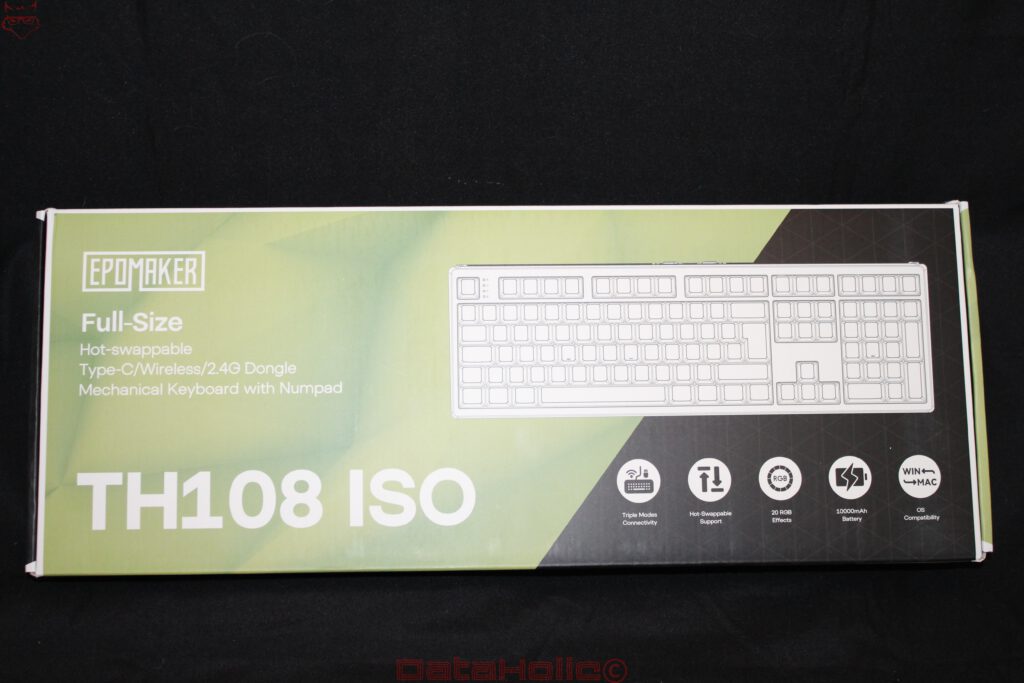
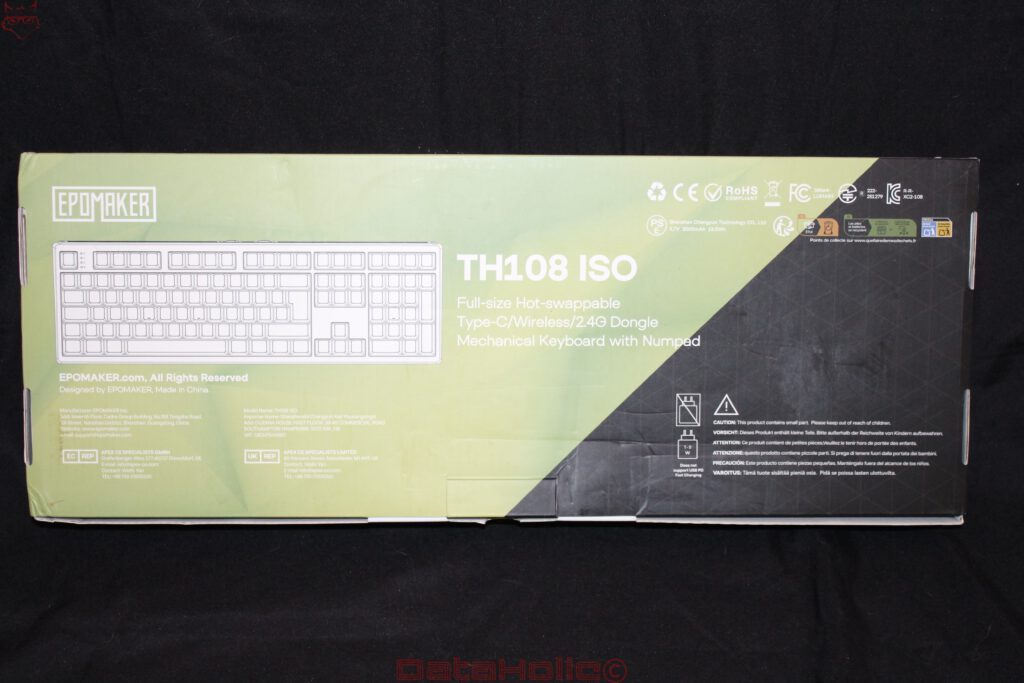
EPOMAKER ships the TH108 ISO in an elongated cardboard box featuring a green-and-black design that differs considerably from the keyboard’s actual color scheme. The front displays a schematic illustration of the full-size layout alongside the most important technical features. These include the three connectivity options, hot-swap support, 20 RGB effects, and the advertised 10,000 mAh battery. The back contains manufacturer information, regulatory markings, and additional product details.
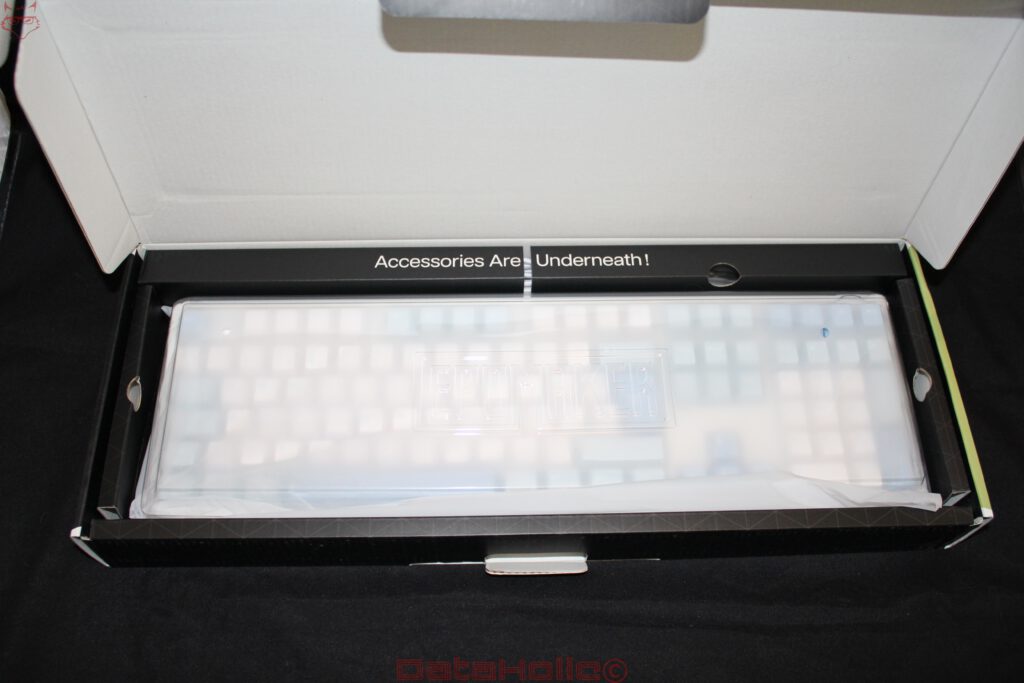
After opening the box, the keyboard rests inside a precisely fitted cardboard insert. A semi-transparent protective sleeve featuring an embossed EPOMAKER logo protects the surface from direct contact with the packaging materials. The accessories are stored separately beneath an additional cardboard cover. This arrangement is functional and keeps the individual components separated during transportation.
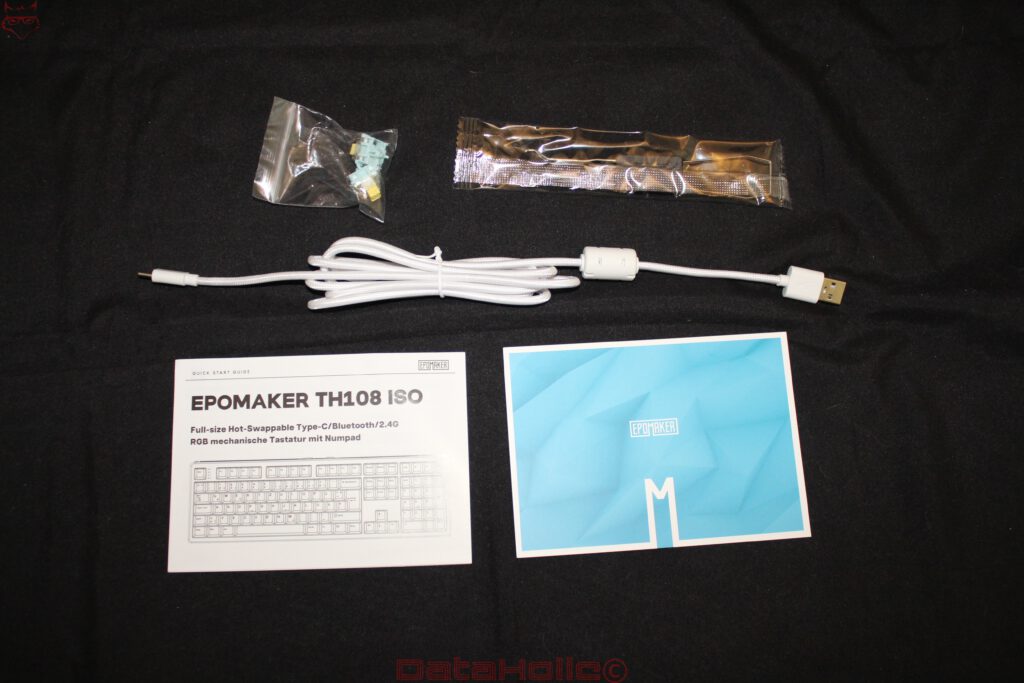
The accessories documented in the photographs include a white, braided USB-A-to-USB-C cable, a combined keycap and switch removal tool, two additional mechanical switches, and a quick-start guide. A manufacturer card is also included. The 2.4 GHz receiver is part of the package as well, although it is not stored loosely in the accessory compartment. Instead, it is housed beneath one of the fold-out keyboard feet.
The cable features an integrated ferrite core. Its purpose is to suppress high-frequency interference along the cable, an established measure for improving electromagnetic compatibility in electronic devices with USB connections. This does not provide any additional benefit to the actual typing function, but it demonstrates that EPOMAKER has also considered the electrical connection.
The accessory package is limited to the essential components required for operation and maintenance. A separate wrist rest is not included. Considering the keyboard’s full hot-swap support, the combined removal tool and two replacement switches are particularly useful. Additional keycap sets or decorative accessories are unnecessary for the intended application.
Design and Build Quality: Traditional Format with Subtle Colors
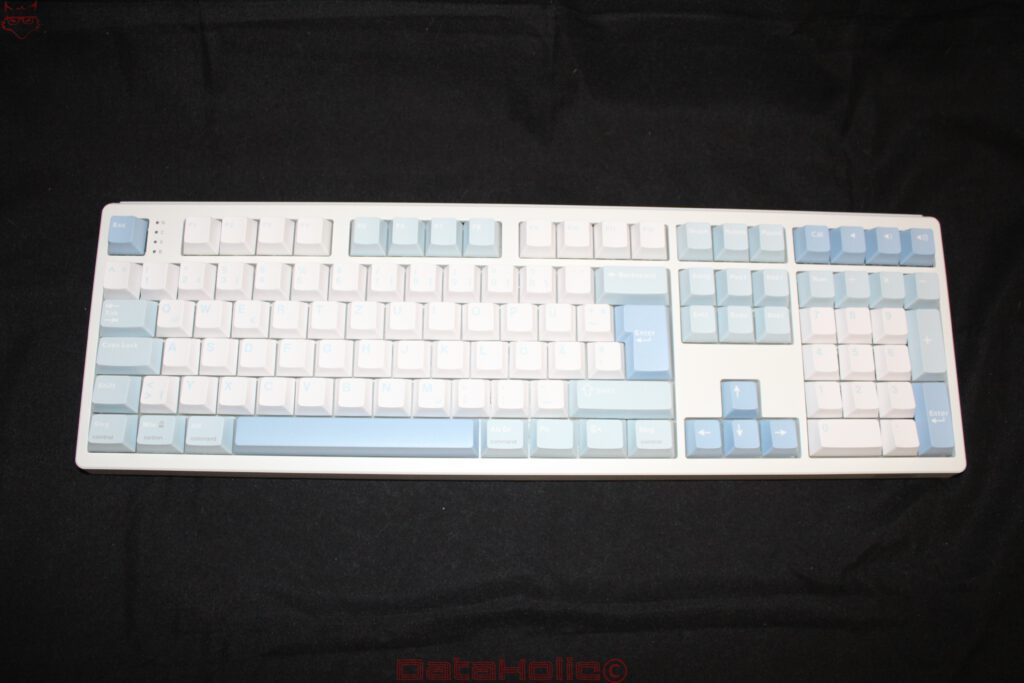
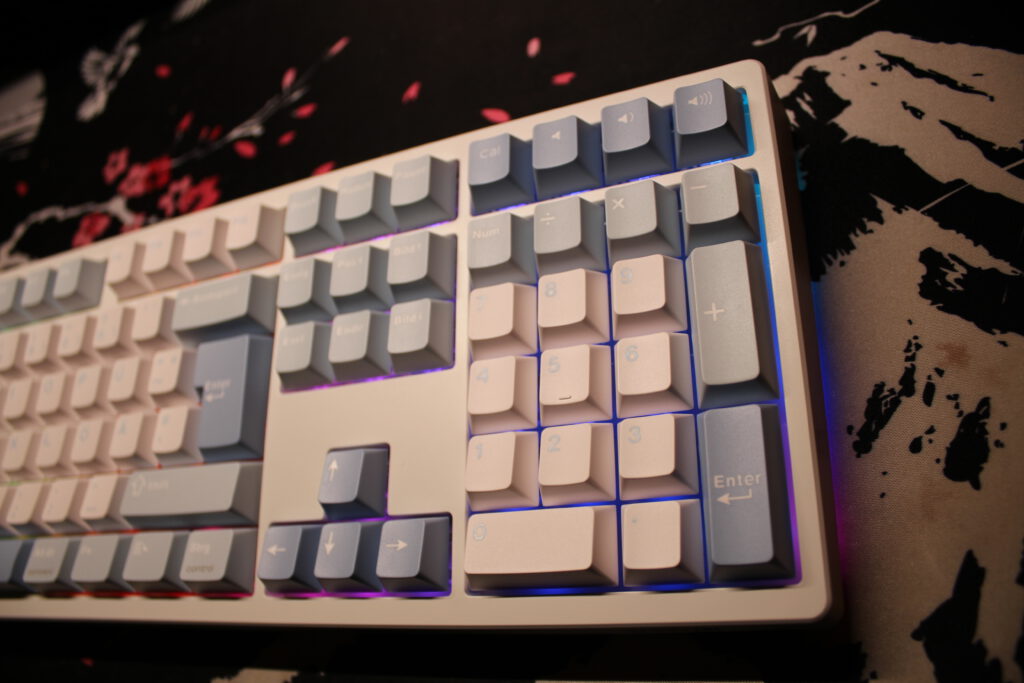
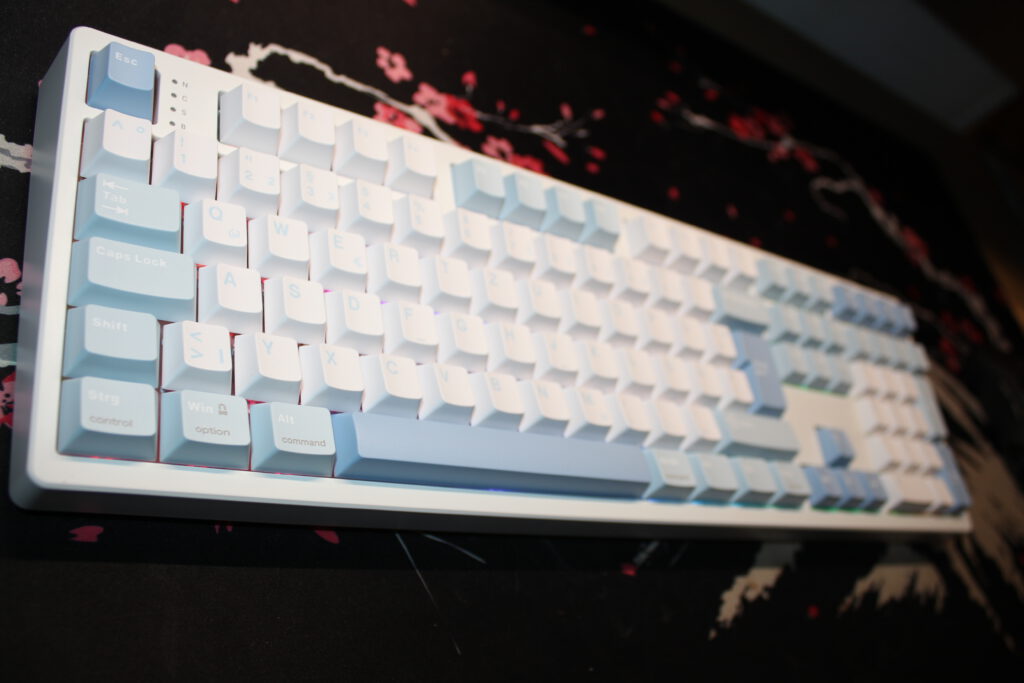
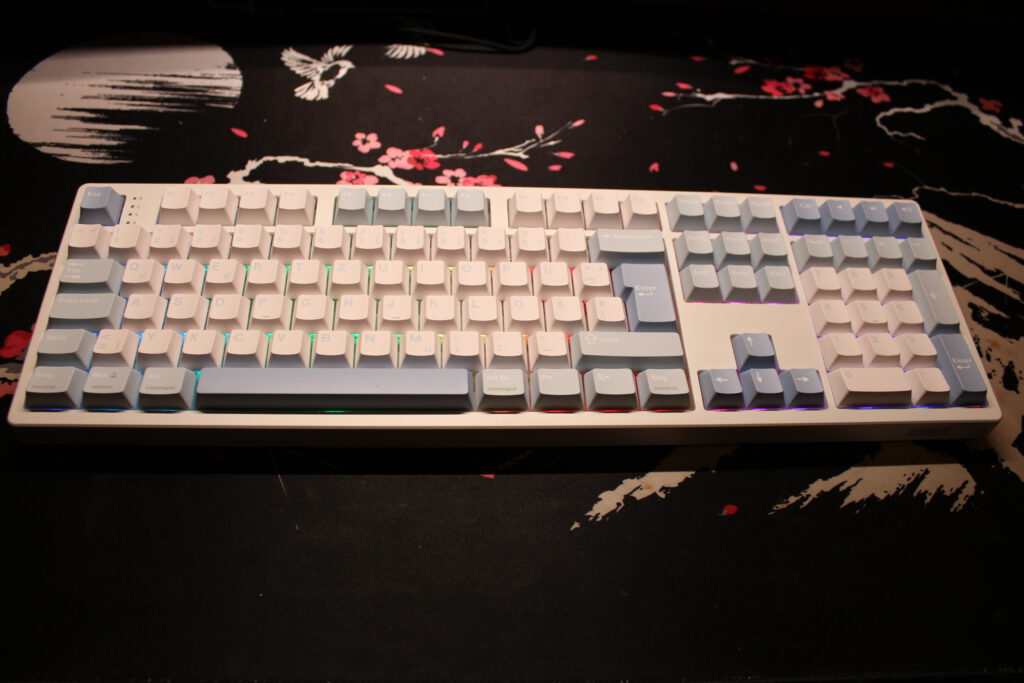
The TH108 ISO reviewed here features a white housing combined with white, light blue, and slightly darker blue keycaps. EPOMAKER refers to this color variant as Blue White. Most of the alphanumeric key section remains white, while selected function keys, the spacebar, arrow keys, and other areas feature contrasting colors. This creates a clear visual separation without giving the keyboard an overly playful appearance.
The design is reminiscent of classic mechanical keyboards whose color schemes were deliberately limited to a few shades. The light blue function keys and somewhat darker arrow keys provide recognizable accents. The legends are color-coordinated and appear relatively subtle in the photographs. The low contrast is particularly noticeable on the white keycaps. Under unfavorable lighting conditions, readability could therefore be worse than with dark keycaps featuring lighter legends.
According to the manufacturer, the housing is made of ABS plastic. EPOMAKER therefore does not use an aluminum construction but instead relies on a comparatively easy-to-process material that can nevertheless provide considerable structural rigidity when appropriately designed. According to the manufacturer, the keyboard weighs approximately 1.2 kilograms and measures around 445 × 141 × 42 millimeters. The ISO user manual specifies a slightly lower weight of approximately 1.14 kilograms.
The dimensions correspond to a traditional full-size keyboard. In addition to the alphanumeric section, dedicated function keys, a separate navigation cluster, arrow keys, and a complete numeric keypad are included. This is particularly advantageous for spreadsheets, numerical data entry, and applications requiring numerous keyboard shortcuts.
The required desk space is correspondingly greater than with a tenkeyless keyboard or a compact 75-percent model. When used alongside a mouse, this means a greater lateral distance between the hands. On wide desks, this is less significant, but with limited workspace, it remains an ergonomic disadvantage of the full-size format.
The keycaps use the Cherry profile. This is characterized by a comparatively low height and staggered key rows. Compared with tall SA profiles or other strongly sculpted designs, the resulting hand position is less extreme. However, actual ergonomics also depend on the housing height, selected typing angle, and individual hand positioning.
German ISO Layout: An Important Detail for Everyday Use
The photographed TH108 ISO features a German QWERTZ layout with the corresponding umlauts and a large, double-height Enter key. The shorter left Shift key and additional adjacent key also follow the ISO standard.
This is far from guaranteed with mechanical keyboards sold internationally. Many models are initially offered exclusively with an American ANSI layout. Changing the operating system’s keyboard language does not replace the physical key arrangement or their printed legends.
The TH108 ISO avoids this compromise. Special characters, umlauts, and the Enter key position correspond to the standard layout commonly used in Germany. At the same time, the complete function key row and numeric keypad remain available.
The labeling of certain modifier keys is noteworthy. Both Windows and macOS labels are visible in the photographs. EPOMAKER therefore accommodates switching between different operating systems directly through the keycap design.
Unlike a dedicated Mac keyboard or a model designed exclusively for Windows, a complete replacement of the modifier keycaps is not necessary to identify their alternative functions. However, this does not mean that every special function is available identically in every application.
Underside and Typing Angle: Three Positions Without Additional Mechanisms
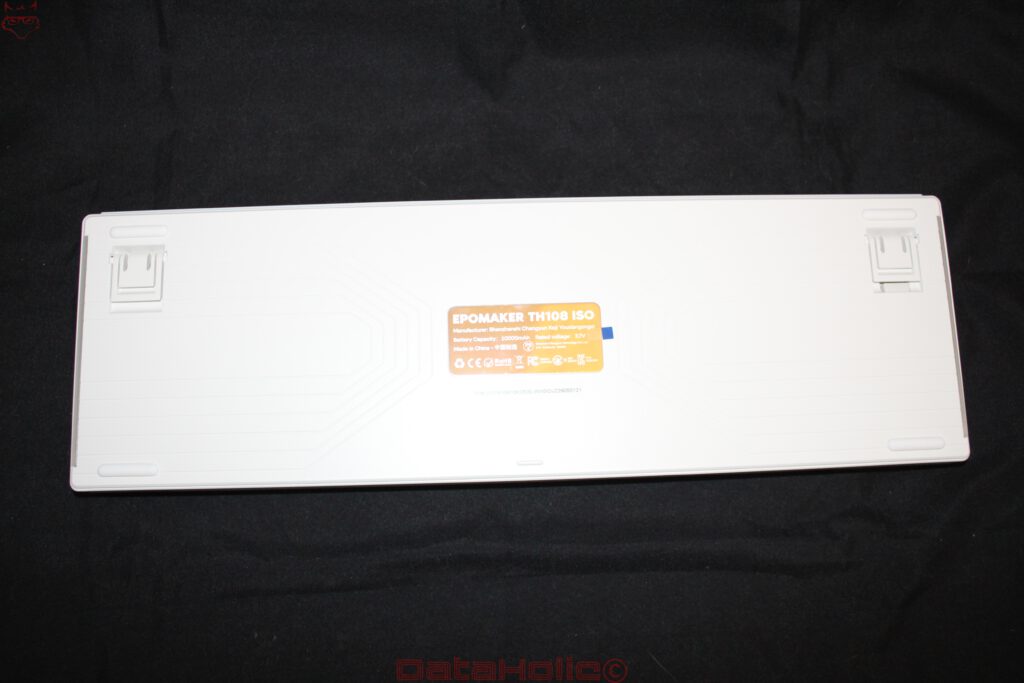
The underside of the TH108 ISO is made of white plastic and features a subtle, symmetrical line pattern. Several elongated rubber pads are distributed around the outer areas of the housing. They are intended to prevent slipping while reducing direct contact between the plastic housing and the desk surface.
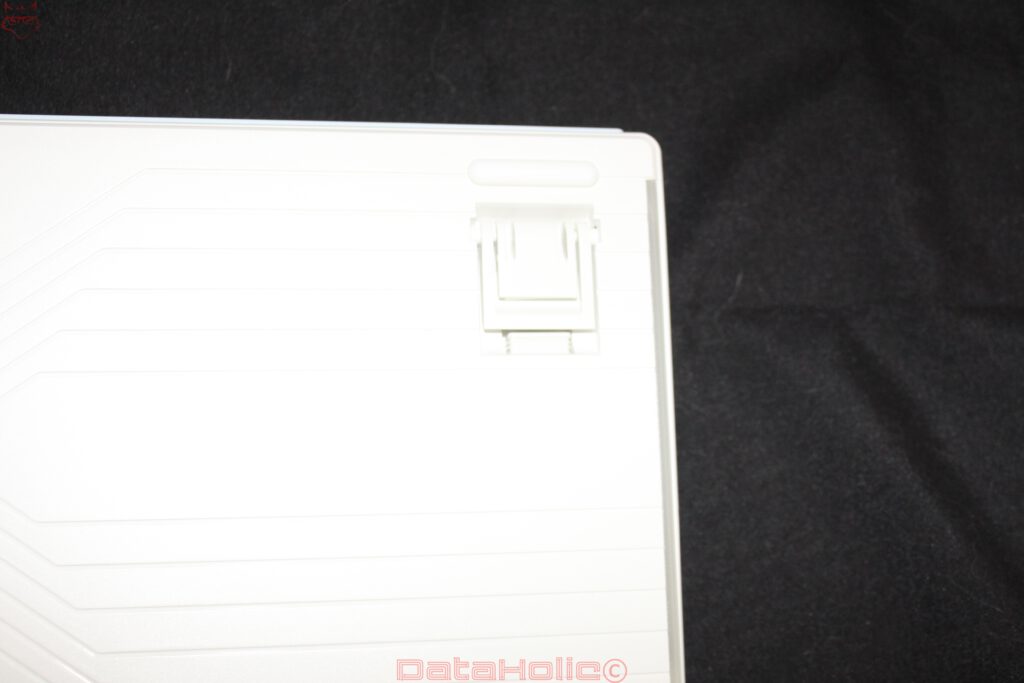
Two fold-out feet are located in the upper left and right sections. These feature a two-stage design and, together with the flat starting position, allow three different typing angles. EPOMAKER specifies angles of 6, 8, and 10.5 degrees.
The construction is straightforward but serves an important purpose. Different typing angles change wrist positioning and therefore the strain experienced during extended typing sessions. A steeper angle does not automatically provide a more ergonomic posture. Particularly during longer sessions, a flatter position can be beneficial because excessive wrist extension should be avoided.
The feet are fully integrated into the housing. Additional height adjustment or a separate wrist rest is not provided. A negative tilt, where the front of the keyboard sits higher than the rear, is also not possible due to the design.
An interesting detail is the storage location of the wireless receiver beneath the left foot. This solution eliminates the need for a separate compartment on the underside and reduces the risk of having to transport the small USB receiver loosely. At the same time, the receiver remains protected when not in use.
Connections and Operating System Switching: Accessible and Clearly Labeled
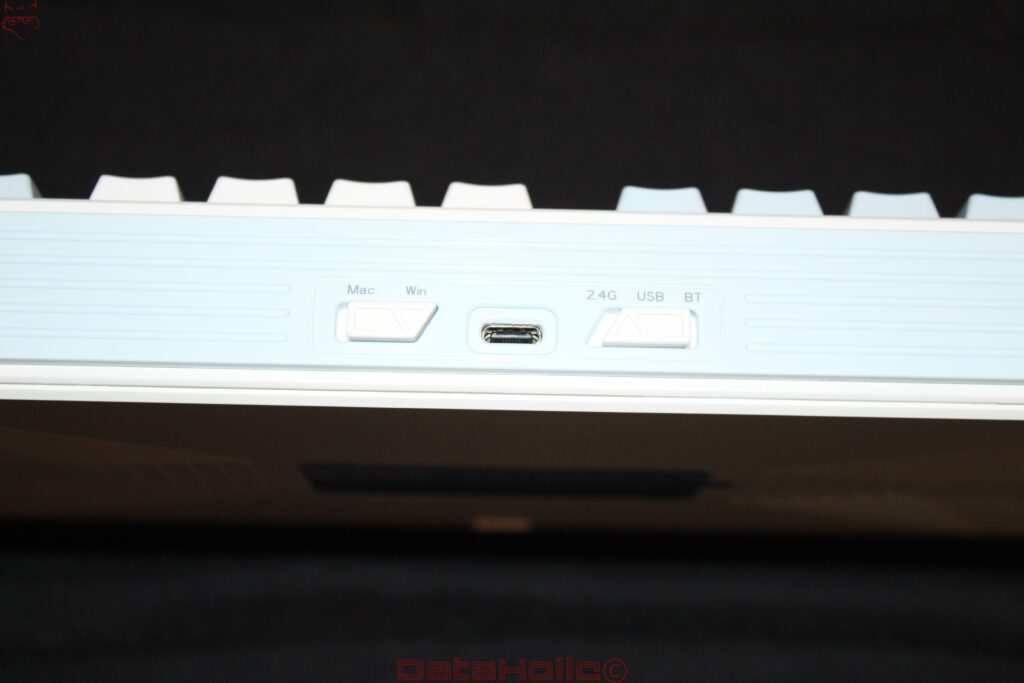
A centrally positioned USB-C port is located along the rear edge of the housing. To its left is a sliding switch for selecting Windows or macOS, while another switch on the right controls the connectivity modes: 2.4 GHz, USB, and Bluetooth.
This separation makes sense. The operating system switch changes the assignment of certain key functions, while the second switch determines only the connectivity mode. This allows the keyboard to be used, for example, with a wired connection under Windows and subsequently via Bluetooth under macOS without requiring complicated keyboard shortcuts to change both settings.
The labels are integrated directly into the housing. Particularly the clear identification of the three connection modes reduces potential operating errors.
The USB-C port is slightly recessed. The supplied cable can therefore be connected at the rear of the keyboard. A detachable cable is not unusual for a wireless keyboard, but it simplifies transportation and replacement in the event of damage.
The TH108 ISO consequently features a traditional, easily understandable connection architecture. EPOMAKER omits additional USB passthrough ports, a dedicated volume control knob, and a separate display.
Internal Construction: Gasket Mount and Five Dampening Layers
The most interesting technical feature of the TH108 ISO is located beneath the keycaps. EPOMAKER uses a gasket-mount construction in which the internal supporting structure is not connected exclusively through rigid mounting points to the outer housing. Instead, elastic mounting elements are used to partially isolate mechanical vibrations from the housing.
The keyboard features a polycarbonate mounting plate. Compared with a rigid metal plate, this material generally offers greater flexibility. EPOMAKER complements the construction with so-called flex cuts, which are strategically positioned cutouts in the mounting plate and printed circuit board. These are intended to increase flexibility during key presses.
However, the actual effectiveness of such a construction depends on several factors. In addition to the material and thickness of the mounting plate, the positioning of the cutouts, mounting points, and compression of the dampening elements all play decisive roles. A gasket-mount design therefore does not automatically guarantee a particularly soft typing experience.
EPOMAKER combines the construction with five different dampening layers. These include PORON foam between the mounting plate and PCB, an IXPE sheet around the switches, a PET layer for acoustic tuning, additional PORON foam beneath the PCB, and a silicone insert at the bottom of the housing.
These materials serve different purposes. PORON primarily provides mechanical dampening and can reduce unwanted resonances. IXPE influences sound transmission between the switches and the PCB. PET changes the acoustic feedback through its material properties, while the silicone insert partially fills the remaining hollow space inside the housing.
The goal is a more controlled typing sound with fewer hollow resonances and reduced transmission of vibrations to the housing. However, the extent to which these measures actually work cannot be conclusively assessed without comparative acoustic measurements and an examination of the internal construction.
Nevertheless, the technical combination is noteworthy. EPOMAKER integrates several structural measures originally associated primarily with individually assembled mechanical keyboards into a factory-equipped full-size model.
Mechanical Switches: Creamy Jade and Sea Salt Silent
EPOMAKER offers the TH108 with different linear switches. The documented options include Creamy Jade Switches and Sea Salt Silent Switches. Both are factory-lubricated and feature a five-pin design.
According to the manufacturer, the Creamy Jade Switches have an actuation force of 45 ± 5 gf. The pre-travel distance is 2.0 ± 0.4 millimeters, while total key travel measures 3.6 ± 0.4 millimeters. The force required to bottom out is approximately 50 ± 5 gf.
The Sea Salt Silent Switches also have an actuation force of 45 ± 5 gf. Their pre-travel distance is slightly shorter at 1.8 ± 0.4 millimeters, while total travel measures 3.5 ± 0.4 millimeters. The specified bottom-out force is 51 ± 5 gf.
The main difference lies in their acoustic tuning. The Sea Salt Silent Switches feature a design specifically intended to reduce noise. This should particularly minimize sounds produced when a key is fully depressed and when the switch returns to its original position.
The Creamy Jade Switches, by contrast, focus on more pronounced mechanical feedback. Despite the somewhat misleading product description, the technical specifications identify them as linear rather than tactile switches. A defined tactile bump is therefore not part of their design.
Although the photographed keyboard shows the Blue White color variant, the exact switches installed cannot be identified with certainty from the images. The included replacement switches alone are insufficient for a reliable identification.
This distinction is crucial when evaluating the typing experience. A silent switch can significantly change acoustic behavior even when the housing, keycaps, and dampening construction remain identical.
Hot-Swap: Replaceable Switches Without Soldering
The TH108 ISO features a hot-swappable PCB. This allows the mechanical switches to be removed and replaced without having to desolder their electrical connections.
According to the ISO user manual, the keyboard supports both three-pin and five-pin mechanical switches. Five-pin variants use two additional plastic positioning pins for mechanical alignment and stability.
The hot-swap concept offers several practical advantages. A single defective switch does not necessarily require repairing the entire keyboard. Different switch types can also be tested, provided their electrical and mechanical designs are compatible.
This is particularly relevant for long-term use. Mechanical keyboards are frequently used for many years, while individual switches may fail due to wear, contamination, or mechanical damage.
However, hot-swap does not mean that every switch available on the market is compatible. The TH108 uses conventional MX-compatible mechanical switches. Magnetic Hall-effect or TMR switches require a different electronic sensing system and cannot simply be installed as replacements.
The stabilizers also place limitations on compatibility. EPOMAKER uses plate-mounted stabilizers. According to the manufacturer, screw-in PCB stabilizers are not compatible with this construction.
This is not a fundamental disadvantage, but it does limit the available options for more extensive modifications.
Keycaps: Double-Shot PBT with Cherry Profile
According to the manufacturer, the TH108 uses PBT keycaps with legends produced using a double-shot molding process. The keycap and its character are created using two plastic components or injection-molding stages.
Unlike legends that are simply printed onto the surface, the characters are therefore part of the material structure. As a result, they are less likely to wear away through normal use.
PBT is also considered comparatively resistant to the surface polishing frequently associated with ABS keycaps. Nevertheless, PBT keycaps can also change over many years of mechanical use. Their actual durability depends on the material composition, surface texture, and manufacturing quality.
The Cherry profile features different heights and angles across the individual key rows. This creates a sculpted surface intended to support natural finger movements.
However, the Blue White color scheme involves a functional compromise. The light legends on the white keycaps offer less contrast than traditional black characters on a light background.
Long-term readability therefore depends not only on material durability but also on how clearly the legends can be recognized under different lighting conditions.
Connectivity and Polling Rate: Three Operating Modes for Different Requirements
The TH108 ISO supports USB-C, Bluetooth, and a proprietary 2.4 GHz wireless connection using the included USB receiver.
EPOMAKER specifies a polling rate of 1,000 Hz for both wired and 2.4 GHz operation. This means the keyboard’s state can theoretically be transmitted to the connected system up to one thousand times per second. Over Bluetooth, the specified polling rate is 125 Hz.
The resulting polling intervals are mathematically equivalent to one and eight milliseconds, respectively. However, these values should not be confused with the complete input latency.
Additional factors include internal switch detection, signal processing, possible debounce mechanisms, wireless transmission, and processing by the operating system.
EPOMAKER specifies a latency of two milliseconds over USB, five milliseconds over 2.4 GHz, and eleven milliseconds over Bluetooth for the TH108. These figures originate from the manufacturer and have not been verified through independent measurements of the reviewed unit.
For ordinary office work, the differences between the connection modes are generally less relevant. In fast-paced games, however, the 2.4 GHz connection can offer advantages over Bluetooth.
The keyboard also supports N-key rollover. This is intended to ensure reliable recognition of multiple simultaneously pressed keys, which is particularly important in games requiring complex key combinations.
Gaming: Solid Technical Foundations Without Specialized Switch Technology
Although EPOMAKER also markets the TH108 as a gaming keyboard, its construction does not make it a specialized esports model.
The mechanical switches operate with a fixed actuation point. Features such as Rapid Trigger, adjustable actuation distances, or continuous analog detection of key position are not part of the documented specifications.
These features are primarily found in magnetic keyboards using Hall-effect or TMR sensor technology. They allow, for example, particularly rapid resetting of the actuation point as soon as a key begins moving upward again.
The TH108 instead follows a conventional approach. Linear switches, a 1,000 Hz polling rate, and N-key rollover provide a technically sound foundation for many games.
In strategy games, role-playing games, and simulations, the complete numeric keypad can offer additional input options. The separate function key row is also practical for titles with extensive key assignments.
In fast-paced competitive games, however, the larger footprint becomes particularly noticeable. A compact keyboard provides more room for mouse movement and can therefore be ergonomically advantageous.
The TH108 is consequently better classified as a universal mechanical keyboard suitable for gaming rather than an input device consistently optimized for minimum input latency.
RGB Lighting: Individual LEDs Rather Than Purely Decorative Effects
EPOMAKER equips the TH108 with RGB backlighting. The LEDs are positioned south of the switches, a configuration known as a south-facing design in mechanical keyboards.
This arrangement can improve compatibility with certain keycap profiles. Particularly with Cherry profiles, it reduces the risk of mechanical interference between the keycaps and switch housings that can occur with some north-facing constructions.
According to the manufacturer, the lighting can be configured with different colors and effects. The packaging specifies 20 RGB effects.
However, it is important to distinguish between keyboard backlighting and the actual illumination of the legends. Double-shot keycaps are not automatically translucent. The manufacturer’s information regarding the PBT construction therefore does not confirm that every character is illuminated from below.
On a keyboard with light-colored keycaps, the lighting can nevertheless improve orientation by allowing light to escape between the keys.
The additional energy consumption of the RGB lighting is particularly relevant during wireless operation. Depending on brightness and the selected effect, battery life can vary considerably.
Software: Configuration Without Complete Hardware Dependence
EPOMAKER provides dedicated configuration software for the TH108. Among other functions, it allows users to adjust key assignments, create macros, and control the lighting.
The basic operating modes can already be selected using the physical switches. As a result, the keyboard does not require software to remain permanently open for its essential functions.
However, the software remains relevant for more advanced customization. Particularly with a full-size keyboard featuring numerous keys, individually assigned functions and macros can improve productivity.
A decisive factor is which settings are stored permanently on the keyboard and which functions require an active software connection. The long-term availability of the configuration program, its updates, and support for newer operating system versions are equally important.
A comprehensive evaluation of software stability, storage functions, and operating system compatibility is not possible based solely on the documented hardware and manufacturer materials.
Battery: 10,000 mAh According to the Packaging, but Conflicting Manufacturer Specifications
One particularly striking feature of the TH108 ISO is its large integrated battery. Both the packaging and the identification label of the photographed unit specify a capacity of 10,000 mAh at a nominal voltage of 3.7 volts.
This results in a nominal energy capacity of 37 watt-hours, which is considerable for a mechanical keyboard.
However, conflicting manufacturer specifications exist. While some current product specifications list 10,000 mAh, the official ISO user manual specifies only 8,000 mAh. Certain regional product descriptions also continue to use the lower figure.
For the unit reviewed here, the information printed on the packaging and device label is the relevant specification. However, this does not constitute independent verification of the actual usable capacity.
EPOMAKER also advertises a battery life of up to 160 hours. Without a clear description of the operating conditions used to determine this figure, its practical significance is limited.
RGB lighting, the selected wireless connection, and automatic shutdown during inactivity all influence power consumption.
The user manual describes an automatic shutdown of the backlighting after five minutes of inactivity during wireless operation. The battery level can be checked using the Fn and Enter key combination. The illuminated number keys then indicate the approximate battery level in ten-percent increments.
Charging takes place via USB-C. According to the user manual, power should be supplied through the connected computer or a suitable USB device. The manual explicitly advises against using a separate charger.
Another important consideration is long-term serviceability. Although the mechanical switches are replaceable, EPOMAKER does not document a similarly straightforward replacement concept for the integrated battery.
For a keyboard intended to remain in service for many years, the availability of a suitable replacement battery is therefore an important factor. The large initial capacity reduces charging frequency but does not prevent the natural aging of lithium-ion cells.
Comparison with Other EPOMAKER Keyboards
Within EPOMAKER’s product portfolio, the TH108 ISO occupies a comparatively traditional position. While compact models such as the HE75 V2 TMR or HE68 Lite focus more heavily on specialized switch technologies and gaming features, the TH108 emphasizes a complete key layout and versatile everyday usability.
There are also differences compared with the previously reviewed TH87 ISO. The smaller TKL format omits the numeric keypad and consequently requires less desk space. The TH108, by contrast, provides the complete set of keys for numerical input and applications requiring extensive key assignments.
Compared with the RT98, the most noticeable difference is its more conventional design. The TH108 omits an additional display and concentrates on traditional controls. This reduces the number of additional functions that need to be maintained through dedicated software or specialized firmware.
These differences demonstrate that mechanical keyboards can no longer be defined by a single characteristic. Layout, switch technology, internal dampening, serviceability, and software support collectively determine their practical value.
The TH108 ISO clearly places its emphasis on a complete layout, a dampened mechanical construction, and versatile connectivity.
Conclusion: Substantial Mechanical Features, but Some Questions Remain
The EPOMAKER TH108 ISO combines a traditional full-size keyboard with construction features that are not necessarily standard in this price category. Its gasket-mount suspension, flexible polycarbonate mounting plate, five dampening layers, and replaceable mechanical switches provide a technically interesting foundation.
The consistent focus on everyday practicality is particularly positive. The German ISO layout is fully implemented, the numeric keypad remains available, and the three connectivity options allow the keyboard to be used with different devices. The dedicated operating system switch also simplifies switching between Windows and macOS.
The double-shot PBT keycaps and hot-swap support also indicate a design that is not focused exclusively on achieving the lowest possible retail price. The ability to replace individual switches without soldering improves serviceability and potentially extends the keyboard’s useful lifespan.
The conflicting battery capacity specifications remain a concern. Although the packaging and identification label of the reviewed unit clearly state 10,000 mAh, the official ISO manual continues to document 8,000 mAh. Clear and consistent technical documentation would be desirable here.
The light-colored legends of the Blue White version are also not ideal in every respect. The subtle color scheme looks visually cohesive but offers less contrast than traditional dark legends.
For ambitious competitive gaming, features such as Rapid Trigger and variable actuation points are absent. However, this limitation is not a design flaw but rather a consequence of the deliberately chosen mechanical switch concept.
The TH108 ISO is therefore particularly interesting for workspaces where a complete key layout, wireless flexibility, and a serviceable mechanical construction are required. The documented feature set is extensive for the price. However, a definitive assessment of typing feel, acoustic performance, wireless stability, and battery life requires corresponding practical measurements and long-term experience.
Transparency Notice
The EPOMAKER TH108 ISO was provided to DataHolic by EPOMAKER as a long-term loan for independent testing and long-term evaluation. The device remains the property of EPOMAKER.
This review is neither sponsored nor paid advertising. EPOMAKER had no influence on the editorial content or the conclusion.
Sincere thanks go to EPOMAKER and the entire team for their trust and continued support. The long-term loan enables a thorough long-term evaluation, including future software updates and everyday reliability, while maintaining complete editorial independence.