
Sandberg Streamer USB-C Wireless Mic x2 in Review: Two Voices, One Receiver and Surprisingly Little Drama
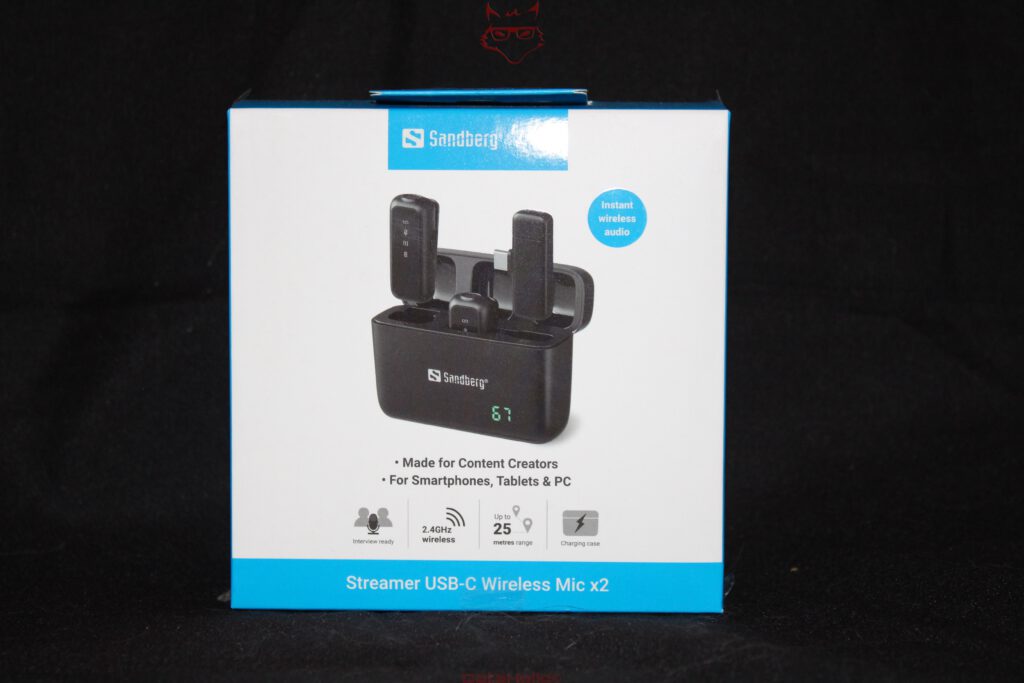
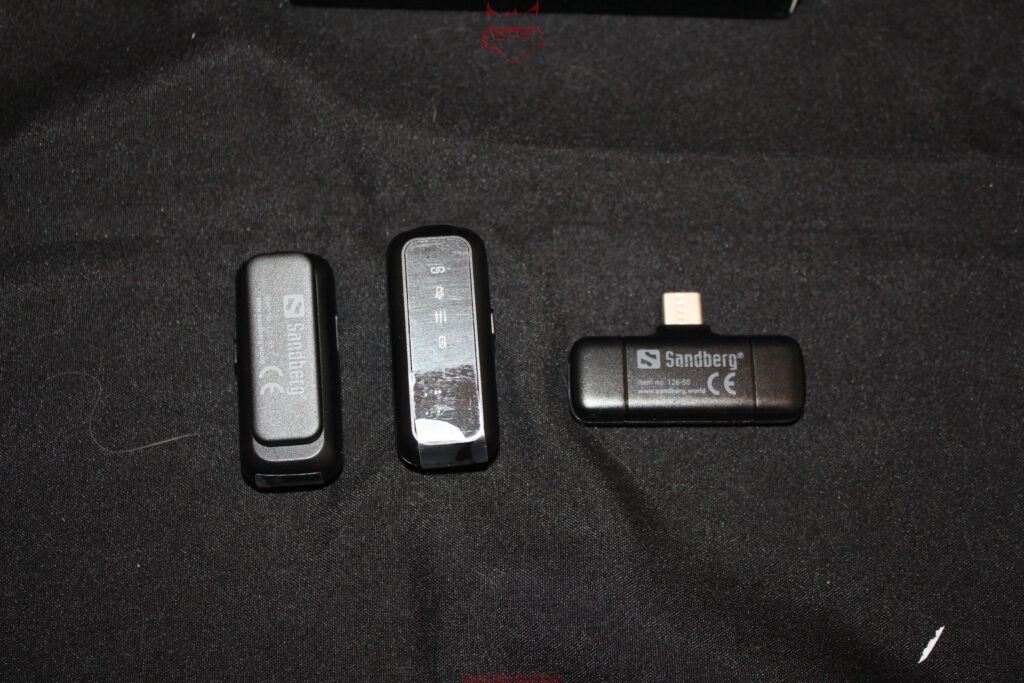
Wireless microphones belong to that category of products whose technical development has changed almost radically over the past few years without attracting much attention. Not too long ago, wireless voice recording meant a small collection of receivers, transmitters, cables, batteries, adapters and the justified hope that all the components involved would actually decide to communicate with each other after being switched on. Today, Sandberg puts two microphones, a tiny USB-C receiver and the entire charging system into a housing barely larger than the charging case of slightly overweight true-wireless earbuds. The Sandberg Streamer USB-C Wireless Mic x2 follows exactly this approach: as little infrastructure as possible between spoken words and the finished recording.
At first, that does not sound particularly spectacular. Two wireless microphones, one receiver, done. Yet that is precisely where the interesting part of this system begins. Sandberg does not try to turn a compact mobile microphone kit into a recording studio for the pocket. There is no base station covered in displays, no app demanding a user account before the first recording and no software interface containing enough controls to accidentally lose an entire afternoon inside it. The USB-C receiver goes into a smartphone, tablet or computer, the transmitters are switched on and the wireless connection takes care of its actual job: transporting audio from A to B.
This pragmatism defines the entire product. At the same time, it also creates clear limitations. The Streamer USB-C Wireless Mic x2 is not aimed at film productions with a dedicated sound department, but at interviews, short videos, mobile reports, social-media productions, presentations and situations where the internal microphone of a smartphone is simply no longer sufficient. The interesting question is therefore not whether the set can compete with professional wireless systems from higher price classes. What matters is how much effort Sandberg removes from a typical mobile recording and which compromises have to be accepted in return.
A microphone system that understands its job
Perhaps the most important characteristic of the Sandberg system cannot be expressed in hertz, milliseconds or milliampere-hours: conceptually, it is easy to understand. Two identical microphones handle the transmitter side, one USB-C dongle receives both signals and the charging case keeps all wireless components together. This simplicity is worth considerably more in mobile audio production than a long specification sheet might suggest.
A recording on the road rarely fails because the microphone being used is theoretically not good enough. More often, an adapter is missing, batteries are empty, a wireless connection has not paired or an app decides immediately before recording that a firmware update is absolutely essential. Technology occasionally has a remarkable sense of bad timing. The old saying, “Anything that can go wrong will go wrong,” almost feels less like a law of nature than a description of mobile production.
Sandberg significantly reduces these possible points of failure. The receiver uses USB-C and therefore exactly the interface that has effectively become standard on current Android smartphones, tablets, many notebooks and modern mobile devices. A traditional analogue connection via 3.5 millimetres plays no role, nor does Bluetooth pairing.
The latter is important. Bluetooth would appear convenient on paper, but it is not automatically the better option for this type of application. The Streamer USB-C Wireless Mic x2 uses its own 2.4 GHz wireless connection between transmitters and receiver. That keeps the audio link separate from the usual Bluetooth circus surrounding a smartphone. Headphones, a smartwatch or a car connection can continue to exist without the microphone first having to appear as yet another Bluetooth device in some settings menu.
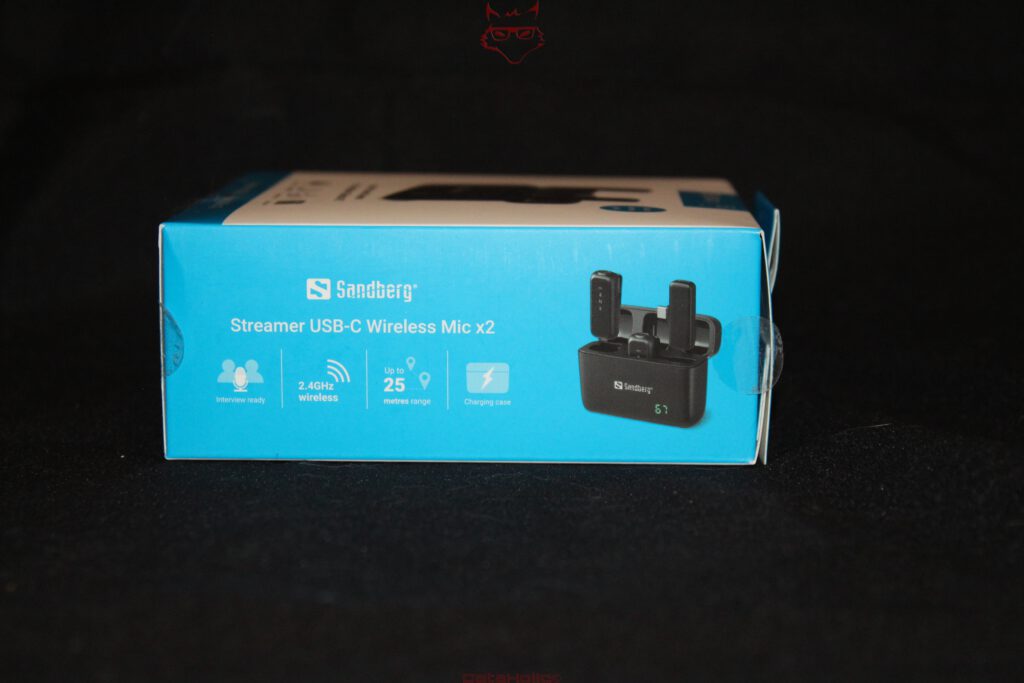
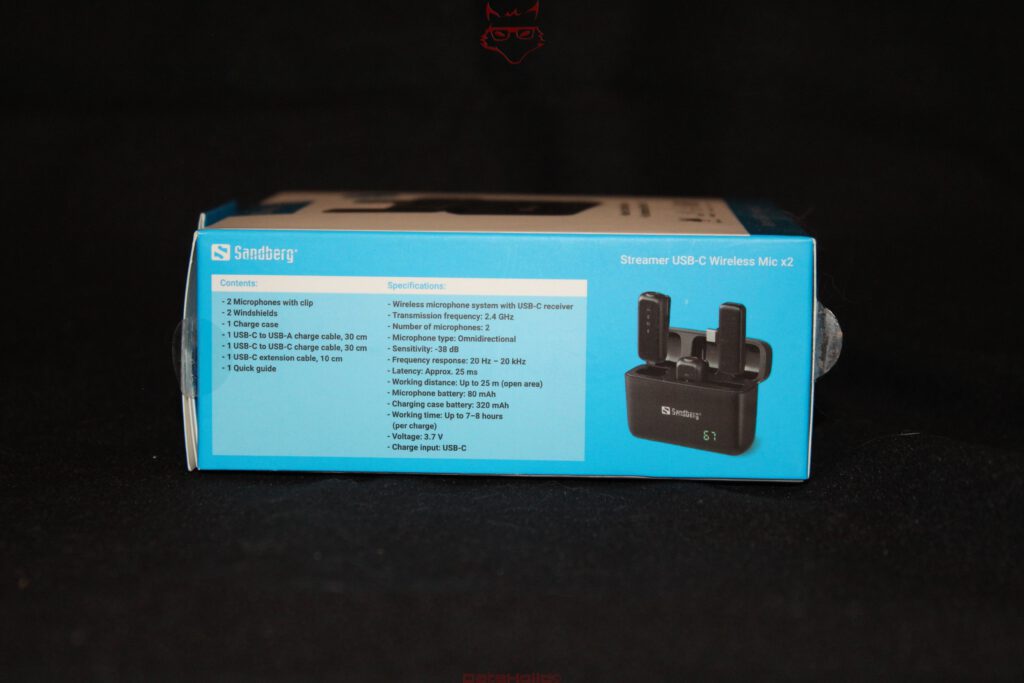
A 2.4 GHz connection is not, however, a magical interference-free tunnel. Wi-Fi, wireless peripherals and numerous other devices also operate within this frequency range. Under normal conditions this is not fundamentally problematic, but it explains why range specifications for wireless microphones should always be regarded as ideal values. Sandberg specifies up to 25 metres in an open area. “Open” is the decisive word. Walls, people, metal structures and a crowded radio environment change the conditions considerably. For an interview with two people, a video contribution in front of a camera or a presentation with a smartphone on a tripod, 25 metres are more likely to represent reserve capacity than a realistic working distance anyway.
Two microphones change more than just the quantity
The “x2” in the product name is not merely decorative. Two transmitters significantly change the practical value of such a system. A single wireless lavalier microphone is sufficient for presentations or short monologues. As soon as a conversation needs to be recorded, the familiar migration of one microphone between two people begins. It works, but by the third handover it starts to resemble an improvised television news segment.
With two transmitters, each voice gets its own microphone. Interviews therefore become technically cleaner and, above all, more relaxed. Both people can speak normally without having to pass a microphone back and forth or constantly alter their distance from the recording source. This consistency is particularly important in video production because microphone volume depends heavily on the distance between microphone and voice.
The integrated microphones use an omnidirectional pickup pattern. The term sounds more complicated than the function actually is. Instead of favouring sound arriving from a narrow direction, omnidirectional microphones respond relatively evenly to sound around the capsule. With small clip-on transmitters this is practical because their position on a collar or shirt does not have to be aligned with the mouth down to the millimetre.
This design has an unavoidable downside: an omnidirectional pattern is not exclusively interested in the desired voice. Room reflections, traffic, keyboard noise, background conversations and other environmental sounds do not disappear simply because a microphone is clipped to clothing. The decisive advantage comes from proximity to the sound source. A transmitter positioned only a few centimetres below the mouth receives the voice far more directly and strongly than a smartphone perhaps two metres away on a tripod. This improved signal-to-background ratio is the real reason why even compact wireless microphones can dramatically improve speech intelligibility in mobile productions.
This is also where expectations need to remain realistic. The Sandberg set does not create a soundproof booth around the people being recorded. A busy trade-show hall remains a busy trade-show hall. A passing bus does not suddenly develop consideration simply because a wireless microphone is present. Good microphone placement does not mean that the environment becomes silent. It means that the desired voice moves further into the foreground relative to that environment.
The specifications make sense for speech
Sandberg specifies a frequency response of 20 Hz to 20 kHz and a sensitivity of -38 dB for the microphones. Such values look impressively complete on a product box, but by themselves they explain surprisingly little about the resulting sound.
The stated frequency response nominally covers almost the entire audible spectrum of a young human ear. For speech, this range is much broader than is actually necessary. The fundamental part of the human voice occupies only a relatively small section of it, while intelligibility depends heavily on higher-frequency components. A microphone therefore does not necessarily need to reproduce deep bass right down to the limits of human hearing in order to record speech convincingly.
Far more important are the tuning of the capsule, the self-noise of the electronics, dynamic headroom, compression, internal signal processing and the way the system handles sudden changes in volume. None of these characteristics can be determined from “20 Hz to 20 kHz” alone. The figure merely shows that Sandberg has not obviously restricted the hardware to an extremely narrow speech band.
The specified sensitivity of -38 dB also fits the typical application of compact lavalier solutions. In simplified terms, sensitivity describes how strongly a microphone reacts to incoming sound pressure. Again, a single number does not decide whether a microphone sounds good or bad. Two microphones with identical sensitivity ratings can still sound entirely different.
For this product category, another characteristic is much more interesting: placement. A mediocre microphone positioned sensibly close to the voice can sound more intelligible than an excellent microphone placed in the wrong location. That is not a particularly glamorous insight, but it is one of the most reliable rules in audio engineering. Physics remains remarkably unimpressed by product marketing.
Around 25 milliseconds of latency is low, but not invisible
Sandberg specifies latency of approximately 25 milliseconds. That places the system in a range that is fundamentally suitable for video and speech recording. Twenty-five milliseconds equal one fortieth of a second. That sounds practically meaningless, yet it is still a value worth putting into context.
For ordinary voice recordings, such a delay is barely disruptive. Video and audio streams have to be processed, buffered and stored in digital recordings anyway. Smartphones, camera apps, operating systems and editing software each add their own delays. The decisive factor is whether image and sound visibly drift apart in the final result.
A difference of only a few dozen milliseconds usually remains within a range where lip movement and speech still appear sufficiently synchronised. Larger offsets become noticeable quickly. Human perception is remarkably sensitive when voices are involved. As soon as the mouth is already forming the next sound while the audio track is still mentally stuck on the previous syllable, even a technically clean recording starts to resemble badly dubbed television from earlier decades.
Latency would be more critical for live monitoring. Hearing the own voice delayed through headphones can disrupt speech rhythm surprisingly quickly. The Sandberg system, however, is not designed as a complex monitoring platform. Its core task remains the direct wireless transmission of audio to the recording device.
The charging case is the hidden central component
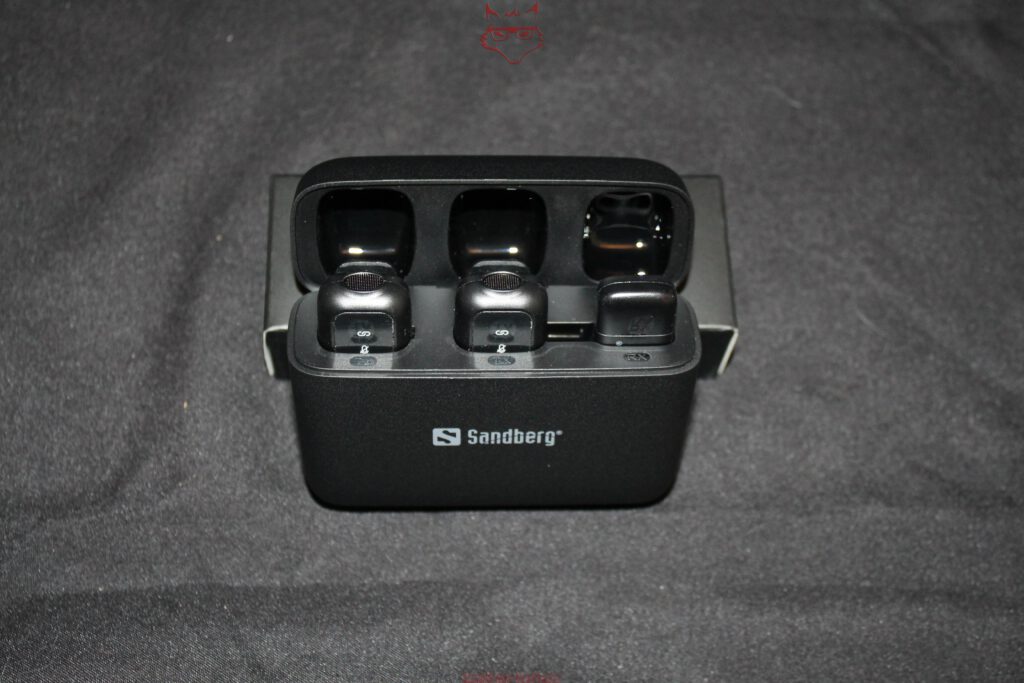
With mobile wireless microphones, the charging case is far more than packaging. It determines whether a collection of individual components actually becomes a portable system. Sandberg integrates both microphones and the receiver into one shared case. That gives every essential component a fixed place.
This sounds minor, but it solves a classic accessory problem: small dongles disappear with almost supernatural reliability. USB receivers apparently possess the same evolutionary escape instinct as single socks after a washing cycle. A receiver with a dedicated slot in the charging case has a much better chance of actually being present at the next recording.
The case also includes its own battery. Each microphone has an 80 mAh battery, while the charging case provides 320 mAh. Purely mathematically, the case therefore contains enough capacity for several additional partial charges of the transmitters, although conversion losses and the case electronics itself have to be taken into account. Simply dividing 320 mAh by two microphone batteries would therefore be technically optimistic.
Sandberg specifies up to seven to eight hours of operating time per charge for the transmitters. For compact interviews, mobile video production or a shooting day with breaks in between, that is a sensible range. The case extends practical autonomy further as long as the microphones are returned to it between uses.
This highlights a fundamental difference compared with traditional wireless solutions using replaceable batteries. Built-in batteries are convenient and compact, but eventually they are empty. A set of AA batteries can be replaced within seconds, while an internal lithium battery requires charging time. The charging case softens this problem but does not eliminate it entirely. Continuous productions lasting many hours still require some energy planning. For the typical mobile use of the Sandberg set this is perfectly reasonable; for a twelve-hour professional event production without meaningful breaks it is less ideal.
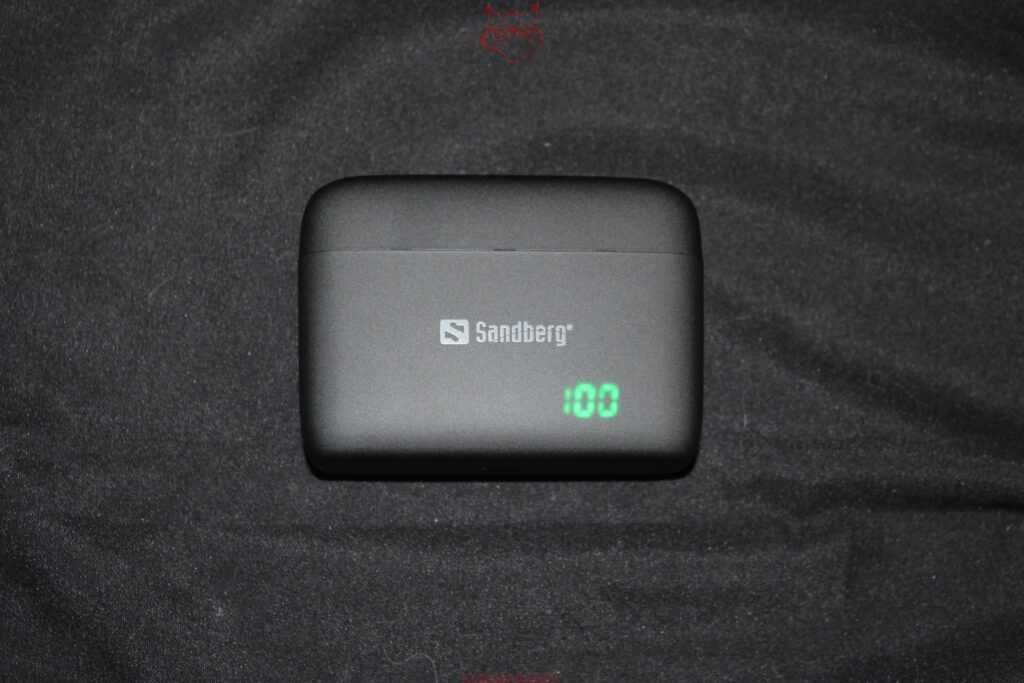
On the front, the case displays its charge level numerically. This small display is more functional than a single status LED would be. An LED can essentially communicate “everything is fine,” “soon it will not be fine” and “too late.” A percentage display offers considerably more planning certainty. A visible value of 67 percent tells a much more useful story than a mysteriously blinking light.
USB-C keeps the system pleasantly uncomplicated
The USB-C receiver is one of the strongest aspects of the concept. Smartphones have now largely moved toward USB-C, tablets have used the connector for years and notebooks include it as standard equipment. A microphone system that works directly through this interface needs neither an analogue sound card nor a separate wired receiver.
For mobile video recording in particular, this significantly simplifies the setup. The receiver sits directly on the device and establishes a digital audio connection. No 3.5-millimetre TRRS cable has to be wired correctly, and no combination of TRS and TRRS adapters creates that very particular kind of technical confusion in which everything fits mechanically while absolutely nothing works electrically.
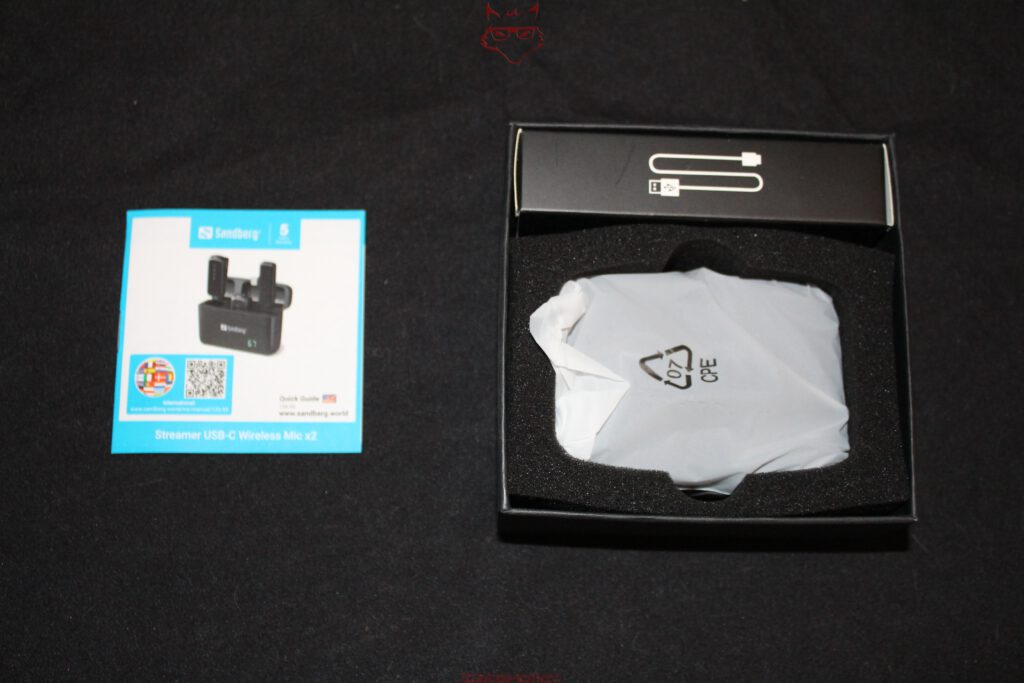
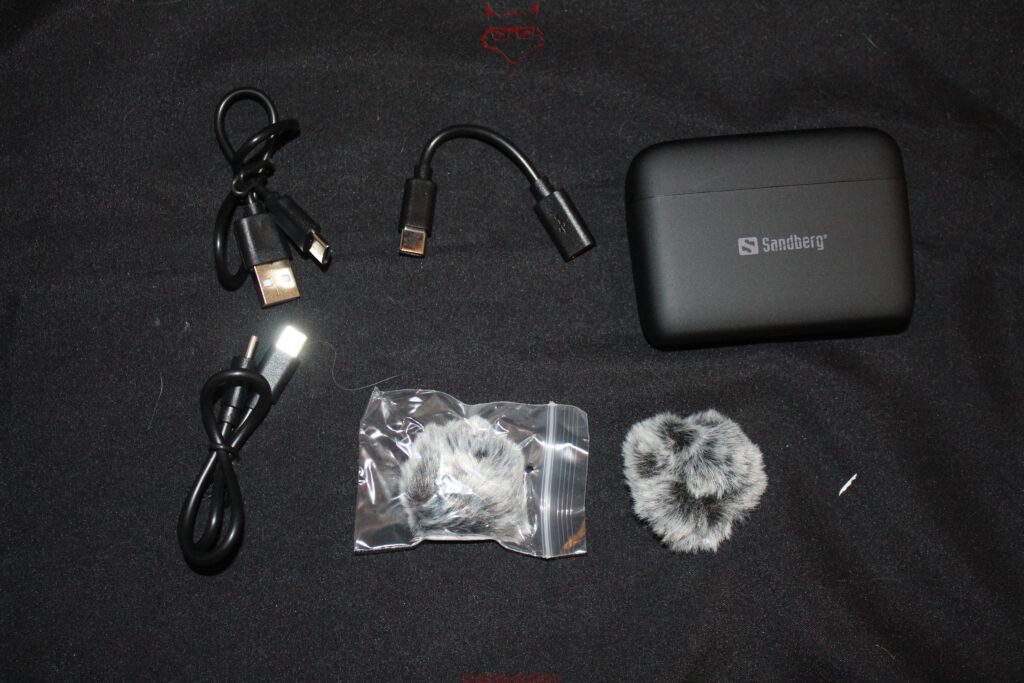
Sandberg also includes a short USB-C extension cable. That is useful because a receiver plugged directly into a smartphone is not optimally positioned with every housing design. Thick protective cases, tightly spaced ports or smartphone rigs can suddenly make a few millimetres extremely important. A short extension removes mechanical strain from the connector and allows more flexible placement.
Sandberg takes an equally pragmatic approach to charging accessories. Cables for USB-C to USB-A and USB-C to USB-C cover both older power supplies and computers as well as modern chargers. This is not a spectacular addition, but it prevents exactly the kind of situation in which a device can theoretically be charged universally while the right cable is, of course, sitting at home.
The windshields are not decorative pieces of fur
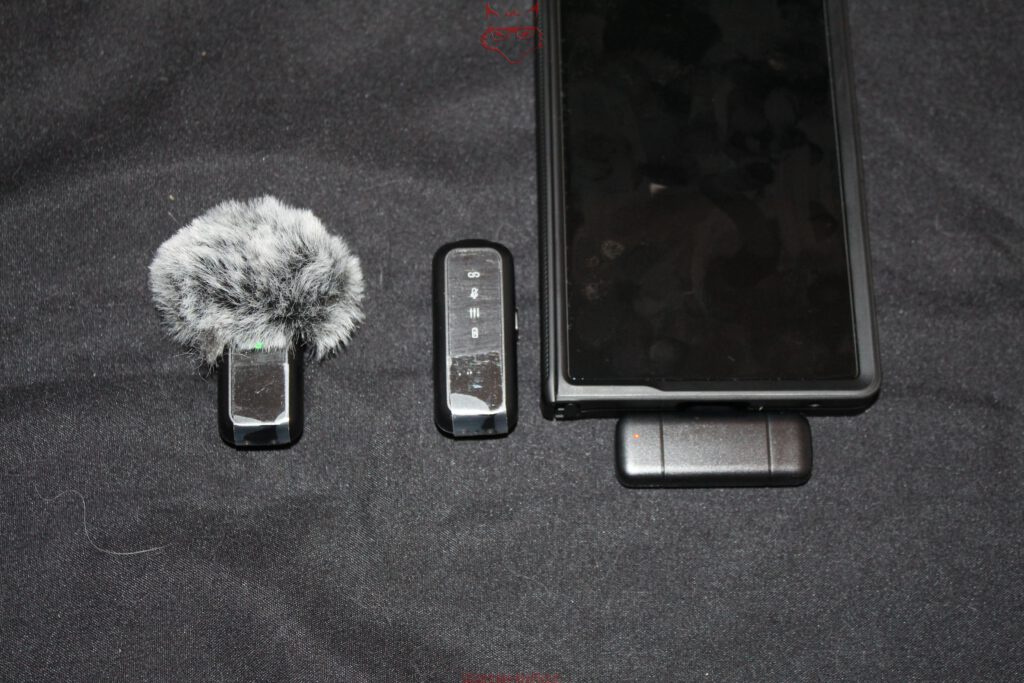
The two included furry windshields look as though two very small grey rodents have had an unfortunate day. Visually, this accessory category generally has a certain resemblance to props from a miniature version of “The Revenant.” Technically, however, the attachments perform an important function.
Wind is problematic for microphones because moving air hits the diaphragm directly and creates strong pressure fluctuations. These disturbances often occur in the lower frequency range and can make a voice recording practically unusable within seconds. Even a light breeze can create far more chaos at a microphone than it appears to create to the human ear on location.
A furry windshield slows and diffuses the airflow before it reaches the microphone opening. Speech is still supposed to reach the capsule while direct air movement is reduced. The principle is simple and works far better than hoping the wind will politely wait until an interview is finished.
Naturally, this protection has limits. Strong wind remains challenging, and a compact furry attachment cannot replace a large professional wind-protection system. For smartphone videos, outdoor interviews or short reports in the open air, however, the inclusion is considerably more relevant than many accessories that spend the rest of their existence in a drawer after the box has been opened.
App-free operation feels almost luxurious by now
The absence of a mandatory app almost feels rebellious for a technical product in 2026. No registration, no cloud account, no software interface and no firmware assistant stand between the hardware and the recording.
Naturally, this also means fewer configuration options. More advanced wireless microphone systems offer gain control, different recording modes, safety channels, local recording inside the transmitters, multiple stages of noise reduction, timecode or detailed level meters. Such functions can be essential in more demanding productions.
The Sandberg Streamer USB-C Wireless Mic x2 follows a different priority. It wants to be available. The technical process should come as close as possible to “plug in and record.” That is pleasant for beginners, while experienced users also benefit from hardware that does not demand a ceremony before use.
A good tool does not always need the largest possible feature set. Often, it is enough for the existing functions to work reliably and remain immediately accessible. A screwdriver is not improved by requiring a software assistant to ask for the preferred direction of rotation before it can be used.
This reduction also defines the upper boundary of the system. Anyone expecting detailed level control, separate audio tracks, backup recordings or internal storage will need a higher product class. That is where convenient consumer hardware separates from production tools with a broader safety net.
Speech rather than studio engineering
When evaluating the sound of a compact wireless system, proper classification matters more than trying to apply studio terminology to hardware that was never designed for studio use. The Sandberg set is supposed to transmit speech intelligibly and directly to the recording device. It is not a large-diaphragm condenser microphone for vocal recording and not a shotgun microphone for a film production.
Omnidirectional lavalier microphones benefit from their proximity to the voice. This creates a direct impression while reducing the amount of room sound. The further the transmitter is positioned from the mouth, the more strongly the surroundings and reflections begin to matter again. Clothing also plays a role. A microphone placed directly underneath a jacket sounds different from one clipped freely to a collar, and rustling fabric cannot be removed by even the best electronics.
Sensible placement therefore remains more important than any menu setting. The microphone should sit relatively freely, avoid constant contact with fabric and should neither sit directly below the chin nor disappear somewhere around chest level. Moving it by only a few centimetres can have a greater effect than extensive post-processing.
The omnidirectional pickup pattern also tolerates changes in angle better than strongly directional microphones. That fits the concept of an uncomplicated mobile system. An interview participant does not need to learn an acoustic choreography before speaking a normal sentence.
For voices, a certain tonal focus is not necessarily a disadvantage either. A recording does not have to preserve every deep breath and every subtle room resonance. Intelligibility, consistent volume and a clean overall character are far more valuable for interviews and social-media content than audiophile obsession with minute details.
What the Sandberg system lacks compared with more expensive alternatives
The low technical overhead has a downside. The Streamer USB-C Wireless Mic x2 omits several functions that have become common in professional systems.
Internal backup recording directly inside the transmitter, for example, would provide a strong safety net. If the wireless connection drops during an important recording, systems equipped with local recording still retain a file on the transmitter. With a simple live wireless link, that second layer of protection does not exist. The received signal is the recording.
Comprehensive level meters are also absent. A compact transmitter can indicate status information, but it cannot replace a receiver with a precise audio meter. Anyone frequently recording speakers with significantly different vocal levels has more control with higher-end systems.
The same applies to separate channel management and advanced post-production. Two transmitters are ideal for interviews, but a professional workflow benefits from recording both voices completely separately and processing them independently during editing. This makes volume adjustments easier and allows corrections without simultaneously affecting the second speaker.
These limitations are not surprising flaws. They follow logically from the product size, operating concept and intended audience. They would only become problematic if Sandberg positioned the set as a replacement for a professional multichannel wireless system. That is not what it is designed to be.
Instead, the device is built around the question of how little technology is actually required for a usable mobile voice recording. The answer is refreshingly short: two transmitters, one receiver and a charging case.
The concept is particularly convincing for interviews
The strongest use case is clearly interviews. Two speakers, two microphones and one smartphone create a setup that can be ready within moments. This is particularly relevant for spontaneous conversations, trade-show coverage, short editorial segments or social-media clips.
The smartphone can be positioned at some distance without audio quality automatically suffering from that distance. The microphones stay on the people while the camera can move or be repositioned. Image composition and audio capture therefore become partially independent from each other.
That may sound technically unspectacular, but it changes the practical workflow considerably. With an integrated smartphone microphone, the camera often has to remain relatively close to the speaker so that the voice does not disappear into the room. With wireless microphones, the shot can become wider without the voice sounding proportionally further away.
The system also makes sense when only one person is speaking. One transmitter remains in the case while the other handles the recording. The second unit becomes a spare or waits for another participant. This redundancy increases the practical value compared with a pure single-microphone package.
Traditional podcasts, by contrast, are only a limited natural use case. For stationary productions, larger microphones provide more control over the room, proximity effect and tonal character. The Sandberg system does not want to occupy a studio desk. It wants to disappear while someone is speaking.
The housing concept is functional rather than luxurious
Visually, the Streamer USB-C Wireless Mic x2 remains understated. Black plastic dominates the entire set. That is a sensible decision because microphones should not become the actual subject during video recording. A shiny chrome housing with RGB lighting would probably attract more attention, but it would be about as useful as a disco ball during a news interview.
The small transmitters feel functional and compact. The clip is an integral part of the concept, so no additional lavalier cable is required between microphone and transmitter. That reduces the number of parts and the setup effort, while also limiting positioning flexibility slightly compared with a system using a separate lavalier microphone.
An external lavalier capsule can be mounted almost invisibly on a collar while the larger wireless transmitter disappears underneath clothing. With the Sandberg system, the entire unit remains visible on the garment. For interviews, streams and short videos, this is usually not a problem. For elaborately produced film footage, however, it would be less elegant.
The charging case is likewise more tool than jewellery box. That fits the product. A mobile audio device does not need to look luxurious. What matters are dedicated slots for the components, a clear battery display and a housing that transports transmitters and receiver together.
Seven to eight hours change the way the battery is handled
The specified operating time of up to seven to eight hours per transmitter is practical for this device class. Interviews rarely last eight hours, and many mobile video productions consist of individual takes with breaks in between.
Those breaks are exactly where the charging case becomes useful. Transmitters go back into their designated slots, the lid closes and energy starts flowing again. The behaviour mirrors the familiar routine of true-wireless earbuds and requires no new habit.
The small battery capacity of 80 mAh per transmitter also demonstrates how efficient modern wireless technology has become. Such a small energy reserve powers the microphone, analogue-to-digital conversion, signal processing and 2.4 GHz wireless transmission for several hours. Only a few years ago, a comparable system would have required significantly larger batteries or replaceable cells.
The case provides 320 mAh. Its task is not to keep the system running for an entire week away from a power outlet, but to recharge the transmitters several times in typical use or extend their operating time across a working day.
USB-C on the case is exactly the right choice. A proprietary charging connector would be difficult to justify on a mobile product in 2026. The existing smartphone, notebook or tablet charger can also power the microphone system. Fewer chargers in the bag are one of those small improvements that barely register on a specification sheet and suddenly become surprisingly valuable while travelling.
The overall package makes particular sense for smartphone production
The Sandberg Streamer USB-C Wireless Mic x2 fits into a development that camera manufacturers probably observe with mixed feelings: smartphones are now good enough for a very large number of video projects. Image stabilisation, HDR, 4K recording and capable lenses have long been available in devices that are carried every day anyway.
Audio remained the weak point for much longer. A smartphone can produce excellent video while still recording speech that sounds as though it came from the other side of a bathroom. The reason is simple physics: the optimal camera position and the optimal microphone position are rarely identical.
A wireless microphone separates these two positions. The smartphone can remain where the image works. The microphone sits where the voice originates. This separation is probably the largest quality improvement that a mobile video setup can achieve with relatively little effort.
That is why a product such as the Sandberg set can have a larger practical influence than numerous camera apps filled with manual parameters. Poor lighting can sometimes be corrected. A slightly dark image can remain usable. Unintelligible speech, by contrast, causes a video to become exhausting remarkably quickly.
The old principle that “sound is half the production” almost underestimates the situation for interviews. An average image with intelligible speech remains watchable. A perfect image accompanied by acoustic mush becomes tiring very quickly.
Low complexity is both the strength and the limit
The Sandberg Streamer USB-C Wireless Mic x2 belongs to those products whose quality depends strongly on the expectations placed upon it. Anyone needing two uncomplicated wireless microphones for a smartphone, tablet or notebook gets a very coherent concept. Anyone expecting professional production features will quickly encounter its limits.
This clear positioning is more of an advantage than a disadvantage. Not every microphone system needs 32-bit float recording, timecode, internal storage, four safety channels and an app containing 17 submenus. Technical capability is only valuable if the relevant workflow actually benefits from it.
For interviews, training sessions, short presentations, mobile reporting, TikTok, Instagram or YouTube recordings and spontaneous conversations, speed matters more. Microphones out of the case, receiver plugged in, recording started. Every additional step increases the probability that something will be forgotten or configured incorrectly.
At the same time, the limitations should not be romanticised. A simple wireless link has fewer safety reserves. An important recording should therefore always be checked briefly. Five seconds of test audio cost almost no time and can prevent the unpleasant discovery that a twenty-minute conversation has resulted in a silent file. Trust is useful; a quick level check is audio.
Conclusion: Technology that gets out of the way as quickly as possible
The Sandberg Streamer USB-C Wireless Mic x2 does not try to impress through technical complexity. That is precisely its greatest strength. Two compact omnidirectional microphones, a 2.4 GHz wireless link, a USB-C receiver, up to 25 metres of nominal range under open conditions, approximately 25 milliseconds of latency and a charging case create a system whose operating principle becomes clear within seconds.
The decisive improvement over a smartphone recording does not come from exotic audio engineering but from microphone placement. Speech is captured where it originates instead of several metres away at the recording device. This simple physical advantage often improves mobile voice production more dramatically than any software correction applied afterwards.
The two transmitters make the set particularly interesting for interviews. No microphone handovers, no smartphone placed between two people and no constant changes in recording distance. The included windshields extend the system to outdoor use, the charging case keeps all components together and provides additional energy. A numerical battery display removes the usual guessing game surrounding the remaining charge.
Technical luxury features are absent. Internal backup recording, comprehensive level control, professional multichannel options and sophisticated safety features are not part of the concept. For critical productions where there is only one chance to capture the material, a higher-end wireless system would therefore be the more appropriate choice.
That, however, is not really the natural competition for the Sandberg Streamer USB-C Wireless Mic x2. Its real opponent is the built-in smartphone microphone, an awkward collection of cables or the spontaneous decision not to record a contribution at all because the required audio equipment is missing. Against those alternatives, this compact Sandberg system becomes surprisingly convincing.
It is not a mobile recording studio and, fortunately, does not try to pretend that it is one. It is a tool for voices. Two of them at the same time, without a complicated setup and without a digital scavenger hunt through apps and pairing menus. In an era where even a light bulb occasionally asks for Wi-Fi credentials, that simplicity almost carries a nostalgic charm.
Transparency notice in accordance with EU requirements:
The Sandberg Streamer USB-C Wireless Mic x2 featured in this review was provided to us by Sandberg as a non-binding loan for testing purposes. This does not constitute paid advertising.
Sandberg had no influence whatsoever on the content, evaluation or editorial independence of this article. All assessments expressed are based exclusively on our editorial hands-on experience.
Our thanks go to Sandberg for providing the Sandberg Streamer USB-C Wireless Mic x2 and for the trust placed in dataholic.de.