
MoErgo Go60: Technical Unboxing of a Travel-Ready Split Keyboard
- Opening the Lid: An Information Surface Instead of Paper Clutter
- Protection Concept: Fabric Instead of Plastic, Transport Instead of Display
- The Hard Case: Transport Container as Functional Component
- Split Design: Symmetrical Logic, Asymmetrical Reality
- Integrated Pointing Devices: Dual Trackpads as a Design Statement
- Low-Profile Architecture: Switches, Keycaps, and Height
- Ports and Controls: USB-C, TRRS, Button, Status
- Cable Set and Connectivity Philosophy
- Tenting Hardware: Modular Angles and Mounting Logic
- Go60 Palm Rest: Separate Module, Separate Function
- Hidden Detail: The Tenting Bar Inside the Palm Rest Compartment
- Magnetic Coupling and Tool-Free Adaptability
- Low-Profile Switches in Detail: Plum Blossom 45gf Silent Linear
- Silent Mechanics: Why It Matters
- Spare Switches as Functional Safeguard
- Specific Keycaps: Targeted Redundancy Instead of a Full Duplicate Set
- System Philosophy: Serviceability as Part of the Design
- Materials and Construction
- Packaging Logic as Quality Indicator
- Sustainability and Packaging Concept: Deliberately Reduced Instead of Conveniently Produced
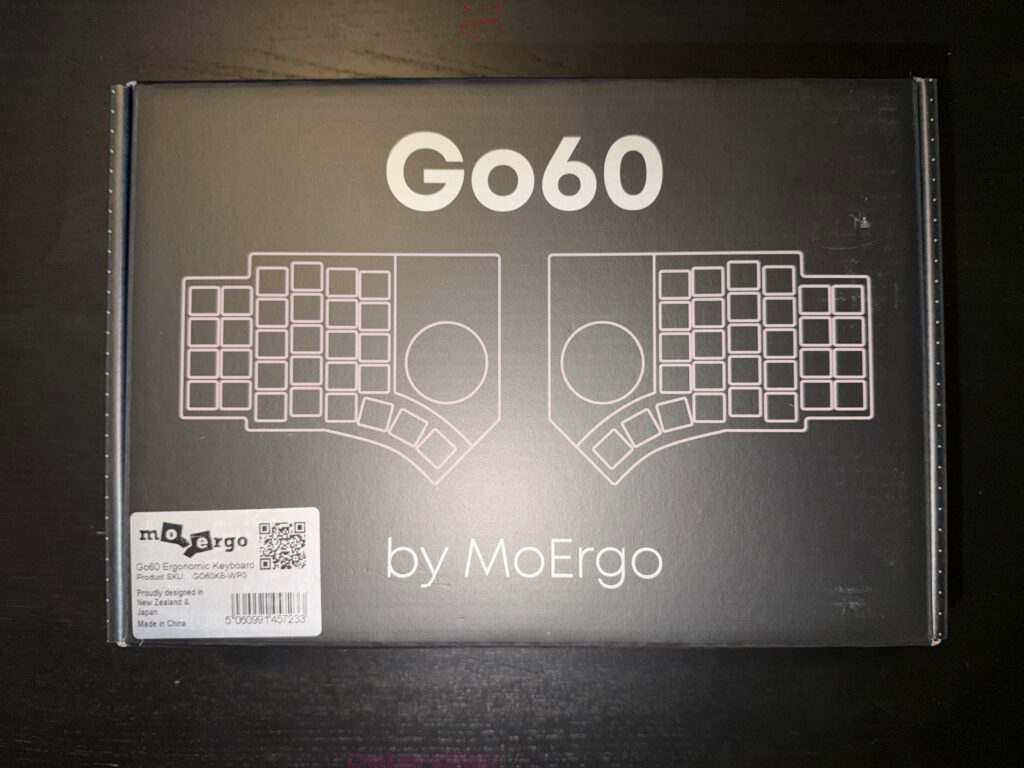
The outer packaging already sets the tone: no flashy marketing box, no overprint, no “gaming” theatrics. Instead, a flat, understated package dominated by a large “Go60” wordmark and a technical line drawing outlining the split geometry. The design feels like an invitation to view the product as a tool rather than a lifestyle accessory. “Form follows function,” as Louis Sullivan once phrased it in the context of architecture, fits surprisingly well here.
The box itself feels rigid and precisely glued. The corners appear sturdy enough to survive the stress of modern parcel logistics. One detail stands out: the packaging remains relatively flat. That is not only an efficient shipping decision but also an early hint at the product’s mobile orientation. A label on the underside confirms the identity: Go60 Ergonomic Keyboard by MoErgo, complete with SKU and origin information. Next to the barcode sits a QR code that replaces the traditional printed manual. This feels modern, but it is also a clear design decision: fewer paper inserts, fewer variables, fewer leaflets that rarely get read.
Opening the Lid: An Information Surface Instead of Paper Clutter
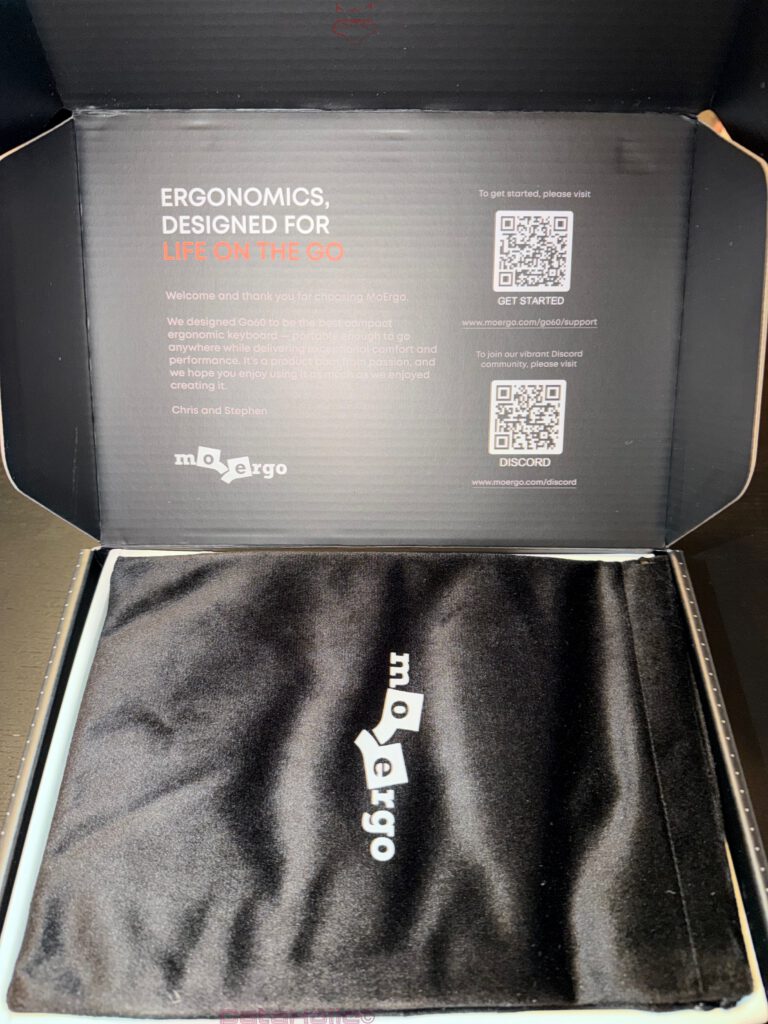
Once the lid is opened, there is no foam jungle and no chaotic accessory pile. Instead, the inside of the lid serves as an informational entry point. On the left, a short welcome message; on the right, two prominently placed QR codes. One leads to the support and getting started page, the other directs to the community on Discord. This is more than a friendly gesture. It signals that MoErgo considers the onboarding process part of the product experience and treats documentation as a living system rather than a static printed snapshot.
The phrase “Ergonomics, designed for life on the go” captures the essence. This is an ergonomic split keyboard that does not present mobility as an afterthought. The inside lid functions almost like a control panel for the first steps, without interrupting the flow of the unboxing.
At the same time, a contrast typical of modern hardware becomes visible: the hardware feels “finished,” while the knowledge around it is intentionally dynamic. “The devil is in the details,” and it is precisely in those details that a product proves whether it will perform in everyday use or only in marketing photography.
Protection Concept: Fabric Instead of Plastic, Transport Instead of Display
The next layer reveals a black felt bag with MoErgo branding. This element is not decorative packaging. It is part of the transport concept, therefore part of the system. Felt offers several advantages: it is lightweight, scratch-resistant, pleasant to the touch, and discreet in a backpack. Additionally, felt hides minor dust marks and pressure traces that would immediately stand out on glossy surfaces.
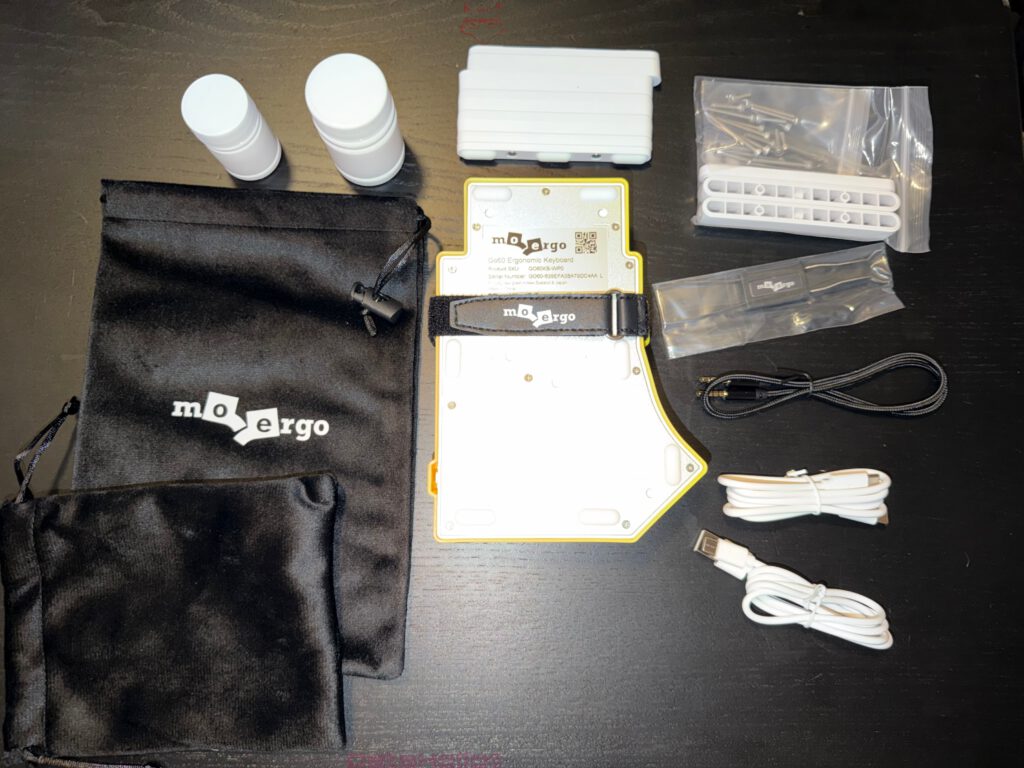
According to MoErgo’s documentation, the Go60 set includes two keyboard halves, a hard case, two felt bags (large and small), and multiple cables. These include USB-A to USB-C, USB-C to USB-C, and a TRRS cable that can optionally connect the two halves. This structure appears physically in the box exactly as described: not random accessories, but a clear separation between core hardware, transport protection, and connectivity components. It subtly communicates the flexibility of the overall system: wireless, wired, or hybrid, depending on the environment.
The Hard Case: Transport Container as Functional Component
The hard case changes the perception immediately after being lifted out. While many split keyboards arrive wrapped in foam or basic cardboard inserts, this case feels like an integral part of the Go60 concept. The keyboard is designed not only to sit on a desk but to be packed and unpacked regularly. That requires fast storage and protection against cosmetic wear after only a few weeks of use.
The case itself is compact and flat, consistent with the 60 percent class but distributed across two halves due to the split architecture. The interior layout ensures both halves sit securely without pressure points. This matters because low-profile keyboards are slim, but the sensitive areas are usually located at the top: keycaps, switch mounts, trackpad surfaces.
An interesting detail: the case does not just protect the keyboard, it stabilizes the entire unboxing logic. Once the case exists, every component has “its place.” This reduces the risk of cables disappearing into drawers and being unavailable when needed. In practice, such small oversights are often more frustrating than major hardware failures.
Split Design: Symmetrical Logic, Asymmetrical Reality
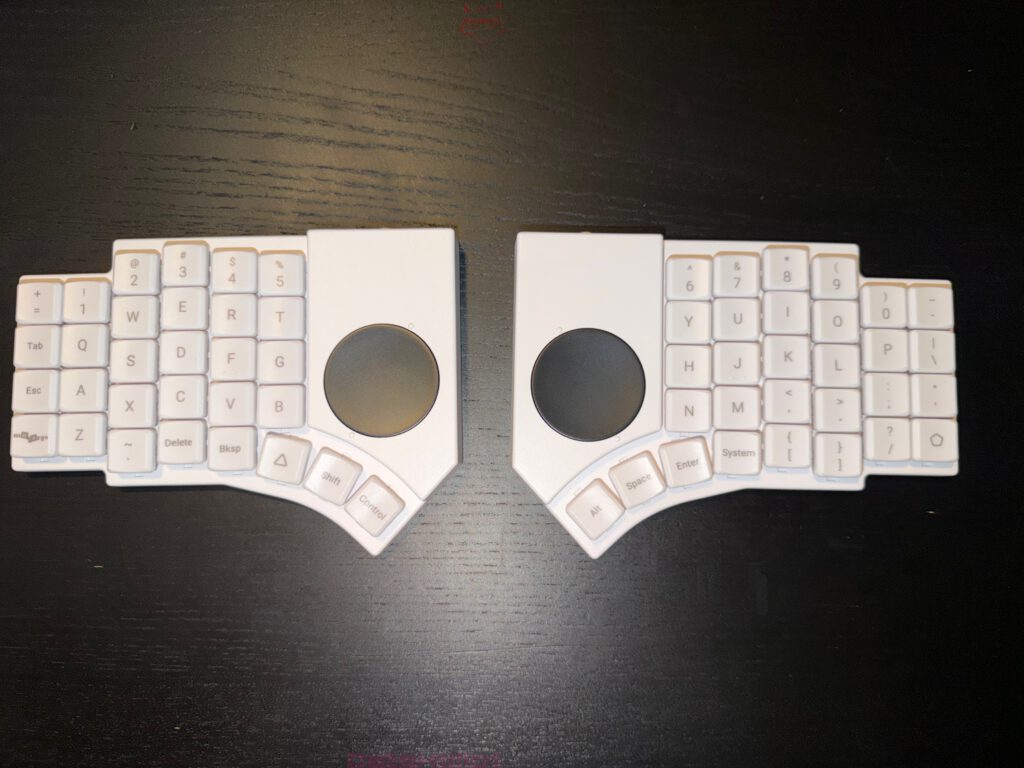
Once the keyboard halves are removed, the geometry becomes immediately apparent. The Go60 is not simply a standard 60 percent keyboard cut in half. The finger sections are ortholinear and column-based, with a noticeable stagger in the pinky area. The technical specifications describe six columns, four to five rows, and a more aggressive pinky stagger. Additionally, there is a curved three-key thumb cluster.
This shape is not only ergonomically motivated but also mechanically considered. The edges and radii are designed so that both halves create a defined inner edge when placed together. The outer edges remain visually calm, which is relevant for storage in bags or cases. With products intended for frequent transport, damage most often occurs on outer edges rather than internal surfaces.
Integrated Pointing Devices: Dual Trackpads as a Design Statement
The most striking feature is the large circular surface on each half. According to technical documentation, these are integrated 40 mm trackpads. This is central to the Go60 concept. Instead of requiring a separate mouse or trackball, the pointing device is placed symmetrically within reach on both sides. At first glance, this appears unconventional, but it is consistent: a mobile ergonomic workstation is only truly mobile if an additional pointing device does not need to be packed.
The trackpad surfaces are recessed within rectangular zones that also function as resting areas. This suggests a dual-purpose design: active cursor control and passive hand placement. Such dual functionality places higher demands on material quality and surface durability. Finger oils, micro-scratches, and pressure wear become visible on large surfaces. Choosing generous dimensions signals confidence rather than caution.
In the context of unboxing, this detail reinforces that the Go60 is more than a keyboard. It is a complete input system in which typing and cursor control coexist.
Low-Profile Architecture: Switches, Keycaps, and Height
The Go60 uses low-profile mechanical switches from the Kailh Choc v1 family, rated for more than 50 million actuations. It also supports hot-swapping, allowing switches to be replaced without soldering. While invisible during unboxing, this feature influences the construction: structural rigidity and tight tolerances are required to withstand repeated switch changes.
The keycaps are translucent POM caps in an MCC profile. POM is a technical plastic known for its smooth surface and abrasion resistance. Translucency may serve aesthetic calmness or material efficiency. In either case, the set does not resemble a generic OEM cap collection but appears purpose-built for low height and travel use.
The total height from desk to keycap top is approximately 17.5 mm. In ergonomic contexts, reduced height influences wrist angles and reduces the need for aggressive palm rest elevation. During unboxing, this becomes evident through the visual flatness of the device.
Ports and Controls: USB-C, TRRS, Button, Status
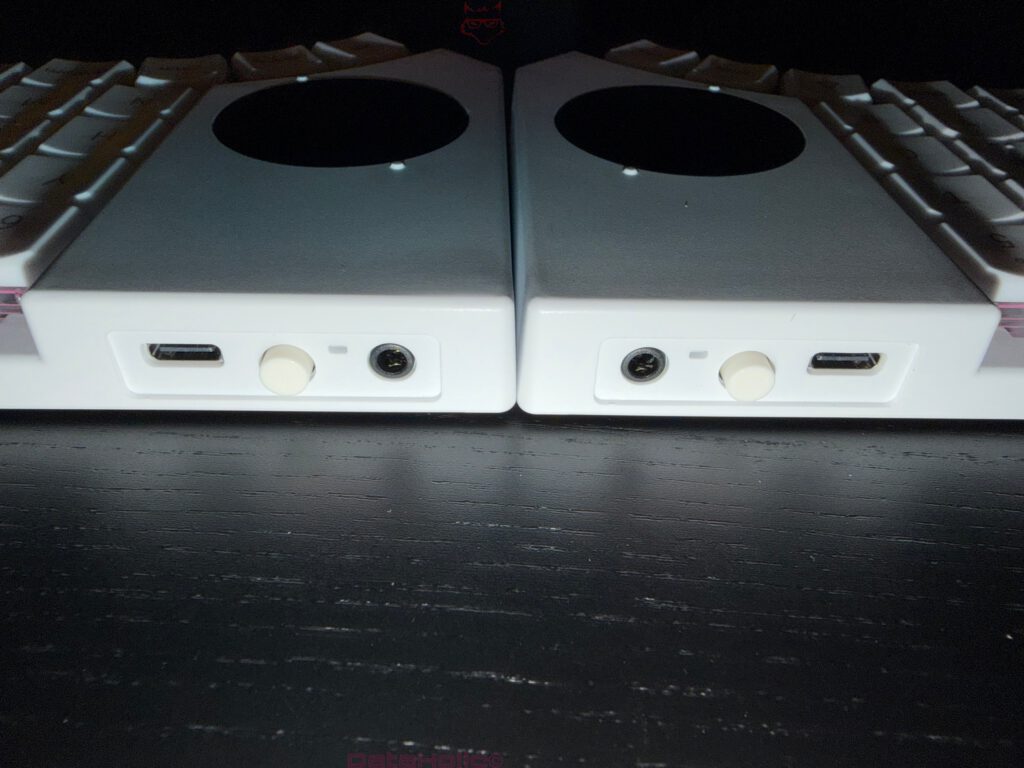
A closer look at the front edges reveals per-half USB-C ports, a circular button, and a 3.5 mm TRRS jack. This combination enables multiple operating modes: fully wireless, fully wired, or hybrid. MoErgo explicitly states that the Go60 can operate as a fully wired split keyboard via USB and TRRS, including the option to disable wireless functionality entirely.
The circular button sits within reach and likely handles pairing, wake, reset, or mode switching. Its placement ensures accessibility without flipping the device over. In mobile scenarios with frequently changing setups, this saves time.
Small status LEDs are also visible. In a mobile device, status indicators are diagnostic tools rather than decoration. An LED communicates operational state instantly, without requiring software access.
Cable Set and Connectivity Philosophy
The accessory kit includes a white USB-A to USB-C cable, a white USB-C to USB-C cable, and a black TRRS cable. The selection is pragmatic: USB-A remains common, USB-C dominates modern laptops and tablets. One meter length balances desk usage and portability.
The TRRS cable enables the fully wired split configuration. A TRRS connection is mechanically simple yet conceptually powerful. It separates data and power pathways depending on internal architecture. Its presence signals flexibility rather than dogmatic wireless-only thinking.
“In theory, there is no difference between theory and practice. In practice, there is.” This often-attributed statement to Edsger Dijkstra resonates here. Including cables is not a bonus; it is insurance against real-world unpredictability.
Tenting Hardware: Modular Angles and Mounting Logic
The box also contains plastic bars, screws, and cylindrical elements forming the tenting system. According to specifications, the Go60 supports six fixed tenting angles between approximately 6.2 and 17 degrees. This range is common in ergonomic setups without compromising desk stability.
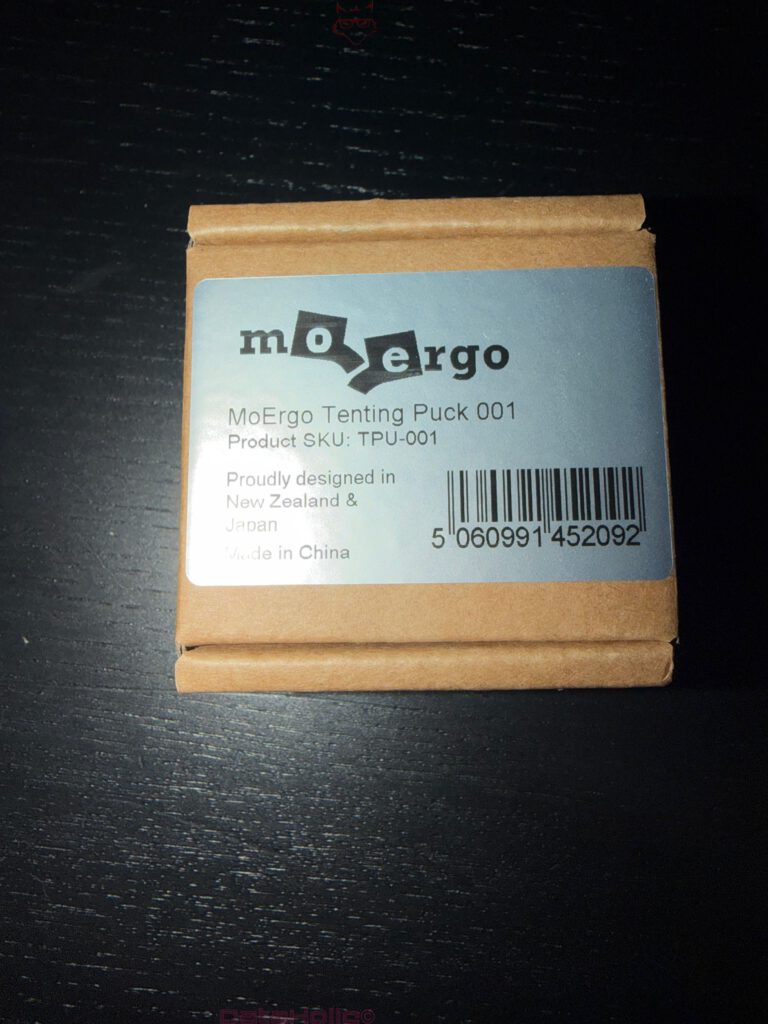
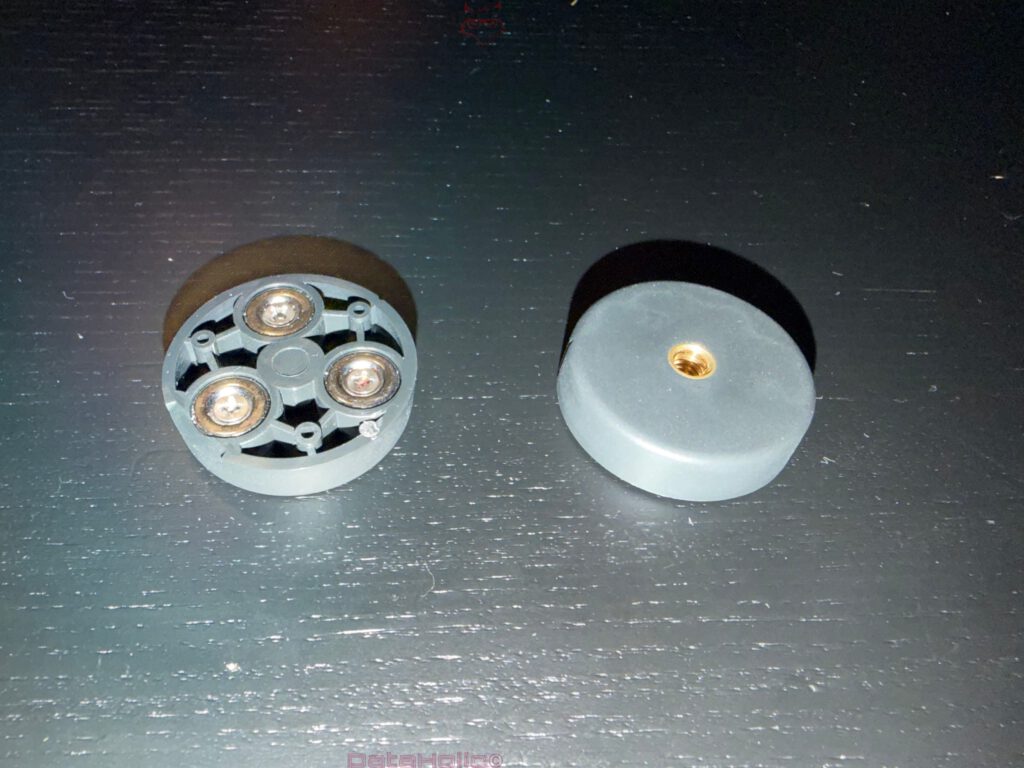
The cylindrical elements correspond to the optional Tenting Puck accessory, designed for compatibility with 1/4”-20 tripod mounts. This standardization allows integration with camera or studio equipment rather than proprietary arms.
The unboxing reveals a modular philosophy. Ergonomics extends beyond key layout into mechanical adaptability.
Go60 Palm Rest: Separate Module, Separate Function
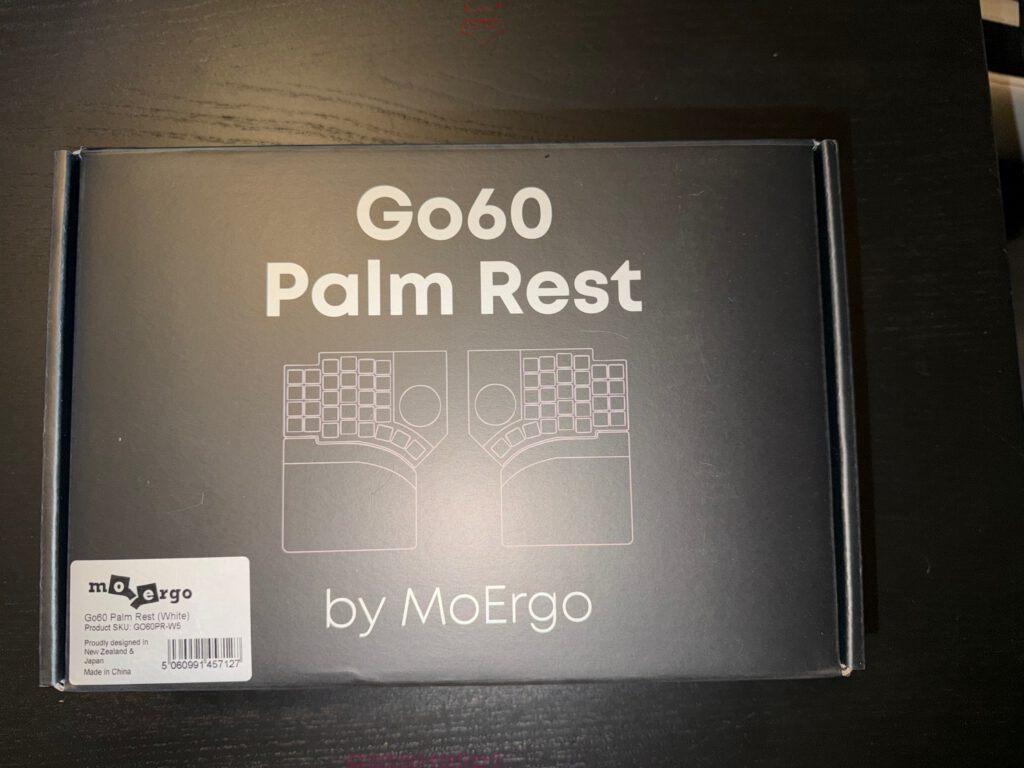
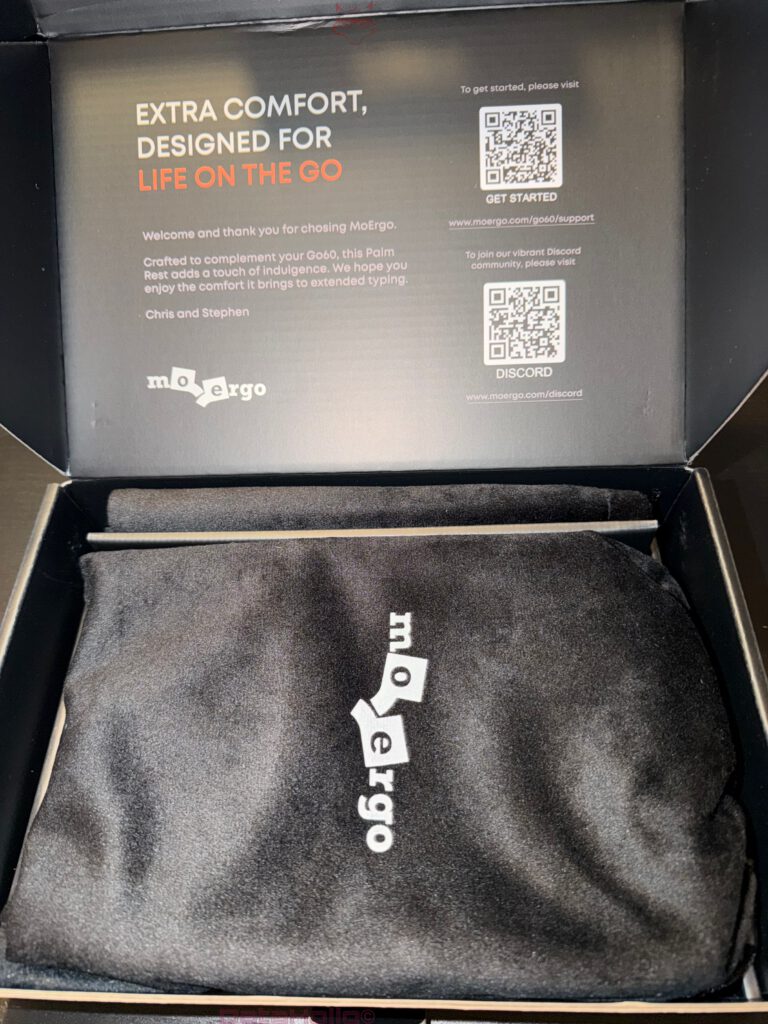
A second box labeled “Go60 Palm Rest” accompanies the keyboard. Again, minimalistic design and technical line drawings. The palm rest is positioned as an optional upgrade within the Go60 ecosystem.
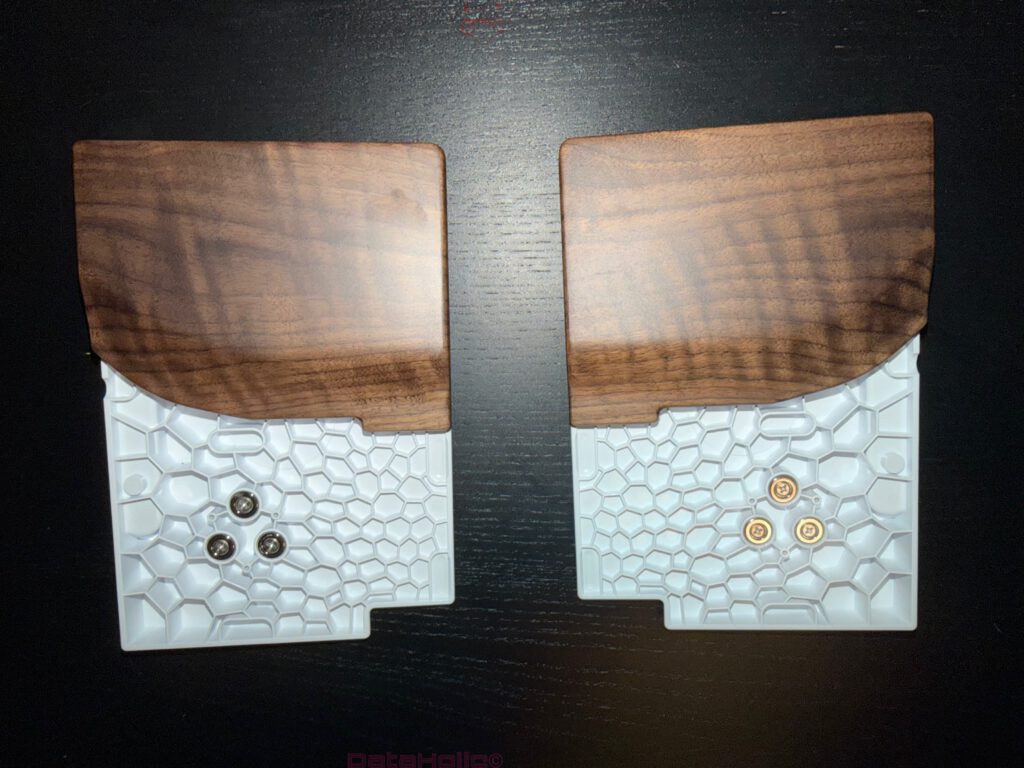
Inside are felt bags, plastic bases, and the actual walnut wood rests. The bases serve as mechanical interfaces between keyboard and wood, integrating magnets and tenting mechanics. The walnut surfaces are cleanly finished, edges softly rounded, likely oiled or sealed.
Walnut is not purely aesthetic. It feels warm, resists stickiness common to some soft-touch plastics, and improves tactile comfort during extended use.
Hidden Detail: The Tenting Bar Inside the Palm Rest Compartment
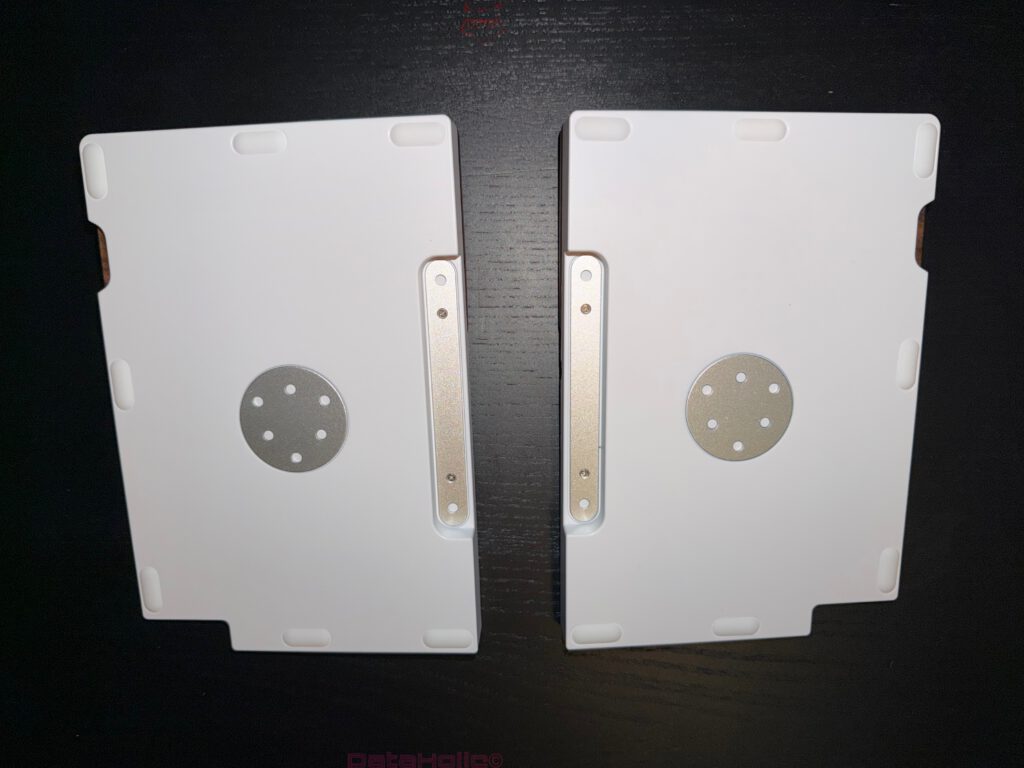
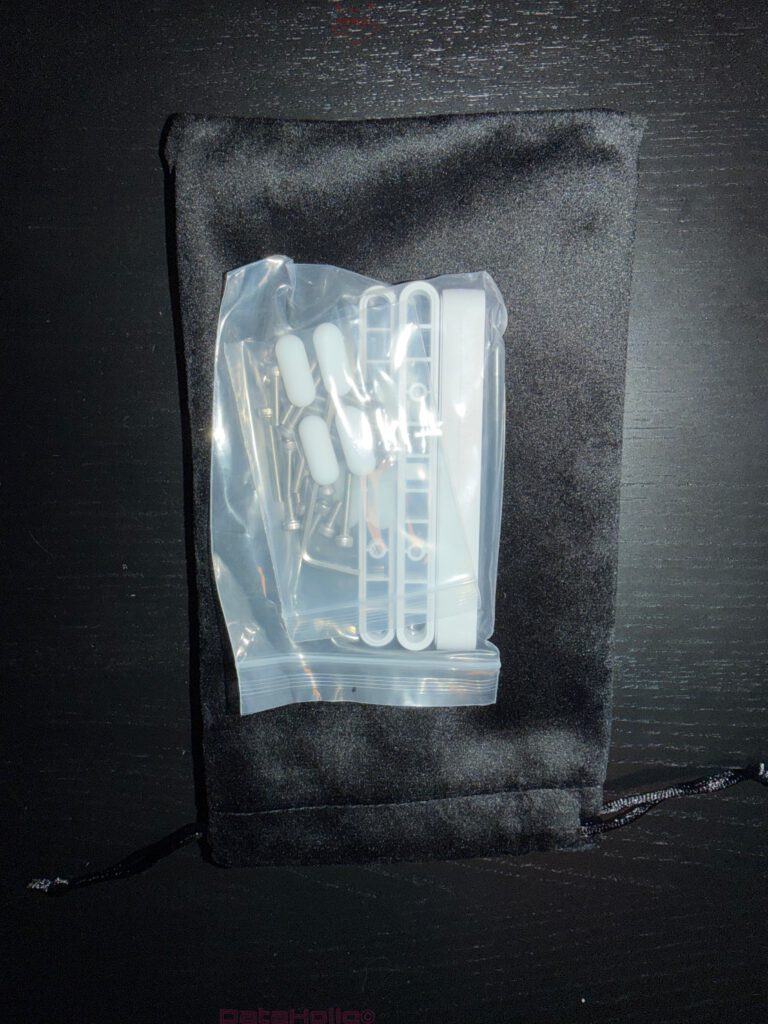
At the bottom of the Go60 palm rest packaging, there is a separate compartment that can easily be overlooked at first glance. Inside this compartment sits the tenting bar, along with its mounting hardware. This component is an integral part of the modular palm rest system and significantly expands the ergonomic adjustment range.
The tenting bar itself is a sturdy plastic bracket with precisely positioned mounting points. Together with the included screws and spacer elements, it enables a mechanically fixed adjustment of the palm rest angle. While the standard palm rest position already provides a moderate base inclination, the additional bar allows for a deliberate increase of that angle.
Technical Function
Once mounted to the underside of the palm rest, the tenting bar alters the geometry of the support surface:
- The inner edge of the palm rest is elevated
- The angle between desk surface and hand position increases
- The forearms can rotate further inward
- Pressure on the wrists is reduced
This adjustment becomes particularly relevant when the keyboard halves themselves are set to a steeper tenting angle. If the keyboard is raised significantly, the palm rest should follow that geometry to maintain a consistent wrist alignment. The tenting bar ensures that palm rest and keyboard remain mechanically and ergonomically aligned.
Mechanical Implementation
The construction is intentionally simple. There is no stepless mechanism and no complex hinge system. Instead, the solution relies on clearly defined, reproducible angles. The screw-based connection ensures stability even under continuous palm pressure. At the same time, the system remains modular: the tenting bar can be removed or reconfigured at any time.
Within a mobile-focused design, this approach makes sense. Complex moving parts increase weight and potential failure points. A fixed bar with a defined angle is lightweight, durable, and travel-friendly.
Ergonomic Value
The ability to adjust the palm rest angle independently from the keyboard base significantly expands the ergonomic flexibility of the overall setup. Different seating positions, desk heights, or individual anatomical requirements can be compensated more precisely.
The additional compartment in the box may seem minor at first, yet it fulfills a central function within the system. The tenting bar is not an optional gimmick, but a structural component for fine-tuning hand positioning.
Taken as a whole, this detail once again highlights the modular philosophy behind the Go60 architecture: adaptability is not simulated through software, but implemented mechanically.
Magnetic Coupling and Tool-Free Adaptability
The palm rest attaches magnetically, enabling quick removal for travel. Fixed screws would provide stability but hinder mobility. Magnets balance retention and flexibility. According to documentation, the palm rest integrates additional tenting angles up to approximately 21.5 degrees.
“Perfection is achieved, not when there is nothing more to add, but when there is nothing left to take away.” This Antoine de Saint-Exupéry quote captures the design balance visible here.
Low-Profile Switches in Detail: Plum Blossom 45gf Silent Linear
The installed and additionally included switches are Plum Blossom 45gf Silent Linear. These low-profile switches belong to the Kailh Choc v1 compatibility family and are specifically designed for slim, transport-oriented mechanical keyboards.
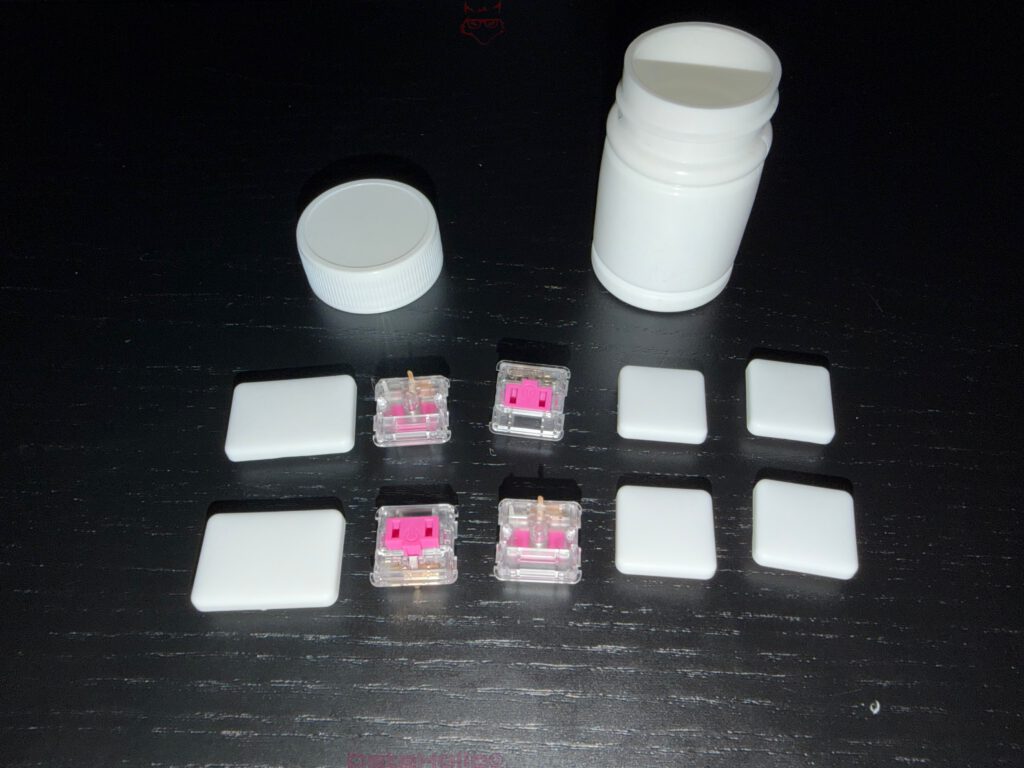
Visually, the switches are easy to identify: transparent housing, pink stem, compact low-profile construction. The clear housing allows a direct view of the internal mechanism — spring, stem guidance, and contact structure are all visible. The pink stem does not indicate tactility in this case; instead, it identifies the linear characteristic combined with an integrated damping mechanism.
Technical Characteristics
- Linear travel without tactile bump
- Actuation force: 45 grams
- Integrated silent damping
- Low-profile height (Choc v1 format)
- Hot-swap compatible
With a 45gf actuation force, the switch sits in the light to medium range. For mobile use and extended typing sessions, this translates into reduced finger fatigue while still maintaining controlled actuation feedback.
The linear characteristic ensures a smooth keystroke without a noticeable actuation bump. Especially in ortholinear layouts with thumb clusters, this results in fluid movement patterns, as no force peaks need to be overcome mid-travel.
Silent Mechanics: Why It Matters
The “Silent” designation is not a marketing label but a structural feature. Noise reduction is typically achieved through integrated silicone or elastomer dampening elements on the stem, which soften both bottom-out and top-out impacts.
The result is a significantly reduced typing sound. For a mobile split keyboard, this is particularly important:
- Use in coworking spaces
- Working during meetings
- Typing on trains or airplanes
- Shared office environments
A loud clicky or tactile switch would be counterproductive in these scenarios. The Plum Blossom 45gf Silent Linear switches are optimized for discreet acoustics without completely eliminating mechanical feedback.
Spare Switches as Functional Safeguard
Including identical spare switches is a technically sound decision. A single defective switch can be replaced individually without altering the typing experience. Different spring weights or switch types would disrupt layout consistency — especially in an ergonomic split system where muscle memory plays a significant role.
Mobile devices are mechanically more exposed than stationary setups. A side impact, pressure point inside a backpack, or a tilted keycap can potentially damage a switch. Thanks to hot-swap sockets, a Plum Blossom 45gf Silent Linear can be replaced within minutes — no soldering, no specialized tools required.
The included switches are therefore not cosmetic extras, but a deliberate redundancy measure.
Specific Keycaps: Targeted Redundancy Instead of a Full Duplicate Set
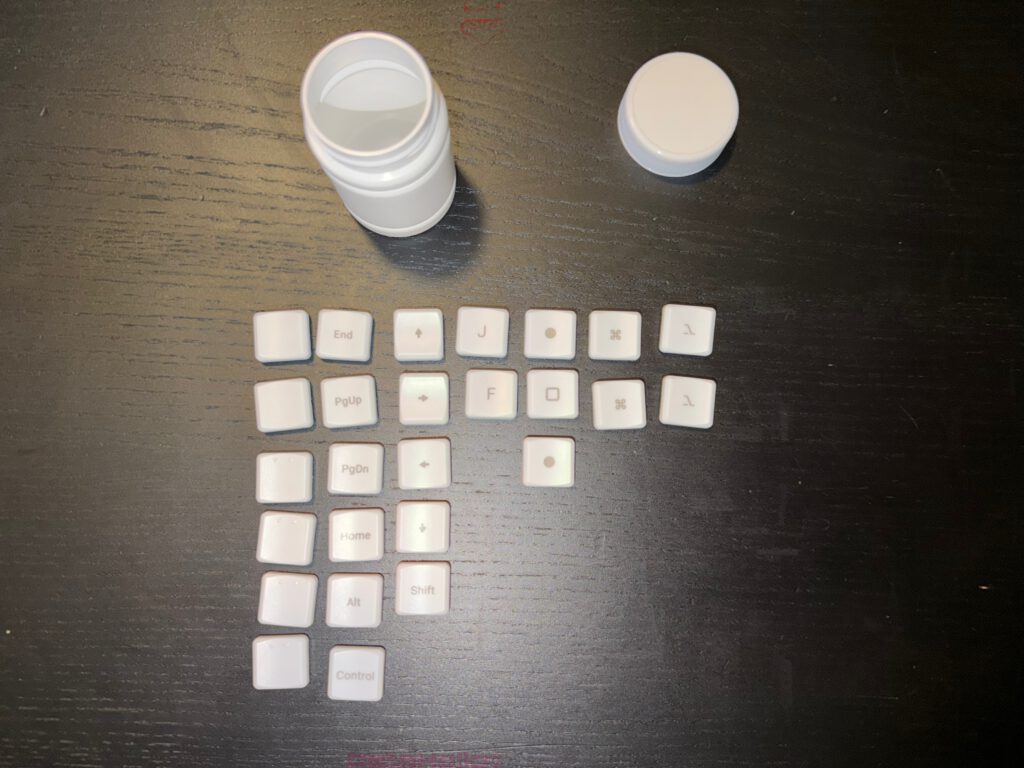
The additional keycaps follow the same system logic. Rather than including a complete second set, the package contains selected special shapes. This primarily concerns keys from the thumb cluster and specific modifier positions.
The MCC profile in translucent POM is not universally compatible with traditional MX keycap sets. Low-profile Choc v1 stems have their own geometry. Losing a special key while traveling would be difficult to compensate without an exact replacement.
Including only the critical formats instead of duplicating standard 1u caps is both efficient and practical.
Not everything needs to be doubled. Only what would be functionally difficult to replace.
System Philosophy: Serviceability as Part of the Design
The combination of:
- Hot-swap sockets
- Identical spare switches
- Specific replacement keycaps
- Compact transport container
clearly shows that maintainability has been integrated into the product architecture.
The Go60 is not a static device but a modular tool. And tools require serviceability — especially when used on the move.
The Plum Blossom 45gf Silent Linear switches align perfectly with this concept: quiet, smooth, consistent, and replaceable.
Materials and Construction
The keyboard halves feel solid without being heavy. Matte surfaces minimize fingerprint visibility. Screws are recessed cleanly. Rubber feet are generously distributed for stability.
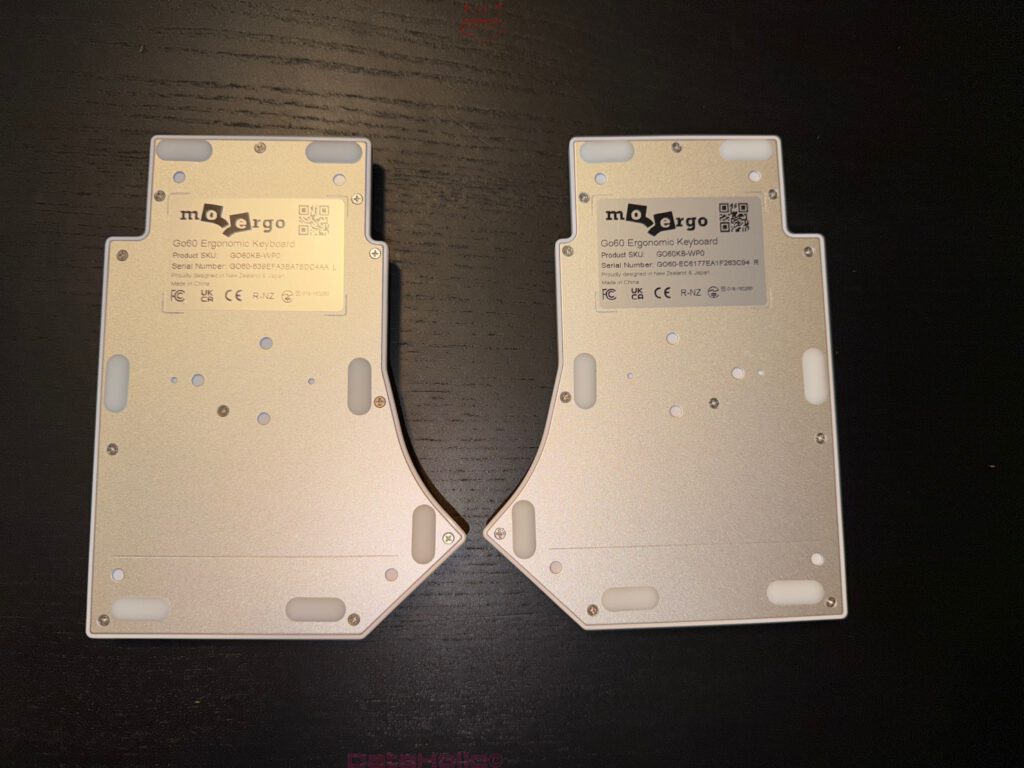
Certification markings and serial labels on the underside confirm compliance and traceability, crucial for professional environments.
Packaging Logic as Quality Indicator
The unboxing demonstrates structural clarity:
- Core hardware in a hard case
- Felt bags for protection and organization
- Comprehensive cable set
- TRRS for wired split configuration
- Modular tenting components
- Optional palm rest with independent transport logic
The Go60 is presented not as a single board but as a portable input platform.
Sustainability and Packaging Concept: Deliberately Reduced Instead of Conveniently Produced
One additional aspect deserves special attention in the context of this unboxing: the packaging concept itself. From the very first opening, it becomes clear that MoErgo follows a consciously deliberate approach.
All packaging components are either made from recyclable materials such as cardboard or compressed paper pulp – or from reusable plastic containers, such as the included bottles styled similarly to traditional medicine containers.
Single-use plastic has been almost entirely avoided.
This is not a minor detail, but a strategic decision. Many technical products in this category still rely on:
- heat-sealed blister packaging
- thin disposable plastic sleeves
- non-reusable plastic inlays
- foam inserts with no realistic recycling pathway
Here, the approach is different. The cardboard is fully recyclable. The molded inserts are made from compressed paper pulp rather than expanded plastic. The small plastic containers are not intended as disposable packaging, but as durable storage solutions for spare switches or keycaps.
In the premium, long-lasting hardware segment, a contradiction often appears: sustainable product philosophy meets short-term packaging solutions. With the Go60, that contradiction appears intentionally resolved.
The reduction of single-use plastic is not only an ecological decision but also a qualitative one. Packaging made from pressed fiber material feels more solid, more structured, and less arbitrary than thin plastic trays.
The overall impression is that not only the product itself was designed to be modular and durable, but its very first layer of protection as well.
In a market where sustainability is frequently communicated but rarely implemented consistently, this approach stands out in a positive way.
Magnetic Coupling and Palm Rest (Sold Separately)
The magnetic coupling system and the walnut palm rest are not included as standard components of the Go60 keyboard. Both elements are optional accessories and are sold separately.
The palm rest attaches magnetically to the Go60, allowing quick installation and removal without tools. This design supports modular flexibility and transport efficiency. Fixed screw mounting would increase rigidity but reduce portability. The magnetic interface strikes a balance between stability during use and rapid detachment for travel scenarios.
According to official specifications, the palm rest integrates additional tenting angles of up to approximately 21.5 degrees, expanding the ergonomic adjustment range beyond the keyboard’s base configuration. However, this functionality is only available when the optional palm rest module is purchased separately.
“Perfection is achieved, not when there is nothing more to add, but when there is nothing left to take away.” — Antoine de Saint-Exupéry
This quote reflects the modular philosophy behind the Go60 ecosystem: the base keyboard remains fully functional on its own, while accessories such as the magnetic palm rest extend its ergonomic range for users who require additional support.
“Transparency notice in accordance with EU guidelines:
The MoErgo Go60 presented in this review was provided to us by MoErgo as a non-binding loan for testing purposes. This does not constitute paid advertising.
MoErgo had no influence on the content, evaluation, or editorial independence of this article. All opinions expressed are based solely on our own practical experience.
We would like to thank MoErgo for providing the keyboard and accessories and for the trust placed in dataholic.de.”