
reMarkable Paper Pure in Technical Unboxing: The Deliberate Escalation of the Digital Notebook
- Less technology as a statement – and exactly why it is so interesting
- The outer packaging: reduction as a design principle
- Rear side without spectacle
- Packaging construction: more book than electronics
- The first view: the device as the centerpiece
- The display: electronic ink instead of a light show
- The Marker Plus: the actual star
- Magnetism with a system
- Replacement tips: wear as a planned component
- USB-C: the standard prevails
- The material choice of the tablet
- Thin, but not fragile
- Focus on the essentials
- Packaging logistics and sustainability
- Why this concept works
- A product against its own industry
- Scope of delivery at a glance
- Technology sometimes begins with omission
- Note pursuant to EU transparency requirements
Hier ist die abschnittsweise Übersetzung:
Less technology as a statement – and exactly why it is so interesting
A package from reMarkable on the desk does not initially raise the pulse. The packaging does not scream for attention, does not lure with big numbers or an endless list of features. No mention of artificial intelligence, no claim to redefine the working day, no attempt to be a tablet, television, game console and office assistant all at once. Instead, there is a surprisingly restrained box that almost gives the impression that a high-quality notebook has somehow wandered into the shipping department of an electronics manufacturer.
That restraint is exactly what makes it interesting. After all, the Paper Pure comes from an era in which technical devices are expected to do more and more. Smartphones replace cameras, tablets want to displace laptops, and even refrigerators are now discussing shopping lists. The reMarkable takes the opposite direction. Even before opening it, there is a sense that something has been created here that does not want to do everything, but instead wants to do one single task as well as possible.
This impression continues when the lid is lifted. The packaging feels less like classic consumer electronics and much more like the presentation of a high-quality writing instrument. Everything has its place. Nothing feels random. No meter-long adhesive strips, no hidden plastic trays that can only be removed with surgical precision. The construction conveys calm and order. Almost as if the product wanted to demonstrate its underlying philosophy while still switched off.
What is interesting here is that the actual technical peculiarity initially remains invisible. Processors, memory chips or wireless modules are hidden inside. What becomes visible instead is the concept. The Paper Pure does not see itself as yet another tablet in the now almost unmanageable market of mobile devices. It wants to reinterpret paper. At first, that thought sounds like a marketing phrase, but during the unboxing it gains surprising credibility.
The French writer Antoine de Saint-Exupéry once formulated a sentence that is still regularly quoted in design departments today:
“Perfection is achieved not when there is nothing more to add, but when there is nothing left to take away.”
That is exactly the feeling that emerges during the first few minutes with the Paper Pure. Every component seems to have been questioned. What is actually needed? Which elements support the core purpose of the device? Which functions would merely distract? While other manufacturers want to provide as many answers as possible, reMarkable apparently starts by sorting out unnecessary questions.
Perhaps that is the real surprise of this first impression. Among graphics cards with three-digit watt figures, smartphones with several camera islands and keyboards that turn into small light installations at night, a digital notebook initially seems almost unspectacular. Yet precisely this understated role ensures that attention suddenly shifts to details that are often lost in everyday use: materials, feel, weight, order and the deliberate omission of anything unnecessary.
The technical unboxing of the reMarkable Paper Pure therefore does not begin with a specification list. It begins with a question that has become surprisingly rare in modern consumer electronics: What actually happens when a product is developed exclusively to place thinking, writing and reading at the center – while everything else is consistently left out?
The outer packaging: reduction as a design principle
The actual encounter with the reMarkable Paper Pure begins in a surprisingly unspectacular way. Anyone who regularly unboxes new technology develops a certain expectation over time. Packaging becomes larger, more eye-catching and often tries to prove how extraordinary the contents are before the box has even been opened. Boxes turn into advertising pillars filled with technical buzzwords, glossy surfaces and render images that look more like movie posters than electronics products.
The Paper Pure consciously chooses a different path.
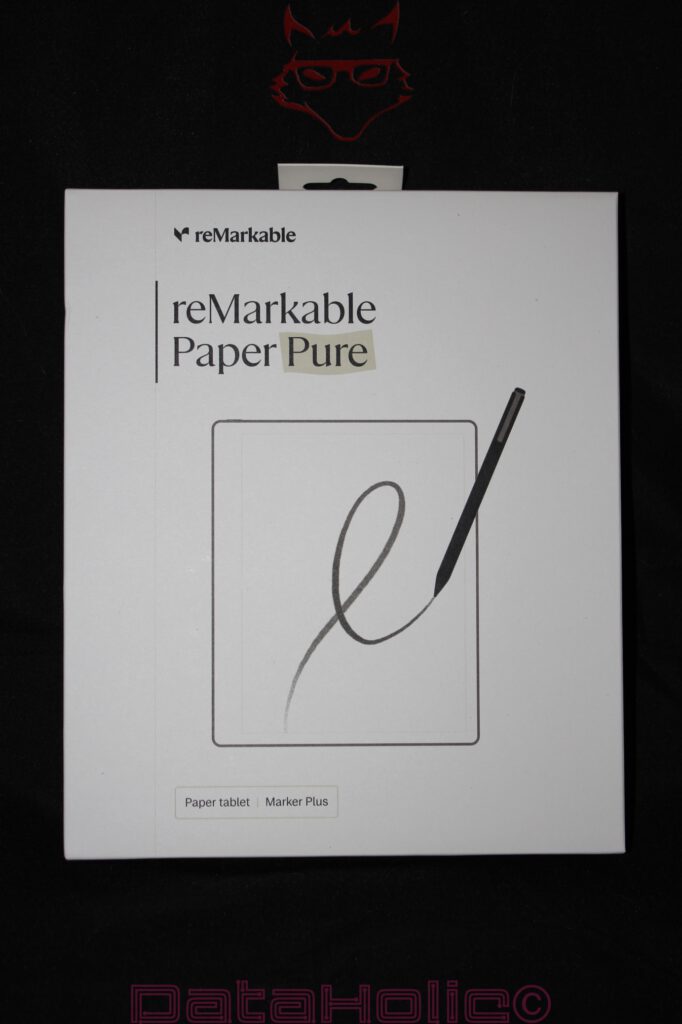
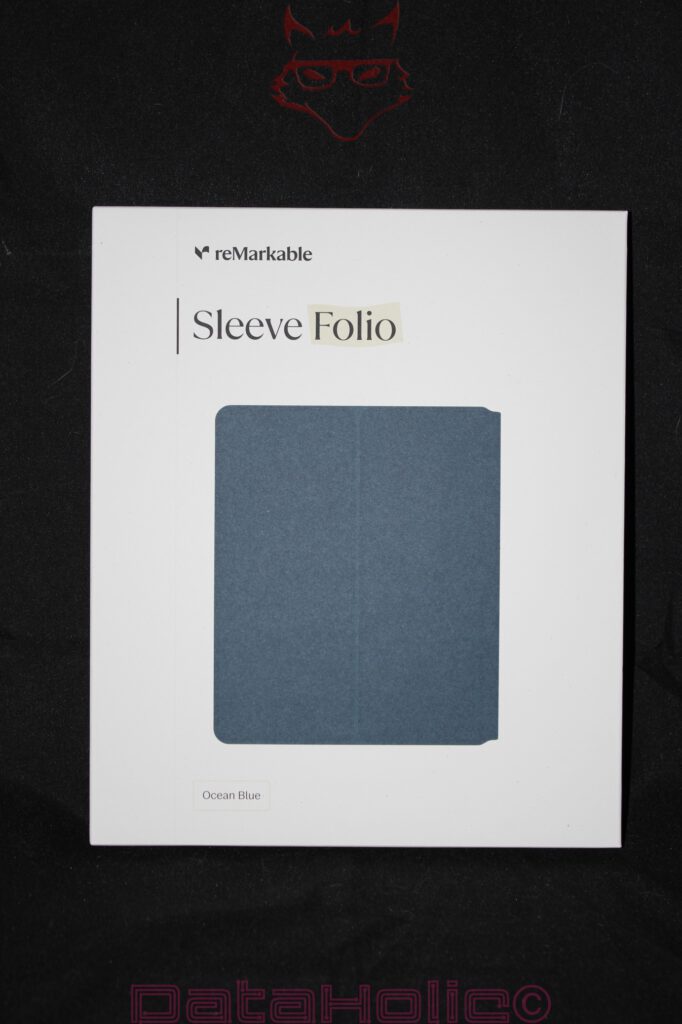
Even the front of the box conveys an almost unfamiliar calm. The reMarkable logo is placed discreetly in the upper area, without pushing itself into the foreground. Below it is the product name “reMarkable Paper Pure,” accompanied by a simple depiction of the device together with the Marker Plus. No perspectives that make the product appear larger than it really is. No exaggerated color gradients. No computer-generated explosions of light and speed intended to suggest that the contents can override the laws of physics.
Instead, the impression is that this could be the packaging of a high-quality notebook. The box could almost stand in a well-stocked bookstore between elegant planners and leather journals without immediately being recognized as consumer electronics. That effect appears to be intentional.
The longer the eye rests on the packaging, the clearer the underlying strategy becomes. reMarkable is obviously not trying to position the Paper Pure as yet another tablet in an already overcrowded market. The term “tablet” almost feels inappropriate here. While classic tablets compete for attention with processing power, multimedia capabilities and ever new usage scenarios, the Paper Pure pursues a completely different goal.
It wants to replace paper.
At first, that statement sounds remarkably ambitious. Paper has accompanied humanity for centuries. It needs no battery, no updates and no instruction manual. Its feel is familiar, its use intuitive. That is precisely why the packaging design is so restrained. Instead of trying to demonstrate technical superiority, it attempts to build a bridge between analog habit and digital support.
What is interesting here is the consistency with which this concept is implemented. Even before opening the box, there is no sense of having acquired another piece of consumer electronics. Rather, the presentation feels like the purchase of a tool for thoughts, sketches and ideas. The box does not appear like a stage for technical peak performance, but like the protective shell of an object intended for daily use.
In a world full of notifications, blinking status indicators and constantly growing feature lists, this kind of restraint has something almost courageous about it. It assumes that the product can speak for itself. No showmanship. No artificially generated drama. Only the quiet claim that focused work and digital writing deserve the same careful design as any other premium product.
The American architect Ludwig Mies van der Rohe once coined a sentence that remains one of the best-known design principles today:
“Less is more.”
The front of the reMarkable Paper Pure seems to follow exactly this idea. It avoids everything that could distract from the actual concept. And precisely because of that, it achieves something remarkable: even before the box is opened, the expectation arises that the product inside will not try to be everything at once. Instead, there is a growing hope that this device pursues one single task – but does so with extraordinary consistency.
Rear side without spectacle
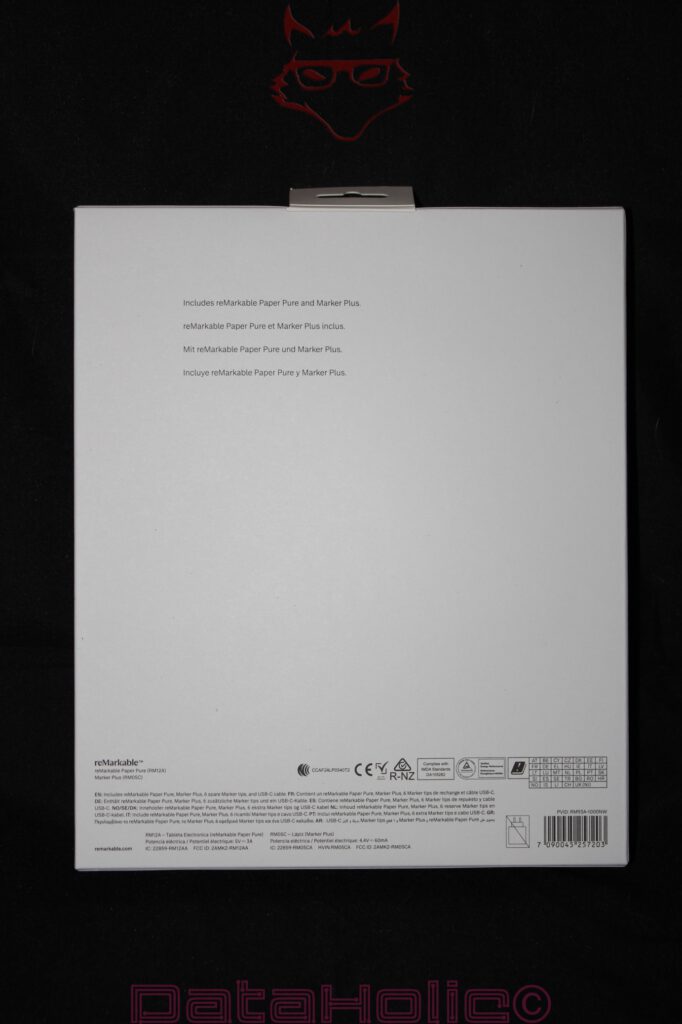
A quick look at the back of the packaging makes it clear that the direction taken on the front was no coincidence. Manufacturers often turn this area into a kind of technical duel. It is where performance promises, feature lists and marketing phrases are placed to suggest, even before first use, that buying a particular product will immediately lead to more productivity, more creativity or at least to a significantly better life.
The reMarkable Paper Pure almost completely refuses to play this game.
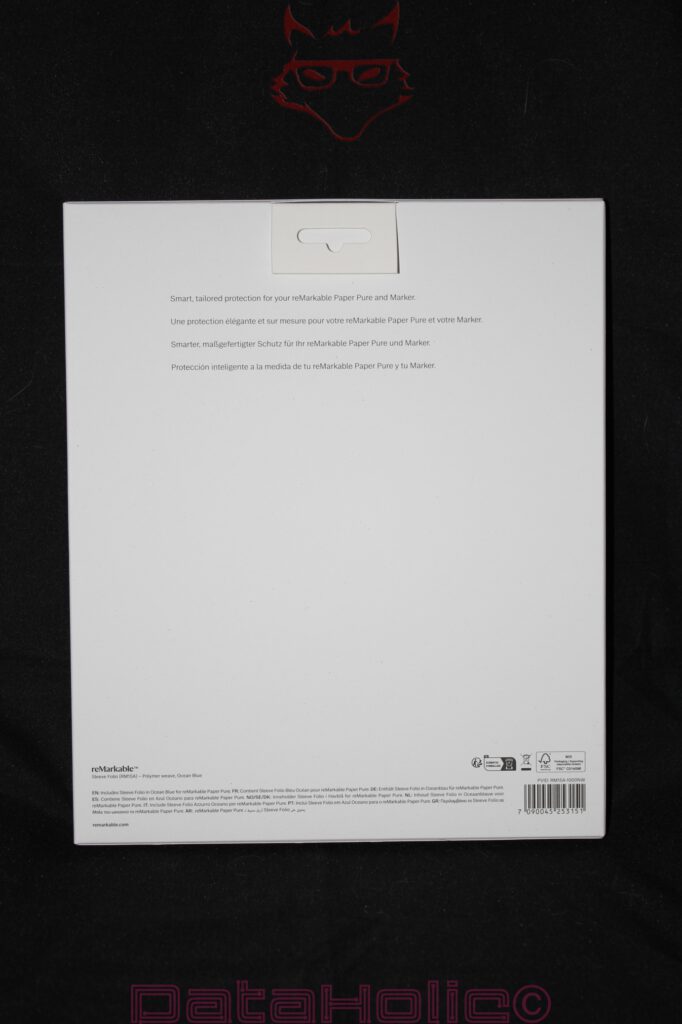
The back is limited to the essential information. At the center are the components included in the box: the Paper Pure itself, the Marker Plus, the replacement tips and the USB-C cable. These details are supplemented by the legally required technical markings, neatly placed in the lower area. No element tries to draw more attention than necessary.
This restraint feels remarkably deliberate.
While many manufacturers put processor names, memory capacities or terms such as “AI-optimized” in the foreground even on the packaging, reMarkable seems to be asking a different question: What is actually needed to understand the purpose of the product?
The answer is surprisingly simple.
A digital writing device.
An input pen.
A few replacement tips.
A charging cable.
Nothing more is needed at this point.
This decision feels almost bold. After all, a significant part of the electronics industry lives from staging technical data as spectacularly as possible. Higher megapixel counts are supposed to promise better photos, additional processor cores are meant to symbolize more performance, and every new software function is declared the next supposed quantum leap. The result often resembles a competition over who can shout the loudest.
The packaging of the Paper Pure takes the opposite path. It is less interested in the question of which components are working inside. Instead, it focuses on the actual usage experience. The focus is not technology as an end in itself, but the activity that is to be performed with its help: writing, reading, thinking and organizing.
Perhaps that is the greatest peculiarity of this product. It does not try to justify its existence with the longest possible list of technical characteristics. Instead, it creates the impression that the developers assume the real strength of the device will only become visible in daily use.
This attitude is reminiscent of high-quality tools. The packaging of a good notebook rarely contains a detailed explanation of how paper is made. A fountain pen does not need a ten-page essay on the composition of its alloy. Quality reveals itself during use.
That is exactly the feeling conveyed by the back of the reMarkable Paper Pure. It does not invite technical specifications to be compared. Instead, it sparks curiosity about why a company in 2026 believes that a digital sheet of paper could be enough to consciously set itself apart from the hectic world of modern consumer electronics.
The British author Douglas Adams once wrote:
“Technology is the stuff that doesn’t work yet when you were born.”
The Paper Pure seems to reverse this definition in an interesting way. It does not try to stand out through ever new functions. Instead, it focuses on an activity that has worked for centuries – writing thoughts on paper – and translates that experience into digital form without losing sight of its essential simplicity.
Even the back of the packaging makes it clear that reMarkable does not want to generate attention at any cost. The company apparently trusts that a good tool does not need big promises. The quiet claim of being developed precisely for the task it is meant to fulfill day after day is enough.
Packaging construction: more book than electronics
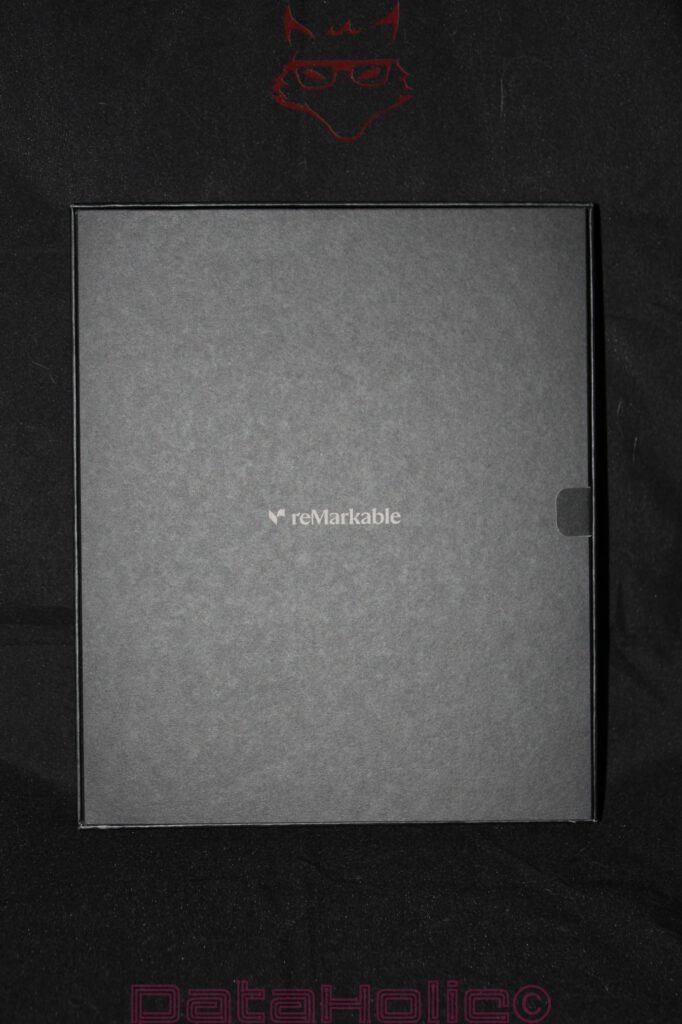
Removing the outer carton marks the point in the unboxing where reMarkable’s actual signature becomes visible. While the first layer of packaging still serves as a protective shell, the box underneath feels much more personal. It creates the impression that the technology is taking a step back to make room for the actual usage experience.
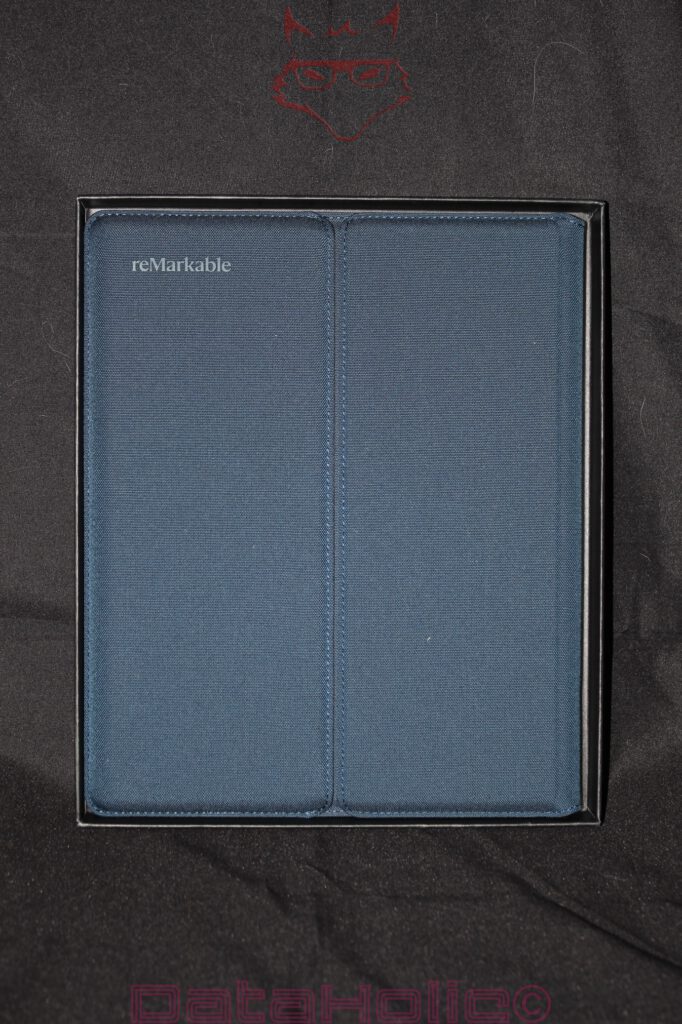
The inner packaging feels surprisingly little like classic consumer electronics. Instead, it evokes associations with high-quality writing instruments, exclusive notebooks or carefully crafted artist tools. The cardboard used feels stable and refined without trying to create an artificial sense of luxury. Nothing shines. Nothing reflects the light dramatically. Instead, a pleasant restraint dominates, perfectly matching the character of the product.
Particularly striking is the precision with which the individual elements have been designed. The edges are clean and even. Fold lines sit exactly where they should. The entire construction conveys a kind of quiet order that is by no means a given today. Many modern packages feel functional, fulfill their protective purpose and then disappear straight into the recycling bin. The inner box of the Paper Pure, however, develops a certain independence. It feels thought through and carefully executed.
Another positive aspect becomes clear when looking at the materials used. Plastic is pleasantly absent from the center of attention. No oversized transparent trays, no disposable constructions that can only be removed with considerable force. Instead, cardboard solutions dominate, fulfilling their task without creating unnecessary complexity.
This decision does not only have ecological advantages. It also changes the perception of the product itself. Plastic packaging often conveys an industrial impression. Cardboard, by contrast, creates warmth and familiarity. Especially with a device whose central promise lies in digitally recreating paper, this material choice feels almost logical.
With every further movement, it becomes clear that every component inside the packaging has been given a fixed place. Nothing seems randomly positioned. The tablet rests securely in its dedicated cutout. Accessories are located where they are intuitively expected. The entire layout conveys structure and clarity.
This order also has a practical background. From a technical perspective, precisely fitted packaging significantly increases transport stability. Movement inside the box is reduced, sensitive components are better protected and the probability of damage decreases. At the same time, this construction subtly influences the unboxing experience.
Good packaging disappears from memory because it does its job.
Very good packaging helps the product tell a story.
With the reMarkable Paper Pure, the feeling increasingly arises that the unboxing itself is already part of the overall concept. The product wants to promote concentration, reduce distractions and create structure. Exactly these qualities are also reflected in the design of the inner packaging.
The Japanese writer Jun’ichirō Tanizaki once wrote:
“Beauty lies not in the object itself, but in the interplay of light and shadow that an object creates.”
In a certain sense, this thought also applies to the presentation of the Paper Pure. The packaging does not try to force attention. It trusts that care in execution will be noticed. The dark cardboard elements, the precise workmanship and the deliberate reduction together create an atmosphere that feels almost calming.
In an industry that often lives from superlatives, this form of presentation feels refreshingly different. It signals that the contents do not need to be enhanced through artificial staging. Instead, trust is created through consistency. The packaging behaves just like the product it protects: functional, orderly and focused on the essentials.
Even before the Paper Pure is fully in hand, the inner box conveys an important message. This device does not want to be yet another screen in everyday life. Rather, it sees itself as a tool for thoughts – and even the way it is presented seems to follow that ambition.
The first view: the device as the centerpiece
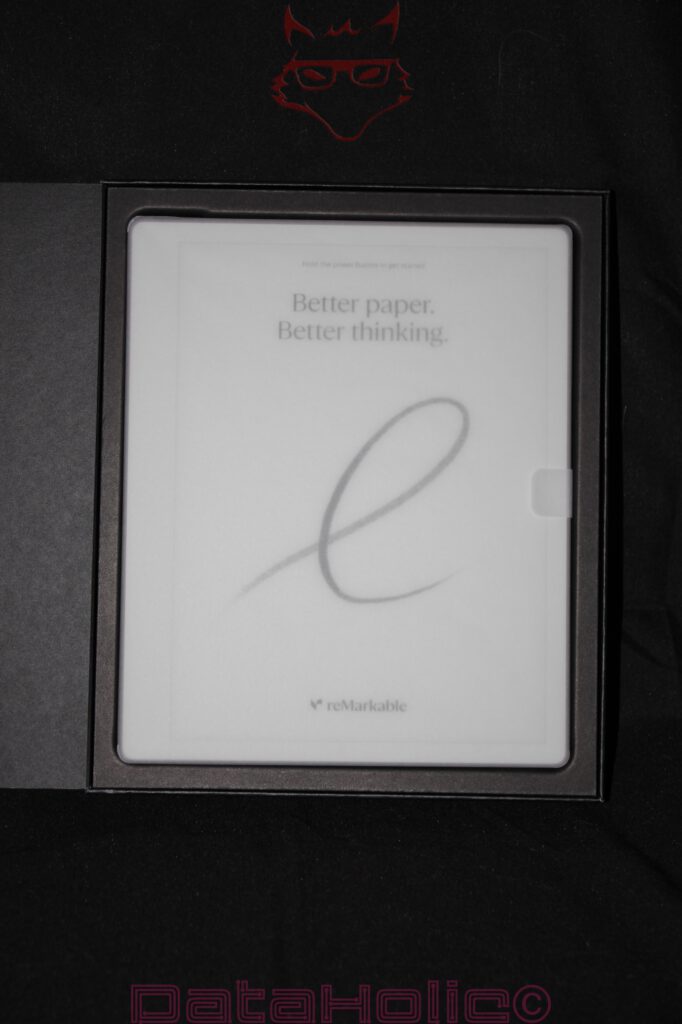
Once the packaging is fully opened, the actual reason for the existence of all those carefully designed layers of cardboard finally comes into focus. The reMarkable Paper Pure lies framed in its precisely fitted recess, as if the packaging up to this point had merely taken on the task of creating the right frame for this first encounter.
The first glance inevitably falls on the display.
More precisely, on something that initially barely looks like a display.
The surface has none of the reflective presence of classic tablets. No deep black, no bright colors, no fingerprints that have already lost the battle against physics while the device is still switched off. Instead, the E-Ink surface resembles high-quality paper. It lies there almost unobtrusively, waiting to be used.
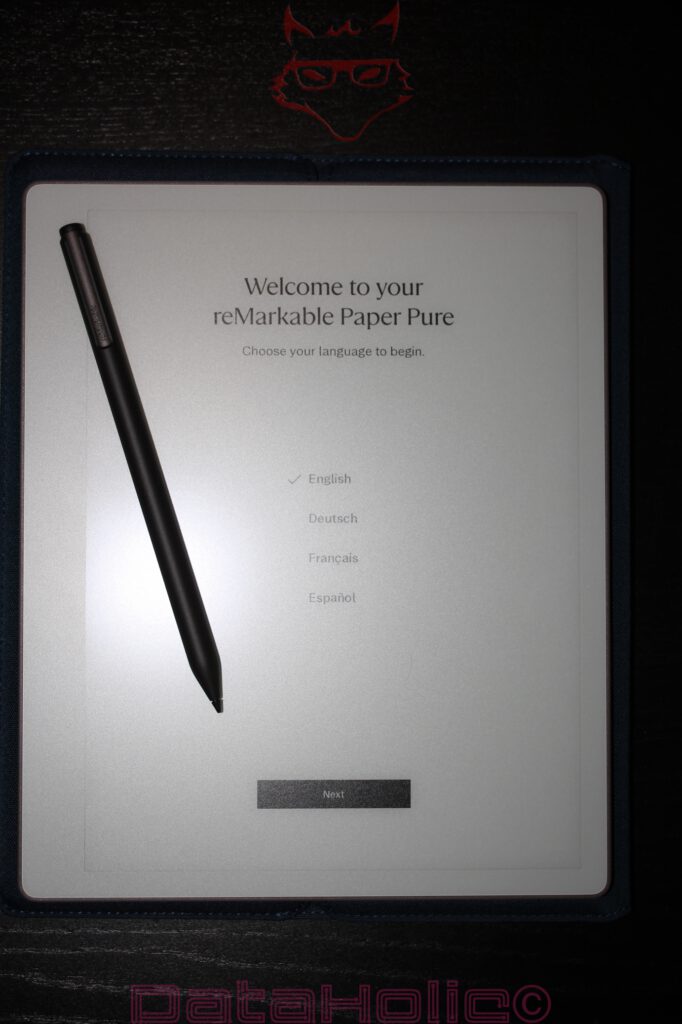
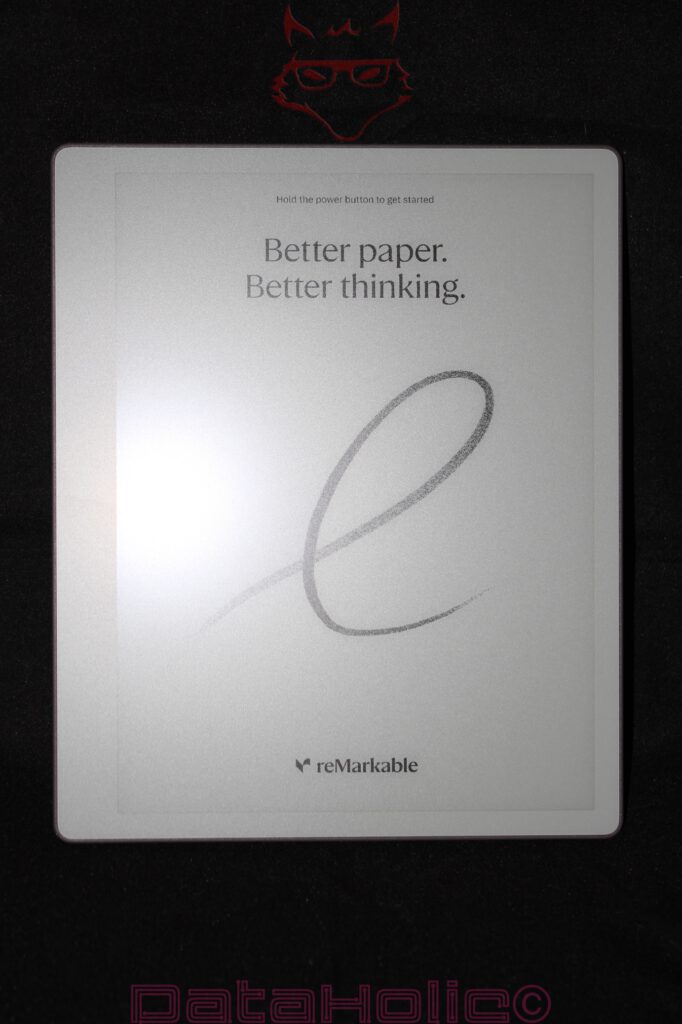
Straight out of the box, the Paper Pure greets its future owner with a simple message:
“Better paper. Better thinking.”
At first glance, this sentence might seem like an ordinary advertising slogan. On closer inspection, however, those few words reveal the entire core of the product.
Because the idea behind reMarkable is based on a question that has occupied researchers for many years: Does the human brain process handwritten information differently from typed content?
The answer is surprisingly nuanced.
Numerous studies from various universities have dealt with precisely this topic over the past decades. Research findings suggest that handwriting activates different areas of the brain than typing on a keyboard. The slower speed of writing forces information to be filtered more strongly, structured more deliberately and formulated more consciously. While typing often encourages word-for-word documentation, handwriting tends to create a more condensed form of processing.
Of course, a digital notebook does not replace neurological miracle tools.
Nevertheless, reMarkable seems to have taken precisely these findings seriously.
The goal is apparently not to technically outperform paper. Rather, it is about preserving the qualities that have made paper such an effective tool for thinking, learning and creativity for centuries.
And precisely this thought already changes the perception of the device during the unboxing.
What lies in front of the viewer is not a classic tablet that happens to support a pen. Nor is it an e-book reader that has been given additional functions. The Paper Pure feels more like an attempt to combine analog thought processes with the advantages of digital organization.
Writing without creating piles of paper.
Collecting ideas without searching for notebooks.
Reading documents without being constantly interrupted by notifications.
This philosophy becomes visible in this very first moment. The startup graphic on the E-Ink display therefore does not serve a purely decorative purpose. It formulates the ambition of the product.
Better paper.
Better thinking.
Of course, there is room to debate whether digital paper can truly replace real paper. Anyone who loves the smell of freshly opened books or has sworn by the same favorite fountain pen for years will have legitimate doubts. Interestingly, reMarkable does not seem to want to force a counterargument on exactly these people. Instead, the impression arises that the company is extending an invitation.
An invitation to test whether traditional ways of working can be combined with modern organizational possibilities.
Especially in an era of permanent distraction, this idea gains remarkable relevance. Smartphones compete for attention, emails arrive by the minute, and social networks have perfected the art of fragmenting concentration into tiny pieces. The Paper Pure pursues the opposite approach. It does not try to provide even more information. Instead, it creates a space in which thoughts are supposed to receive enough time to fully unfold again.
Perhaps that is the real peculiarity of this first encounter. The technology moves into the background. Processors, storage capacities and wireless standards suddenly lose significance. Instead, the question of how people think, learn and develop ideas takes center stage.
The German philosopher Arthur Schopenhauer once wrote:
“Reading means thinking with someone else’s head instead of one’s own.”
Writing behaves in a sense the other way around. It forces thoughts into form, reveals connections and makes ideas visible.
The reMarkable Paper Pure seems to want to support exactly this process. And while it still lies completely unused in its packaging, the impression already emerges that this device wants to be understood less as a technical toy and more as a tool for all those thoughts that would otherwise disappear somewhere between loose sheets of paper, open browser tabs and half-forgotten notes.
The display: electronic ink instead of a light show
The display technology of the reMarkable Paper Pure is without question one of the most fascinating components of the entire device. At the same time, it is the point at which many expectations first need to be recalibrated. After all, a certain image of what a modern display should look like has established itself over the years. Bright colors, deep blacks, high refresh rates and the most spectacular contrasts possible have almost become a given.
The Paper Pure pursues a completely different approach.
While classic tablets rely on LCD or OLED technologies, this device works with electronic ink, better known as E-Ink. The differences between these technologies could hardly be greater.
A conventional tablet generates light.
The reMarkable reflects it.
This seemingly small difference changes the entire perception of the device.
Anyone who has spent a long time looking at a classic screen knows the feeling of tired eyes, especially after several hours of focused work. Even high-quality modern displays remain active light sources. They radiate information directly outward and therefore constantly compete with the natural lighting conditions of their environment.
An E-Ink display behaves very differently.
It resembles real paper.
The surface reflects the available ambient light instead of generating its own. That is exactly why the presentation feels unusual at first glance. At the same time, it creates a surprisingly familiar feeling. Texts do not appear like content on a monitor, but rather like printed pages.
Especially in daylight, this technology plays to its strengths impressively. While glossy displays often struggle with reflections, the presentation on E-Ink panels remains excellently readable. The brighter the environment becomes, the more natural the display appears. This behavior feels almost paradoxical, since classic displays often reach their limits under exactly these conditions.
Another advantage lies in energy consumption.
The technology mainly requires power when content is changed. A static image consumes hardly any additional energy. This property contributes significantly to the long battery runtimes for which E-Ink devices have become known. In a time when many mobile devices need to be plugged in every day, this aspect becomes a real comfort benefit.
Of course, every technology also brings limitations.
And reMarkable, fortunately, does not try to hide them.
The refresh speed of an E-Ink display remains far behind modern OLED panels. Content builds up more slowly, movement appears less fluid and fast animations are not among the strengths of this concept. In addition, color reproduction is limited. Anyone expecting vivid images, elaborate graphics or brilliant video content will inevitably be disappointed.
But exactly at this point, the real consistency behind the entire product becomes clear.
Neither videos nor computer games belong to the intended use of the Paper Pure.
It is not meant to replace a streaming platform.
It does not want to be a mobile cinema.
It was never intended as a gaming device either.
Instead, the device focuses on activities that have remained remarkably constant for centuries: reading, writing, sketching and thinking.
This specialization initially seems like a limitation. In reality, however, it develops into one of the product’s greatest strengths. In a world of constant distractions, a tool suddenly emerges whose display does not tempt anyone to watch “just one quick” video or scroll through social networks. The reduced technology supports the actual purpose of the device instead of constantly offering additional possibilities.
The American computer scientist Alan Kay once said:
“Technology is everything that was invented after you were born.”
Interestingly, despite its digital nature, E-Ink often feels like the exact opposite. It recalls something familiar, almost analog. Newspapers at the breakfast table, margin notes in specialist books or the first page of a freshly opened notebook.
Perhaps that is precisely where the fascination of this display technology lies. It does not try to surpass existing screens. Instead, it asks whether every form of digital work really has to take place on luminous glass surfaces.
The reMarkable Paper Pure answers this question with remarkable consistency. It accepts the limits of its technology and uses exactly those properties that create real added value for focused reading and writing. The result is not a better tablet in the classic sense.
It is a different approach.
And exactly for that reason, the E-Ink display is one of the most exciting aspects of this unusual device.
The Marker Plus: the actual star
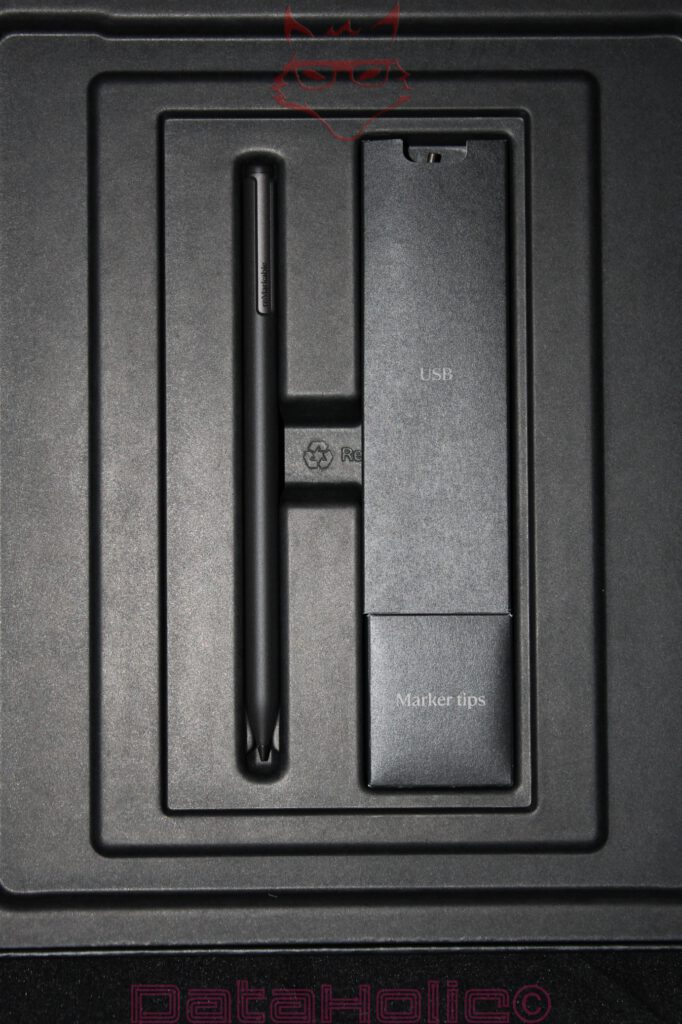
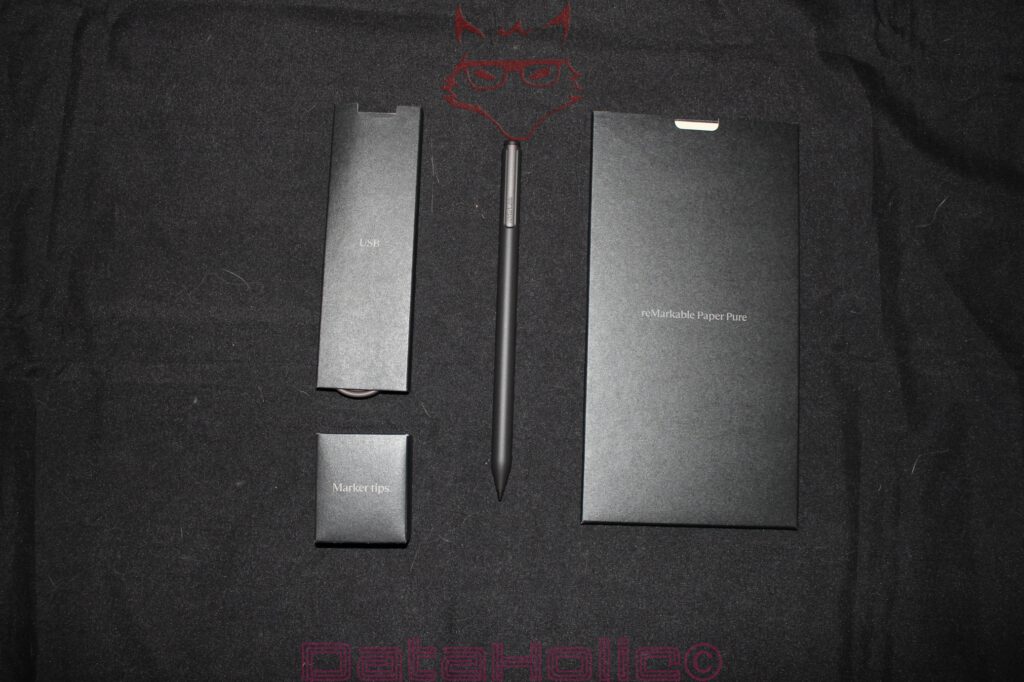
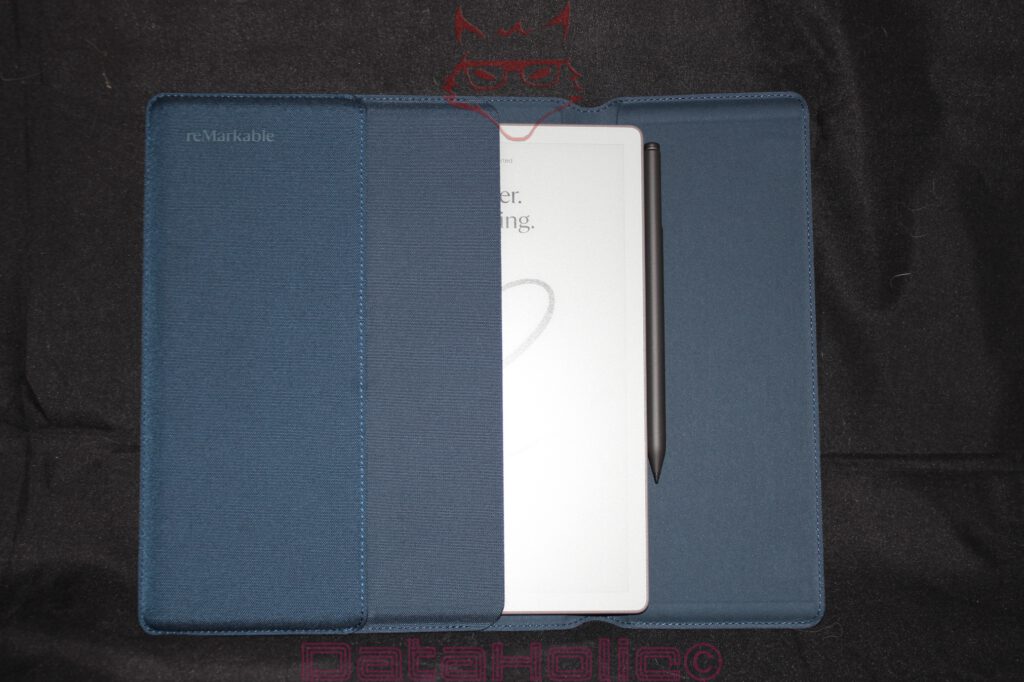
With the removal of the first insert, the component finally appears that forms the actual bridge between human and device. The Marker Plus lies neatly in its designated recess and makes it clear at first glance that its role goes far beyond that of an ordinary accessory.
With many tablets, an input pen has become part of the extended feature set. Practical, occasionally helpful, but rarely indispensable. The reMarkable Paper Pure follows a fundamentally different approach. Without the Marker, the concept of the device would be incomplete. Only the combination of E-Ink surface and pen turns a digital document viewer into a tool for notes, sketches and thoughts.
The external design already underlines this ambition. The Marker Plus feels less like technical accessory and much more like a high-quality fineliner. Its shape feels familiar, almost self-evident. No futuristic design elements. No eye-catching button landscape. No additional controls that first need to be decoded through a manual.
The matte surface contributes significantly to this impression. It feels pleasant, reduces fingerprints and at the same time prevents unwanted slipping during longer writing sessions. The material choice conveys quality without making the mistake of trying to make the pen appear artificially luxurious.
The ergonomic decision is particularly interesting. While other manufacturers try to equip their input pens with pronounced grip zones, asymmetric shapes or striking contours, the Marker Plus remains surprisingly restrained. It does not want to constantly draw attention to its existence. Instead, it creates the impression of a tool that ideally almost disappears from awareness during use.
That is precisely where the real art of good input devices lies.
The most exciting property, however, only becomes apparent when looking at the underlying technology.
Because the Marker Plus requires no battery.
It has no integrated rechargeable battery.
There is no charging port.
Bluetooth pairing is also completely unnecessary.
At a time when even toothbrushes regularly demand charging, this fact feels almost irritating.
The explanation is provided by the so-called EMR method, short for Electromagnetic Resonance. Behind this somewhat unwieldy term lies an extremely elegant technical solution. The display of the Paper Pure generates electromagnetic fields that can precisely detect the position of the pen. The Marker itself remains completely passive.
To put it simply, the tablet does all the active work.
The pen merely reacts to the environment provided.
The result brings several remarkable advantages.
First, the weight is significantly reduced. Without a battery and additional electronics, the Marker remains pleasantly light. This property may appear unspectacular on a data sheet, but in everyday use it becomes enormously important. Just a few grams can decide whether longer writing sessions feel comfortable or tiring.
Added to this is complete independence from charging cycles. There is no situation in which a spontaneous idea first has to wait for a charged pen. No frantic search through drawers for the right cable. No glance at the battery level. The Marker simply works.
That self-evidence feels surprisingly liberating.
Another advantage lies in the precision of the input. EMR technologies have established themselves over many years in professional graphics tablets and enjoy an excellent reputation there. Position detection works reliably and enables a natural writing feel that creates as few technical obstacles as possible between thought and note.
This aspect deserves particular attention.
Technology occasionally tends to insert additional layers between the person and the actual task. Settings need to be adjusted, connections established and batteries monitored. With the Marker Plus, the Paper Pure follows exactly the opposite path. The technology deliberately withdraws so that the actual act of writing can move back into the center.
The American designer Charles Eames once said:
“The details are not the details. They make the design.”
The Marker Plus provides an impressive example of this statement. At first glance, it appears unobtrusive. A black pen with restrained design. Yet beneath this simple surface lies a technical concept that elegantly avoids numerous everyday problems.
Perhaps that is precisely its greatest strength.
The Marker Plus does not want to be perceived as a technological sensation. It does not want to be a topic of conversation at conferences and does not try to generate attention through spectacular additional functions. Instead, it fulfills its task with a self-evidence that has become almost rare in modern consumer electronics.
It writes.
Without charging.
Without pairing.
Without needing to think about it.
And that is exactly why this seemingly inconspicuous pen becomes one of the most important components of the entire reMarkable ecosystem.
Magnetism with a system
Another technical peculiarity only reveals itself when taking a closer look at the side edge of the Paper Pure. At first glance, it seems unspectacular and almost disappears among the bigger topics such as E-Ink technology or the special writing feel. In everyday use, however, precisely this detail becomes one of those small comfort features whose importance is only fully understood when they are missing.
The point is the magnetic attachment of the Marker Plus.
The idea behind it is by no means new. Magnetic pen holders are now part of the standard equipment of many manufacturers’ premium devices. Nevertheless, experience shows that there can be a considerable difference between theoretical implementation and truly successful integration.
Because the real challenge is not simply installing a magnet in a housing.
The challenge lies in the balance.
Magnets that are too weak turn the input pen into a permanent search game. Put the device into a bag a little carelessly, pick it up from the desk at a slightly awkward angle – and the pen quietly slips away into freedom. Especially with mobile devices, this quickly becomes a source of lasting frustration.
The opposite extreme does not solve the problem either.
Magnets that are too strong do provide secure hold, but make removal difficult. Reaching for the pen becomes a small exercise in force, spontaneous notes lose their natural flow and the actual elegance of the solution disappears.
The reMarkable Paper Pure seems to master exactly this balancing act surprisingly well.
The Marker Plus almost finds its intended position by itself. As soon as the pen approaches the corresponding edge, the magnetic force takes over the last part of the movement. There is a clearly noticeable snap-in effect that conveys security without feeling intrusive. The Marker sits firmly enough to withstand everyday movements without issue, while still being easy to remove without force.
This circumstance deserves particular attention.
Because good product design often does not reveal itself in spectacular individual features, but in the sum of many small decisions. The magnetic attachment of the Marker Plus undoubtedly belongs in this category. It does not make headlines. It rarely appears as a central feature in advertising campaigns. Yet in daily use it shapes the entire user experience.
A tool that constantly needs to be searched for loses its appeal.
A tool that is only awkwardly accessible is used less often.
The Paper Pure tries to avoid both problems at the same time.
Interestingly, this solution recalls the development of high-quality writing instruments from past decades. There, too, seemingly secondary details mattered: How easily can the cap be removed? How securely does it stay closed during transport? How quickly is the pen ready for spontaneous notes?
The questions have hardly changed over time.
Only the technical answers look different today.
The American architect and designer Charles Eames once said:
“The details are not the details. They make the design.”
The magnetic integration of the Marker Plus provides an excellent example of this. It shows that functionality does not arise exclusively from major innovations. Often, the care applied to small everyday interactions decides whether a product is perceived as successful over the long term.
This thought becomes even more important with a device like the reMarkable Paper Pure. After all, the entire concept is based on the most natural possible workflow. Thoughts should be captured as soon as they arise. Ideas should immediately find their way onto digital paper. Any unnecessary hurdle would contradict this ambition.
The magnetic holder therefore supports more than just safe transport of the pen.
It ensures that the Marker remains exactly where it is needed.
Not somewhere in a bag.
Not between loose documents.
Not in that famous desk drawer where objects occasionally disappear and are only rediscovered weeks later.
But directly on the device.
Ready for the next note, the next sketch or that thought which often waits only a few seconds to be captured before disappearing again.
Perhaps that is the real quality of this solution. It is barely noticeable as long as it works. Only compared with less successful implementations does it become clear how much thought can go into a seemingly simple magnet.
And exactly this quiet form of engineering runs like a thread through the entire concept of the reMarkable Paper Pure.
Replacement tips: wear as a planned component
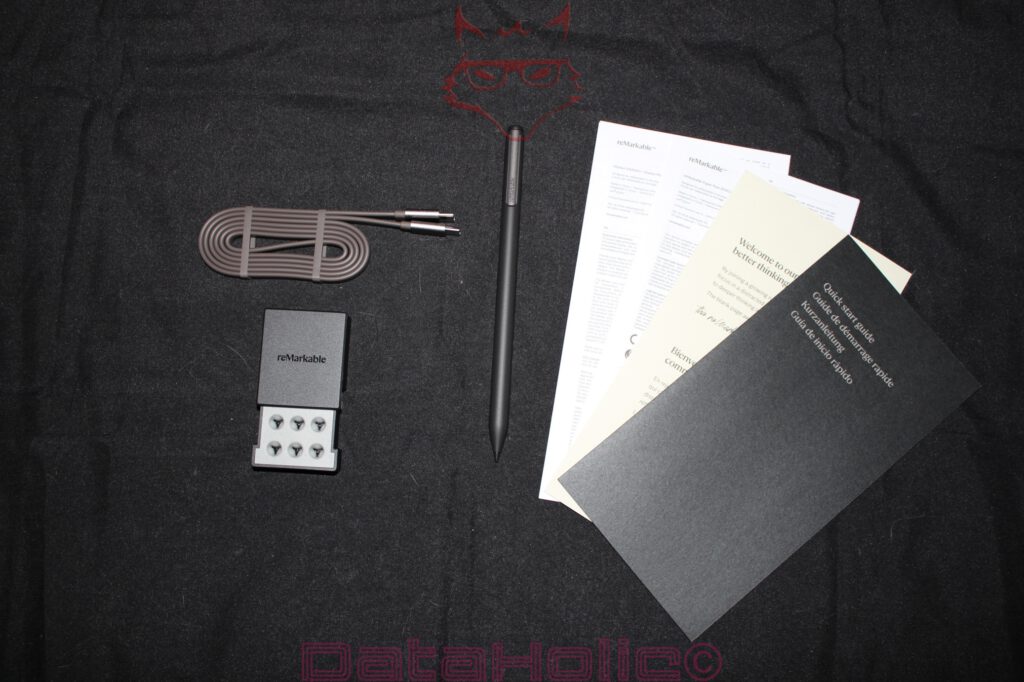
A small compartment inside the packaging contains a component that hardly draws attention at first glance. Between tablet, Marker Plus and charging cable, the included replacement tips almost seem secondary. Yet they tell a remarkable story about how reMarkable understands its own product.
In classic consumer electronics, there is often the silent expectation that wear should remain as invisible as possible. Batteries become smaller and more difficult to access, moving parts disappear and even obvious consumables are rarely mentioned. The message is often: this product simply works – always.
The reMarkable Paper Pure takes a different path.
The replacement tips are naturally included in the box.
No optional accessory packs.
No hidden notes in the fine print.
No surprises after the first months of intensive use.
Even during unboxing, it becomes clear that the tips of the Marker Plus are wear parts. That realization may seem unspectacular at first, but from a technical perspective it is a direct consequence of the entire product concept.
Because the special writing feel of the Paper Pure does not arise by chance.
The display surface has been deliberately developed to create noticeable resistance. While many classic tablet pens glide almost without resistance across glass, here there is controlled friction that comes much closer to real paper. The tip does not scratch unpleasantly across the surface, but instead provides that fine feedback that feels entirely natural when writing with a pencil or fineliner.
This property is a major part of the device’s fascination.
Writing does not consist solely of visual impressions.
It is an interplay of different sensory impressions.
The resistance of the surface.
The movement of the hand.
The minimal vibration when tip and surface meet.
The sound created in the process.
The reMarkable tries to transfer as many of these properties as possible into the digital world. The generated friction improves control over handwriting and supports the feeling of actually writing on paper.
But every form of friction inevitably has a price.
Material wears down.
The tips of the Marker Plus become smaller over time. The more intensively the device is used, the more visible this effect becomes. People who take extensive notes every day, create sketches or annotate documents will likely notice this change earlier than occasional users.
And this is exactly where the honesty of the overall concept becomes visible.
reMarkable does not try to hide this circumstance.
Wear is accepted.
More than that: it is planned from the beginning.
This approach feels almost refreshingly pragmatic. High-quality writing instruments require ink. Pencils become shorter. Notebooks fill page by page. Tools used every day change through use.
The Marker Plus follows the same logic.
Interestingly, this thought even reinforces the closeness to the analog world that reMarkable is aiming for. The replacement tips are a reminder that digital tools also have physical properties. They are not abstract software solutions, but objects that are touched, used and placed under strain.
The Japanese craft concept of Wabi-Sabi describes the beauty of things that develop traces of use and visibly carry their history. Of course, it would be exaggerated to romanticize worn Marker tips. Still, there is a certain sympathy in the openness with which reMarkable handles this topic.
Instead of pretending perfection, reality is acknowledged.
The writing feel that characterizes the Paper Pure arises precisely from the friction between tip and surface. That same friction inevitably causes wear. Both qualities belong inseparably together.
In a sense, it is a deliberately accepted compromise.
More naturalness in exchange for a limited lifespan of individual components.
More control in exchange for regular replacement of the tips.
More closeness to paper – including its peculiarities.
Perhaps that is exactly where the real strength of these small accessories lies. They make it clear that reMarkable has not thought about writing exclusively in digital terms. The company is not trying to completely eliminate physical reality. Instead, it adopts those qualities that have made paper one of the most effective tools for thought and creativity for centuries.
And that is precisely why the replacement tips are already included in the packaging.
Not as a bonus.
Not as a marketing instrument.
But as an honest acknowledgment that good writing sometimes leaves a little abrasion behind.
USB-C: the standard prevails
Between the actual device, the Marker Plus and the replacement tips lies an accessory that receives little attention at first glance. It is neatly stored in its compartment, fulfills a clear purpose and often disappears shortly afterward into a drawer or into a bag together with the device.
A USB-C cable.
The reaction to this is often unspectacular. After all, USB-C has become a familiar sight in modern electronics. Smartphones, notebooks, headphones and increasingly smaller everyday devices rely on this connection standard. That is why it is easy to assume that this is simply a given.
The situation is not quite that clear, however.
Despite the increasing spread of USB-C, proprietary solutions and manufacturer-specific peculiarities still exist. Especially in accessories or older devices, different cable standards are still encountered. Anyone who regularly works with technology probably knows the infamous drawer full of cables whose original purpose has long been forgotten. They lie there side by side: Micro-USB, Lightning, proprietary charging cables of unknown origin and those strange connectors developed exclusively for one single device.
The reMarkable Paper Pure consciously chooses a different path.
The choice of USB-C feels almost self-evident, but ultimately it is an expression of a pleasingly pragmatic decision. The device relies on a connector that has now achieved broad acceptance and whose everyday benefits should not be underestimated.
First and foremost is universal compatibility.
There is a high probability that several USB-C cables are already available in a household. The charging cable of a smartphone, the connection to a notebook or the power supply of other technical companions can often also be handled via USB-C. The need to permanently carry an additional special cable therefore disappears in many situations.
Especially when traveling, this aspect becomes a real comfort gain. Every reduction in cables carried means less weight, less space required and, above all, fewer opportunities for that moment of mild despair when exactly the one required cable has been left at home.
In addition, USB-C opens up technical possibilities that older standards could only support to a limited extent. Higher charging power enables shorter charging times and at the same time creates sufficient reserves for future developments. Even if the Paper Pure does not require extreme amounts of energy, it still benefits from the flexibility of the standard.
Another advantage appears in the everyday handling of the connector itself.
The days of asymmetric plugs that inevitably only went in correctly on the third attempt are largely over. USB-C can be inserted both ways. A seemingly small improvement that saves countless moments of time and nerves over the years.
This decision becomes particularly interesting in view of the fundamental philosophy of the Paper Pure.
The device was not developed for short product cycles. It is meant to accompany thoughts, manage notes and ideally become a permanent part of daily work over a longer period of time. For precisely this reason, the choice of an open, widely used standard gains additional importance.
Future viability does not arise solely from powerful hardware.
It also arises from connection options that can still be used without problems years later.
The American designer Raymond Loewy once formulated the thought:
“Between two products equal in price, function and quality, the one with better design will outsell the other.”
In the case of the USB-C connector, this statement can be expanded by another thought. Good design often appears where technical decisions are made that work in the long term instead of merely generating short-term attention.
The integration of USB-C on the reMarkable Paper Pure belongs exactly in this category.
It does not feel spectacular.
It will probably rarely become a topic of conversation at press events.
And yet it influences the use of the device over many years.
Perhaps that is the real strength of this decision. The cable does not try to appear particularly innovative. It simply fulfills its task – reliably, straightforwardly and compatible with a world that is fortunately increasingly agreeing on common standards.
It is merely a USB-C cable.
And at the same time, it is a small detail that shows the Paper Pure was not only designed for the first impression, but also for the everyday use that inevitably follows every technical product.
The material choice of the tablet
As soon as the reMarkable Paper Pure is fully lifted out of its packaging, an aspect comes to the foreground that is difficult to communicate through data sheets or product photos: the feel. Weight, surface texture and material impression are among those qualities that only reveal their actual effect through direct contact. This is exactly where the Paper Pure develops a surprisingly independent character.
The first impression is remarkably matter-of-fact.
The device does not try to look futuristic. It avoids eye-catching design elements that generate attention for their own sake. No reflective glass backs, no colored accents and no shapes primarily intended to create recognition value. Instead, the impression is that of a tool that knows its task very precisely.
This restraint is particularly positive.
At a time when consumer electronics are often staged like fashion accessories, the Paper Pure feels more like an instrument for focused work. The design does not appear to orient itself toward short-term trends, but toward long-term functionality.
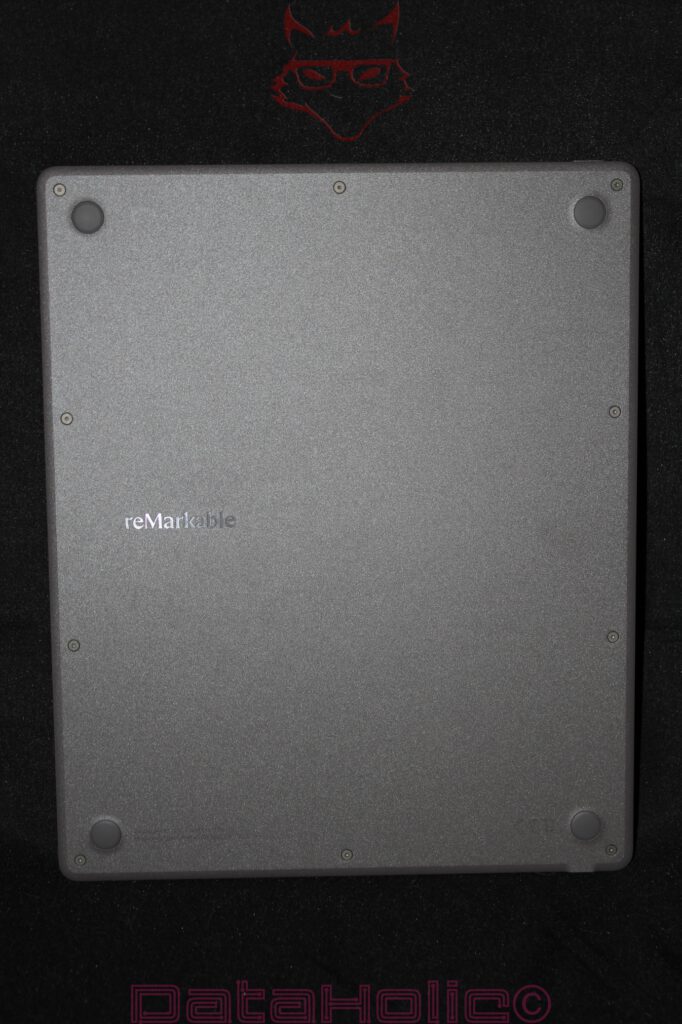
The back contributes significantly to this impression. The finely textured surface not only improves grip, but also gives the device a pleasant material feel. It appears robust without feeling rough and reduces sensitivity to fingerprints or small traces of everyday use.
Also interesting is the openness with which constructive elements are allowed to remain visible.
The screws are not hidden at any cost. They are present and may be perceived as part of the technical reality. This decision conveys a certain honesty. The device does not present itself as a magical black monolith, but as a precisely manufactured working tool whose construction remains comprehensible.
There are also four small feet on the back, which might almost be overlooked at first. Their task seems simple, but in everyday use they provide a noticeable benefit. They ensure secure placement on smooth surfaces and prevent unwanted slipping while writing. At the same time, they create a minimal distance between housing and tabletop, additionally protecting the back.
Details like these make clear how consistently the developers kept the actual usage scenario in mind. The Paper Pure does not merely want to be looked at. It wants to be used.
Interestingly, the entire construction is less reminiscent of classic consumer electronics and more of professional working devices. There is almost an association with scientific measuring instruments, high-quality laboratory equipment or technical tools developed for daily use. In such contexts, function traditionally takes precedence over staging. Decisions are not primarily made for aesthetic reasons, but oriented toward practical requirements.
This approach has a long design tradition.
The famous phrase “form follows function” is often attributed to the American architect Louis Sullivan and later became a central idea of the Bauhaus movement. The idea behind it is as simple as it is demanding: the outer design of an object should derive from its actual purpose.
The reMarkable Paper Pure seems to have implemented exactly this principle consistently.
The reduced design supports concentration.
The textured surface improves handling.
The visible construction elements convey robustness.
The feet increase everyday usability.
Nothing feels random.
Nothing seems to serve purely decorative purposes.
Perhaps that is the real strength of this device’s haptics. It does not try to create excitement through spectacle. Instead, with every touch, the feeling grows of holding a tool whose developers have spent a surprising amount of time thinking about the small moments of daily use.
The German architect Ludwig Mies van der Rohe once coined the words:
“God is in the details.”
Independent of the religious dimension of this statement, it describes a thought that fits the Paper Pure remarkably well. The quality of a product often reveals itself not in its big promises, but in the sum of its small decisions.
The way a device lies in the hand.
The texture of its surface.
The security with which it rests on a table.
The self-evidence with which its design supports the actual task.
In this section of the unboxing, the reMarkable Paper Pure makes clear that good design does not have to be loud. It is enough if every single decision feels comprehensible. That is exactly how the sober impression emerges that separates this unusual device from many of its modern contemporaries.
It does not want to impress.
It wants to function.
And precisely because of that, its haptics leave a remarkably lasting impression.
Thin, but not fragile
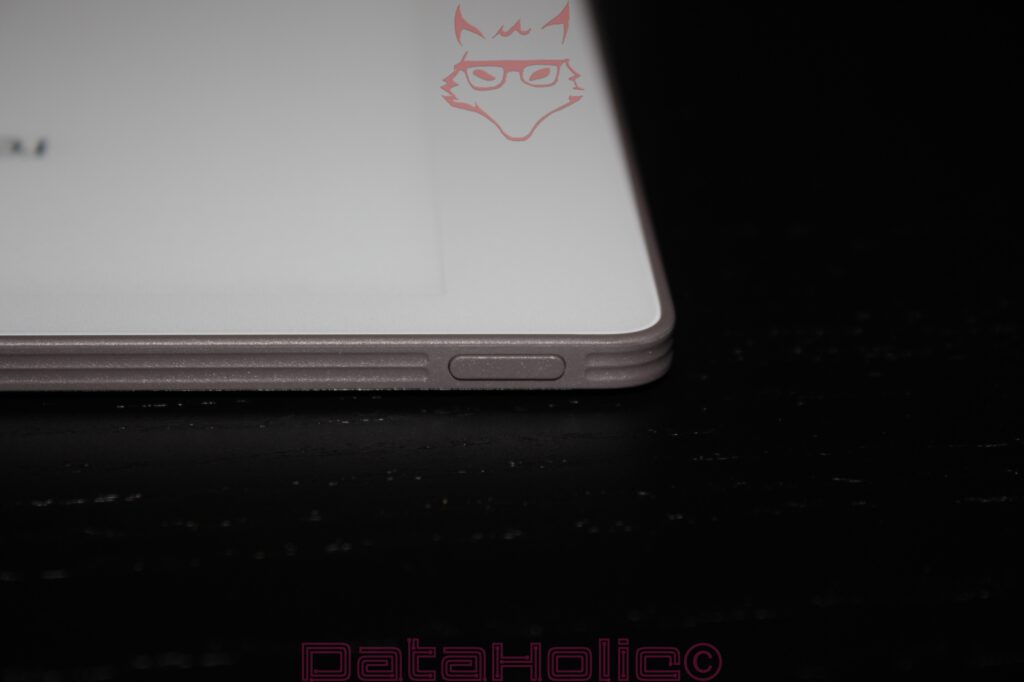
A look at the side profile of the reMarkable Paper Pure is enough to notice one property immediately: the device is surprisingly slim. In direct comparison with classic notebooks or many conventional tablets, the low height almost feels impressive. Interestingly, however, there is no sense of fragility – an impression that many modern devices struggle to avoid.
The development of mobile electronics has followed a clear trend for years. Devices are becoming thinner, lighter and more compact. Every new generation tries to save a few more millimeters. At product presentations, calipers are brought out and cross sections are shown as if actual everyday usability depended solely on the smallest possible material thickness.
What is sometimes forgotten is that extreme thinness is rarely achievable without compromises.
The less material available, the more difficult it becomes to ensure stability. Housings can twist more easily, pressure sensitivity increases and even small everyday stresses become a challenge. Many users know the unpleasant feeling of having to handle a particularly thin device more carefully than its intended purpose should require.
The reMarkable Paper Pure seems to take a consciously different path here.
Yes, the device is slim.
It fits easily into bags, backpacks or briefcases and therefore meets the requirements for a mobile companion. At the same time, the construction conveys enough confidence to withstand daily transport without constant concern about damage.
This balance is by no means self-evident.
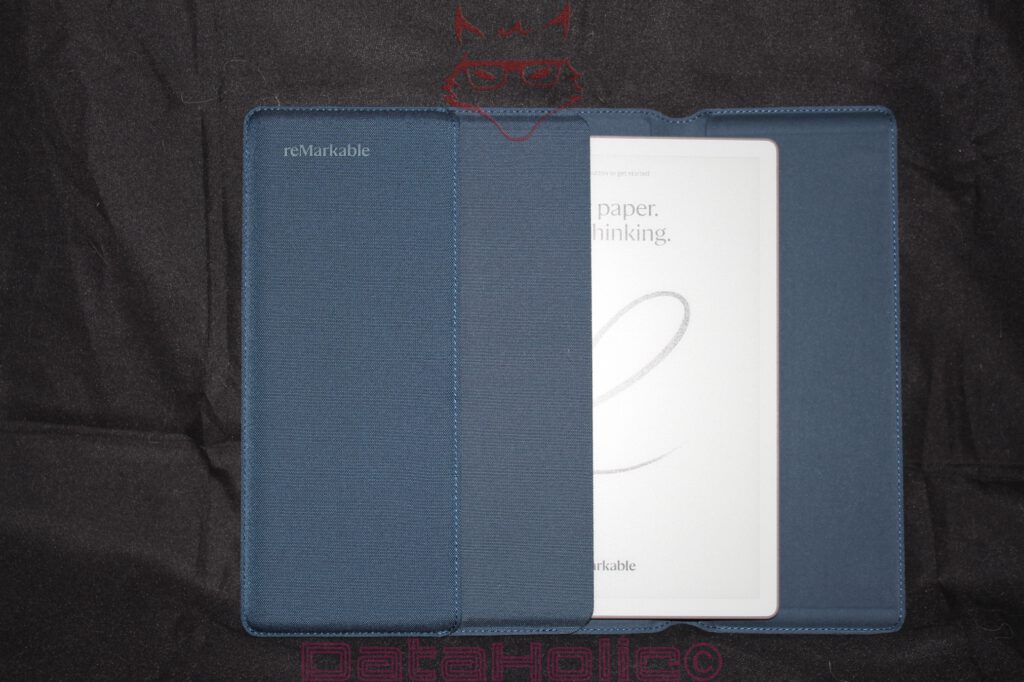
Because mobility does not mean low weight or minimal height alone. Real everyday usability only emerges when a device can be used frequently without constantly demanding special caution. The Paper Pure seems to have taken precisely this thought into account.
The choice of materials contributes significantly to this impression. Already when holding the device, there is no sense of uncertainty. It feels neither fragile nor overly sensitive. Instead, the feeling develops of holding a tool that should be treated with care, but at the same time does not create concern with every movement.
Interestingly, this philosophy is reminiscent of high-quality notebooks. No one expects a bound journal to survive falls from great heights undamaged. At the same time, hardly anyone would accept its cover deforming permanently under light pressure. The Paper Pure seems to move exactly between these two poles.
Slim enough to always be with you.
Robust enough to actually be taken along.
This distinction carries considerable importance. Many products impress on paper but fail under real everyday conditions. A device optimized exclusively for maximum thinness quickly loses appeal as soon as concern for its integrity accompanies every use.
The reMarkable fortunately conveys a different impression.
The British industrial designer Sir James Dyson once said:
“Design is the way something works.”
This thought can be applied excellently to the construction of the Paper Pure. The low height does not serve purely aesthetic purposes. It supports mobility, improves transportability and contributes to the device feeling more like a classic notebook than a computer.
At the same time, it becomes clear that functionality goes beyond mere numerical values. A few millimeters of additional material can under certain circumstances make a considerable difference in stability. A slightly more robust housing can decide whether a device is carried daily without hesitation or remains mostly on the desk at home.
The Paper Pure seems to have deliberately chosen this middle path.
The side view therefore shows much more than a technical property. It reveals a fundamental attitude within the product design. Extreme solutions are avoided in favor of practical usability. Neither maximum robustness at the expense of elegance nor uncompromising thinness at the expense of everyday suitability determines the design.
Instead, a balance emerges.
And exactly this balance is likely to determine whether the Paper Pure can truly take on the role reMarkable has intended for it: a constant companion for thoughts, notes and ideas – not just for a few weeks after purchase, but over a long period of time.
Because the best tools are rarely defined by being the thinnest, lightest or most spectacular in their category.
They are defined by reliably functioning where they are actually needed.
That is exactly the impression left by the construction of the reMarkable Paper Pure after it has been fully removed from its packaging for the first time.
Focus on the essentials
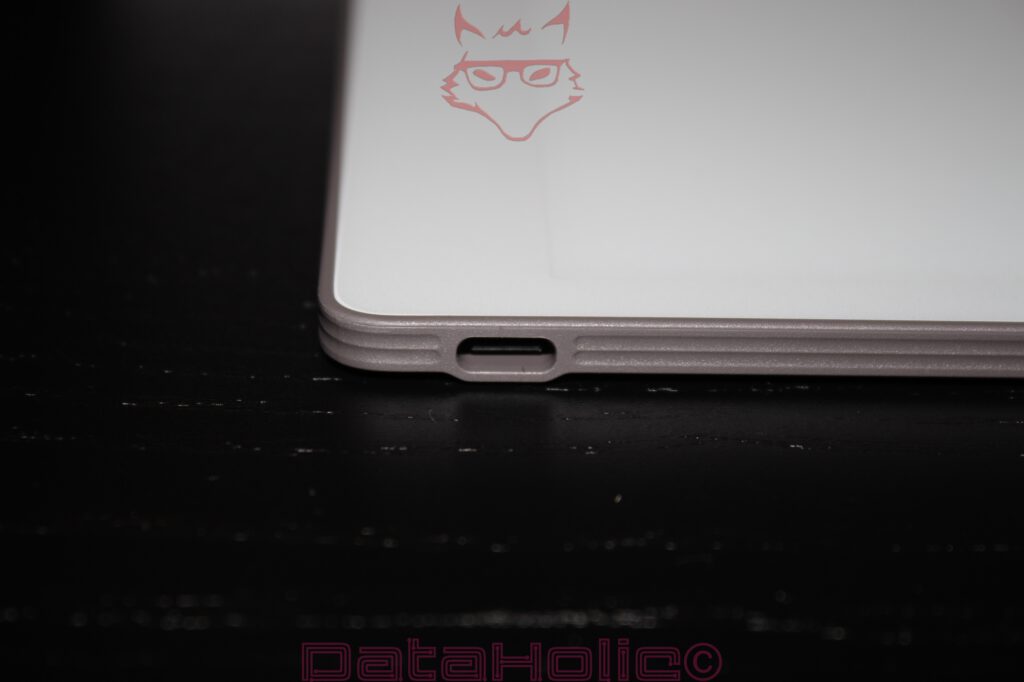
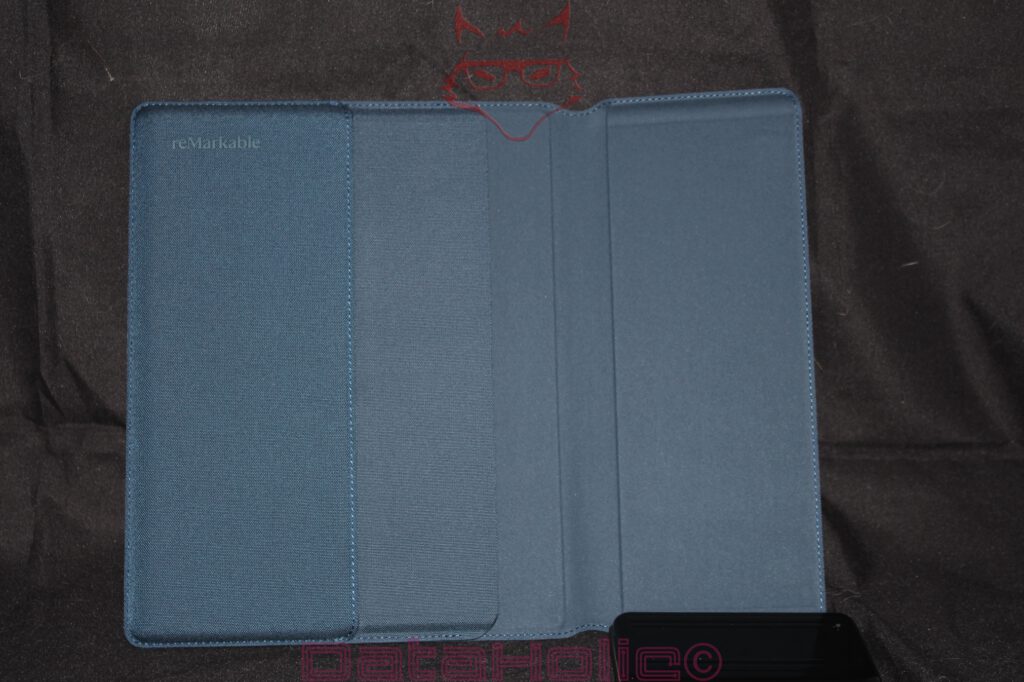
The connection options are limited to the absolute minimum.
USB-C.
Nothing more.
This reduction has both advantages and disadvantages.
Advantages:
clear design,
lower susceptibility to errors,
fewer openings for dust,
simpler construction.
Disadvantages:
limited expandability,
stronger dependence on cloud or synchronization solutions.
However, this corresponds exactly to the product concept.
The Paper Pure does not want to be a universal workstation.
It wants to capture thoughts.
Packaging logistics and sustainability
Another aspect of the unboxing reveals itself not in the actual product, but in the materials that accompanied the Paper Pure on its way to the desk. Packaging first fulfills a very pragmatic task: it is meant to protect. At the same time, it reveals a surprising amount about the priorities a manufacturer has set in developing its product.
With the reMarkable Paper Pure, it is immediately noticeable how sparingly plastic is used.
Of course, this is not a completely plastic-free solution. Some areas still require materials that ensure safe transport or meet certain requirements for stability and durability. Nevertheless, another material dominates throughout the unboxing.
And in a form that does not feel like a cost-saving emergency solution.
For many years, elaborate plastic inserts were almost considered synonymous with high-quality packaging. Vacuum-formed holders presented products like museum pieces, films created additional shine and every single component received its own transparent stage. With growing awareness of sustainability, however, a shift in thinking began – not only from an ecological perspective, but also in terms of how quality is perceived.
The Paper Pure seems to embody exactly this change.
The predominantly paper-based packaging elements convey a refined impression without trying to appear overly luxurious. The cardboard materials used have pleasant stability, the folds appear precise and the entire construction gives the impression of careful planning.
These decisions bring practical advantages.
Paper-based packaging can be recycled much more easily in many regions than complex plastic solutions. The separation of different materials is often unnecessary or at least significantly reduced. The route from packaging material back into the recycling stream is therefore more straightforward.
Interestingly, the significance of this material choice does not end with sustainability.
The perception of the product itself also changes.
High-quality cardboard creates a different atmosphere than glossy plastic inserts. The presentation feels calmer, warmer and less industrial. Especially with a device that wants to transfer the analog experience of writing into the digital world, this creates a remarkable conceptual coherence.
Paper protects digital paper.
This small irony definitely has charm.
In addition, the packaging reflects a trend that is becoming increasingly clear, especially in the premium segment. Sustainability is increasingly developing from an optional extra into a quality characteristic. Products are not assessed solely by their technical properties, but also by how responsibly resources are used and what considerations stand behind their presentation.
And this is no longer only about ecological aspects.
Carefully designed packaging conveys attention to detail. It signals that a company also takes seriously those areas that often end up in the recycling bin immediately after purchase. Precisely there, the consistency of an overall concept often becomes visible.
The American designer Frank Chimero once said:
“People ignore design that ignores people.”
Applied to the packaging of the Paper Pure, this thought means that even seemingly secondary decisions affect later perception. Packaging that avoids unnecessary complexity, is easy to handle and uses high-quality materials respects the time and attention of its users.
That is exactly the impression created by the reMarkable Paper Pure.
Nothing feels overloaded.
Nothing seems developed solely for the brief effect of first opening.
The packaging reliably fulfills its protective function, presents the product appropriately and at the same time reduces the use of materials that would offer little added value afterward.
Perhaps that is where its real quality lies.
It does not try to take the leading role.
It supports the product it protects.
And just like the Paper Pure itself, it follows a remarkably consistent approach: as much as necessary, as little as possible.
In an industry that for many years produced ever larger packaging, ever more elaborate staging and ever more spectacular unboxing experiences, this restraint feels almost refreshing.
It shows that value does not necessarily arise from more material.
Sometimes the deliberate decision to use exactly what is actually needed – and leave everything else out – is enough.
Why this concept works
Perhaps the greatest technical peculiarity of the reMarkable Paper Pure lies paradoxically not in what is present, but in all the things that are consciously absent. Especially in an industry that has followed the principle of “more is better” for years, this decision feels almost rebellious.
No cameras.
No speakers.
No app store with thousands of applications.
No constantly incoming notifications.
No red numbers in little circles demanding attention.
No frantic vibration on the desk.
Seen from the perspective of classic consumer electronics, these missing functions could even be interpreted as a weakness. After all, modern technology has been trained for decades to take on as many tasks as possible at the same time. Smartphones replaced cameras, MP3 players, calculators and navigation devices. Tablets developed into mobile workstations, streaming platforms and game consoles. Each product cycle produced new functions, while hardly anyone asked which of them were actually needed.
The reMarkable Paper Pure asks exactly that question.
And the answer is surprisingly consistent.
The developers seem to have consciously decided not to exhaust all possibilities of modern hardware. Instead, the device focuses on a narrowly defined range of tasks: reading, writing, thinking and organizing.
Interestingly, this creates precisely a quality that has increasingly been lost in many digital devices.
Concentration.
The French philosopher Blaise Pascal wrote as early as the 17th century:
“All of humanity’s problems stem from man’s inability to sit quietly in a room alone.”
Of course, Pascal could hardly have imagined that centuries later, small rectangular devices would arise that permanently compete for attention. Nevertheless, his statement has remarkable relevance today. Modern technologies offer countless possibilities for absorbing information, communicating and consuming content. At the same time, they often make exactly the kind of calm required for deep thought or focused work more difficult.
This is exactly where the Paper Pure comes in.
It does not try to solve all the problems of digital distraction. It makes no moral claim and does not want to explain how technology should be used. Instead, the device follows a much more pragmatic approach.
It simply removes the distractions.
The decision against cameras means more than merely giving up an additional function. It automatically prevents the temptation to photograph documents, sort images or switch between different media worlds. The absence of speakers ensures that no spontaneous video detours or background audio interrupt the actual activity. And the absence of an open app landscape prevents those small detours that can quickly turn a short note into twenty minutes of aimless scrolling.
This reduction initially feels unfamiliar.
Perhaps even uncomfortable.
Because it requires acceptance that not every free minute needs to be filled and not every technical possibility automatically creates added value. At the same time, it opens up something that has become rare in digital everyday life: a clearly defined space for focused work.
The American computer scientist and author Cal Newport coined the term “Deep Work,” meaning those phases of undisturbed concentration in which complex thoughts arise and creative processes can reach their full depth. The reMarkable Paper Pure seems to have been developed precisely for such moments.
It is not a device for everything.
And exactly for that reason, it could be exceptionally well suited to certain tasks.
Interestingly, this limitation does not create a sense of deprivation. Rather, the reduced functionality almost feels liberating. Without constantly available alternatives, the actual activity moves back into the center. An open text remains a text. A note remains a note. A sketch develops further without emails being answered or messages checked in between.
Perhaps that is precisely the real strength of the Paper Pure.
It does not try to gain attention.
It gives attention back.
In a world where more and more devices are fighting to become indispensable, this approach seems almost unusually bold. The reMarkable Paper Pure does not want to be the center of digital life.
It merely wants to be a tool.
A tool that accompanies thoughts without constantly interrupting them.
And perhaps that is exactly the most innovative property of this remarkably unspectacular device.
A product against its own industry
The technical unboxing of the reMarkable Paper Pure ultimately reveals much more than the mere presentation of a new device. It shows a product that consciously positions itself against numerous developments in the modern electronics industry while following its own path with surprising consistency. While many manufacturers try to unite as many functions as possible in a single device, reMarkable concentrates on the art of leaving things out. At first glance, this decision may seem unusual, but on closer inspection it develops a remarkable logic.
Recent years have been shaped by a steady expansion of technical possibilities. Smartphones received additional cameras, tablets developed into mobile workstations and even simple everyday devices increasingly gained intelligent additional functions. The underlying assumption was often that more functions automatically generate greater usefulness. The Paper Pure contradicts exactly this idea. Instead of wanting to be yet another all-rounder, the device chooses specialization.
This attitude is also visible in the display technology. While the industry develops ever brighter screens with more intense colors and higher refresh rates, reMarkable relies on a technology that does not generate light, but reflects it. The E-Ink display is much more closely oriented toward the properties of classic paper than toward the expectations associated with modern tablets. At first, this approach feels almost old-fashioned, but in the context of focused reading and writing it unfolds remarkable consistency.
The same applies to the entire construction of the device. Numerous technical products are becoming increasingly complex. New functions bring additional settings, more menus and ever more extensive operating concepts. The Paper Pure follows the opposite path. Complexity is not expanded, but reduced. Distractions are not managed, but removed. The result is a device whose focus is not on technical versatility, but on focused use.
Of course, such decisions are not without risks. A product that consciously omits certain functions inevitably narrows its target group. Anyone looking for a tablet for entertainment, video playback or the use of all kinds of applications will hardly find the ideal solution in the reMarkable Paper Pure. The lack of universality is not an accident, but part of the fundamental concept. For precisely that reason, this device will not appeal to everyone.
And perhaps that is exactly its greatest strength.
The Paper Pure does not try to satisfy as many people as possible at the same time. It does not claim to solve every digital challenge of everyday life. Instead, development focuses on a clearly defined task: capturing thoughts, reading documents and supporting focused work. At a time when technical products often become increasingly similar, this specialization feels almost refreshing.
The British designer Dieter Rams once formulated a thought that has lost none of its relevance:
“Less, but better.”
The reMarkable Paper Pure seems to follow exactly this principle. Not out of nostalgic idealization of analog ways of working, but from the conviction that certain activities can benefit from a reduced environment. The technical peculiarity of the device therefore does not lie solely in its E-Ink technology or its extraordinary writing feel. It becomes visible above all in the consistency with which everything was omitted that could distract from the actual task.
This consistency is exactly what makes the Paper Pure a remarkable product. It does not try to chase trends or outdo the competition with ever new functions. Instead, it asks a simple but quite bold question: What would happen if a digital device were developed exclusively to support people in thinking, reading and writing?
The answer now lies on the desk – unobtrusive, reduced and precisely because of that exceptionally interesting.
Scope of delivery at a glance
The scope of delivery includes:
reMarkable Paper Pure,
Marker Plus,
USB-C cable,
six replacement tips,
documentation,
quick start guide.
The selection feels complete.
No unnecessary accessories.
No unnecessary extras.
Every component fulfills a clearly defined purpose.
Technology sometimes begins with omission
The technical unboxing of the reMarkable Paper Pure ultimately leaves an impression that has become almost unusual in today’s technology world. The excitement does not arise from ever new records or from the longest possible list of technical features. No RGB lighting bathes the device in changing colors. No fans acoustically remind anyone that powerful hardware is working inside. Benchmark results play no role here either. No one will buy this device to launch the latest games or explore the limits of modern processor architectures.
And yet, during the unboxing, a form of technical fascination develops that feels surprisingly lasting.
It arises from the realization that progress does not necessarily mean integrating more and more functions into ever smaller housings. For many years, technical progress was often equated with growth: more performance, more possibilities, more applications. The reMarkable Paper Pure moves in the opposite direction. It does not try to impress through variety. Instead, it concentrates on a very consciously defined task.
Antoine de Saint-Exupéry once formulated a thought that can be applied surprisingly well to this device:
“Perfection is achieved not when there is nothing more to add, but when there is nothing left to take away.”
The Paper Pure seems to follow exactly this principle. Every section of the unboxing conveys the impression that decisions were not made from the perspective of maximum feature density, but on the basis of a different question: What is actually needed in order to read, write and think with focus?
The answer is surprisingly reduced.
The E-Ink display gives up spectacular colors in favor of a paper-like presentation. The Marker Plus requires neither battery nor Bluetooth connection. The packaging reduces unnecessary materials. Even the entire construction of the device conveys a certain sobriety that consciously avoids showmanship. Reduction is not understood here as limitation. Rather, it becomes a design tool that minimizes distractions and places the actual task at the center.
Of course, this does not mean that the Paper Pure is equally suitable for every target group. Anyone looking for a universal tablet will miss numerous functions. Yet exactly this consistency is what makes the device so interesting. It does not try to satisfy every requirement. Instead, it follows a clear idea with remarkable persistence.
The technical unboxing therefore does not end with the impression of having merely encountered another piece of consumer electronics. Rather, curiosity arises about how this philosophy will prove itself in actual use. After all, one decisive question remains unanswered so far: How does the interplay of hardware, operating concept and software perform in everyday life?
The next section of this long-term test is dedicated precisely to that topic.
Within the next two weeks, the detailed software section on the reMarkable Paper Pure will follow. The focus will be on the initial setup of the device, account linking, synchronization options and the first steps in daily use. It will also examine how intuitive the user interface feels, which functions actually become relevant in everyday work and whether the consistent reduction of the overall concept is implemented convincingly on the software side as well.
Until then, the technical unboxing already leaves a remarkable impression. It shows a product that consciously withdraws from the general trend toward ever greater complexity and thereby develops its own form of technical depth. Not through what was added, but through the careful decision of what could be left out.
And exactly that makes the reMarkable Paper Pure one of the most unusual technology products of recent years even before it is switched on for the first time.
Note pursuant to EU transparency requirements
The reMarkable Paper Pure featured in this review was provided to us by reMarkable as a non-binding loan unit for testing purposes. This is not paid advertising.reMarkable had no influence on the content, evaluation or editorial independence of this article. All opinions expressed are based exclusively on our own practical experience.We would like to sincerely thank reMarkable for providing the test device and for the trust placed in dataholic.de.