
LC-Power LC1200P V3.1 Unboxing and Verdict – 1200 Watts, Plenty of Headroom, and a Refreshingly Straightforward Appearance
A power supply belongs to those components that are easily forgotten once a finished PC has been assembled. It has no display, does not appear in benchmark charts across the internet, and rarely attracts admiring looks through a tempered glass side panel. At the same time, this very black metal box determines whether the CPU, GPU, motherboard, memory, and storage receive stable power—or whether a high-end PC responds to its first serious load change with the electrical equivalent of an offended shrug. The LC-Power LC1200P V3.1 takes on this role in a pleasantly understated manner: 1200 watts, 80 PLUS Platinum, ATX 3.1, PCIe 5.1, fully modular cable management, and a 135 mm fan. No RGB show, no showroom attitude, and no attempt to turn a power supply into a lifestyle product. The packaging already sums it up quite dryly: performance, efficiency, connectors, protection circuits. More toolbox than cocktail bar.
The First Impression: Black, Heavy, Matter-of-Fact
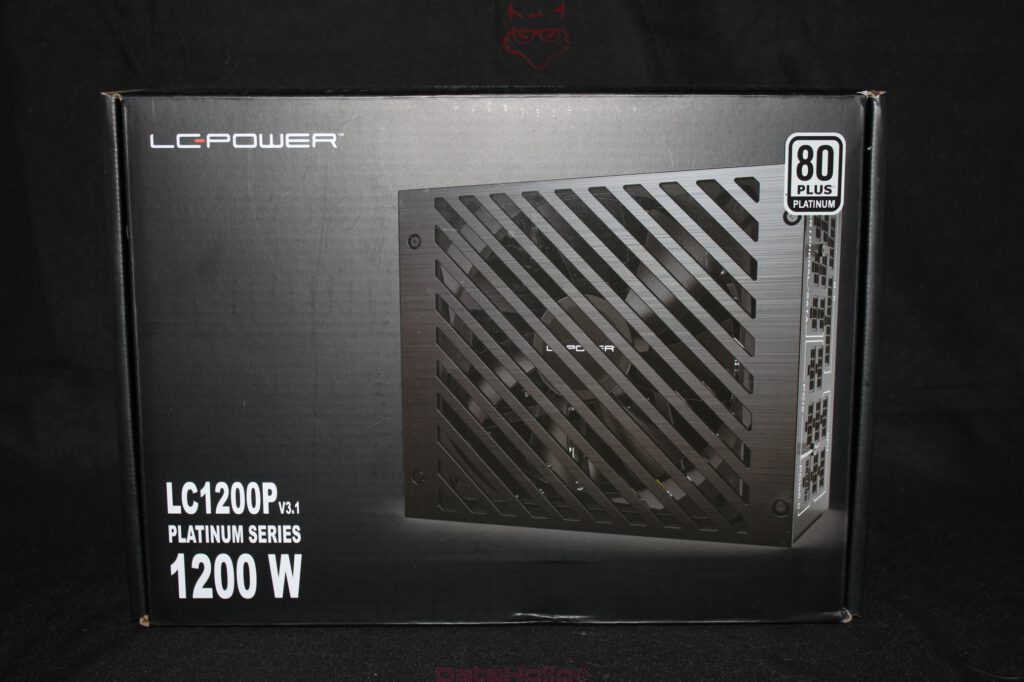
Even the packaging feels noticeably more robust than what could simply be regarded as a standard requirement for a power supply in this class. The box arrives large and solid, cleanly printed, with a large product image on the front, the LC-Power logo, the 80 PLUS Platinum badge, and the unmistakable indication of 1200 watts. That immediately sounds like headroom, and this very headroom is the true core of this unit. A 1200-watt power supply is not intended for economical office systems with integrated graphics. Instead, it is aimed at systems with a powerful graphics card, a fast processor, multiple storage drives, and the realistic expectation that future upgrades will not immediately require another new power supply.
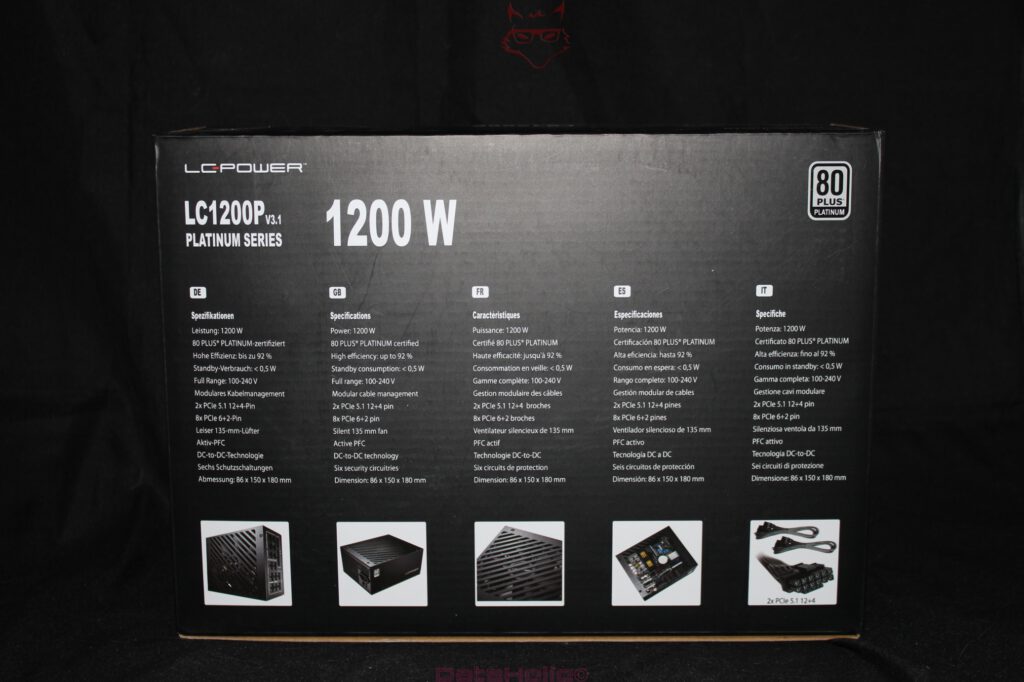
The rear of the packaging provides the most important technical specifications in several languages. In addition to output power and efficiency, it also lists the relevant connectors, dimensions, the full-range input of 100 to 240 volts, DC-to-DC technology, active PFC, and the integrated protection circuits. This is exemplary because a power supply should never be judged solely by its wattage. While 1200 watts certainly sounds impressive, output alone remains nothing more than an attractive number printed on cardboard without proper voltage regulation, suitable connectors, and reliable protection mechanisms.
“A good power supply is hardly noticeable in everyday use. A bad one ensures that everything else suddenly becomes very noticeable.”
Unboxing Without Any Drama
Opening the box reveals a neatly organized interior. The power supply, cables, power cord, and manual are securely arranged inside. This is more important than it may initially seem. A heavy metal block containing a power input and a modular connector panel should not be moving freely inside the packaging during transport. LC-Power handles this aspect convincingly. Everything feels securely packed, nothing rattles unnecessarily, and the cables are neatly bundled.
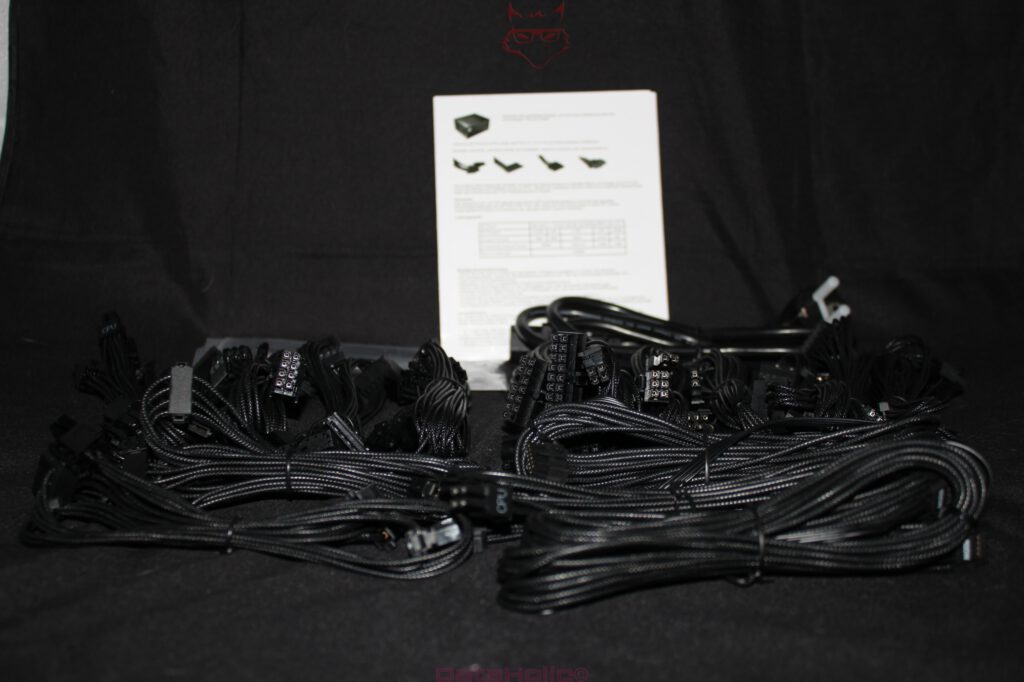
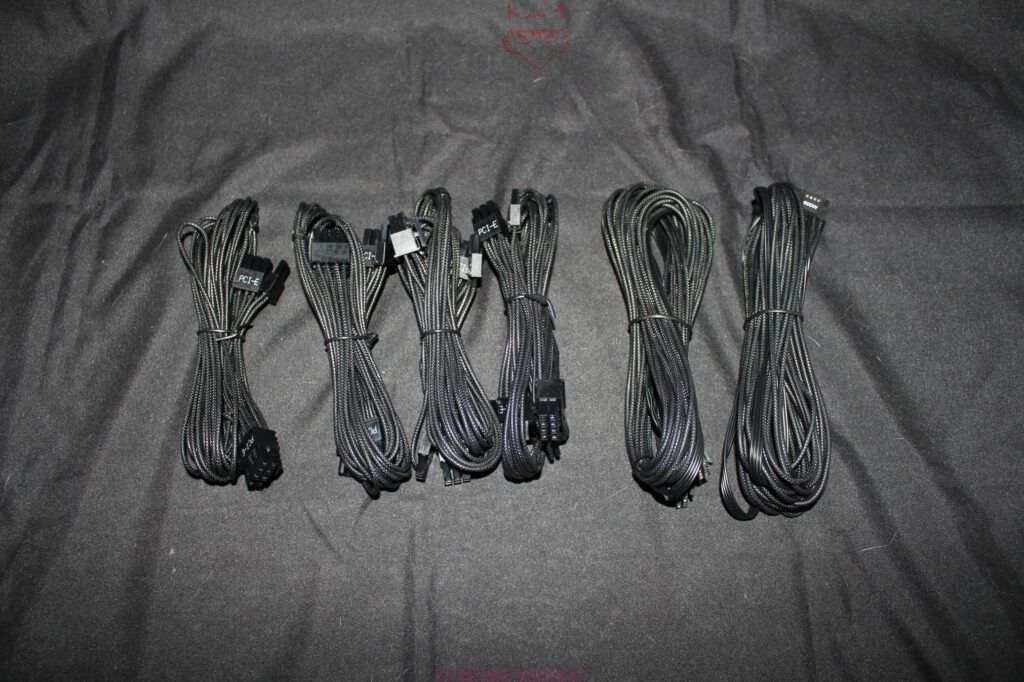
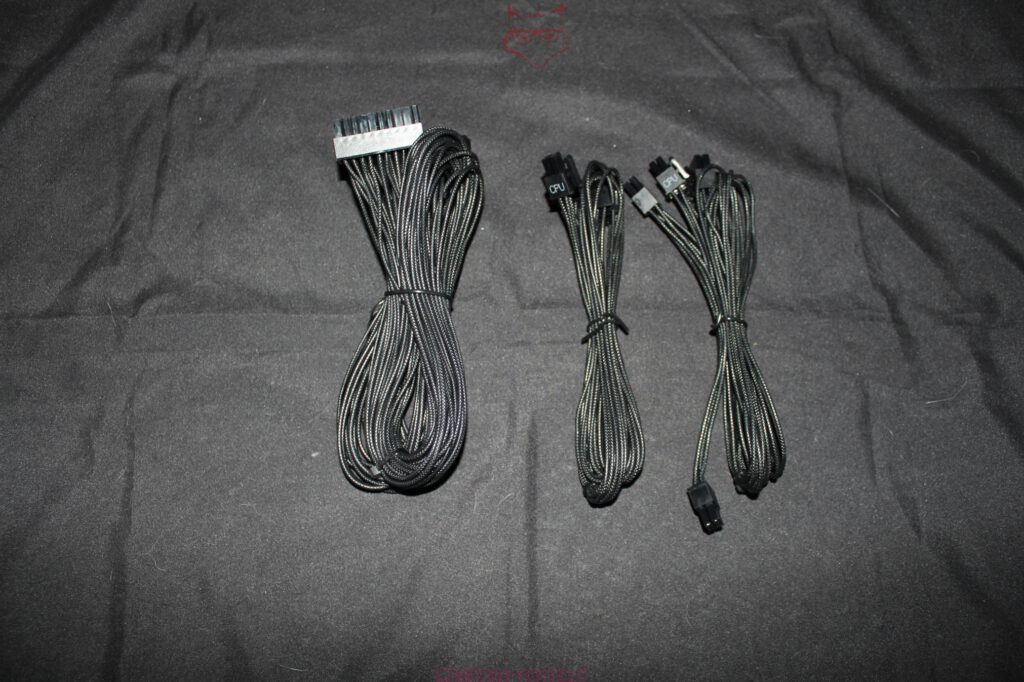
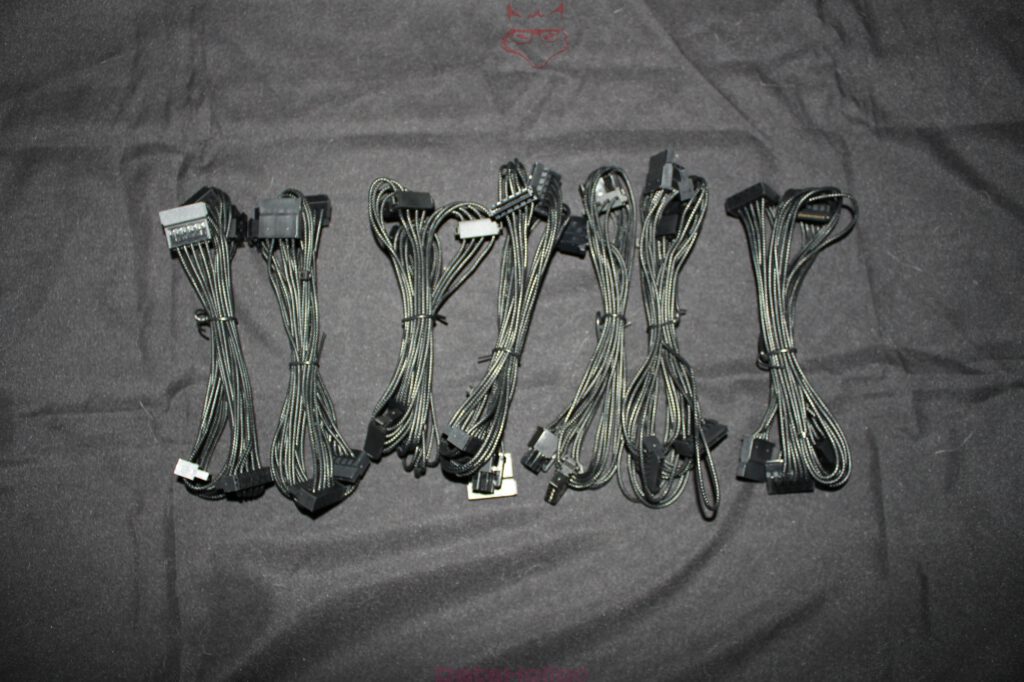
The included accessories are generous. Alongside the power supply itself, numerous modular cables are included, among them four traditional PCIe cables with 6+2-pin connectors as well as two PCIe 5.1 cables featuring 12+4-pin connectors. This allows the LC1200P V3.1 to support both current graphics cards and older or parallel PCIe configurations without compromise. Particularly welcome is the complete absence of adapter gymnastics. Native cables remain the significantly better solution for modern graphics cards because they eliminate unnecessary connection points while also keeping the inside of the system much cleaner. Cable adapters have roughly the same charm as multiple power strips behind a Christmas tree: they usually work, but they never inspire complete confidence.
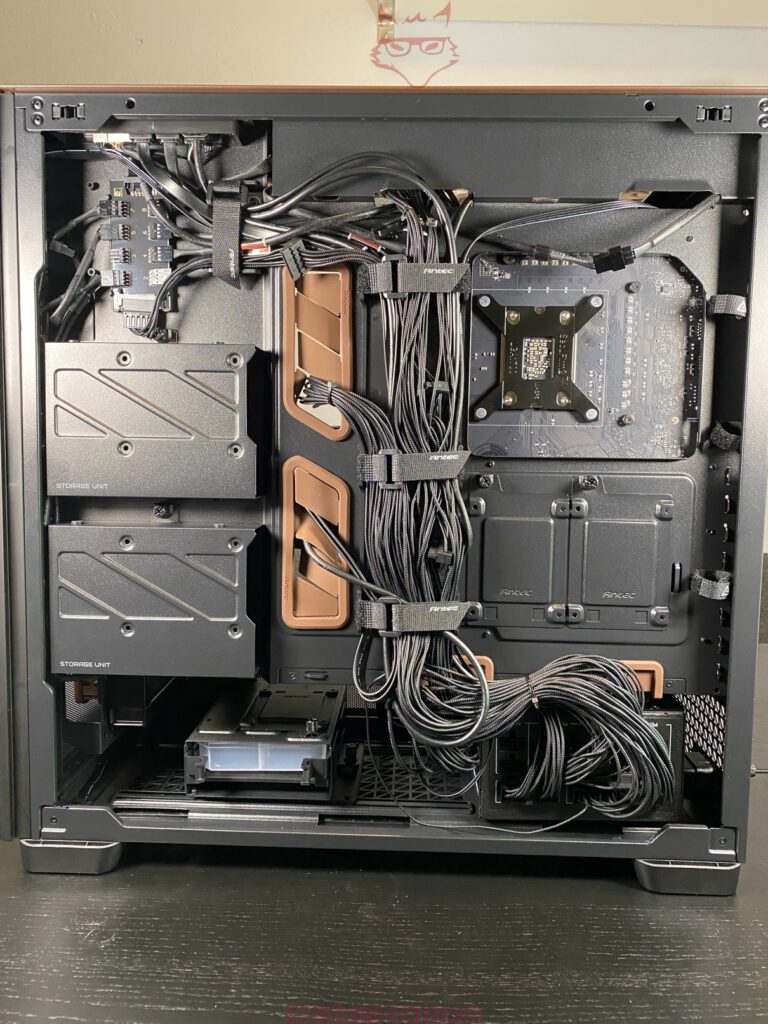
The cables themselves are finished in black and feature sleeved wiring. This visually matches almost every modern PC build while making clean cable management considerably easier. Their stiffness and overall construction clearly lean toward robustness rather than flexibility. This is perfectly understandable in a power supply of this performance class, as high current demands solid wiring. At the same time, installation requires a little patience, especially inside compact cases or when routing cables through narrow channels behind the motherboard tray. Anyone installing 1200 watts into a PC should also provide sufficient room for the power supply and its cables. Physics has always been remarkably resistant to folding itself into smaller spaces, even though some chassis manufacturers occasionally appear rather optimistic about that fact.
Housing and Build Quality: Not a Piece of Jewelry, but a Tool
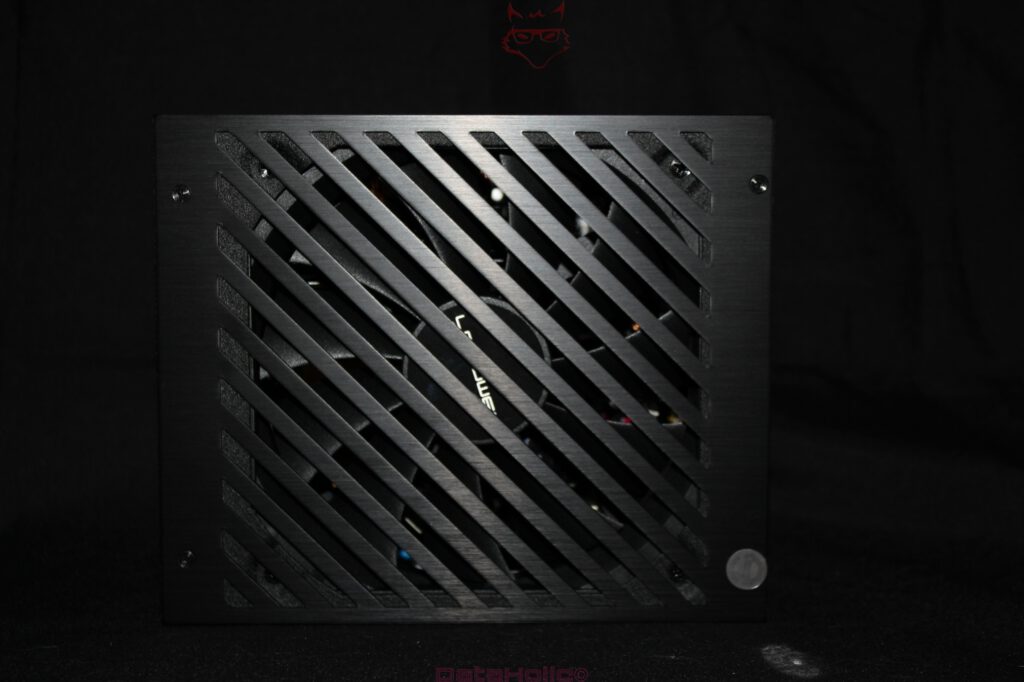
The power supply itself uses a black metal housing with a textured finish. The construction feels solid, resistant to flexing, and clearly focused on functionality. On the fan side sits a distinctive grille with diagonal slats. This immediately looks more individual than a simple perforated mesh while providing the 135 mm fan with ample breathing room. Internal components remain partially visible through the openings without making the housing appear exposed or fragile.
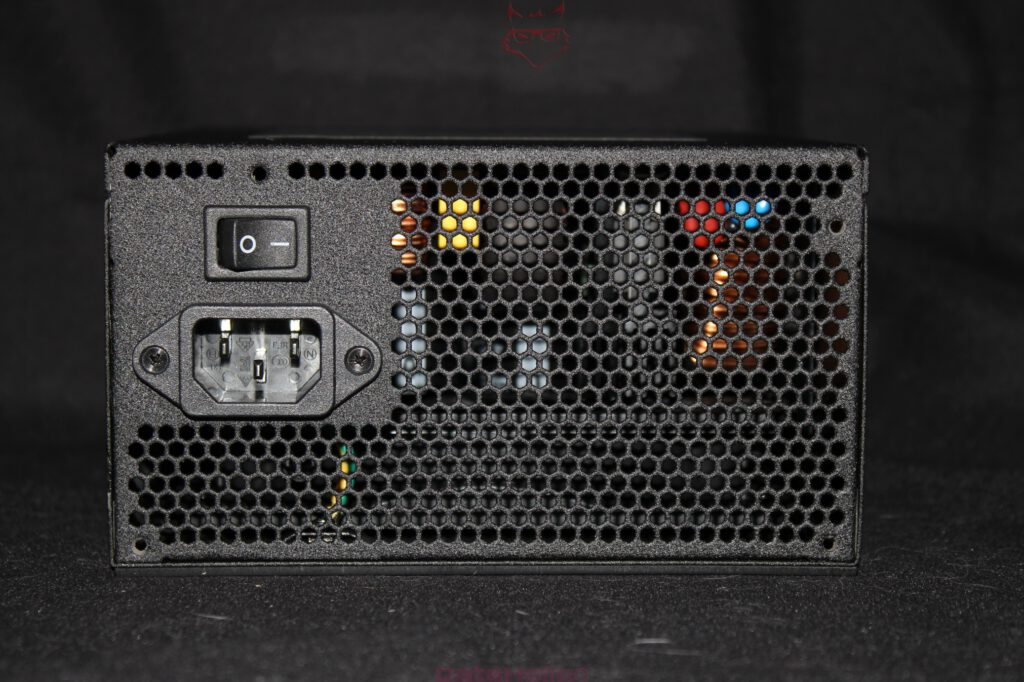
The rear panel is generously perforated and combines the IEC power connector, power switch, and ventilation openings. The power switch feels precise, while the power socket sits firmly in place. Exactly these kinds of details matter far more on a power supply than decorative design elements. A power supply is installed, secured with screws, connected, and ideally spends years quietly performing its job. The overall material quality of the LC1200P V3.1 perfectly supports this expectation. There are no playful design elements, no unnecessary plastic covers, and no lighting. The unit simply looks like a component designed to deliver power rather than attract attention.
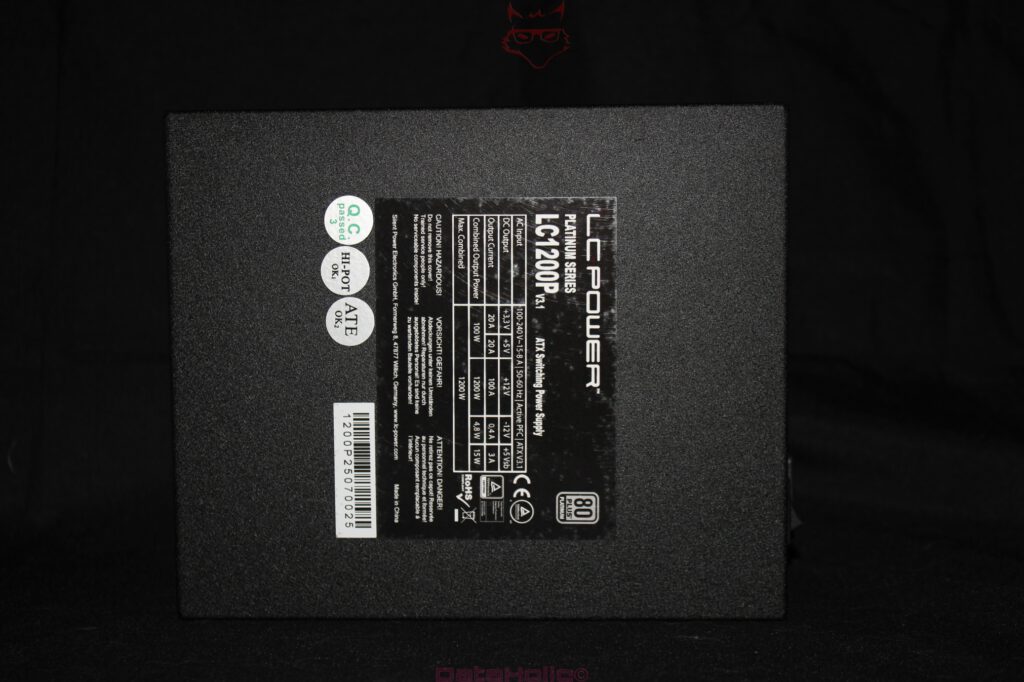
On one side sits the specification label containing the electrical ratings. The most important figure is naturally the +12-volt rail, delivering 100 amps and the full 1200 watts. For modern systems, this rail is especially important because both the processor and graphics card draw the majority of their power from it. The smaller 3.3-volt and 5-volt rails are each rated at 20 amps, with a combined output of 100 watts. This reflects the architecture of today’s high-performance power supplies: the primary focus lies clearly on the +12-volt rail, while the lower voltages are generated using DC-to-DC converters.
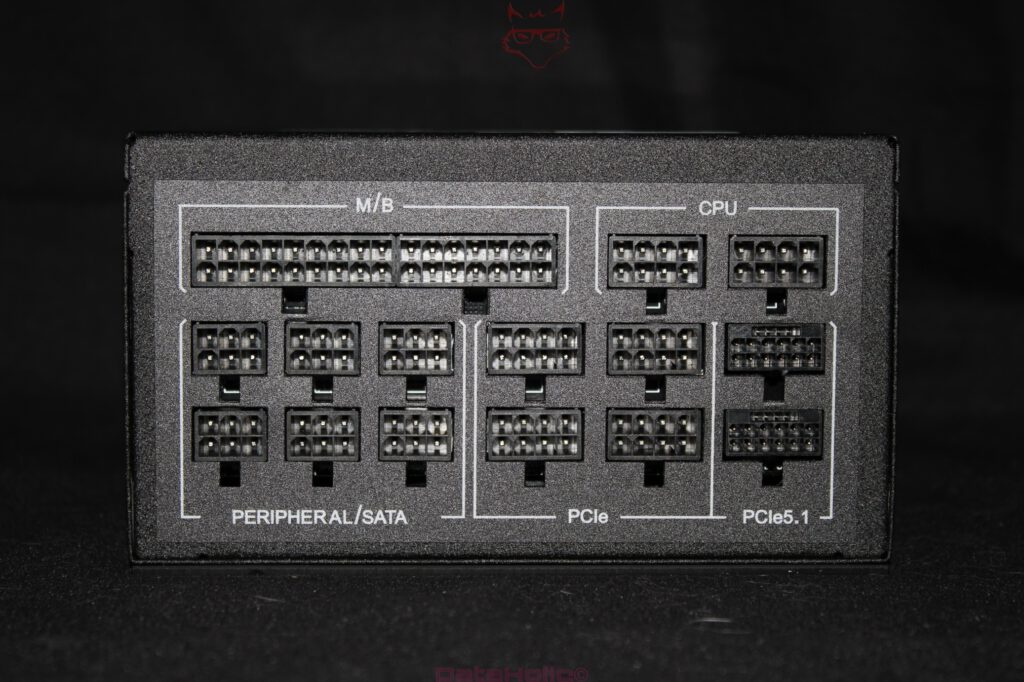
The Modular Connector Panel: Organization Instead of Guesswork
The modular connector panel is clearly labeled. Motherboard, CPU, PCIe, Peripheral/SATA, and PCIe 5.1 are all cleanly separated. This significantly reduces the risk of installation mistakes. On fully modular power supplies, proper labeling is not a luxury but an important safety feature. Incorrect cable placement or confusing connector layouts are among the things nobody wants during a PC build. The layout on the LC-Power power supply appears logical and well organized.
The two PCIe 5.1 connectors are particularly interesting. Modern graphics cards are increasingly adopting 12V-2×6 or 12+4-pin connectors. A power supply compliant with ATX 3.1 and equipped with matching native connectors is therefore far more than a snapshot of current technology—it represents an investment in future graphics card generations. At the same time, the traditional PCIe connectors remain available. This makes the LC1200P V3.1 equally suitable for today’s high-end graphics cards and for systems requiring multiple 8-pin PCIe connections.
“Cable management is the art of arranging chaos in such a way that airflow never notices it.”
Technical Specifications at a Glance
The technical specifications clearly show that LC-Power positions the LC1200P V3.1 for high-performance systems. The combination of a powerful +12 V rail, 80 PLUS Platinum certification, ATX 3.1, and PCIe 5.1 makes it well suited for modern gaming PCs, workstations, and graphics cards with high transient loads. The manufacturer lists the power supply as a fully modular ATX model featuring a 135 mm fan, up to 92 percent efficiency, DC-to-DC technology, active PFC, and comprehensive protection circuits.
| Feature | Specification |
|---|---|
| Manufacturer | LC-Power |
| Model | LC1200P V3.1 |
| Series | Platinum Series |
| Form Factor | ATX Power Supply |
| Standard | ATX 3.1 / PCIe 5.1 |
| Rated Output | 1200 Watts |
| Efficiency | 80 PLUS Platinum, up to 92% |
| Input Voltage | 100–240 Volts |
| Fan | 135 mm |
| Cable Management | Fully Modular |
| +12 V | 100 A / 1200 W |
| +5 V | 20 A |
| +3.3 V | 20 A |
| +5 VSB | 3 A / 15 W |
| -12 V | 0.4 A / 4.8 W |
| Combined 3.3 V & 5 V | 100 W |
| Standard PCIe | 8× PCIe 6+2-pin via four cables |
| PCIe 5.1 | 2× 12+4-pin |
| Technology | DC-to-DC, Active PFC |
| Protection Circuits | OVP, OCP, OPP, OTP, SCP, UVP |
| Dimensions | 86 × 150 × 180 mm |
Protection Circuits: The Invisible Insurance Policy
When it comes to power supplies, protection circuits are among the most important features, even though they remain invisible during everyday operation. The LC1200P V3.1 includes the complete set of relevant safeguards: OVP protects against overvoltage, UVP against undervoltage, OCP against excessive current, OPP against overload, SCP against short circuits, and OTP against overheating. Ideally, none of these mechanisms will ever need to intervene. Nevertheless, they are essential because a power supply should not only deliver energy but also limit potential damage whenever something goes wrong.
In this context, a secure power rail means far more than simply delivering high output. It also means controlled and stable power delivery. The +12-volt rail, capable of supplying 100 amps, provides generous headroom for modern graphics cards and processors. At the same time, a power supply should never become unstable under load. Voltage drops, noticeable fluctuations, or poorly managed transient spikes can cause system instability that is often mistakenly blamed on the graphics card, memory, or motherboard. A high-quality power supply therefore forms the stable foundation beneath a system whose other components frequently demand the spotlight.
Measured Results in Practical Use
The test system produced a very clear picture.
Power consumption measured 117 watts while idle and 145 watts during typical office workloads. Under gaming load, consumption increased to 546 watts. Prime95 on its own resulted in 400 watts, while FurMark alone reached 536 watts. Running Prime95 and FurMark simultaneously produced a maximum power draw of 828 watts. This left the LC1200P V3.1 operating comfortably below its rated output while maintaining considerable headroom.
This reserve is important because power supplies should not operate continuously at their maximum capacity. A 1200-watt unit running at 828 watts does not appear stressed. Instead, it operates with sufficient margin for transient spikes, future hardware upgrades, and the natural aging process that affects electronic components over time. Modern graphics cards, in particular, are capable of generating extremely rapid transient loads. ATX 3.1 and PCIe 5.1 therefore represent much more than fashionable buzzwords—they are technical responses to the actual requirements of today’s hardware.
| Scenario | Measured Power Consumption |
|---|---|
| Idle | 117 W |
| Office | 145 W |
| Gaming | 546 W |
| Prime95 | 400 W |
| FurMark | 536 W |
| Prime95 + FurMark | 828 W |
These figures also demonstrate why a power supply of this capacity should not automatically be regarded as excessive. A system equipped with a powerful graphics card and high-end processor can generate significant loads under extreme conditions without spending its everyday life anywhere near those values. Most of the time, the system operates far below its maximum. This is exactly where the high efficiency becomes beneficial, as less energy is converted into waste heat. With its 80 PLUS Platinum certification, the focus is not solely on peak performance but on efficient operation across the entire load range.
Noise Levels: Audible, but Never Annoying
The measured average noise level reached 47.1 dB(A) at a distance of 30 centimeters in an office environment. This value is certainly audible, although it should be interpreted correctly. Under normal installation conditions, a power supply is mounted inside a chassis, usually beneath a PSU shroud and further isolated by side panels, dust filters, and the physical distance to the user. Measuring directly in front of the unit from only 30 centimeters naturally makes the cooling fan much more noticeable than it would be inside a closed system.
The 135 mm fan itself leaves a pleasant impression. Rather than producing an unpleasant high-pitched whine, its acoustic signature is characterized primarily by moving air. Under sustained combined load, its presence naturally increases, yet it remains well within the expectations for a high-performance system. In many gaming PCs, a graphics card running FurMark or a CPU cooler under Prime95 will almost certainly produce more noticeable noise. As a result, the power supply never becomes completely silent, but it certainly does not attempt to become the leading actor of the system’s acoustics.
“1200 watts do not automatically mean noise. Noise only appears once cooling and load management are organized less effectively than the bundle of cables behind the motherboard tray.”
Everyday Use: Plenty of Headroom, Very Little Drama
In practical use, what stands out most is how unobtrusive the LC1200P V3.1 remains. For a power supply, that is a genuine compliment. It does not try to turn its output capability into a spectacle. It starts cleanly, supplies the system with stable power, and, thanks to its fully modular design, offers enough flexibility for a wide variety of system builds. At first glance, the large number of included cables may even appear slightly intimidating, but the advantage becomes obvious during installation: only the cables that are actually required end up inside the chassis, while the remaining ones stay safely stored inside the box. This makes it considerably easier to build a system with clean cable routing.
The combination of four traditional PCIe cables and two PCIe 5.1 cables deserves particular praise. It is a practical solution. Many power supplies either focus heavily on legacy connectors or shift almost entirely toward the newest graphics card standards. LC-Power chooses the sensible middle ground. As a result, the LC1200P V3.1 is equally well suited for existing systems and future PC builds. Anyone using a current high-end graphics card benefits from native 12+4-pin connectivity. Those still relying on older graphics cards or additional PCIe devices do not have to resort to adapters or compromises.
Verdict: A Solid Foundation for Powerful Systems
The LC-Power LC1200P V3.1 is not a power supply designed for showcase systems whose primary goal is to impress with lighting effects and decorative displays. Instead, it is a powerful, straightforward, and well-built power supply intended for systems with demanding power requirements. The sturdy construction, excellent packaging, clearly labeled connector panel, and generous cable set all leave a highly convincing impression. Particularly noteworthy is the fact that LC-Power includes two native PCIe 5.1 cables alongside four traditional PCIe cables. This provides excellent flexibility while eliminating the need for unnecessary adapter solutions.
From a technical perspective, the overall package is equally convincing. A 1200-watt output, a powerful +12-volt rail, 80 PLUS Platinum certification, DC-to-DC technology, Active PFC, ATX 3.1, PCIe 5.1 compatibility, and a complete range of relevant protection circuits combine to create a power supply that is exceptionally well prepared for today’s high-end systems. The measured power consumption clearly demonstrates that even an extremely demanding workload consisting of Prime95 and FurMark reaches only 828 watts, leaving a considerable margin below the rated capacity. It is precisely this reserve that provides both peace of mind and long-term system stability.
Within the scope of this unboxing and practical evaluation, genuine points of criticism are difficult to identify. Due to their quantity and robust construction, the cables naturally require a certain amount of installation space, although this is hardly surprising for a 1200-watt power supply. The measured noise level is noticeable at very close range, yet remains entirely unproblematic once the unit is installed inside a real PC chassis. A power supply in this performance class is not expected to provide acoustic meditation; its purpose is to deliver reliable power without becoming an unwanted source of attention. That is exactly what this unit accomplishes.
The LC-Power LC1200P V3.1 therefore represents an excellent choice for powerful gaming PCs, professional workstations, and future upgrades involving current or upcoming graphics card generations. Anyone searching for a straightforward, fully modular power supply offering generous performance reserves and a modern connector layout will find a very well-balanced solution here. It is not a product that insists on being the center of attention while sitting on the desk. Instead, it resembles the quiet colleague working in the engine room—the one who knows every fuse, keeps every cable perfectly organized, and does not even raise an eyebrow when faced with an 828-watt workload.

Transparency Notice in Accordance with EU Regulations:
The LC-Power LC1200P V3.1 presented in this review was provided to us by LC-Power as a non-binding loan unit for testing purposes. This review is not sponsored content or paid advertising.
LC-Power had no influence whatsoever on the content, evaluation, or editorial independence of this review. All opinions expressed are based exclusively on our own practical testing and experience.
We would like to sincerely thank LC-Power for providing the power supply and for placing their trust in dataholic.de.