
GeForce RTX 5080 Suprim
- Introduction: When a Box Dominates the Desk
- The Outer Packaging: A Minimalist High-End Statement
- First Look Inside: Lifting the Lid, Meeting Reality
- The MSI GeForce RTX 5080 Suprim on the Desk: Presence in Metal and Plastic
- The Backplate: More Than Just Aesthetic
- Cooler Architecture: Vapor Chamber Meets Fin Engineering
- I/O and Slot Design: Four Outputs, Generous Ventilation
- Handling, Weight, and Installation Reality
- Accessories and Packaging Structure
- Overall Visual Impression: Between Workstation and Show Build
- Unboxing Conclusion (Without Performance Judgment)
Introduction: When a Box Dominates the Desk
When the package containing the MSI GeForce RTX 5080 Suprim (SOC Edition) arrives at the door, it looks at first like a small moving box. Anyone who knows modern high-end graphics cards will already suspect: if the packaging takes up this much volume, the hardware inside is anything but lightweight. “Performance needs space” is one of those phrases you hear often — and the moment you lift the box, it suddenly feels very literal.
On the desk, the box nearly covers the entire depth. Even before anything is unpacked, the first “benchmark” runs in your head: Will this thing actually fit into my case, or is this the moment you quietly search for a new chassis?
This unboxing focuses strictly on that early chapter in the life of a graphics card: from opening the package to the detailed inspection of every visible cooling fin. No benchmarks, no drivers, no RGB profiles — just hardware you can touch.
The Outer Packaging: A Minimalist High-End Statement
Front: A White Monolith with Holographic Accents
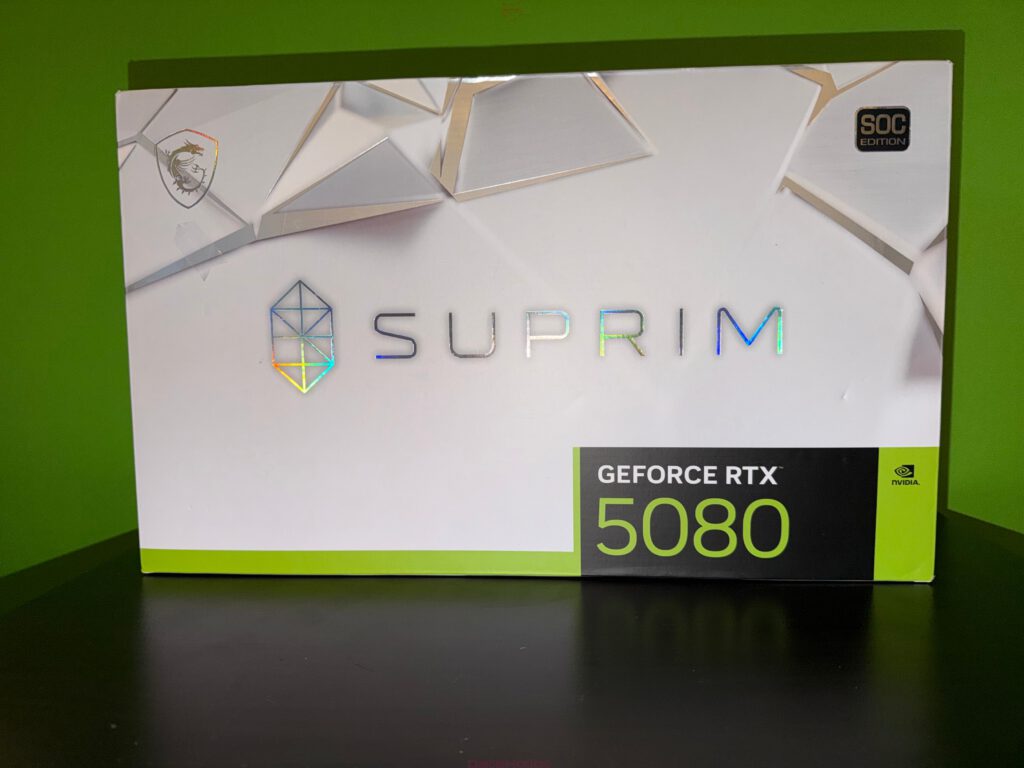
The front of the packaging is intentionally reduced and clean. A nearly all-white cover dominates the first impression, interrupted only by geometric metallic structures along the top edge. At the center sits the “Suprim” lettering, executed in a holographic finish that changes color depending on the angle. The logo beside it — a stylized crystal symbol — mirrors this aesthetic.
In the top-left corner is the familiar MSI dragon shield; in the top-right sits an “SOC Edition” badge signaling that this model carries a factory overclock. At the bottom, NVIDIA’s classic green stripe showcases the model name: GeForce RTX 5080. Under it lie the expectations: 16 GB GDDR7, a 256-bit interface, and everything people associate with “5080” — firmly in the enthusiast segment.
The front feels like a hybrid between premium hi-fi gear and designer laptop packaging. No exaggerated gaming motifs, no extreme colors, no exploding sci-fi artwork. More like “premium consumer hardware.” To loosely borrow from Dieter Rams: “Good design is as little design as possible.” MSI clearly leans into that philosophy here.
Back: Technical Promises at a Glance
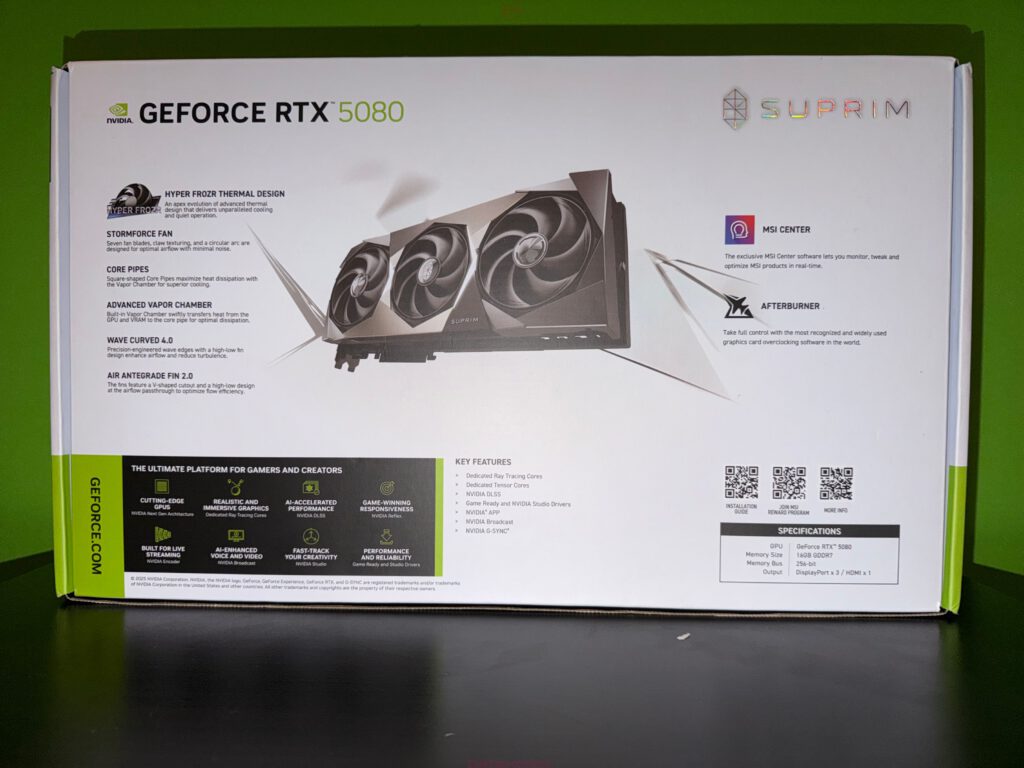
The back of the box contrasts the calm front: text-heavy, structured, and full of engineering keywords. On the left, a series of feature blocks describe the cooling solution:
- HYPER FROZR THERMAL DESIGN An advanced architecture promising “unparalleled cooling and quiet operation.” Marketing language, yes — but it reveals MSI’s priorities: low temperatures at minimal noise.
- STORMFORCE FAN Seven specially shaped fan blades with micro-structured surfaces and a circular frame for optimized airflow and reduced noise.
- CORE PIPES Square-shaped heatpipes designed to maximize contact and thus heat transfer from the vapor chamber.
- ADVANCED VAPOR CHAMBER A vapor chamber integrated into the baseplate to rapidly distribute heat from GPU and VRAM across all connected heatpipes.
- WAVE CURVED 4.0 Fin edges shaped in a wave pattern to reduce air resistance and turbulence.
- AIR ANTERGRADE FIN 2.0 V-shaped notches and alternating fin heights to guide airflow more effectively through the heatsink.
Below is the standard RTX feature block — ray tracing cores, tensor cores, Studio drivers, etc. On the bottom right sits the specification box, highly relevant for unboxing:
- GPU: GeForce RTX 5080
- Memory Size: 16 GB GDDR7
- Memory Bus: 256-bit
- Outputs: 3× DisplayPort, 1× HDMI
More isn’t needed for an initial overview. Already, these specs indicate a card built not only for high frame rates, but for high resolutions and multiple-display setups.
First Look Inside: Lifting the Lid, Meeting Reality
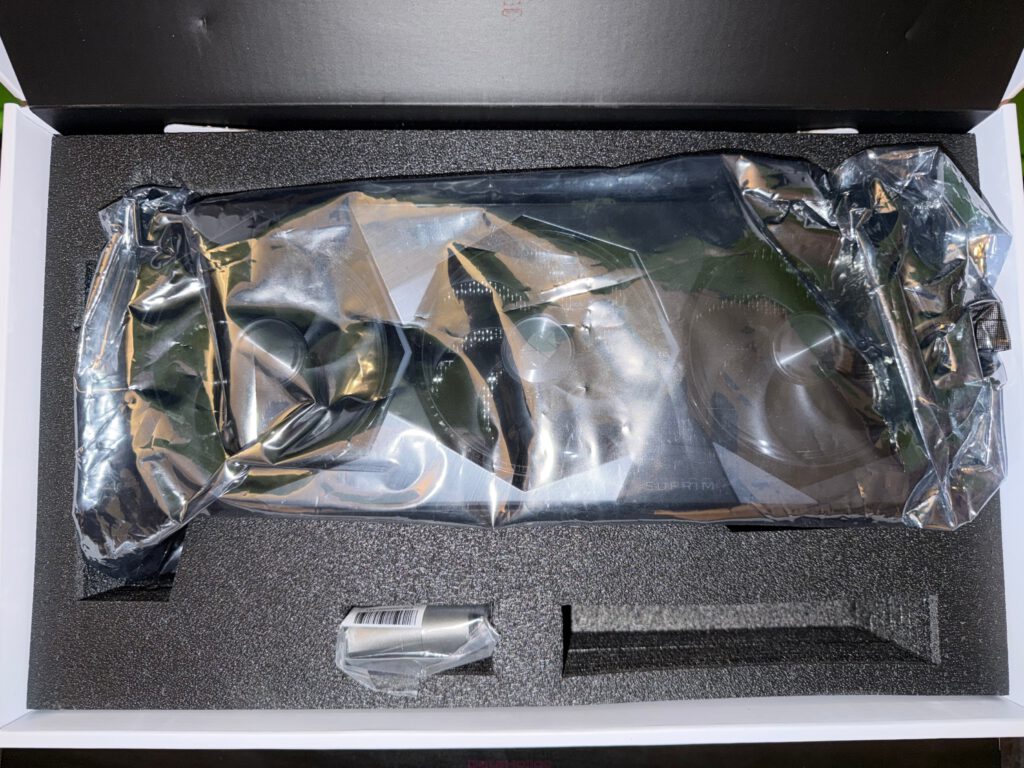
Removing the top lid, you immediately notice that MSI has refined its packaging over several generations. The interior is simple — no excessive printing, no awkward folding structures. Below the lid sits a thick, dense foam block that fills the entire surface. The graphics card is embedded precisely within this molded foam.
On the left side of the foam lies an accessory compartment. In our unit, a small box sits neatly in that cutout. MSI typically places stands, adapters, documentation or cable accessories here — everything needed for installation but not essential for the first visual impression.
The card itself is sealed in a tightly fitting anti-static bag, snug but not overly restrictive. The bottom of the bag is open, enabling you to grip the card with both hands and lift it straight out without friction. A small but important detail — wrestling heavyweight GPUs out of overly tight plastic sleeves can be nerve-wracking.
The foam density feels high, reminiscent of studio-equipment packaging rather than mass-market consumer goods. Even if the box took a serious hit during shipping, the hardware inside should remain unharmed.
The MSI GeForce RTX 5080 Suprim on the Desk: Presence in Metal and Plastic
Once freed from the anti-static sleeve, the card reshapes the scene. The 5080 Suprim is long, tall, and visually dominant — exactly what you expect from top-tier enthusiast hardware. It’s the moment when you ask yourself: “Will this beast actually fit on my motherboard without kissing the front radiator?”
Front View: Triple-Fan Cooler with Clear Geometry
Three large axial fans define the face of the card. Each fan sits inside a faceted frame reminiscent of a cut gemstone — a geometric motif repeated throughout the Suprim series. The fan blades curve subtly, with crisp edges, supporting MSI’s claim of high airflow with reduced turbulence.
The hubs feature the Suprim emblem in a soft holographic tint. The shroud combines matte and brushed metallic textures, giving the card an industrial, engineered character. The diagonal brushed metal plate between the fans spans the whole width and emphasizes the cleaner aesthetic.
A small “Suprim” engraving sits at the bottom-right corner — understated and confident. No RGB explosion, no aggressive gamer clichés. More like: “I don’t need to shout. You’ll notice me anyway.”

Side Profile: Thick Fin Stacks and Through-Glass Visibility
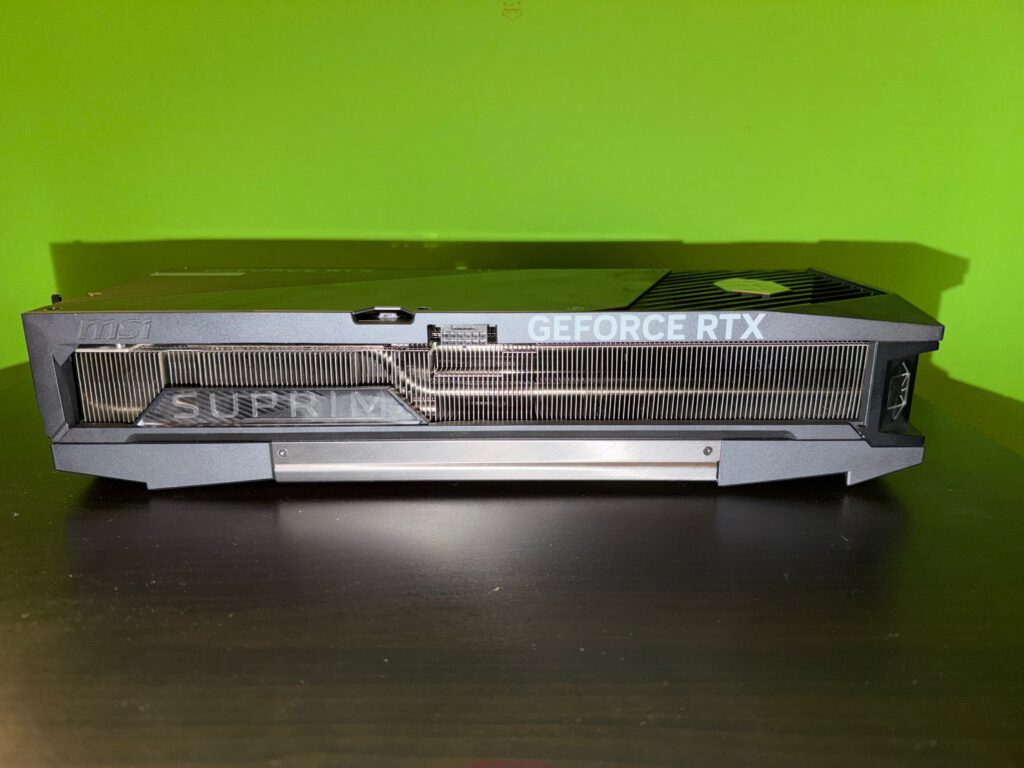
From the side, the cooling architecture becomes clear: dense fin arrays fill almost the entire height. Only structural elements and the translucent “Suprim” side lettering break up the pattern.
On the top edge, the “GEFORCE RTX” branding sits exactly where it will be visible through a glass side panel. The card clearly accommodates both enthusiast PC builds and professional workstations.
Zooming in reveals the lamella variations characteristic of the Wave Curved design. Heatpipes stretch across the visible segments, routing heat through multiple thermal zones.
Power Connector: Modern High-Power Input
The card uses a modern high-power connector (12V-2×6/12VHPWR). MSI recesses the connector slightly into the cooler housing, easing cable insertion and reducing strain on the plug. This design also prevents interference with side panels — a frequent problem in compact or mid-size cases.
The Backplate: More Than Just Aesthetic
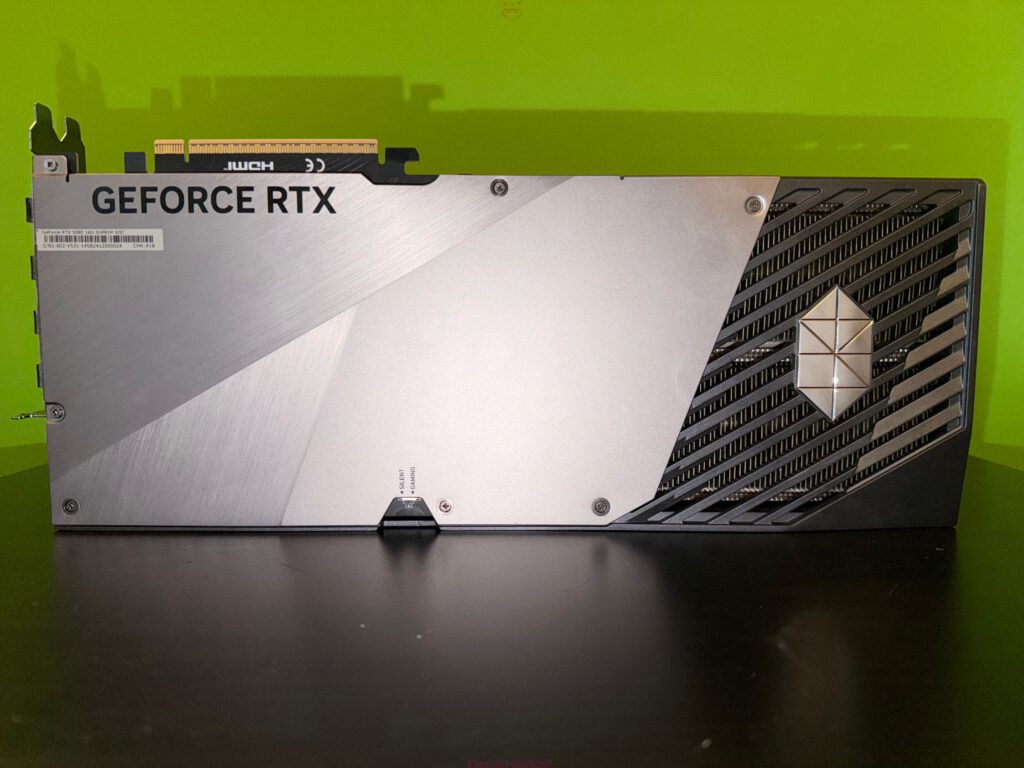
Flipping the card over reveals a full-length metal backplate divided into two areas: a brushed-metal section on the left and a ventilated zone on the right, cut with geometric precision and featuring the Suprim emblem.
Material and Manufacturing
The backplate is rigid and well aligned, giving the entire card structural reinforcement. Screw placement is symmetrical and secure. A slight bulge around the GPU area suggests direct thermal coupling — likely for VRAM and VRM cooling.
The ventilation cutout aligns with the heatsink fins below, ensuring heat can rise and escape efficiently through the top of the card.
Stability and Cooling in One
A good backplate does more than look clean:
- It prevents PCB sag over time.
- It draws heat away from components via thermal pads.
- It helps exhaust warm air through intentional cutouts.
This backplate clearly serves all three purposes.
Cooler Architecture: Vapor Chamber Meets Fin Engineering
Without disassembly, only part of the cooler design is visible — but the exposed regions tell much about MSI’s engineering.
Fin Density and Segmentation
The fin stacks are tight and deep, split into multiple zones to distribute heat across several banks. The wave-shaped edges help reduce airflow noise, particularly during high fan speeds.
Heatpipes and Contact
Several flat-oval heatpipes run through the fins, maximizing heat transfer. MSI’s “Core Pipes” design uses square-shaped surfaces at the base to increase contact with GPU and memory modules.
Fans: Stormforce Up Close
Each of the three fans uses seven blades designed for high static pressure — ideal for pushing air through thick heatsinks. The semi-enclosed outer ring reduces lateral air loss. Mounting points suggest replaceability without full cooler removal — a service-friendly design choice.
I/O and Slot Design: Four Outputs, Generous Ventilation
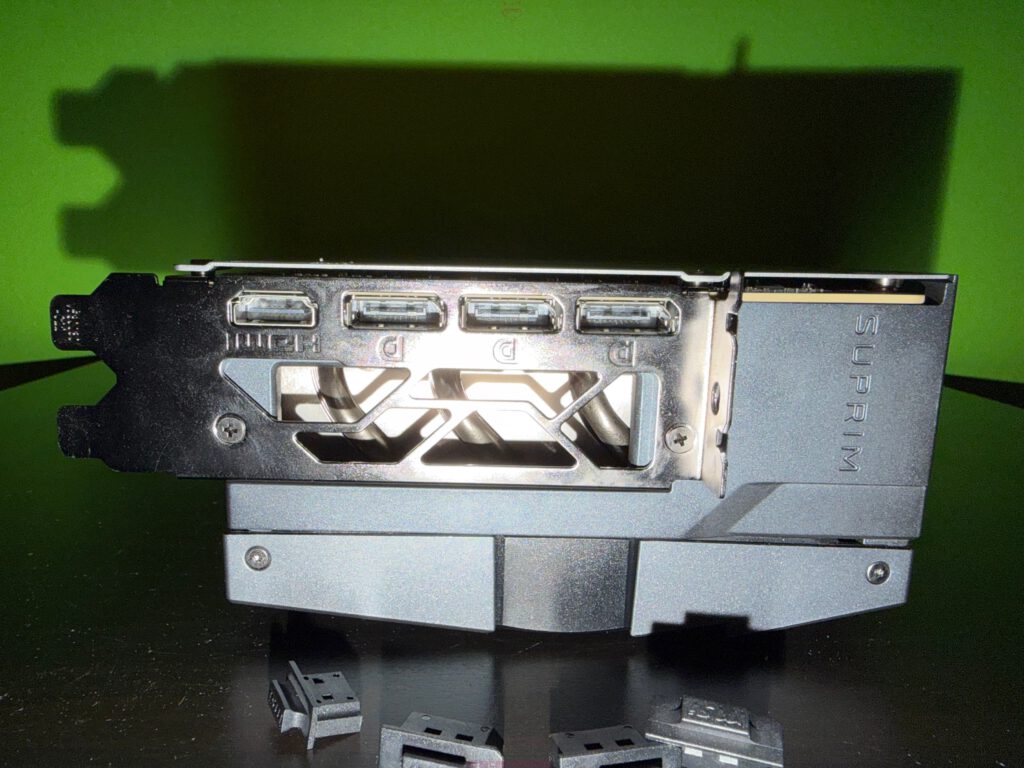
The I/O bracket features:
- HDMI
- DisplayPort
- DisplayPort
- DisplayPort
All ports are protected with caps; additional dust covers included in the package show MSI’s thoughtfulness for long-term storage or frequent swapping.
Below the connectors sits a large exhaust opening shaped as a stylized “X”. It provides a wide exit path for hot air and exposes heatpipes directly behind it — evidence that cooling and airflow were treated as an integrated design challenge.
Handling, Weight, and Installation Reality
The card is heavy but balanced. The structural rigidity of the metal frame, backplate, and cooler assembly prevents flexing, even when handled at awkward angles.
The overall thickness clearly places the Suprim in the 3 to 3.5-slot category — something to consider for multi-card or tightly packed builds.
Accessories and Packaging Structure
The two-tier packaging design is practical:
- Top level: the card, secured in foam
- Lower level / side compartment: documentation, accessories, support brackets, and adapters (varies by model and region)
It’s a clean and intuitive packaging layout — everything essential is immediately accessible, everything else is smartly tucked away.
Overall Visual Impression: Between Workstation and Show Build
Stepping back, the GeForce RTX 5080 Suprim looks like a hybrid of workstation engineering and enthusiast flair. The brushed metal surfaces, sharp edges, and geometric motifs give it a refined, purposeful look.
At the same time, the branding placement suggests MSI expects many owners to showcase the card behind tempered glass.
To loosely adapt a famous engineering quote:
“Power is nothing without control.”
This card’s unboxing already hints strongly that MSI wants to tame extreme GPU performance with an equally serious cooling system.
Unboxing Conclusion (Without Performance Judgment)
While this unboxing intentionally avoids performance tests or acoustic measurements, several things become clear:
- Packaging is sturdy and intelligently structured.
- Design is premium, subdued, and material-focused.
- Cooling architecture is the centerpiece: triple fans, vapor chamber, dense fins with engineered contours.
- Connectivity (3×DP, 1×HDMI) and the modern power connector signal top-tier positioning.
Everything visible during unboxing suggests that MSI built this card for sustained workloads, controlled temperatures, and premium system integration.
The actual performance story comes later — but the foundation visible here is undeniably solid.
Transparency Notice (EU Requirement):
The MSI GeForce RTX 5080 Suprim (SOC Edition) featured in this review was provided to us by MSI as a non-binding loan unit for testing purposes. This is not paid advertising. MSI had no influence on the content, assessment, or editorial independence of this article. All opinions expressed are solely based on our hands-on experience.
We sincerely thank MSI for providing the graphics card and for their trust in dataholic.de.