
Conclusion: MSI GeForce RTX 5080 Suprim (SOC Edition) – When “too much” suddenly becomes exactly right
- Context: What is the RTX 5080 Suprim SOC actually trying to be?
- Test System Overview
- Performance: 4K becomes the new “sweet spot”
- DLSS 4 and Ray Tracing: More than a bonus toggle
- Cooling, Noise and Efficiency: Luxury with technical merit
- Everyday Experience: When “overkill” becomes “just right”
- Pros: Where the MSI RTX 5080 Suprim SOC shines
- Cons: Where the 5080 Suprim SOC pushes limits
- Who should buy the MSI RTX 5080 Suprim SOC?
- Personal Take: When the GPU fades into the background — in the best way
- Summary: Strengths and weaknesses at a glance
- Final Thought: A choice — and one you can live with confidently
There are graphics cards you install, update the driver, toggle a few settings like “XMP” or “Resizable BAR” – and then you barely think about them again. And then there are cards that radiate authority the moment Windows loads, as if saying: “I run this place.”
The MSI GeForce RTX 5080 Suprim (SOC Edition) falls firmly into that second category.
After many hours of gaming, benchmarking, daily use and a few “just one quick level” sessions that inevitably turned into long nights, one impression stands above all: this isn’t a normal high-end GPU. It’s a very deliberately crafted blend of performance, efficiency and luxury-feel – with all the advantages and the inevitable trade-offs that come with such an approach.

Context: What is the RTX 5080 Suprim SOC actually trying to be?
At its core, the RTX 5080 is based on NVIDIA’s Blackwell architecture with 10,752 CUDA cores, 16 GB of GDDR7 on a 256-bit interface, and all the modern features like DLSS 4 with Multi Frame Generation and next-gen ray tracing capabilities.
In simple terms: the second-fastest GPU in the current GeForce lineup, positioned well below the RTX 5090 but clearly above an RTX 4080 / 4080 Super.
MSI takes this foundation and pushes it into “premium territory” with the Suprim SOC design:
- an oversized cooler with vapor chamber and extensive fin stack
- high factory overclock
- robust, high-end VRM design
- cooling built for low noise and low temperatures even under sustained 4K load
In short: a performance-heavy GPU wrapped in a cooling and power design that feels like engineers asked themselves, “What if we just didn’t hold back?”
Test System Overview
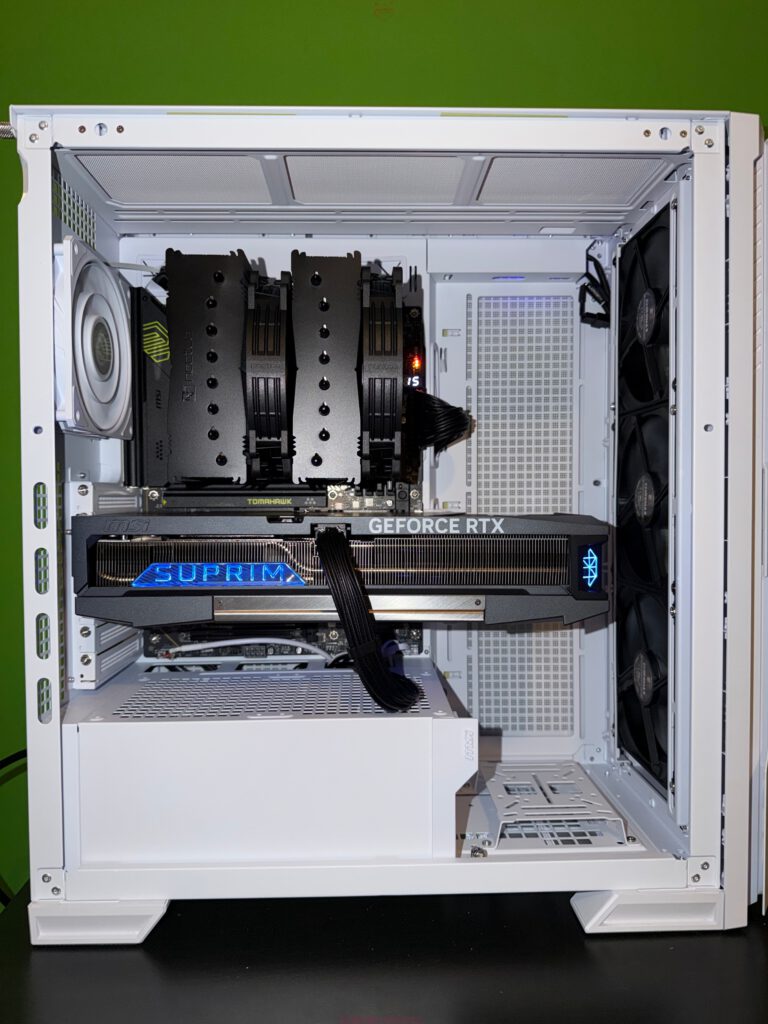
Here is the system used during evaluation, providing enough headroom for the GPU’s performance envelope:
| Hardware | Manufacturer / Model |
|---|---|
| Mainboard | MSI MAG X870E Gaming Plus Max WiFi |
| CPU | AMD Ryzen 9 9900X |
| RAM | Crucial Pro DDR5 RAM 64 GB Kit (4×16) 6000 MHz |
| SSD | Kingston 2 TB PCIe 4.0 NVMe M.2 SSD |
| CPU Cooler | Noctua NH-D15 G2 chromax.black |
| GPU | MSI GeForce RTX 5080 Suprim (SOC Edition) |
| Power Supply | MSI MPG A1000GS PCIe 5 |
| Case | MSI MPG Velox 300R Airflow |
| Display | LC-M27UFD |
| Keyboard | Dygma Defy |
| Mouse | Razer Viper V3 Pro |
| Mousepad | MSI True Gaming |
A system that lets the card stretch its legs without CPU, airflow or power limitations.
Performance: 4K becomes the new “sweet spot”
Let’s start with the obvious question: “How much faster is it?”
Compared to an RTX 4080 / 4080 Super, a well-designed RTX 5080 typically lands in the 15–20% performance uplift range at 4K, depending on the engine, game and settings. Factory-overclocked cards like the Suprim SOC can sit near the upper end of that range.
Relative to older cards:
- Coming from an RTX 3080, the uplift in 4K can exceed ~80% depending on the title.
- Even compared to an RTX 3090 or 3090 Ti, the 5080 pulls ahead clearly, especially in ray tracing workloads.
In everyday use, the experience looks like this:
- Modern AAA titles in 4K with high or max settings typically land in triple-digit FPS territory with DLSS 4 enabled.
- Ray tracing-heavy titles that used to push older hardware to its thermal or power limits feel noticeably more fluid here.
- Gamers moving from 1440p to 4K will find that this GPU provides exactly the headroom needed.
A fitting analogy:
You start a new game, slide every graphics setting to “maximum,” enable ray tracing and set DLSS 4 to Quality – and then you look at the FPS counter. With this card, that no longer feels like wishful thinking; it feels like a reasonable default.
DLSS 4 and Ray Tracing: More than a bonus toggle
DLSS 4 with Multi Frame Generation isn’t a side feature – it’s a central part of the RTX 5080 experience. In many real-world tests, DLSS 4 can provide performance gains of 60–80% while keeping image quality impressively intact, depending on the title and integration.
Especially in 4K with heavy ray tracing enabled, DLSS 4 changes the definition of “playable.”
Scenes that would otherwise sit at 40–50 FPS can suddenly run at 70–90 FPS.
Games like Alan Wake 2 or Cyberpunk 2077, often cited as “GPU crushers,” feel considerably more manageable.
It’s often like this:
“Raw GPU power gets you to the limit — DLSS 4 encourages you to go beyond it.”
That said, competitive players may still prefer native rendering.
But for single-player cinematic experiences, DLSS 4 is a game-changer.
Cooling, Noise and Efficiency: Luxury with technical merit
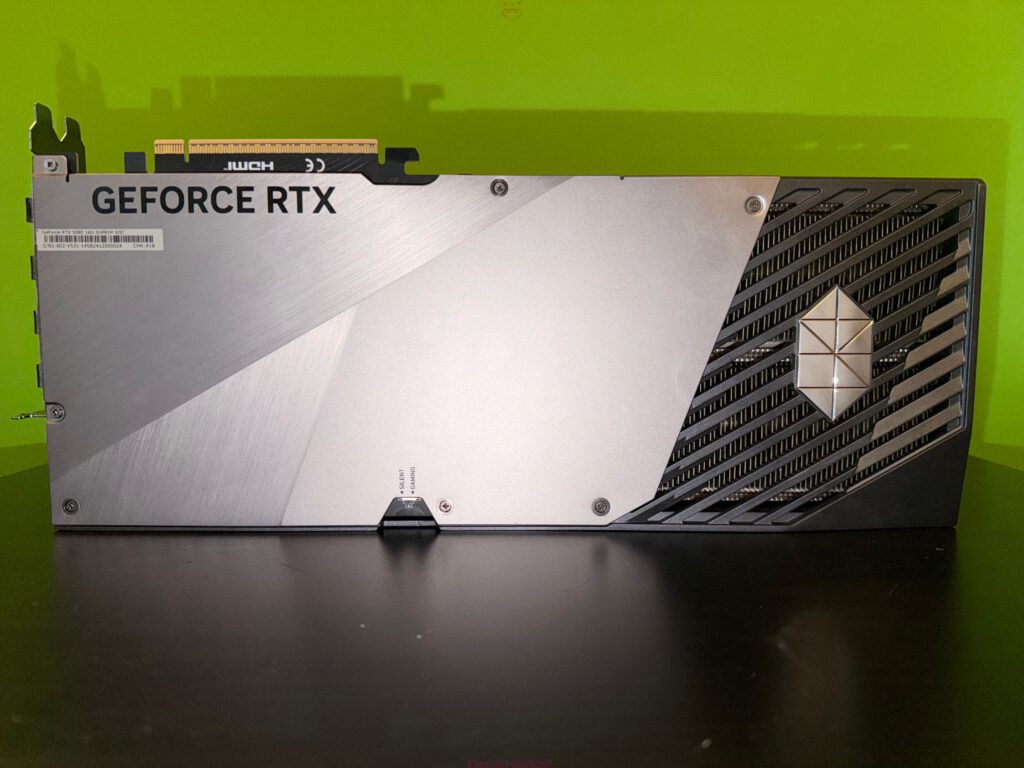
MSI’s cooling solution for the Suprim SOC looks like it was built for a 600-watt GPU – yet the card is rated at 360 W. This leads to three major real-world benefits:
1. Low temperatures
During sustained 4K gaming, temperatures often sit around 50–60°C. For this class of GPU, that’s excellent.
2. Strong efficiency
Despite its 360 W specification, real gaming consumption often falls around 280–300 W. That gives the cooling system plenty of overhead.
3. Very low noise
Thanks to the oversized heatsink and gentle fan curves, the GPU is often quieter than the case fans in a well-ventilated chassis. Many reviews rank the Suprim models among the quietest in their respective performance classes.
This brings to mind the old phrase:
“Power is nothing without control.”
Originally from a tire advertisement, but it fits perfectly here — the RTX 5080 delivers the raw force, and MSI ensures it remains cool, stable and quiet enough to use comfortably.
Everyday Experience: When “overkill” becomes “just right”
In browsing, office work or light editing, the GPU downclocks aggressively. Power use drops, and the fans often stop entirely. The result: you rarely notice the GPU unless you check a monitoring tool.
Gaming is where the card naturally spreads its wings:
High-resolution, high-detail 4K content feels effortless.
- In 1440p, the CPU becomes the limit more often than not.
- In 4K, the 5080 feels perfectly aligned with modern engines.
One anecdote illustrates this nicely:
You load an older title, max everything out, activate ray tracing and… the GPU fans barely spin up. A quick check reveals the GPU is at maybe 60–70% load.
The 5080 Suprim SOC is, in many titles, simply “overqualified.”
Pros: Where the MSI RTX 5080 Suprim SOC shines
1. Excellent 4K performance with headroom
It lands clearly ahead of the 4080/4080 Super and just below the 5090, especially in GPU-bound scenarios.
2. DLSS 4 and advanced RT hardware
DLSS 4, next-gen AI acceleration and improved ray tracing cores make current and upcoming titles much more manageable.
3. Exceptional cooling and low noise
The vapor chamber, oversized heatsink and tuned fan profiles deliver cool, quiet operation.
4. Premium design and build quality
Suprim means metal, stability, a reinforced PCB, clean aesthetic and high-quality components.
5. Strong efficiency
The performance-per-watt ratio is impressive given its output.
Cons: Where the 5080 Suprim SOC pushes limits
1. High price
This is a premium card in a premium segment.
If you don’t play in 4K, the justification becomes harder.
2. Not a revolutionary upgrade for 4080 owners
The generational uplift is decent but not dramatic.
For a 4080 user, this is more a luxury upgrade than a necessity.
3. Large and heavy
The cooler is excellent — but enormous. Small cases or weak PCIe slot reinforcements may struggle.
4. 12V-2×6 connector still demands caution
Even though improved over 12VHPWR, careful seating and cable management remain important for long-term safety.
Who should buy the MSI RTX 5080 Suprim SOC?
Ideal for:
1. 4K gamers who value visual fidelity
If you aim for maxed-out settings, ray tracing and longevity, this card is a perfect fit.
2. Upgraders from the RTX 30 series or older
The performance jump is huge — not just in FPS, but also in features like DLSS 4 and improved ray tracing.
3. Silent PC and premium enthusiasts
If you want high performance without high noise, the Suprim SOC excels.
Not ideal for:
- 1080p or 1440p competitive players
- Compact ITX builds
- Budget-focused buyers
Personal Take: When the GPU fades into the background — in the best way
The highest compliment for a high-end GPU is this:
After a few days, you stop testing it and start playing again.
You stop fine-tuning sliders, you stop obsessing over limits, and you stop compromising on visuals just to stay above a certain FPS threshold.
The MSI GeForce RTX 5080 Suprim (SOC Edition) creates exactly that feeling.
Once the initial curiosity is gone, the GPU becomes the backbone of the system — quiet, powerful and reliable enough that you simply trust it to deliver.
Yes, it’s “overkill” in the classical sense.
But in a landscape of increasingly demanding engines, complex lighting and higher resolutions, today’s overkill is often tomorrow’s standard.
Summary: Strengths and weaknesses at a glance
Strengths
- outstanding 4K performance
- substantial uplift for RTX 30 users; solid uplift for 4080 users
- DLSS 4 and modern AI/RT features
- excellent cooling and very low noise
- premium materials and design
- strong efficiency relative to workload
Weaknesses
- high price, especially for the Suprim SOC version
- modest generational gain for 4080 owners
- very large and heavy
- 12V-2×6 connector still requires care
Final Thought: A choice — and one you can live with confidently
The MSI GeForce RTX 5080 Suprim (SOC Edition) is not a mass-market card.
It’s a deliberate decision:
- for 4K instead of “just” 1440p
- for high details including ray tracing
- for quiet operation
- for hardware you don’t want to second-guess for years
If that’s what you’re after — and the price is acceptable — then this card delivers a cohesive, reliable and undeniably impressive experience.
Transparency Notice (as required by EU guidelines):
The MSI GeForce RTX 5080 Suprim (SOC Edition) featured in this review was provided to us by MSI as a non-binding loan for testing purposes. This is not paid advertising.
MSI had no influence on the content, evaluation or editorial independence of this article. All opinions expressed are based solely on our own practical experience.
We sincerely thank MSI for providing the graphics card and for their trust in dataholic.de.