
reMarkable Paper Pure: The Quiet Discipline of a Digital Notebook
- When Technology Finally Keeps Quiet
- Writing Without the Circus Act
- Small Form, Big Use
- E-Paper in the Sun: The Moment LCDs Quietly Cry
- The Missing Backlight as an Honest Compromise
- Software as a Toolbox Without Fairground Lighting
- Word, Web, and the Small Triumph Over Distraction
- Battery: The Calm Between Two Charging Cables
- Order Without Paper Piles
- E-Books, PDFs, and Comics: Not Everything Is Equally Grateful
- Marker Plus: The Pen as the Secret Main Character
- Productivity Without an App Zoo
- Connect and Data Privacy: A Cloud with a European Anchor
- Between Paper and Computer
- The Matter of Humor: A Digital Notebook and Cthulhu at the Table
- Repairability, Material, and Quiet Progress
- Limits Without Drama
- Why the Paper Pure Does Not Need to Win Loudly
- The Clean Final Line
- Notice in accordance with EU transparency requirements:
When Technology Finally Keeps Quiet
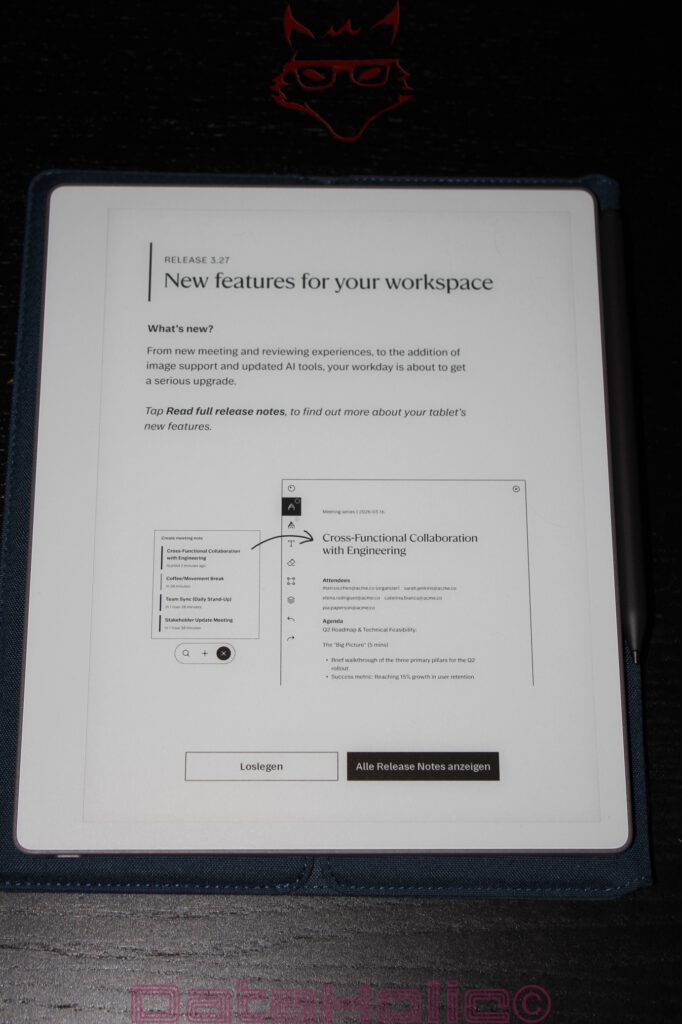
The reMarkable Paper Pure feels almost defiantly calm in a device world full of push notifications, app icons, color gradients, animations, and update prompts. No home-screen fireworks, no app-store bazaar, no blinking ecosystem with the character of a digital fairground. Instead, there is a flat, lightweight writing device that does not try to be a tablet, laptop, e-reader, calendar hub, streaming screen, and mobile game console all at once. This limitation is not a weakness, but the core of the concept. The Paper Pure is not a device for as many things as possible, but for a few things with remarkably clear intent.
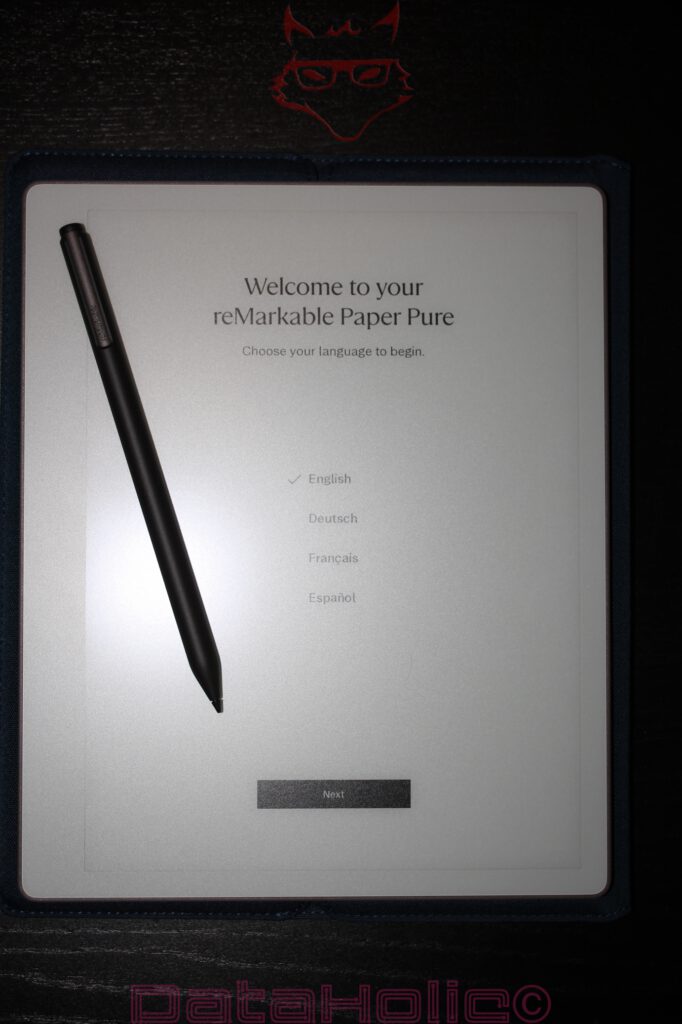
The first impression in everyday use is strongly shaped by this reduction. The device is small enough to disappear into a bag, backpack, or work folder without planning, yet it does not feel like a stopgap in pocket format. The 10.3-inch class remains large enough for notes, PDF annotations, long texts, sketches, meeting minutes, and structured project pages. At the same time, the weight is low enough that moving from desk to sofa, from office to meeting room, or from domestic chaos to a café does not feel like a device relocation. It is more like the digital counterpoint to the typical tablet grab, where charger, cover, stylus, adapter, and a bad feeling about the battery all travel along.
What stands out as especially pleasant is that the Paper Pure does not constantly demand attention. A classic tablet almost automatically invites a “quick” detour into something else. A note turns into an email, the email into a message, the message into a browser tab, and the browser tab into half an afternoon spent wondering why a video about mechanical keyboards suddenly ended with medieval siege warfare. The Paper Pure refuses this pull. It offers paper, folders, documents, handwriting, import, and synchronization. Nothing more. At first, this limitation almost feels strict. Later, it feels like a small liberation.
Writing Without the Circus Act
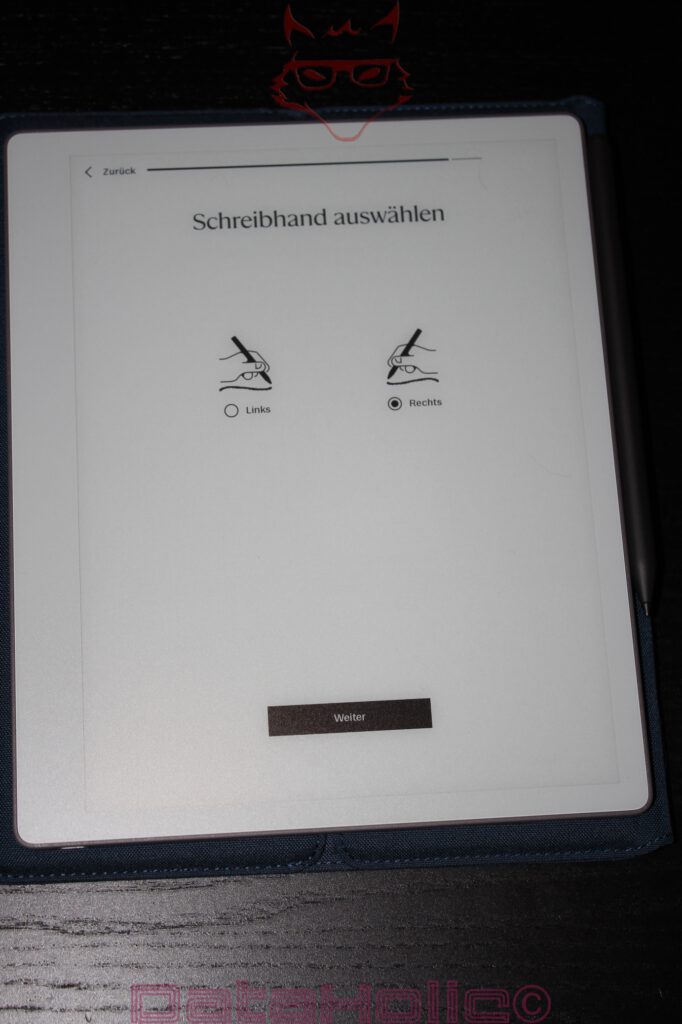
The most important point remains the response while writing. A digital note-taking device stands or falls with the question of whether there is a noticeable distance between thought, hand movement, and visible line. With the Paper Pure, that distance is pleasingly small. Input feels direct, fast, and precise enough not to constantly remind of the technology behind the surface. That is crucial for E-Paper devices. As soon as latency becomes noticeable, the impression tips. Handwriting then becomes a technical demonstration with a patience test attached.
The Paper Pure remains pleasantly unobtrusive here. The Marker Plus glides across the surface with controlled resistance, without feeling glassy or slippery. This haptic quality matters because writing is not just made of lines. Writing is pressure, speed, angle, habit, correction, and occasionally also frustration management. The eraser on the Marker Plus is therefore more than a nice accessory detail. It brings back a familiar gesture. Turn it over, erase, keep writing. No need to search for a toolbar, hit an icon, or open a menu. The movement is so ordinary that it could almost be underestimated technically. In everyday use, exactly this ordinariness matters.
The eraser function feels particularly natural with handwritten notes. A pen with an eraser is taken for granted in the analog world. On digital devices, it has often turned into an operating logic with selection fields, modes, and tool icons. The Paper Pure makes this step physical again. The pen is turned around, the line disappears, the thought keeps flowing. In meetings, lectures, phone calls, or while quickly sorting ideas, this is significantly more valuable than any elaborately animated tool palette.
Small Form, Big Use
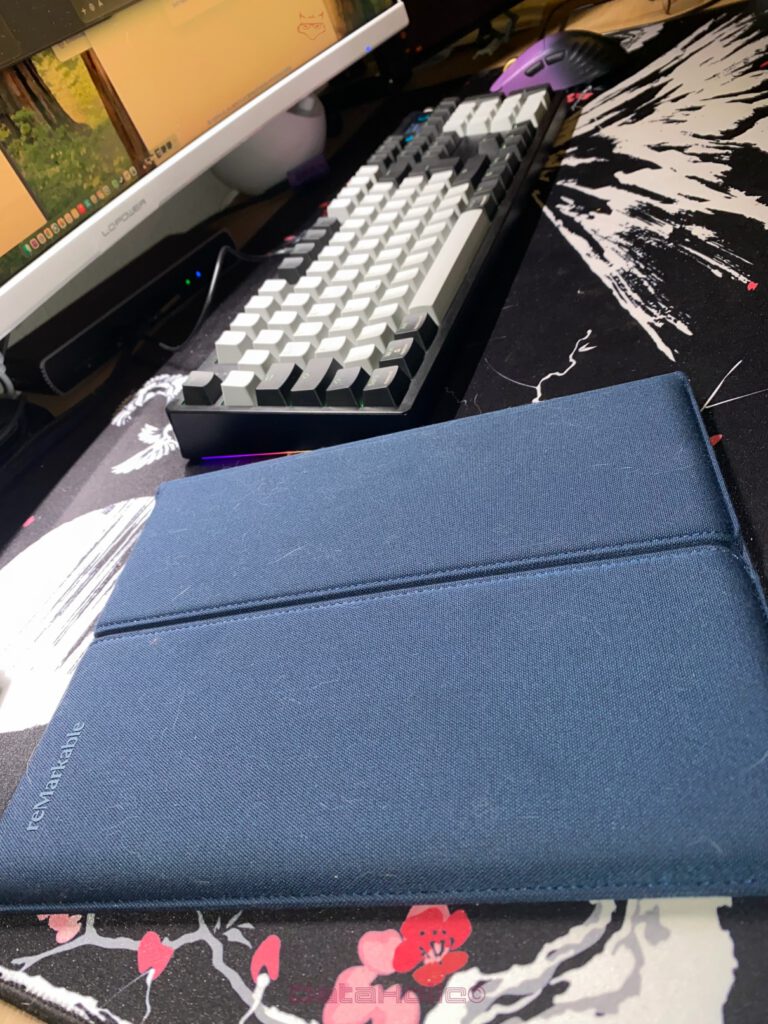
The low weight is one of the Paper Pure’s strongest practical arguments. Many technical products look light on the spec sheet, but still feel bulky in everyday use. The Paper Pure avoids exactly that problem. In its cover, it remains portable, stable, and quickly accessible. The secure, sturdy cover plays a larger role than an accessory might suggest at first glance. A digital notebook is not treated like a stationary device. It lands on tables, sofas, kitchen counters, office piles, and in bags between charger, keychain, notebook, headphone case, and that one object that has been there for three months and still has not been identified.
The cover not only protects the device, it also changes how it is handled. Without a cover, flat tablets quickly create that cautious glass-plate nervousness. With a sturdy cover, the Paper Pure feels more like a working tool. Open it, write, close it, take it along. The textile surface also gives it a pleasantly calm, almost book-like character. As a result, the device does not become luxurious in an exaggerated sense, but more familiar. It sits closer to a notebook, folder, and writing pad than to a multimedia tablet and glossy screen device.
This combination of format, weight, and protection shows its value especially on the move. A device can be technically excellent and still stay at home as soon as transport and everyday handling become too cumbersome. The Paper Pure belongs more to the category of devices that simply come along. Not because it is spectacular, but because hardly any friction arises. This lack of friction is rare. Many devices want to be taken along, but require a small logistics department. The Paper Pure needs little space, little attention, and only rarely power.
E-Paper in the Sun: The Moment LCDs Quietly Cry
Readability in direct sunlight is one of the areas where E-Paper once again plays to its old strength very clearly. While classic displays often turn into mirror cabinets under strong sunlight, the Paper Pure remains confident. The brighter the environment, the more plausible the concept becomes. Outdoors, by the window, in a bright office, or on a terrace, the display shows exactly the property that has made paper annoyingly competitive for centuries: light is not an opponent, but the requirement.
This point sounds technically dry, but has enormous impact in everyday use. A device that remains readable in sunlight changes where it can be used. Notes outdoors, PDFs while traveling, sketches on the go, study materials on the balcony, or role-playing material on a large table with daylight from the side work without the usual battle against reflections. A normal tablet likes to respond to such scenarios with maximum brightness, reduced battery life, and a display that still looks as if a mirror had been secretly installed.
The Paper Pure stays calm in such situations. The display does not have the hard luminance of an LCD or OLED panel, and it does not need it. Text rests quietly on the surface, lines remain recognizable, handwriting feels organic. With e-books, longer PDFs, or work documents, this creates more relaxed reading. The screen appears less as a light source and more as a surface. This difference is not only technical, but physically noticeable. Reading feels less like screen time and more like contact with material.
The Missing Backlight as an Honest Compromise
The missing backlight is the most important neutral point of the Paper Pure. It is not a hidden flaw, but a conscious decision with clear consequences. In bright surroundings and daylight, the device benefits from its E-Paper strength. In dark rooms, it requires external light. A book requires the same. The difference is that digital technology now often creates the expectation that every device should work on its own in every environment. The Paper Pure contradicts this reflex.
In practice, this means: for night readers, dark hotel rooms, late bedtime reading, or dimly lit train compartments, the device is less flexible than models with a front light. Anyone wanting to read another twenty pages at night with the lights off needs an external light source. That feels almost old-fashioned in 2026, but also consistent. Without lighting, the device remains lighter, simpler, and more power-efficient. The surface also stays closer to the idea of paper instead of acting like a glowing screen.
This compromise deserves a sober classification. The lack of lighting does not matter in every use case. For daytime notes, office work, study, project planning, technical documents, meeting minutes, or writing in a bright room, it hardly plays a role. For evening reading, however, it certainly does. The Paper Pure is therefore not a universal e-reader replacement for all environments, but a digital writing and work device with very good readability when light is available. That is exactly where its strength lies.
Software as a Toolbox Without Fairground Lighting
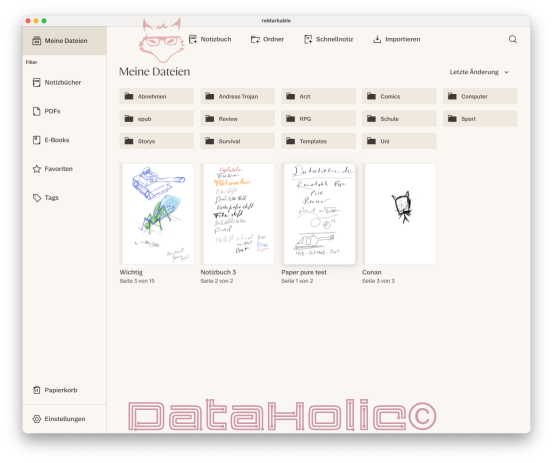
The Paper Pure’s software largely follows the same logic as the hardware. It does not want to entertain, but to organize. The main view with files, notebooks, folders, PDFs, e-books, favorites, and tags is deliberately matter-of-fact. Folders can be created cleanly, notebooks quickly generated, quick notes opened directly. This structure is not exciting, but useful. And usefulness is far more important in a digital notebook than visual self-presentation.
The direct data exchange through the reMarkable app is especially pleasant. Documents do not end up in an opaque device limbo, but can be moved fairly easily between desktop, cloud, and Paper Pure. Especially with longer texts, PDF documents, scanned files, or prepared note structures, this saves a lot of friction. The app thus takes on the role of a quiet bridge. It does not stand at the center, but it performs exactly the task that matters in everyday use: content must get onto the device and back off again without theater.
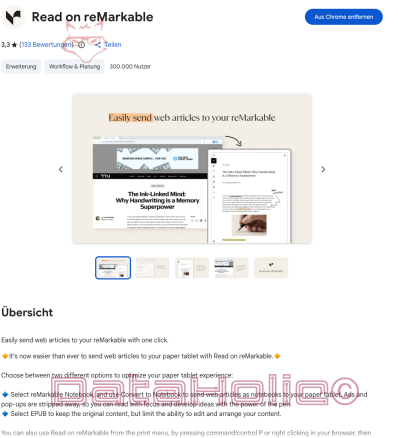
There is also the option to send Word documents and websites directly to the Paper Pure via plug-in. At first, that sounds like a convenience feature, but it quickly develops genuine value. A website, a longer article, or a work document does not first need to be saved, moved, and imported in a cumbersome way. The path from browser or Word to the device becomes much shorter. Especially with longer web texts, this is an important point because the Paper Pure removes the text from the usual browser environment. Ads, pop-ups, tabs, and other digital background noise lose importance. What remains is reading material with pen access.
Word, Web, and the Small Triumph Over Distraction
The integration with Word and the browser extension shows where the Paper Pure is aimed as a work device. It is not about replacing the computer. It is about taking certain content out of the computer. A Word document on a normal monitor is a work document. On the Paper Pure, it becomes more like a manuscript, a correction sheet, a thinking surface. This shift in perspective sounds more pathetic than it feels in everyday use. In reality, the switch to E-Paper is often enough for a text to be read more calmly.
The same effect applies to websites. The browser is a place of permanent temptation. Even with the best intentions, the next tab is only one click away. The Paper Pure cuts off this possibility. A sent article lands on the device as a focused reading text. Reading becomes slower, but not worse. It becomes more deliberate. A famous line often attributed to designer Dieter Rams says: “Less, but better.” This idea fits the Paper Pure surprisingly well. Fewer functions, but better concentration on what is currently in front of the reader.

The Chrome extension “Read on reMarkable” brings exactly this idea into the workflow. Web articles can be transferred to the device in just a few steps. Depending on the mode, the content is either preserved more like a document or converted into an editable notebook. The option to use articles as notebooks fits particularly well with the device’s strengths. Reading, highlighting, commenting, mentally taking things apart. Passive consumption becomes a more active form of working with text. That sounds like university, but works just as well for product research, technical articles, long press information, project documents, or role-playing material that is guaranteed to become longer than planned.
Battery: The Calm Between Two Charging Cables
Battery life is one of those qualities that only becomes noticeable in everyday life when it is missing. With the Paper Pure, it stands out positively because it rarely becomes a topic. A digital note-taking device that constantly reminds of its battery level destroys its own paper illusion. Paper does not need to be charged. An E-Paper device does, of course, but the less often that moment appears, the stronger the impression of an always-ready tool remains.
The Paper Pure lasts long enough not to fall into the same rhythm as smartphone, smartwatch, headphones, and notebook. These devices have long hung from chargers like a small electronic flock of sheep. The Paper Pure stands beside them and seems almost stoic. The low energy consumption of the E-Paper display pays off especially with notes, reading, and document work. No permanent backlight, no video playback, no constant animations, no app storm. Power is used where it is needed.
In everyday work, this changes usage. A device with long runtime remains more accessible and is used more spontaneously. It does not need to be checked every evening, charged before every appointment, or nervously inspected after every longer session. In this way, the Paper Pure approaches the behavior of an analog notebook. It lies ready. It waits. It is not offended if ignored for two days. And it does not demand a dramatic return to the outlet as soon as another thought needs to be written down.
Order Without Paper Piles
A major advantage of digital note systems lies in organization. Paper is wonderfully direct, but eventually the battle begins against stacks, folders, loose sheets, and that one note that was definitely important and very certainly lies somewhere. The Paper Pure brings structure without exaggerated complexity. Folders, notebooks, tags, and favorites are enough to build a clean system. The interface does not impose an overly ambitious organizational philosophy. It offers tools, not life coaching.
In practice, useful areas quickly emerge: work, school, university, review, comics, RPG, sports, doctor, computer, e-books. Such folders seem unspectacular, but they represent real everyday life. As a result, the Paper Pure becomes not just a writing pad, but a kind of personal archive with handwriting. The mix of imported documents and original notes is crucial here. A PDF can be read and marked up, while separate notebooks, sketches, lists, or drafts sit alongside it. This transition feels much more natural than on classic e-readers, which may read well but often feel stiff when active work begins.
It is also interesting how much the visual restraint of the interface helps. Folders are not inflated with colorful icons or overloaded designs. Everything remains calm, almost office-like. That sounds dry, but it makes sense. A digital notebook does not need to look like an amusement park for productivity. It needs to keep content findable. The Paper Pure manages exactly that convincingly.
E-Books, PDFs, and Comics: Not Everything Is Equally Grateful
When reading, the Paper Pure shows its strongest side whenever text dominates. E-books, longer articles, technical texts, scripts, and PDFs with clear structure benefit from the calm display. The font is easy to read, page turns respond quickly enough, and the surface supports longer sessions without screen fatigue. In direct sunlight, the device plays to its strengths particularly clearly.
PDFs are, as expected, dependent on the source material. Cleanly formatted documents, scientific texts, manuals, or A4 pages with moderate font sizes work well. Very dense layouts require more zooming or landscape thinking. This is not specifically the fault of the Paper Pure, but the familiar tension between PDF as a rigid page format and E-Paper as a limited surface. Still, the device’s quick response helps because navigation, page changes, and annotations do not feel sluggish.
Comics are a special case. Black-and-white comics, manga, or high-contrast line art fit the device well. Color comics naturally lose a lot because the Paper Pure works in monochrome. That is not a criticism, but physics with a matter of taste attached. Anyone reading comics primarily for layout, drawing, and narrative flow will find usable applications. Anyone expecting color, large panels, and rich presentation is more likely to end up with the Paper Pro or a classic tablet. The Paper Pure remains a focused device, not a miracle box.
Marker Plus: The Pen as the Secret Main Character
The Marker Plus deserves special attention because it strongly shapes the character of the Paper Pure. An E-Paper note-taking device can be as light, flat, and beautifully built as it wants; if the pen does not convince, the whole concept becomes shaky. With the Marker Plus, the balance works. It sits comfortably in the hand, does not feel like cheap accessory hardware, and responds with the necessary precision. The eraser function at the end creates a familiar, almost analog form of operation.
The tip provides enough resistance to make handwriting feel controlled. Writing on glass often feels as if a pen were slipping across a very determined windowpane. The Paper Pure avoids that feeling. The surface slows the movement slightly without becoming sticky. Lines appear cleanly, pressure and speed can be controlled well. Especially with longer notes, this reduces fatigue. Writing does not become a fight against material and software.
Small sketches also benefit from this. The Paper Pure does not replace a professional drawing tablet, nor does it want to. Quick diagrams, arrows, layout ideas, technical sketches, mind maps, or small doodles work very well. And of course those drawings that appear during longer phone calls and later look like an archaeological discovery from the subconscious. A digital pad is allowed to absorb such things. That is exactly what notebooks exist for.
Productivity Without an App Zoo
The strength of the Paper Pure lies less in a single function than in the sum of the functions left out. No social networks, no video platforms, no news stream, no games, no endless app experiments. This emptiness is productive. It creates a space in which text and handwriting do not constantly compete with other stimuli.
This makes the device especially suitable for workflows in which thinking comes before reacting. Meetings, lectures, research, article outlines, project planning, study phases, private organization, journaling, role-playing preparation, or technical notes benefit from a device that does not try to monetize every spare second. In a digital environment that often treats attention as raw material, the Paper Pure feels almost polite.
A small anecdote from the world of technology fits surprisingly well here: When early home computers entered living rooms in the 1980s, they often felt like open promises. Everything was possible, but almost nothing was convenient. The Paper Pure does the opposite. It promises little, but makes that little very convenient. No blinking cursor before BASIC, no cassette-deck patience test, no “PRESS PLAY ON TAPE.” Instead, a digital sheet with sync functionality. Progress can also mean delivering less theater.
Connect and Data Privacy: A Cloud with a European Anchor
The Connect function expands the Paper Pure with synchronization, cloud storage, and more convenient workflows. The important question is where data is stored and how it is protected. Especially with handwritten notes, this is not just about harmless shopping lists. Such devices often hold meeting contents, personal thoughts, project plans, medical notes, work documents, or private sketches. Data privacy is therefore not a side issue, but part of product quality.
reMarkable states that data synchronized via Connect is stored by default on Google Cloud servers in the European Economic Area. In addition, the data is encrypted both in transit and at rest. If transfers outside the EU or the user’s own jurisdiction become necessary, reMarkable refers to GDPR-compliant safeguards and corresponding contractual protections. This classification is important because it promises neither a purely local solution nor a completely unclear cloud.
For everyday use, this means: Connect brings convenience, but also a deliberate cloud decision. Anyone seeking maximum local control will evaluate this point differently from users who prioritize cross-device synchronization, backup, and document transfer. A positive point is that reMarkable does not evade this question, but provides specific statements on standard storage region, encryption, and responsibility toward service providers. For a note-taking device, this transparency is at least as relevant as battery life or pen feel.
Between Paper and Computer
The Paper Pure sits in an interesting intermediate position. It is digital enough to synchronize documents, import websites, receive Word files, and organize notes. At the same time, it remains analog enough in feel not to seem like just another computer. Not every device manages this balance. Many E-Paper tablets try to take on more and more tablet functions until the original calm is lost. The Paper Pure stays closer to the notebook.
This approach has clear limits. No backlight, no color, no classic app world, no universal media consumption. Yet precisely these limits shape the usage experience. The Paper Pure is not suited as the only digital device, but as a deliberately specialized companion beside notebook, smartphone, and desktop. There, it takes on tasks where concentration, handwriting, and quiet document work matter more than maximum functional variety.
The difference becomes particularly apparent when switching from computer to Paper Pure. On the desktop, content often emerges in a stream of windows, sources, messages, and tools. On the Paper Pure, the same content is slowed down. An article is read, a document commented on, an idea sketched. That sounds less productive, but can be more productive. Not every quick action creates progress. Not every opened app produces insight. Occasionally, a device that simply stays quiet helps.
The Matter of Humor: A Digital Notebook and Cthulhu at the Table
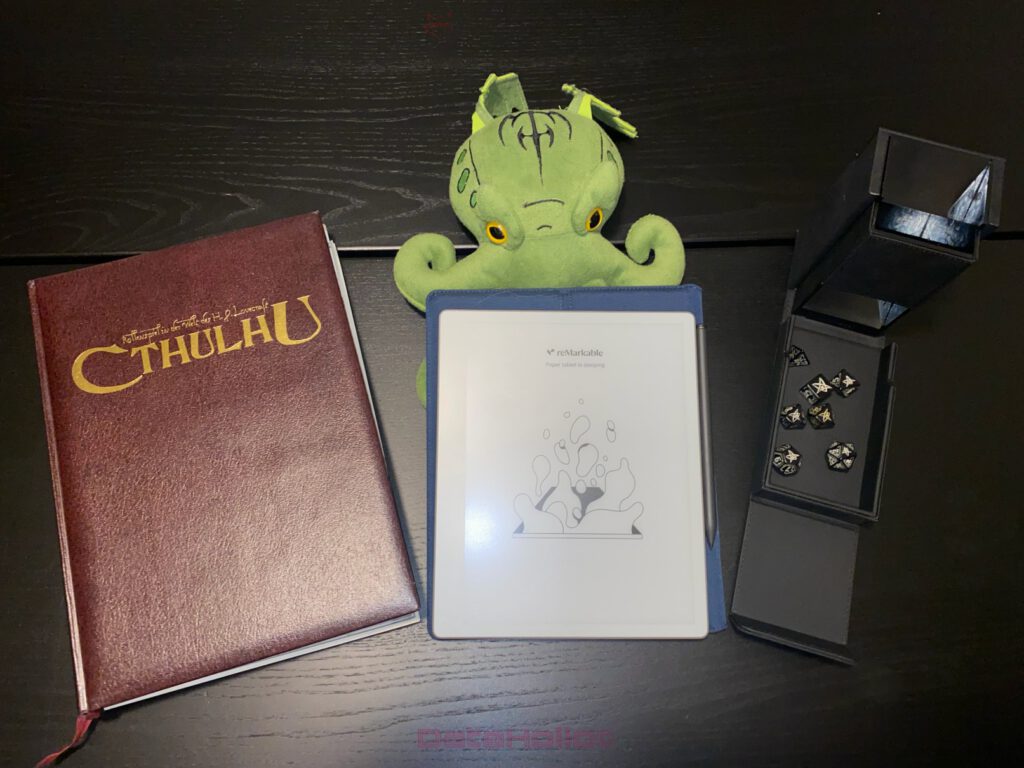
At first glance, an E-Paper note-taking device seems like the opposite of humor. It is gray, quiet, factual, and almost Protestant in its discipline. And yet the funny moments emerge precisely where digital order meets real everyday life. There lies a minimalist writing tablet next to dice, keyboard, mouse pad, stacks of books, and a plush Cthulhu that looks as if it has just reviewed the cloud synchronization of the Great Old Ones. Technology does not always have to be presented clinically. A device proves everyday suitability not in a sterile render image, but between dust fluff, sticky note, cables, and coffee cup.
The Paper Pure handles such environments well. It does not seem sensitively offended when it is not lying alone on a perfectly lit designer desk. It fits next to textbooks as well as role-playing materials. Especially with role-playing, research, campaign planning, or long PDF documents, an underestimated use becomes apparent: the device can bundle material without filling the table further with paper. Notes, map ideas, NPC lists, handouts, rule references, and sketches land in one place. An old game master saying goes something like: “Preparation is everything until the group enters the first room.” The Paper Pure does not solve that problem. But it does ensure that at least the preparation remains findable.
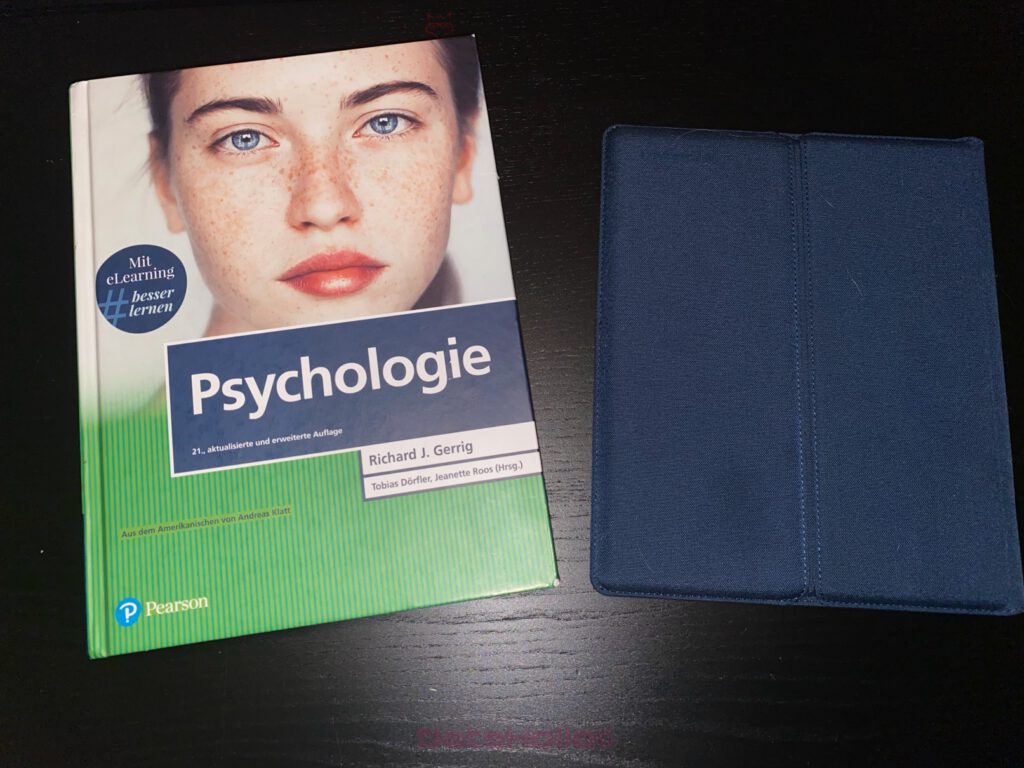
The device also fits well in learning contexts. Highlights, handwritten summaries, structure sheets, and exported documents can be worked through with concentration. The lack of a distraction apparatus helps precisely where reading and writing should not happen on the side. Anyone who has ever tried to study seriously with a normal tablet knows the gradual slide from technical text to browser to video to a completely different topic. The Paper Pure builds fewer exits into that path.
Repairability, Material, and Quiet Progress
Alongside format and weight, the Paper Pure’s material choices also stand out. reMarkable does not simply aim for maximum premium coolness, but for a construction that is intended to feel lighter and more suitable for everyday use. Plastic components and more repair-friendly approaches are not a minor point in an industry that likes to glue, seal, and disguise devices as electronic waste after only a few years. Sustainability does not arise only from recycled materials, but from repairability, long usability, and accessories that survive daily life.
The device still does not feel cheap. The cover additionally stabilizes the overall impression. Together, they create a working tool that is less showpiece and more instrument. This direction fits the Paper Pure better than a pure luxury presentation. A note-taking device is used, not admired. It should open, respond, save, sync, and disappear again. The Paper Pure fulfills this simple chain very cleanly.
The long battery life also contributes to sustainability in the small everyday sense. Fewer charging cycles, less dependency on power adapters, less constant energy management. That sounds unspectacular, but it is part of a calmer device concept. The technological progress here does not lie in flashy acceleration, but in reduced friction. The Paper Pure becomes faster, lighter, more practical, and still remains true to its basic promise: write like on paper, work without distraction.
Limits Without Drama
A good look at the Paper Pure must clearly name the limits without turning them artificially into a problem. The missing backlight remains the most obvious limitation. In dark environments, an external light source is required. That is part of the truth of the device. Color is also absent, which can be relevant for comics, colored diagrams, highlights, or creative applications. Anyone wanting to read large colorful PDF presentations or magazines will find more suitable devices elsewhere.
The deliberate lack of an open app platform is also both a blessing and a limitation. Concentration remains intact, flexibility remains limited. The Paper Pure is not an Android tablet with an E-Ink display and countless installation options. It is a closed writing and reading system. Anyone seeking maximum customization will hit limits sooner. Anyone seeking a stable, quiet tool benefits precisely from that.
It is also important to note that the best use emerges with clear expectations. The Paper Pure does not replace a notebook computer and does not replace a full-fledged e-reader for every situation. It replaces stacks of notebooks, printed PDFs, loose sheets, and partly also the unhealthy habit of reading every text on a glowing monitor. In this role, it is strong. Outside this role, it remains deliberately reserved.
Why the Paper Pure Does Not Need to Win Loudly
Many technical products try to impress through specifications. More hertz, more cores, more brightness, more colors, more cameras, more AI, more everything. The Paper Pure takes a different path. It does not win through excess, but through precision in its intended use. Small, light, quickly at hand, direct in input, strong in sunlight, enduring in battery life, cleanly integrated with app, plug-in, and cloud. Add to that a very good Marker Plus and a sturdy cover that only truly makes the device suitable for everyday use.
This approach feels almost old-fashioned, but in truth it is quite modern. Modern technology does not have to fill every gap. It may also leave spaces open. The Paper Pure creates such a space. It is a device for thoughts, not for distraction. For notes, not for notifications. For longer texts, not for short chains of stimuli. For focused work, not for digital constant noise.
The strongest quality of the Paper Pure therefore does not lie in a single data-sheet point. It lies in the interplay of hardware, surface, pen, battery life, and reduced software. The device feels complete even though it cannot do many things. Or more precisely: because it does not want to do many things. In a technology world where every device increasingly sounds like a universal tool, a specialized writing device almost feels bold.
Data Privacy and Connect: Transparency Instead of a Black Box
One aspect deserves particular attention when discussing a digital notebook: the way personal data is handled. Handwritten notes are no longer limited to shopping lists or quick reminders. Project documentation, meeting minutes, lecture notes, personal ideas, confidential information, and business documents all find their way onto an E-Paper device. As a result, expectations regarding data privacy and security are understandably high.
Upon request, reMarkable provided a refreshingly transparent explanation of its approach. Content synchronized through the Connect service is stored by default on Google Cloud servers located within the European Economic Area (EEA). All data is encrypted both during transmission and while stored at rest. These two measures alone establish a solid foundation for everyday use, particularly in professional and academic environments where confidentiality is often essential.
International data transfers are addressed just as openly. reMarkable explains that data may, in specific situations, be transferred outside the European Economic Area when required to ensure the proper operation of its services. At the same time, the company emphasizes that every such transfer is carried out in compliance with the General Data Protection Regulation (GDPR) and other applicable international data protection requirements. Appropriate contractual safeguards and legally recognized protection mechanisms are in place with all relevant service providers to ensure a consistently high level of security.
Equally important is reMarkable’s statement that responsibility for customer data is not simply delegated to Google or other infrastructure partners. According to the company, reMarkable remains fully responsible for ensuring that personal information is processed appropriately, even when external cloud providers are involved. To support this commitment, contractual agreements have been established with all relevant partners to maintain a high standard of data protection.
This level of transparency is far from common. Many manufacturers rely solely on generic privacy statements without providing concrete information about storage locations or technical implementation. reMarkable chose a different approach by answering these questions directly and in a comprehensible manner. For a device that is frequently used to store professional notes, academic research, personal journals, or confidential documents, this openness creates an additional level of trust. The Paper Pure therefore presents itself not only as a tool for focused writing and reading, but also as a platform that treats data privacy with the level of importance a modern digital notebook should offer in 2026.
The Clean Final Line
The reMarkable Paper Pure is a small, lightweight, and remarkably consistent E-Paper device for handwritten notes, quiet reading, and focused document work. Its fast writing response, the excellent Marker Plus with eraser function, the sturdy folio, the long battery life, and the outstanding readability in direct sunlight come together to form a well-balanced overall package. The integration with the reMarkable app, seamless data synchronization, and the ability to send Microsoft Word documents and web pages directly to the device via the browser extension make the Paper Pure far more than just a digital notepad with an attractive design.
The lack of a built-in front light remains the primary compromise. The device excels in bright environments and daylight but is less suited to dark rooms. However, this limitation perfectly matches the philosophy behind the Paper Pure. It was never designed to be another glowing tablet, but rather a digital paper tool. Anyone looking for exactly that concept will find an exceptionally clear, calm, and highly portable companion.
The Paper Pure shines wherever technology is not supposed to dominate the moment. It supports writing, organizing, reading, annotating, and carrying ideas without demanding attention itself. It never feels intrusive, does not overload everyday life, and deliberately stays away from the attention economy that has turned so many modern devices into permanent sources of distraction. Positioned somewhere between a computer, a smartphone, and a traditional notebook, it occupies a unique and genuinely useful space. Not as a replacement for everything, but as the right tool for precisely those moments when less truly becomes more.
After spending considerable time with the Paper Pure in everyday life, another effect gradually becomes apparent: it quietly works its way into routines where paper, a laptop, a tablet, or even a smartphone would previously have been the default choice. At trade shows, presentations, product launches, university lectures, during product reviews, and even around the tabletop during role-playing sessions, it quickly becomes so natural to use that going back hardly feels worthwhile. Notes appear without the clatter of a keyboard, sketches emerge without stacks of paper, and meeting points are captured without the glow of a conventional display. Particularly in situations where concentration should remain undisturbed, the Paper Pure becomes less of a gadget and more of a trusted companion.
This experience aligns surprisingly well with the ideas presented by Cal Newport in Digital Minimalism: Choosing a Focused Life in a Noisy World. The Paper Pure is not about escaping technology—it represents a more deliberate way of using it. Setting aside thirty minutes every day without a smartphone, smartwatch, notifications, or the endless stream of digital interruptions fundamentally changes the perspective on technology. During this daily break, only the reMarkable Paper Pure is allowed—and expected—to come along. It is in those quiet moments that the device reveals its greatest strength. It remains a piece of technology, yet without the constant noise that usually accompanies it. It captures thoughts without creating new distractions. It supports concentration instead of fragmenting it. That is precisely why it becomes remarkably difficult to put the Paper Pure back down once it has found its place in everyday life.
Quote by Marcel Bauschke: “The reMarkable Paper Pure is one of the ten items that would always make the trip to a deserted island with me.”
Notice in accordance with EU transparency requirements:
The reMarkable Paper Pure presented in this review was provided to us by reMarkable as a non-binding loan unit for testing purposes. This is not paid advertising.
reMarkable had no influence on the content, evaluation, or editorial independence of this article. All opinions expressed are based solely on our own practical experience.
We would like to sincerely thank reMarkable for providing the Paper Pure and for the trust placed in dataholic.de.