
Noctua NF-A12x25 G2 PWM chromax.black in unboxing and verdict: Black refinement for a fan that is more than rotating air
- When a 120-millimeter fan is not just a fan
- Packaging: Black, red, restrained, and surprisingly close to the technology
- First contact: No RGB, no theater, but material feel
- Accessories: Small parts, big effect
- Construction: The rotor as the real main character
- Sx2-PP: Two fans, but not simply doubled
- Installation: The difference between installing and integrating cleanly
- Acoustics: Not only quiet, but controlled
- Performance: Pressure, airflow, and the art of compromise
- chromax.black: Finally without visual compromise
- Build quality: Premium shows itself in the unspectacular places
- Price and target group: Expensive, but not arbitrarily expensive
- A small anecdote from the world of PC fans
- Verdict: A fan for systems that should not sound like compromise
- Transparency notice in accordance with EU requirements:
When a 120-millimeter fan is not just a fan
The Noctua NF-A12x25 G2 PWM chromax.black arrives in a product category that could hardly seem more understated at first glance: a 120-millimeter fan, four screw holes, a 4-pin PWM cable, a rotor, a frame, done. In practice, precisely this apparent simplicity is where the appeal lies. PC fans are among those components that rarely receive applause, but immediately stand out as soon as they perform poorly. A good fan disappears acoustically, remains thermally present, and only becomes visually noticeable when the case window is very honest. A bad fan does the opposite: it whines, rattles, vibrates, hits unfavorable resonances, and at certain speeds sounds like a bad-tempered drone in a shoebox.
Over the years, Noctua has built a reputation that is remarkably stable, especially in this understated category. The classic beige-brown fans from the Austrian company have long been more than just cooling components. They are memes, identifiers, points of debate, and a promise of quality all at once. In a world where many PC components try to look as aggressively illuminated and angular as possible, or where every product photo looks like an e-sports bunker, Noctua’s color scheme long felt like a technical interjection from another era. “Form follows function” would have fit as a motto, only with the addition: function yes, color consultation later. That is exactly why the chromax.black version of the NF-A12x25 G2 PWM is more than a simple color change. It brings the technical idea of the second A12x25 generation into a format that integrates more easily into modern builds without giving up Noctua’s typical claim to quality.
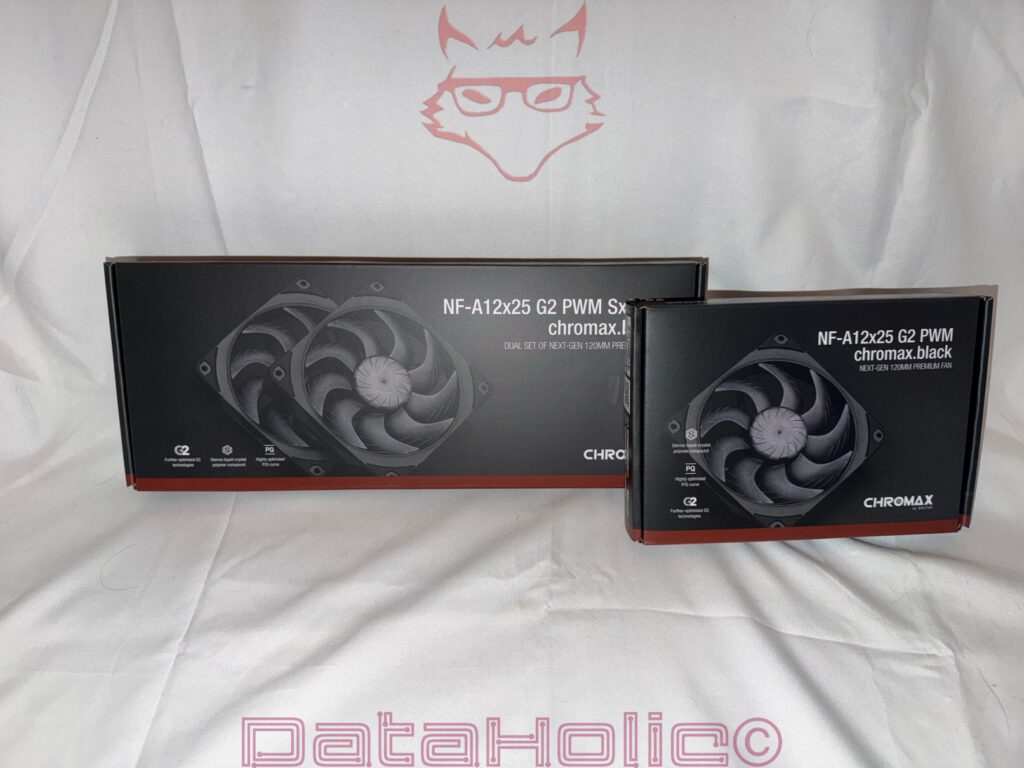
On the table are two variants at once: the single NF-A12x25 G2 PWM chromax.black and the Sx2-PP set with two fans. That matters because Noctua has not simply placed a dual pack into a longer box here. The Sx2-PP set works with slightly offset speeds in order to reduce acoustic interference in push-pull configurations or with fans mounted side by side. According to Noctua, the speed offset is around plus/minus 50 revolutions per minute. Especially with radiators, closely positioned front fans, or dual-fan setups, this small difference can determine whether the result is a uniform airflow noise or periodic humming. The technical punchline is therefore not in the number, but in the tuning.
Packaging: Black, red, restrained, and surprisingly close to the technology
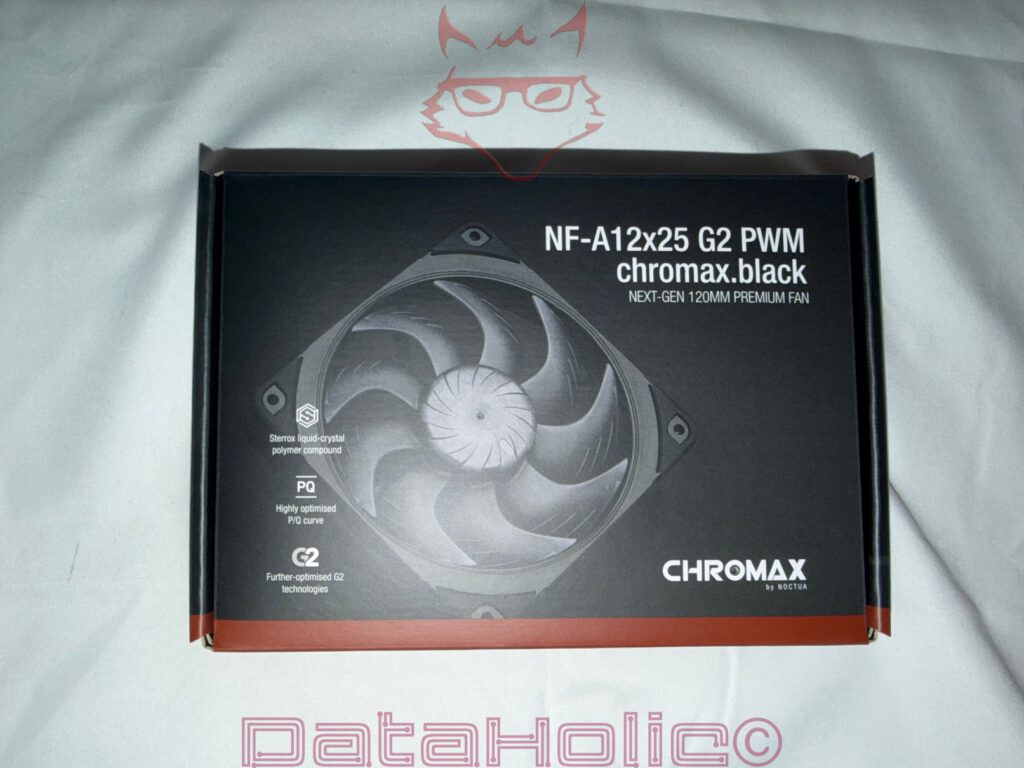
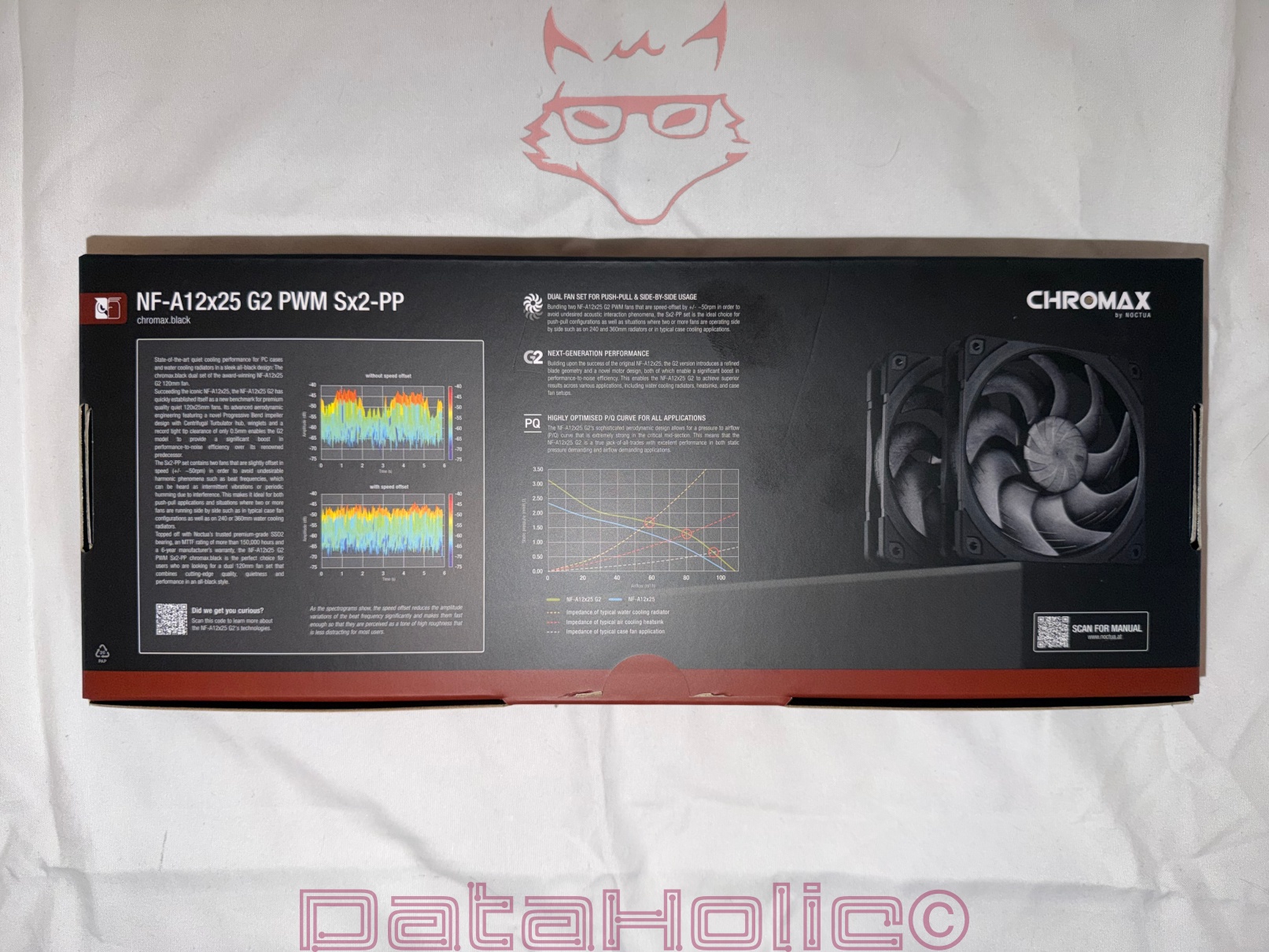
The packaging of the NF-A12x25 G2 PWM chromax.black has a noticeably different appearance from the classic Noctua boxes of earlier years. Instead of beige-brown engineering nostalgia, black dominates, complemented by a dark red strip along the lower edge. The front shows the fan prominently, almost like a shadow, with bright lettering and clearly placed typography. It looks less like a loud gaming appearance and more like technical tool packaging that no longer has to explain why it is expensive. The central keywords are printed on the front: Sterrox Liquid-Crystal Polymer Compound, optimized P/Q curve, G2 technologies. This is not decorative language, but an attempt to anchor the actual construction directly on the packaging.
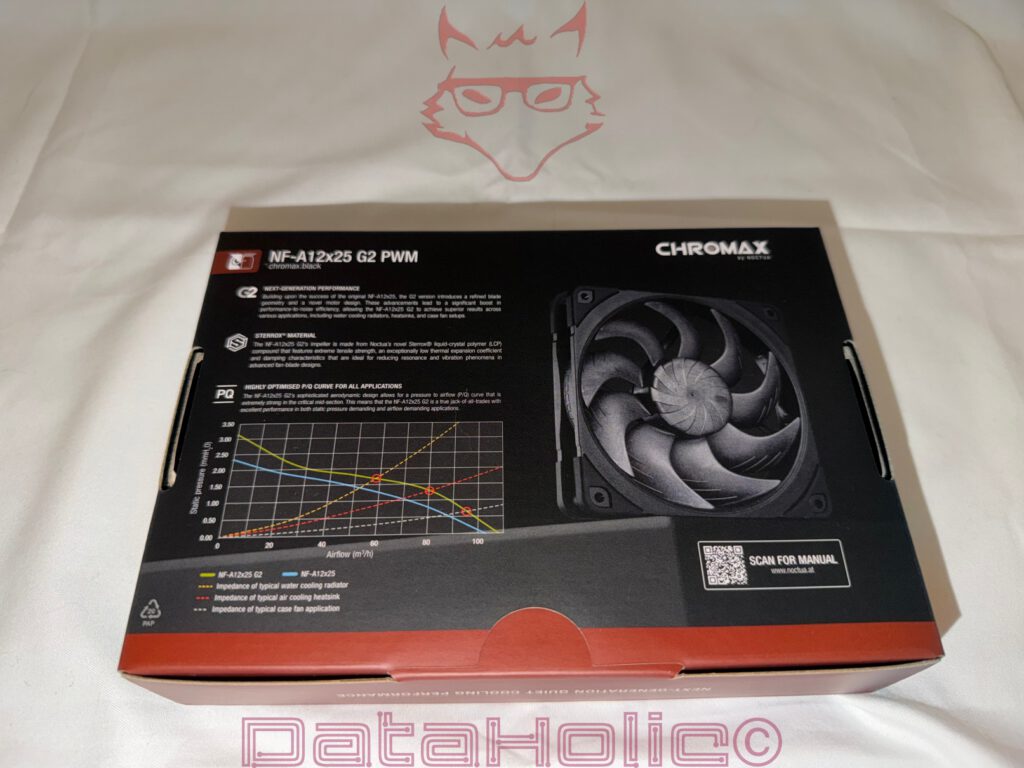
What stands out particularly positively is that Noctua does not fall into the trap of pure lifestyle packaging, even with the chromax.black series. The back uses the available space for technical context. There are diagrams, notes on application areas, and an explanation of why the NF-A12x25 G2 is interesting not only as a case fan, but also on radiators and heatsinks. The P/Q curve is at the center of this. It describes the relationship between airflow and static pressure, meaning precisely the trade-off that has accompanied PC fans for decades. A lot of airflow in open space is of little help once a dense radiator, a dust filter, or a tightly packed tower cooler is in the way. High static pressure alone is also not a cure-all if the sound profile becomes annoying or the fan moves little volume at low speeds. The NF-A12x25 G2 attempts to bring these two worlds together.
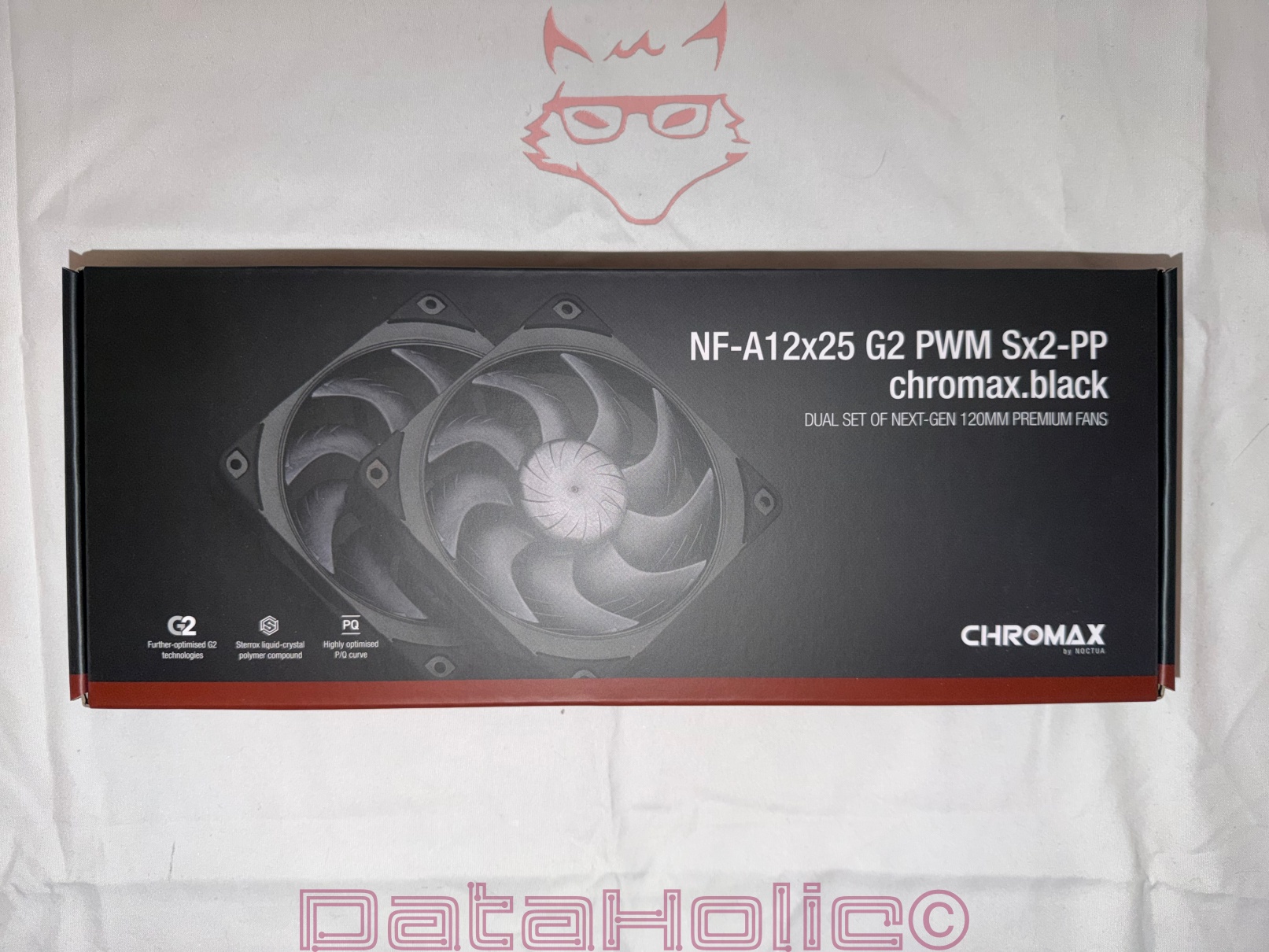
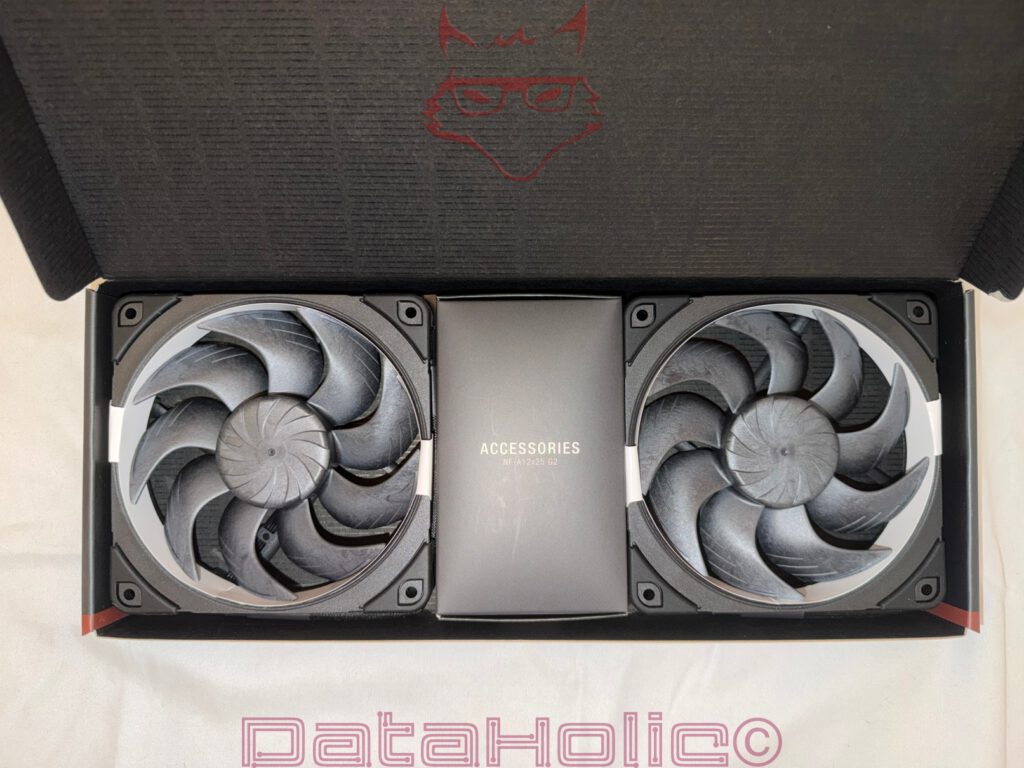
The larger Sx2-PP package initially seems almost exaggerated in its length for two 120-millimeter fans. After opening it, the need for space becomes immediately clear. The two fans sit cleanly separated from each other in the cardboard structure, with the accessory box positioned between them. This feels less like a simple retail package and more like a small technical set in which every part has a defined task. The presentation remains restrained, but not careless. The first impression fits Noctua quite well: no show effect, no transparent plastic window, no RGB promises, but packaging that, in the best sense, looks like “nothing has been forgotten here.”
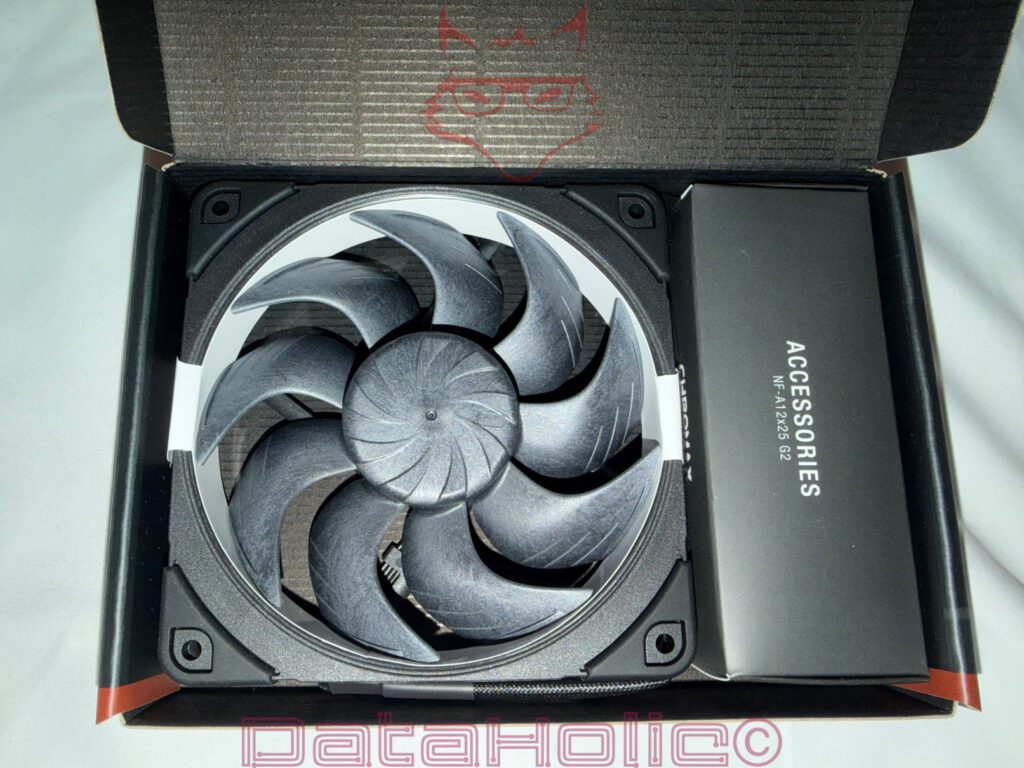
In the single NF-A12x25 G2 PWM chromax.black box, the fan also sits precisely fitted. Next to the rotor area is the accessory box, clearly marked as such. Already when opening the box, it becomes clear that Noctua does not understand the fan merely as a rotating component, but as a small mounting system. Cables, adapters, decoupling, and sealing frame are not supporting actors here, but part of the functional chain. A fan can be aerodynamically excellent; mounted incorrectly, poorly decoupled, or routed with an unsuitable cable path, part of that quality is lost directly at the installation point. This is exactly where Noctua’s attention to detail begins.
First contact: No RGB, no theater, but material feel
The NF-A12x25 G2 PWM chromax.black leaves a very distinct impression when lifted out of the box. There are countless black fans, but the Noctua does not look like just any black case fan. The surface of the rotor has a lightly structured, almost fibrous appearance. This is due to the Sterrox LCP material used, a liquid-crystal polymer that Noctua already highlighted as a central element in the original NF-A12x25. The reason is technically understandable: with very tight clearances between the rotor blade tips and the frame, the rotor needs high dimensional stability. Any expansion, any deformation, any manufacturing tolerance can otherwise become an acoustic or mechanical disturbance. With the NF-A12x25 G2, Noctua stays with this material approach and combines it with a revised geometry.
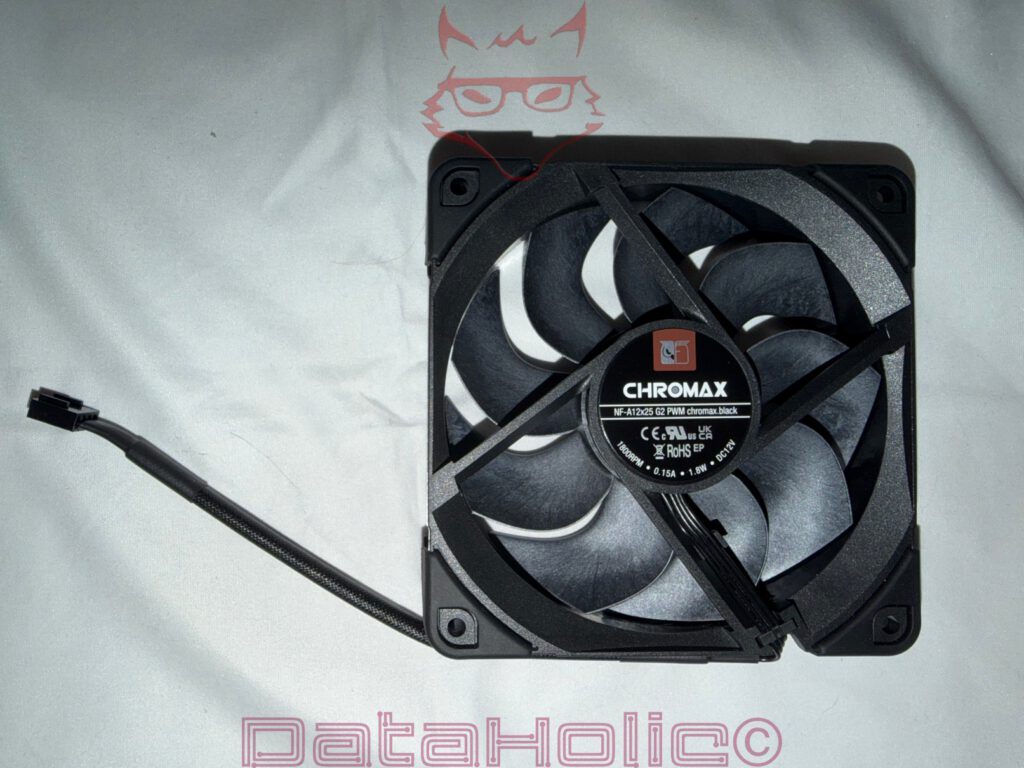
The fan has a classic 120 x 120 x 25 millimeter format and therefore remains compatible with the usual case, cooler, and radiator positions. The maximum speed is 1800 revolutions per minute, the maximum airflow is 107.3 cubic meters per hour or 63.15 CFM, the maximum static pressure is 3.14 mm H₂O, and the maximum noise specification is 22.5 dB(A). In addition, there are 12 volts nominal voltage, a 4-pin PWM connector, 1.8 watts maximum power consumption, and 0.15 amps maximum current draw. Noctua also specifies an SSO2 bearing, an MTTF rating of more than 150,000 hours, and a six-year manufacturer warranty.
These figures read dryly, but they are crucial for classification. The NF-A12x25 G2 PWM is not a pure high-speed fan that forces performance through speed. It belongs to the category that has to convince at medium and low speeds. That is exactly where everyday use decides whether a system remains pleasant. 1800 revolutions per minute provide reserves, but the actual charm lies below that. According to Noctua, the fan can be controlled via PWM down to around 360 revolutions per minute at a 20 percent PWM signal and can stop completely at 0 percent. Modern motherboards in particular, which regulate case fans very finely depending on temperature, benefit from this wide range.
Visually, the chromax.black version is the decisive step. Noctua’s technology was never the problem, the color scheme was. The brown-beige original aesthetic has cult status, but cult is not automatically compatible with every build. In an all-black case with a dark motherboard, black graphics card, black radiator, and tinted side panel, the classic Noctua look often appeared like a friendly foreign object. The chromax.black version solves exactly this problem without visibly diluting the construction. Rotor, frame, cable, accessories, and decoupling remain dark. As a result, the fan no longer has to justify its color.
Accessories: Small parts, big effect
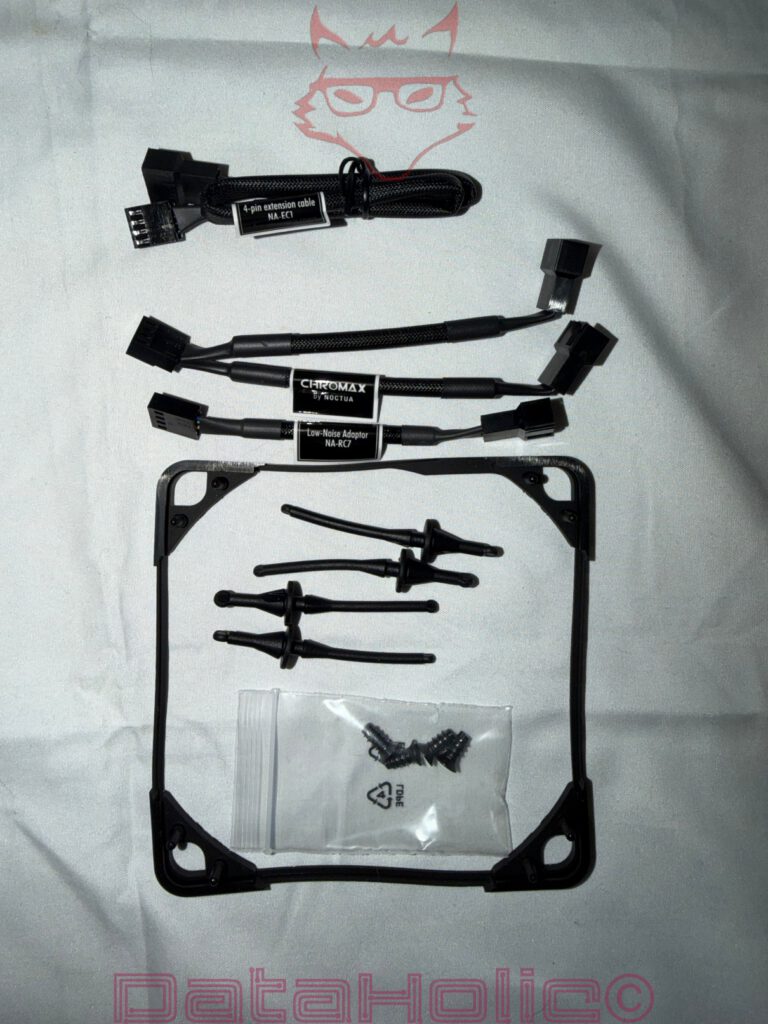
Noctua has traditionally been strong when it comes to accessories, and the NF-A12x25 G2 PWM chromax.black confirms that. The box includes, among other things, a 4-pin extension cable, a Low-Noise Adapter, a Y-cable or suitable connection options depending on the set, anti-vibration mounts, screws, and a black sealing frame. This frame in particular is interesting for radiators because it improves contact between the fan and the cooling surface and can reduce air losses at the edges. With radiators, it is not only important how much air a fan can generally move. What matters is how much of this air is actually pushed through the fins instead of escaping sideways through gaps.
The included anti-vibration mounts are also more than a nice addition. Rigid screw mounting works reliably, but it can potentially transfer vibrations to the case or radiator. Especially thin side panels, large mesh areas, or light case fronts can amplify small vibrations. Decoupling reduces this risk. That sounds banal, but in practice many annoying noises do not come directly from the bearing or rotor, but from resonances in the case. A fan can run technically cleanly and still be annoying as soon as a sheet-metal panel, a front cover, or a radiator frame starts resonating. The small rubber parts are therefore acoustic prevention.
At first glance, the Low-Noise Adapter seems almost old-fashioned in the age of modern PWM control. Many motherboards can set fan curves precisely, store profiles, and regulate via temperature sources. Nevertheless, such an adapter remains useful. It limits the speed on the hardware side and can be helpful in systems whose fan control works too coarsely or whose BIOS does not offer clean regulation. It also creates a kind of safety net against accidentally aggressive curves. Especially in an office or living room PC, maximum thermal reserve is not always the goal, but rather a reliable acoustic limit.
The fan cable is kept short and cleanly sleeved. That is smarter than attaching a permanently long cable to every fan. In cases with nearby fan hubs or radiator mounting directly on the motherboard, long cables get in the way. For greater distances, the extension helps. This keeps the actual fan clean and flexible. The connectors sit firmly without feeling unpleasantly rough. With the Sx2-PP set, the accessories pay off particularly well because two fans are often connected together, routed together, or used together on a radiator. The difference between clean cable routing and cable chaos determines, especially in tight top-mounted radiator installations, whether an installation is pleasant or unnecessarily fiddly.
Construction: The rotor as the real main character
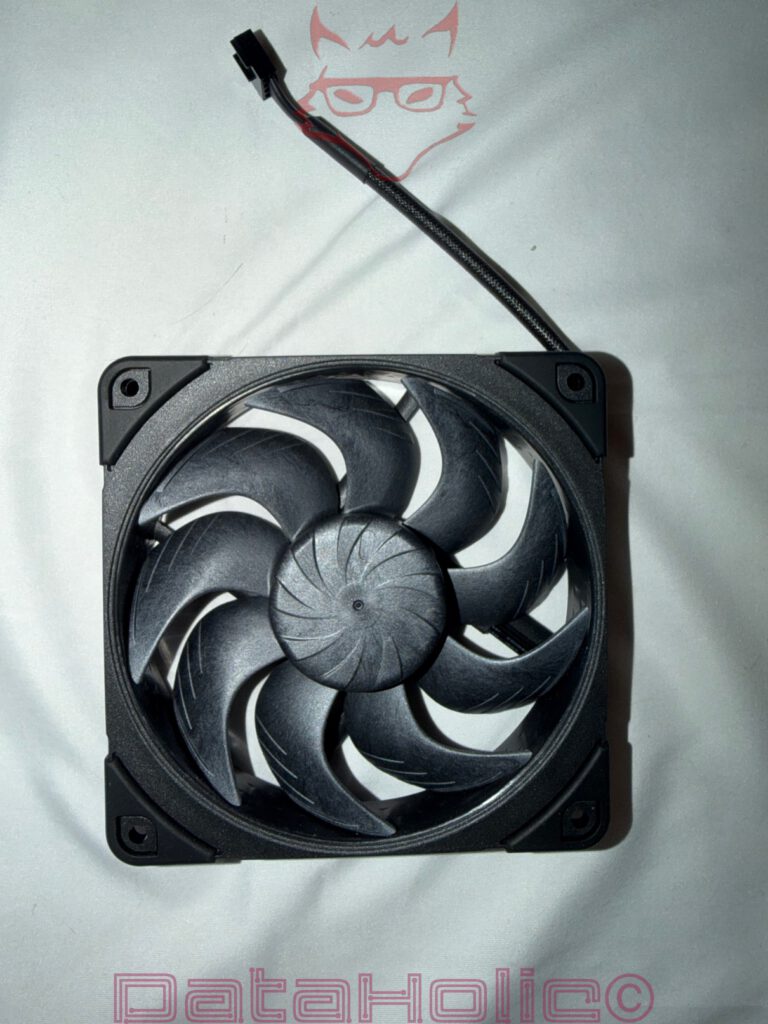
The NF-A12x25 G2 PWM chromax.black already shows visually that Noctua has not drawn the rotor according to a standard recipe. The blades have a strongly developed curvature, small structures, and a shape intended to combine airflow guidance, pressure buildup, and noise behavior. Noctua refers to the G2 generation with terms including Progressive-Bend blades, winglets, Flow Acceleration Channels, and a Centrifugal Turbulator Hub. These terms sound like marketing, but they actually describe different interventions in the airflow.
In a PC fan, noise does not arise only from speed. It arises from turbulence, pressure changes, blade-tip vortices, interaction with the frame, and obstacles directly in front of or behind the fan. Every cooler, every radiator, and every dust filter changes the behavior. A fan that sounds pleasant on an open table can suddenly behave differently behind a dense front filter. Likewise, a fan optimized for static pressure can seem unnecessarily present in a free case position. Noctua’s approach with the NF-A12x25 has always been to avoid separating these application areas too strictly. The G2 continues this idea: one fan for radiators, coolers, and cases, without visibly becoming a specialist with blinders in one discipline.
The tight blade-tip guidance is central here. The smaller the gap between rotor blade and frame, the less air can flow back at the blade tip. This helps pressure buildup and improves efficiency, but places high demands on material and manufacturing. A softer rotor or one that changes more with heat would be risky because contact could occur at high speeds or during temperature changes. The Sterrox LCP material is therefore not a pretty datasheet detail, but part of the functional logic. The fan wants to run with tight tolerances, so it needs a material that makes this tightness controllably possible.
The frame itself feels torsionally stiff and cleanly made. The corners with decoupling pads are neatly integrated, the edges show no rough burrs, and the feel remains high-quality. The rear with the struts is also typical Noctua: functional, stable, without visual gimmicks. The sticker on the hub lists the relevant data and fits into the black look. What stands out is how little the fan tries to force attention. Especially compared with RGB fans with transparent rotors, illuminated rings, or mirrored hubs, the NF-A12x25 G2 PWM chromax.black almost seems dry. That is exactly where its strength lies. It does not want to be part of a light show, but part of a thermally and acoustically clean system.
Sx2-PP: Two fans, but not simply doubled
The Sx2-PP set deserves its own classification because, at Noctua, it does not merely appear as a practical dual pack. Two identical fans side by side or one behind the other can become acoustically problematic if they run at exactly the same or very similar speeds. This can lead to beats, interference, or periodic hum components that are significantly more annoying than a uniform rushing sound. This phenomenon is not new in the PC sector, but it is rarely addressed directly in the product concept. Many manufacturers deliver multi-packs; Noctua delivers a pair with deliberately offset speed characteristics.
The offset of around plus/minus 50 revolutions per minute sounds unspectacular. In practice, exactly this small shift can prevent two fans from hitting the same acoustic rhythm. It is a bit like two washing machines in spin cycle that are not running exactly the same: synchronized running can amplify itself, a minimal difference can calm things down. In a PC case, the scale is of course smaller, but the principle remains understandable. Especially on 240- or 360-millimeter radiators, where several fans sit directly next to each other, such a detail can become audible.
Push-pull configurations are also an obvious application. In this setup, one fan sits in front of the radiator and pushes air in, while a second fan pulls from the other side. This can improve airflow through dense fins, but it also increases complexity. Two fans, two noise sources, two bearings, two rotors, two interaction surfaces. A matched pair seems more sensible here than two randomly combined single models. The Sx2-PP approach shows that Noctua looks not only at individual performance, but also at behavior in combination.
The larger package presents the two fans mirrored on the left and right, with the accessory box in the center. This layout is practical and looks pleasantly tidy. The impression when opening it is almost a little ceremonial, even though, soberly speaking, it is only two fans. “Small cause, big effect” fits better here than any superlative formula. In a heavily dampened system where the graphics card remains the loudest component under load, the difference may barely stand out dramatically. In a quiet work machine, an open mesh case, or a radiator setup with low speeds, an unsettled tone can quickly become annoying. That is exactly where the Sx2-PP set plays out its idea.
Installation: The difference between installing and integrating cleanly
Installing a 120-millimeter fan is actually one of the simpler PC tasks. Four screws, check direction, connect cable, set fan curve. Nevertheless, premium fans repeatedly show that the actual quality becomes visible not only in operation, but also in the installation environment. The NF-A12x25 G2 PWM chromax.black offers several paths: classic screws, decoupling pins, sealing frame for radiators, cable extension, adapter. This allows the fan to be used in very different ways.
As a case fan in the front, the Noctua benefits from its broad design. Behind a dust filter, a fan needs more pressure reserve than in a free rear exhaust. At the same time, the sound profile must not tip over as soon as the front opening is narrow or the airflow has to pass through mesh, filter, and plastic struts. The NF-A12x25 G2 is interesting precisely for such mixed situations. As a rear fan or top fan, even airflow at low speed matters more. It also fits well there thanks to its broad PWM range.
On a radiator, the sealing frame becomes more important. Air seeks the path of least resistance. Every small gap between the fan frame and the radiator surface can cause pressure to be lost. The included frame helps make these transitions cleaner. With very thick or dense radiators, of course, the total surface area, fin density, and pump or loop performance remain decisive. A fan alone does not turn a weak radiator into a miracle device. But the NF-A12x25 G2 provides the right foundation: pressure, controlled noise, and geometry that is not designed only for free airflow.
The airflow direction is clearly recognizable from the frame shape and rotor, and the usual markings on the fan frame also help. The sleeved cable makes clean routing easier because it does not visually fall out of the black build. The short cable length directly on the fan reduces excess, while the extension provides enough room when needed. Especially with radiators in the top or front area, this modularity is valuable. A fixed long cable would have to be stowed somewhere; a cable that is too short would immediately become an annoyance. Noctua chooses the better middle ground.
Acoustics: Not only quiet, but controlled
With a Noctua fan, attention almost automatically turns to noise level. But pure dB(A) values tell only part of the story. Two fans can achieve the same measured value and be perceived completely differently. A uniform, broadband rushing sound is significantly less disturbing than tonal whistling, clicking, scraping, or periodic humming. That is exactly why the sound profile is more important than the bare number. The NF-A12x25 G2 PWM chromax.black aims for controlled airflow and clean running, not for the most spectacular maximum values possible.
The manufacturer’s specification of 22.5 dB(A) at maximum speed places the fan in a very quiet range, although under standardized conditions. In a case, the result depends on mounting position, obstacles, fan curve, and surroundings. A top radiator directly under perforated steel sounds different from a free rear exhaust. A front filter with fine mesh can generate airflow noise that does not come from the bearing. A poorly decoupled case can amplify vibrations. Still, due to its calm basic character, the NF-A12x25 G2 remains a very strong candidate for quiet systems.
The wide control range is decisive in everyday use. At low load, the fan can be regulated very far down or stop completely, provided the controller supports it. This makes it suitable for systems intended to remain almost silent during office use. Under load, enough reserves are available without immediately jumping into unpleasant speed ranges. A gentle fan curve with a slow rise is particularly sensible. The fan does not have to react nervously to every short temperature spike. Modern CPUs boost quickly, and temperature peaks often last only seconds. A curve that is too aggressive turns this into acoustic fidgeting. The NF-A12x25 G2 deserves a control setup that uses its smoothness instead of wasting it through hectic jumps.
The Sx2-PP set additionally addresses acoustic interference. Two fans with minimally offset speeds can feel more uniform than two models running exactly the same. That is not a magic trick, but acoustic damage control. Especially in quiet setups, it matters not only whether a fan is quiet, but whether several fans remain pleasant together. In this regard, Noctua shows an unusual amount of practical awareness. Many annoying PC noises do not arise from one poor component, but from several good components that together hit an unfavorable frequency.
Performance: Pressure, airflow, and the art of compromise
The NF-A12x25 G2 PWM chromax.black is not a specialist fan with a narrowly defined application area. That makes its classification interesting. Traditionally, there were long two schools of thought: fans with high airflow for case ventilation and fans with high static pressure for radiators or heatsinks. In practice, however, modern systems are rarely so cleanly separated. Front fans sit behind filters, bottom fans work against PSU shrouds, radiator fans sit in tight top sections, and CPU coolers need pressure and airflow at the same time. A good all-rounder is therefore often more valuable than a fan that shines only in a laboratory case.
With 107.3 cubic meters per hour maximum airflow and 3.14 mm H₂O static pressure, the NF-A12x25 G2 brings values that seem very strong for a 120-millimeter fan without driving speed into extreme regions. What remains decisive, however, is behavior along the curve. A fan that impresses only at maximum speed is less attractive in everyday use. The Noctua aims to maintain its efficiency over a broad range. The P/Q curve shown on the packaging makes exactly this claim visible: it is about a balanced pressure-airflow characteristic.
On radiators, the fan should be particularly interesting when low to medium speeds are desired. There, pressure reserve, sealing at the frame, and a calm sound profile matter. On air coolers with dense fin structures, the same applies. As a case fan, it offers the advantage of not immediately collapsing even with obstacles. This also partly puts the price into perspective: a fan that works well in several roles is more flexible than a cheap specialist that has to be replaced with the next case rearrangement.
Still, a clear classification is necessary. The NF-A12x25 G2 PWM chromax.black is not a magical problem solver for poor case ventilation. A case with a blocked front, too little distance from the wall, or chaotic airflow will become better with premium fans, but not automatically good. Air needs paths. Clean airflow arises from intake area, exhaust area, cable organization, fan position, heat sources, and fan curves. The Noctua is a strong tool, but not a substitute for system understanding. “A fool with a tool is still a fool” fits surprisingly well here as a workshop saying, even if the fan itself certainly cannot be blamed for that.
chromax.black: Finally without visual compromise
The chromax.black version is the actually decisive variant for many builds. Noctua’s classic color scheme was never accidental, but it was also never universal. In a closed case, it did not matter. In an open test system, it had recognition value. Behind glass, depending on taste, it could appear charming, idiosyncratic, or simply disruptive. Black fans are the lowest common denominator in PC building, but exactly for that reason they are so practical. They visually disappear where they are supposed to disappear.
The NF-A12x25 G2 PWM chromax.black solves this issue elegantly. The fan does not look like a compromise colored after the fact, but like an independent product. The black surface matches the frame, the cable, the accessories, and modern components. The white accents in the rotor area, which show through depending on the viewing angle, add a slight contrast without disturbing the overall look. Especially in the Sx2-PP set, a very clean impression emerges when two identical black fans sit next to each other.
What is interesting is that with chromax.black, Noctua does not try to completely erase its own character. The product remains recognizable as Noctua, just no longer through beige and brown. The brand identity shifts more strongly from color to construction: rotor shape, packaging, accessories, technical specifications. For users with show builds, dark workstations, or reduced setups, this is important. Quality no longer has to be weighed against appearance. The sentence “Noctua would be perfect if it weren’t for the color” loses a lot of weight with this version.
Build quality: Premium shows itself in the unspectacular places
The build quality of the NF-A12x25 G2 PWM chromax.black appears consistently high-quality. The frame lies flat, the corners are cleanly executed, the pads sit properly, the rotor runs freely, and the cable sleeving looks neat. Such details sound boring until a fan does not fulfill them. Crooked decoupling, flimsy frames, poorly routed cables, or uneven rotors stand out immediately during installation. Noctua delivers the expected care here.
The overall tuning of fan and accessories is particularly convincing. The sealing frame does not feel like a token part, but like a seriously intended component for radiator operation. The rubber mounts are usable in a clean way. The screws fit. The adapters are neatly labeled. This sounds like small stuff, but premium rarely comes from one single spectacular feature. Premium arises when many small friction points never appear in the first place.
Another point is the long-term perspective. Noctua specifies an MTTF of more than 150,000 hours and a six-year warranty. Such figures do not replace a long-term test in a specific case, but they show the positioning. A fan of this class is not bought for a quick budget build, but for systems intended to remain quiet and reliable for years. This is exactly where the price becomes more relative than with components that have a short trend half-life. RGB trends change, sockets change, case shapes change. A good 120-millimeter fan can survive several system generations.
Price and target group: Expensive, but not arbitrarily expensive
Noctua fans do not belong to the inexpensive category. That also applies to the NF-A12x25 G2 PWM chromax.black. The price is a real factor, especially when a case is to be equipped with three, four, or six fans. In such scenarios, the fan inventory quickly reaches sums for which solid CPU coolers, larger SSDs, or PSU upgrades are already available. That is why the NF-A12x25 G2 needs an honest target group assessment.
It makes sense for systems where noise, temperature, and reliability truly matter. These include quiet work machines, high-quality gaming systems, compact builds with limited airflow, radiator setups, workstations, and builds where a uniform black appearance is important. It makes less sense for very inexpensive systems where the case itself is acoustically or thermally limiting, the PSU is loud, or the graphics card under load drowns out every case fan decision. A premium fan can only shine where the overall system does not cover up its quality.
The price is therefore high, but not automatically excessive. Noctua is not selling only a rotor with a frame here, but a complete, very finely tuned fan system consisting of material, aerodynamics, bearing, accessories, mounting options, and warranty. Whether that is worth the surcharge depends heavily on the requirement. In a system that runs for many hours every day and should remain acoustically pleasant, the calculation looks different than in a secondary computer under the desk. The NF-A12x25 G2 PWM chromax.black is a product for priorities. Those who see cooling merely as a mandatory item will find cheaper alternatives. Those who understand cooling as part of overall system quality inevitably end up in this class.
A small anecdote from the world of PC fans
There is hardware that immediately makes an impression when unpacked: graphics cards with three slots, motherboards with massive heatsinks, OLED monitors, mechanical keyboards with heavy metal cases. Fans normally do not belong to that group. A 120-millimeter fan looks next to a modern high-end GPU like a coaster with a cable. Nevertheless, exactly this inconspicuous square often determines whether a computer feels confident in everyday use or sounds like strained technology.
In many PC builds, this is exactly the point where improvements are made late. First comes the strong CPU, then the large graphics card, then a nice case, then a power supply with enough reserve. Weeks later it becomes apparent that temperatures are fine, but the system produces an unsettled soundscape. Then begins the classic fan-curve odyssey: open BIOS, move curves, reboot, load test, back to BIOS, suddenly the rear fan is quiet, but the front hums, then a radiator fan turns into a small siren. This process has something of “The Sorcerer’s Apprentice”: the spirits that were summoned now run through the case at 1400 revolutions per minute.
The NF-A12x25 G2 PWM chromax.black is interesting precisely for the moment when not only “more air” is required, but better air movement. A uniform airflow with controlled acoustics is less spectacular than an RGB animation, but more valuable in the long term. In this respect, the Noctua feels almost old-fashionedly sensible. It does not turn cooling into a show, but into a discipline.
Verdict: A fan for systems that should not sound like compromise
The Noctua NF-A12x25 G2 PWM chromax.black is one of those rare PC components whose actual strength does not lie in a single datasheet value. The airflow is strong, the static pressure is strong, the speed range is broad, the material choice is high-quality, the accessories are extensive, and the build quality is clean. But the decisive point is the sum. Noctua does not deliver a fan that wants to impress only on paper, but a very well-thought-out component for real installation situations.
The chromax.black version makes the NF-A12x25 G2 attractive for significantly more systems. The classic Noctua color scheme remains iconic, but black is simply more compatible in modern PC building. The fan fits into dark cases, radiators, and workstations without losing its technical identity. This removes the biggest aesthetic reservation. What remains is a premium fan with a serious claim.
The Sx2-PP set is particularly successful because it takes the multi-fan reality of modern systems seriously. Two fans in a set are nothing new. Two fans with a deliberately offset speed to reduce acoustic interference, however, show how deeply Noctua looks into practical use. Especially on radiators or with fans mounted next to each other, this detail is useful. It is not loudly advertised, but technically well justified.
There is still criticism. The price remains high. Anyone who wants to fully equip an entire case with NF-A12x25 G2 PWM chromax.black fans will invest noticeably. In addition, the fan only unfolds its quality in a system that is sensibly built overall. A poorly ventilated case, blocked intakes, or rough fan curves can also slow down this Noctua. Premium fans do not replace clean planning. They reward it.
Ultimately, with the NF-A12x25 G2 PWM chromax.black, Noctua delivers one of the most convincing 120-millimeter fans for demanding builds. It is expensive, but understandably expensive. It is unobtrusive, but not generic. It is technically dense without remaining visually difficult. Exactly this mixture makes it strong. The fan fits systems that should not only stay cool, but also sound acoustically mature.

Transparency notice in accordance with EU requirements:
The Noctua NF-A12x25 G2 PWM chromax.black and Noctua NF-A12x25 G2 PWM Sx2-PP chromax.black featured in this review were provided to us by Noctua as a non-binding loan sample for testing purposes. This is not paid advertising.
Noctua had no influence on the content, evaluation, or editorial independence of this article. All opinions expressed are based exclusively on our own practical experience.
We sincerely thank Noctua for providing the fans and for the trust placed in dataholic.de.