
Dygma Select: Articulated Arm & Suction Cup Mount Set and 1/4” Adaptor Puck Set
Arrival and first impression: when the accessory is already screaming “tool” from the cardboard
Sometimes you can tell from a parcel alone that it isn’t just “some” accessory. Not because of loud colors or marketing slogans, but because of how it’s packaged: more matter of fact, almost industrial, with labels, barcodes, and the feeling that what’s been delivered is meant to fulfill a function, not just look pretty. That’s exactly how the first contact with Dygma Select felt, specifically with the Articulated Arm & Suction Cup Mount Set and the 1/4” Adaptor Puck Set.
Dygma calls the Select line a “curated selection” of desk gear that deserves its own name. That initially sounds like a promise you can’t really verify during an unboxing, but it sets the frame: this isn’t about RGB or software, it’s about mechanics, materials, interfaces. The kind of things you can touch, rotate, screw together, and, if they’re badly made, ultimately break.
And that’s exactly where the unboxing starts: not with “wow,” but with “okay, let’s see how cleanly this is built.”
Packaging logic: two sets, one system idea
Several cartons are on the table. Two larger, flat boxes in an understated gray, plus a smaller padded package. The labels aren’t just decoration. You read:
DYGMA SELECT
Articulated Arm & Suction Cup Mount (on the larger boxes)
and separately the 1/4” Adaptor Puck topic, which is handled as its own set.
So even before opening anything, it’s clear: this is designed as modular. Not “one product,” but building blocks that together form a setup. Dygma also sells the arms as a bundle with the pucks, which makes the system idea even clearer: arms as positioners, puck as the interface to the keyboard (or, more generally, to a mounting point with the right screws).
What stands out: no exaggerated outer packaging, no gloss, no “unboxing experience” in the Apple sense. More like a “workshop.” That’s not a negative. On the contrary: with mechanical accessories, understatement is often a good sign because budget and attention should flow into materials and manufacturing rather than paint and foam theater.
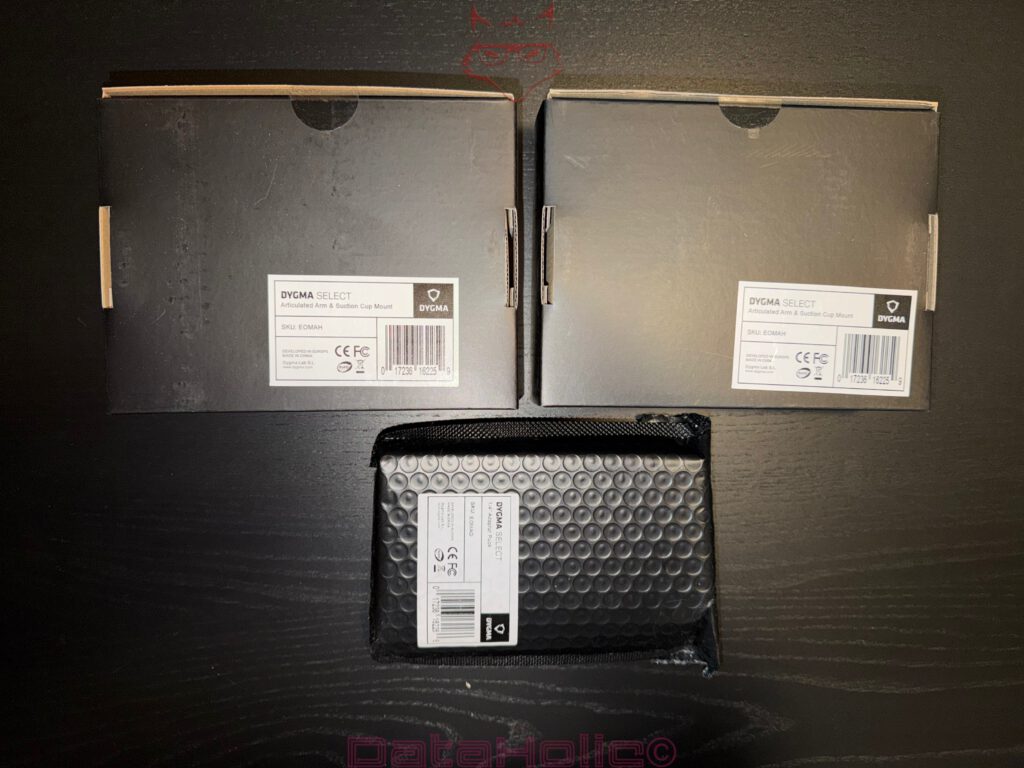
Box and label: the moment standards start to matter
For tech people, labels are more than mandatory stickers. They reveal how a manufacturer thinks: is what’s inside named cleanly? Are there SKUs or article numbers? Is there any reference to standards?
With the Articulated Arms set, the designation is clear: a set of articulated arms and suction cup mounts, both using 1/4” screw heads as the standard. This 1/4” interface is so widespread in the photo/video and tripod world that it’s almost invisible. You use it constantly, but rarely think about the fact that there’s an actual standard behind it: 1/4”-20 UNC is the typical tripod screw found on tripod heads, magic arms, camera cages, light stands, and countless accessories. Dygma is leaning into exactly that to avoid ending up in a proprietary cage.
Dygma describes the set as the Articulated Arm & Suction Cup Mount Set with “360º toric joints” and 1/4” screw heads. The word “toric” alone is interesting because it doesn’t sound like a cheap ball joint, but like a joint geometry designed around defined friction surfaces and stable clamping.
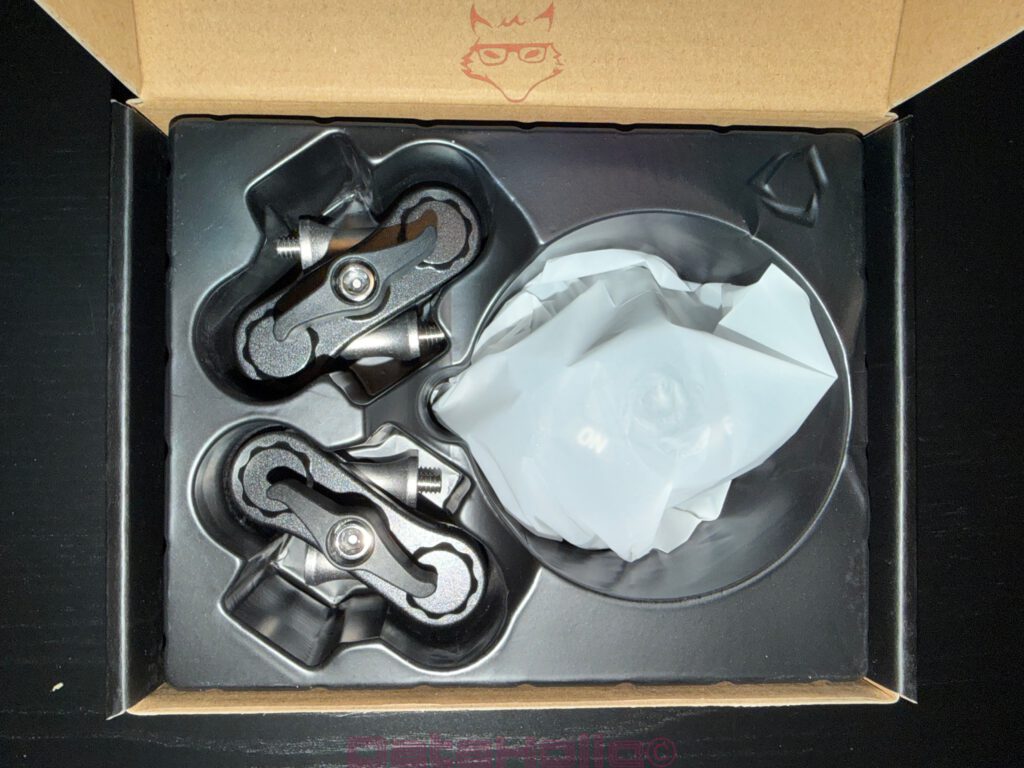
Opening the boxes: no show effect, but a clear protection strategy
The outer shell
The cartons open in a classic way via tabs. No magnet, no fabric pull, no “premium ritual.” But the material feels sturdy enough to survive shipping without the corners immediately collapsing.
Inside: molded insert instead of chaos
The first look inside highlights the molded insert. Parts aren’t rattling around loose, but sit in precisely shaped recesses. That’s more than aesthetics: with articulated arms, pressure points, scratches, or edge impacts can ruin the finish or damage threads. A proper insert prevents that and also ensures nothing “works” during shipping.
That “working” is the underestimated problem with mechanical parts, by the way: when metal pieces bang against each other inside a box with every jolt, you end up with tiny dings you only notice later, but immediately feel when you touch surfaces or move joints.
Here: calm, fixed, purposeful.
Component 1: the suction cup mounts – adhesion isn’t a side topic here
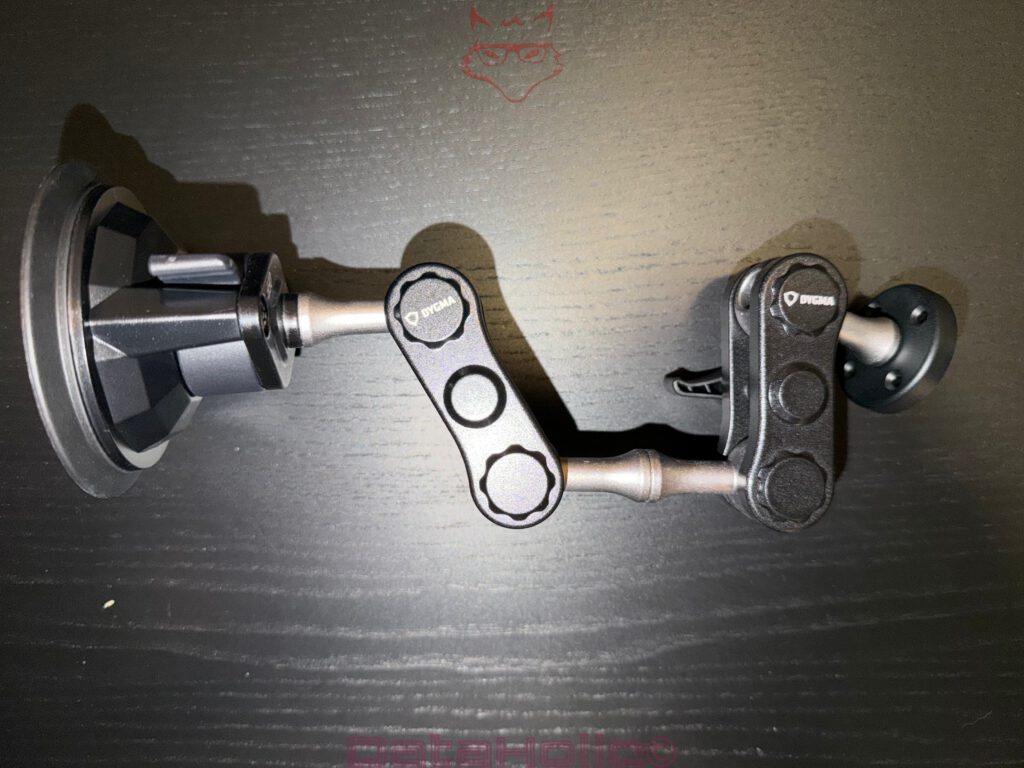
The suction cup elements are the base of the system. In the arm set, Dygma includes two suction cup mounts for 1/4” screw heads.
And suction cups are a bit of a minefield in practice because they only feel “magical” when the surface cooperates. Dygma itself and external notes (for example from the video context) emphasize: suction cups work reliably on smooth, non porous surfaces like glass, painted metal, or very smooth laminate. On wood with open pores, rough MDF, or textured tabletops, results can vary significantly.
Mechanical details you can already see during the unboxing
- The suction cup itself is large enough not to feel like a toy.
- The mechanism for “pulling” (creating and holding vacuum) feels more like a tool lever than a rubber gimmick.
- The top connection is designed around the 1/4” system.
A line from Dygma’s own communication sticks in your head: the suction cups are said to be “much stronger than clamps.” That’s marketing, of course, but it hits a real point: clamps depend on table edge, material thickness, and lever arm. Suction cups depend on surface and vacuum. On a suitable surface, they can be absurdly stable.
And that brings us to a classic that fits surprisingly well: “The details are not the details. They make the design.” (Charles Eames). With a suction cup, the “detail” isn’t the logo embossing, but whether the vacuum is still holding after two hours.
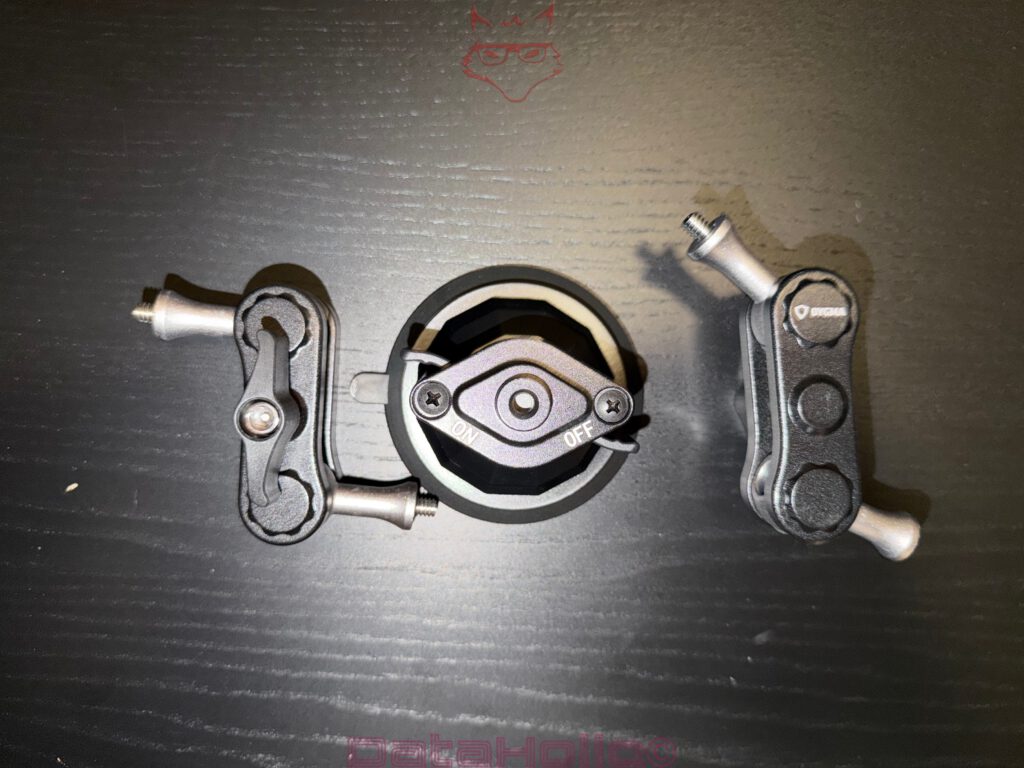
Component 2: the articulated arms – 13 cm segments and the logic of male male vs. male female
According to Dygma, the set includes:
2× 13 cm male-male articulated arms
2× 13 cm male-female articulated arms
That sounds dry, but it’s crucial in practice. Because this is how you build chains. If you only have male-male, you can’t extend indefinitely, because sooner or later you run into thread-on-thread where you actually need a socket. Dygma even points this out explicitly: if you extend, you should use male-female to continue the “chain.”

What you notice immediately when unpacking: material mix and friction surfaces
The arms feel like a hybrid build:
- metallic arm segments
- joint points with a clear clamping surface
- large tightening knobs that don’t look like delicate camera accessories, but more like “hand-tight, even without pliers.”
Dygma talks about “toric aluminum joints” and emphasizes that the joints are significantly larger than on typical camera arms so they stay in position. That’s an important detail, because many cheap magic arms fail exactly here: friction surfaces too small, too little clamping travel, surfaces too smooth. Then the whole thing holds only as long as nothing pulls on it.
And suddenly you’re in mechanical fundamentals: friction, clamping force, surface pressure. You can anodize as nicely as you want, if the geometry of the clamping surfaces is bad, it slips.
During an unboxing you obviously can’t measure long-term holding forces, but you can collect indicators:
- Joint size: the larger the friction surface, the less “point load” and the better the chance it holds at the same torque.
- Knob design: a knob that’s large enough allows controlled tightening without overdoing it.
- Surface texture: slightly grippy surfaces instead of high gloss.
Here it feels like Dygma has responded directly to those typical weak points.
Component 3: the 1/4” adaptor puck – the interface to the keyboard
The 1/4” Adaptor Puck Set is the second big box in your head because it’s the link: not everyone wants to mount a keyboard on a tripod head, but if you do, you need a stable, defined interface. That’s exactly what this puck is supposed to provide.
Dygma describes the set very specifically:
- 2× CNC aluminum adaptor pucks for 1/4” screws
- 8× 10 mm M3 countersunk Allen screws
- Dimensions: 4 × 4 × 0.7 cm
- Hole spacing: 19.5 mm, matching the M3 holes in Dygma Defy and Raise 2
That’s worth its weight in gold in an unboxing because it shows: this isn’t just a “puck” that was milled, they also thought about screw length, countersink, and hole pattern.
CNC aluminum is not just a buzzword
“CNC aluminum” can mean anything, from cheap quick milling to clean precision. But the decision for aluminum over plastic makes sense for a 1/4” interface because forces act through lever arms here. When you align a keyboard via articulated arms, tensile and torsional forces don’t act only axially, but also rotationally. Plastic can do it, but it creeps, and screw heads can “bed in” over time.
Aluminum combined with countersunk screws means: flush surface, less tilting moment at the screw head, clean seating. M3 at 10 mm sounds like a consciously chosen compromise: long enough for a load-bearing thread, short enough not to bottom out or punch through anything.
The hole pattern: 19.5 mm as an invisible standard in the Dygma ecosystem
19.5 mm is not “random.” It’s a dimension that shows up in Dygma’s products so accessories actually fit without having to hack anything together. And that “no hacking” is often the difference in ergonomic setups between “I’ll do it sometime” and “I use it daily.”
Small parts and screws: the moment you realize whether someone has real-world experience
In the unboxing, the screws appear: neatly in a small bag, not loose in the carton. That sounds trivial, but it matters, because M3 countersunk screws at 10 mm are not the kind of tiny part you just happen to have in a drawer unless you already tinker with electronics all the time.
A quote helps here, one you usually hear in workshops rather than reviews: “If you don’t have time to do it right, when will you have time to do it over?” (John Wooden). Missing screws are exactly that “do it over” problem: project stops, motivation drops, setup stays unfinished.
Dygma includes the screws instead of saying “just buy M3.” That supports the idea of a setup that should truly be mountable out of the box.
Feel and surfaces: unboxing as a material check
Unboxing isn’t just “what’s in the box,” but “how does it feel.” Especially with mechanical accessories.
Surface finish
The parts look matte, more functional than decorative. That makes sense for articulated arms: smooth high-gloss surfaces look classy, but they show fingerprints, and overly smooth anodizing can also influence friction values on clamping surfaces. Matte finishes are often the better choice here.
Edges and transitions
With CNC and metal parts, edges are critical. Sharp edges aren’t just unpleasant, they can also damage cables or get in the way during mounting. Handling it doesn’t feel like there’s a “razor blade” waiting somewhere. No guarantee without measurement, but the first impression: deburred, everyday-friendly.
Tightening knobs
The knobs are large enough to tighten firmly without tools. That’s a deliberate ergonomic choice. Small knobs make you apply too much force on too little area, so you either slip or overtighten. Large knobs give you controllable torque.
Dygma positions the set explicitly as stable and adjustable. One sentence from their presentation sticks: they “looked for a solution” and prioritized two criteria. The unboxing at least confirms that the parts look like they take that goal seriously.
Modularity in the box: why the split makes sense
You could ask: why not put everything in one box? Answer: because different user groups exist.
- If you already own camera arms, you might only need the pucks.
- If you want the arm set but use it for other accessories, you don’t need pucks.
- If you want to mount Dygma keyboards, you take the bundle.
Dygma sells exactly that combination as the “Articulated Arms + Adaptor Puck Bundle.” For an unboxing that means: it’s not just “more content,” it’s a consciously modular system.
And this is also the point where you briefly think of Dieter Rams: “Good design is as little design as possible.” Here that doesn’t translate into minimalism, but into interface openness: 1/4” standard instead of special threads, modular sets instead of forced packages.
The technical core: 1/4” as a bridge between desk setup and photo accessories
What’s exciting about the Dygma Select approach is that it builds a bridge: ergonomic keyboard setup meets the photo/video accessory ecosystem. That’s clever because photo accessories have had a culture for decades built around standard threads, modular arms, quick-release plates, and defined mechanics.
The 1/4” thread is the Esperanto of hardware. And Dygma uses it so they don’t have to invent everything themselves. That’s even stated, in essence, in their product description: the arms can be used with any clamp or accessory that accepts 1/4”.
In the unboxing, that feels like a quiet promise: you can work here with off-the-shelf tools from two worlds.
Safety and practical notes that stand out already while unpacking
A suction cup is not “stick it once and done”
Even if the suction cup looks mechanically solid: adhesion depends on surface and cleanliness. Grease film, dust, micro texture in the tabletop, everything matters. That’s not criticism, it’s physics. And because the set explicitly relies on suction cups, this reality belongs in a technical unboxing. Dygma itself even shows use cases on the top and underside of tables, which expands the range, but the surface question remains.
Joints: tighten with control
Big joints sometimes tempt you to apply “feel-based” too much force. Especially with aluminum clamps, the rule is: tighten with control, don’t overtighten. An overtightened knob can stress threads, and permanently excessive clamping force can “polish” friction surfaces or fatigue material. Those are details you notice later in use, but you already think about them during the unboxing when the parts feel this substantial.
Screws: countersink must match
Countersunk screws are only perfect when the countersink and head geometry match cleanly. Dygma delivers M3 countersunk screws and a puck designed for them. That suggests a good match, which you can’t fully confirm without mounting, but conceptually it’s sound.
A quick look at the “Dygma Select” idea: why it matters in an unboxing
Normally, product line names don’t matter in an unboxing. Here they do a bit, because Dygma Select doesn’t mean “we made another thing,” but “we searched worldwide and only take what we use ourselves.” Dygma frames it as desk gear that should be “worthy of your money and our name.” That’s a positioning you can at least sanity-check during an unboxing through packaging, material choices, and interface strategy.
And what you can say up to this point without drifting into any kind of full review conclusion: the parts aren’t built for show. They’re built for function and system compatibility.
Contents, as they crystallize out of the unboxing
Articulated Arms Set
- 2× suction cup mounts for 1/4” screw heads
- 2× 13 cm male-male arms
- 2× 13 cm male-female arms
1/4” Adaptor Puck Set
- 2× CNC aluminum adaptor pucks for 1/4”
- 8× M3 countersunk Allen screws, 10 mm
- Puck dimensions: 4 × 4 × 0.7 cm
- Hole spacing: 19.5 mm, matching Dygma Defy / Raise 2
This list alone shows how technically clear Dygma communicates. No fantasy names for screws, no “premium fasteners,” just hard facts.
Packaging details that are easy to miss, but say a lot
- Molded inserts reduce transport damage and keep parts stress-free.
- The separation of components feels like it’s also meant for storage: you can repack the accessories without having to play Tetris.
- No unnecessary mountains of foil. There is some protection material, but it doesn’t feel like “plastic as stage set.”
For WordPress readers this is often secondary, for tech people it’s a signal: if someone cares about the interior packaging, the chance is higher they also cared about threads, fits, and material pairings.
Small nerd note: why 13 cm as a segment length makes sense
Dygma uses 13 cm arm segments. That’s a length that’s sensible in setup worlds:
- short enough not to start wobbling like a flagpole
- long enough to allow real positioning (distance, height, angle)
- modularly extendable without the chain becoming unstable immediately
The longer a single segment, the greater the lever arm, the more moment on joints and base. With several shorter segments you can fine-tune geometry and better control force distribution.
Dygma also emphasizes the larger joint dimension compared to “regular camera arms.” That matches the segment logic: the weak point is almost always the joints.
A line that sticks while handling it
As you lift the parts out of the molded insert, a lot of it feels like classic industrial accessory hardware. And a famous quote comes to mind that rarely feels annoying in tech reviews because it fits: “Simplicity is the ultimate sophistication.” (Leonardo da Vinci)
The set doesn’t try to reinvent the wheel. It uses standards, leans on materials, and the “innovation” is more the combination: marrying keyboard ergonomics with photo mechanics.
Conclusion: an unboxing that says more about attitude than about contents
Drawing a conclusion without including real usage experience is unusual in a classic review sense. In the context of a technical unboxing, however, it’s possible—if you treat the conclusion as an assessment of the constructive and conceptual decisions.
The Dygma Select Articulated Arms and the 1/4” Adaptor Puck already leave the impression while unpacking of a well-thought-out, modular system. Nothing feels random, nothing overdecorated. The choice of materials, the sizing of the joints, and the decision to use established standards point to a manufacturer that puts function over form.
The unboxing doesn’t show showmanship, but consistency. If you expect colorful accents or emotional packaging moments, you’ll be disappointed. But if you value mechanical solidity, interface openness, and long-term usability, you can already see very early where this is headed.
At a time when accessories are often designed as disposable products, this approach feels almost old-fashioned—in the best way. It’s accessories that don’t explain how they want to be used, but quietly assume the user knows what they’re doing.
Or to put it in a line that fits surprisingly well here:
“Form follows function – and function follows understanding.”
Notice under EU transparency rules:
The Dygma Select Articulated Arms and the Dygma Select 1/4” Adaptor Puck Set presented in this review were provided to us by Dygma as a non-binding loan for testing purposes. This is not paid advertising.
Dygma had no influence on the content, rating, or editorial independence of this article. All opinions expressed are based exclusively on our own hands-on experience.
We would like to sincerely thank Dygma for providing the accessories and for the trust placed in dataholic.de.